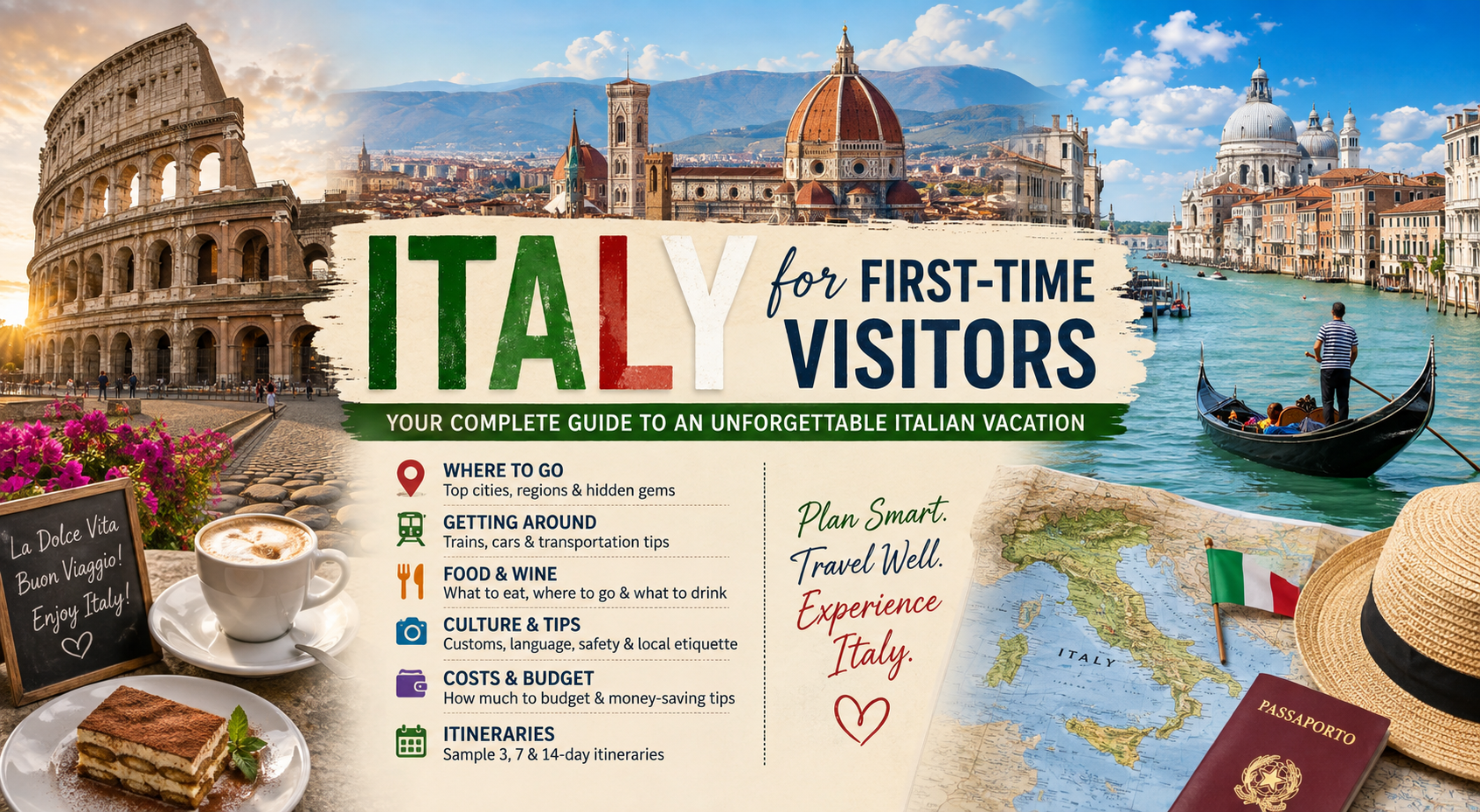
Italy is one of those countries that can be both wonderfully easy and surprisingly complicated for a first-time visitor. It is easy because the country has an extraordinary tourism infrastructure, excellent rail connections between major cities, countless hotels and restaurants, and an almost endless supply of historic and cultural attractions. It can be complicated because Italy is not one homogeneous destination. Rome is not Florence, Florence is not Venice, and Venice is certainly not Sicily.
For a first visit, the biggest mistake is trying to see everything.
Italy stretches from the Alps to the Mediterranean, with enormous differences in landscape, cuisine, architecture, climate and traditions. A successful first trip is therefore less about checking every famous attraction off a list and more about choosing a manageable area and allowing enough time to experience it.
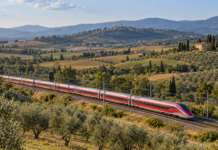
The country’s official tourism portal, Italia.it, emphasizes the extensive transportation network connecting Italian destinations, including high-speed rail between major cities.
If you are planning your first Italian vacation, this guide will help you understand where to go, how long to stay, how to get around, what to eat, what mistakes to avoid and how to experience Italy rather than simply photograph it.
Planning your trip to Italy?
Discover the best boutique hotels, charming B&Bs, and exclusive resorts across the region. Check real-time availability and secure the best rates for your itinerary.
Why Italy Is So Popular With First-Time Visitors
Few countries combine history, art, architecture, food, wine, scenery and lifestyle on such a scale.
In a single vacation you can walk through ancient Roman streets, admire Renaissance masterpieces, eat pizza in Naples, drink Chianti in Tuscany, ride a gondola in Venice, swim in the Mediterranean and explore medieval hill towns.
The diversity is one of Italy’s greatest strengths.
Northern Italy offers the Alps, spectacular lakes, sophisticated cities and some of Europe’s most important fashion and design centers. Central Italy contains Tuscany, Umbria and Lazio, with Florence, Siena, medieval villages and Rome. Southern Italy introduces visitors to Naples, Campania, Puglia, Calabria, Sicily and Sardinia, where landscapes, cuisine and traditions can feel very different from those of the north.
Italia Mia’s overview of Italian culture and geography is a useful introduction to this extraordinary regional diversity, from the Dolomites and Venice to Tuscany, Sicily, Puglia and the Amalfi Coast.
For a first trip, however, less is usually more.
How Many Days Do You Need in Italy?
There is no perfect answer, but the length of your vacation should determine the number of destinations you attempt.
Three to four days
Choose one city.
Rome is probably the best choice if you want ancient history, major monuments, museums and the Vatican.
Florence is ideal for Renaissance art, architecture, Tuscan cuisine and easy excursions into the surrounding countryside.
Venice is an exceptional choice for a short romantic or cultural trip.
Milan works particularly well if you are interested in fashion, design, shopping, architecture and contemporary Italy.
Five to seven days
You can comfortably combine two or three destinations.
A classic first trip might be:
Rome → Florence → Venice
Another excellent option is:
Rome → Florence → Tuscany
Or:
Milan → Lake Como → Venice
Eight to ten days
Ten days gives you considerably more flexibility.
A classic itinerary could be:
Rome – Florence – Venice – Bologna
Another possibility is:
Rome – Naples – Amalfi Coast
Or, for a slower vacation:
Florence – Tuscany – Siena – Lucca – Pisa
Two weeks
With two weeks, you can begin combining regions without feeling as though you are spending the entire vacation in airports and railway stations.
A north-to-center itinerary could include:
Milan – Lake Como – Venice – Florence – Tuscany – Rome
A southern itinerary could include:
Rome – Naples – Pompeii – Amalfi Coast – Puglia
Trying to add Sicily to either itinerary is generally better reserved for a separate trip. Sicily deserves considerably more time than a hurried two- or three-day extension.
For more destination ideas, Italia Mia’s guide to the Top Italian Destinations and Italian Cities provides a useful overview of both famous destinations and less obvious alternatives.
Rome: The Best Introduction to Italy’s History
For many first-time visitors, Rome is the logical starting point.
Rome is not simply another European capital. It is a city where different periods of history exist almost on top of one another.
You can have breakfast near a Baroque piazza, walk past an ancient Roman temple, visit the Colosseum, eat lunch in a traditional trattoria and finish the evening in a neighborhood that feels distinctly modern.
The major attractions include:
- The Colosseum
- Roman Forum
- Palatine Hill
- Pantheon
- Trevi Fountain
- Piazza Navona
- Spanish Steps
- Vatican Museums
- St. Peter’s Basilica
- Castel Sant’Angelo
- Trastevere
Do not make the mistake of spending every minute inside museums. Rome is also experienced on foot.
Walking through streets such as those around the Pantheon, Piazza Navona and Trastevere can be as memorable as visiting a major museum.
Plan at least three days for Rome. Four or five days is considerably better.
Florence: Renaissance Italy
Florence is smaller and more manageable than Rome, making it particularly attractive to first-time visitors.
The city is essentially a concentrated Renaissance museum.
The Duomo dominates the skyline, while the Uffizi Gallery contains masterpieces by artists including Botticelli, Leonardo da Vinci and Raphael. The Accademia is famous for Michelangelo’s David.
You can cross the Ponte Vecchio, explore the Oltrarno, visit Palazzo Pitti and spend an evening enjoying Florentine cuisine.
Italia Mia’s A Day in Florence provides another perspective on experiencing the city.
One advantage of Florence is its location.
It is an excellent base for day trips to:
- Siena
- Pisa
- Lucca
- San Gimignano
- Chianti
- Arezzo
- Other Tuscan hill towns
Venice: A City Unlike Anywhere Else
Venice is one of the world’s most recognizable destinations, and photographs do not really prepare you for the experience.
The city is built around canals rather than conventional streets. Walking involves bridges, narrow passages, small squares and countless unexpected views.
The major attractions include:
- St. Mark’s Square
- St. Mark’s Basilica
- Doge’s Palace
- Rialto Bridge
- Grand Canal
- Bridge of Sighs
- Accademia Gallery
- The islands of Murano and Burano
For first-time visitors, Venice is worth at least two nights.
And do not spend the entire visit around St. Mark’s Square.
One of the pleasures of Venice is simply getting lost.
Walk away from the busiest areas and you will discover quiet canals, small restaurants, neighborhood churches and streets where the tourist atmosphere almost disappears.
For a broader overview, see Italia Mia’s Top Italian Destinations and Italian Cities.
Milan: Modern Italy
Some first-time visitors skip Milan because they associate Italy exclusively with ancient monuments and Renaissance art.
That is a mistake.
Milan represents a very different side of Italy.
The Duomo, Galleria Vittorio Emanuele II, La Scala, Brera and Leonardo da Vinci’s Last Supper are major attractions, while the city is also the country’s fashion and business capital.
Milan is particularly convenient for visitors arriving from North America because it has excellent international connections and is an ideal starting point for northern Italy.
From Milan, you can also reach destinations around Lake Como and other parts of Lombardy by train.
Tuscany: The Italy Many Visitors Imagine
If Italy has an internationally recognizable landscape, it is probably Tuscany.
Rolling hills, cypress trees, vineyards, olive groves, medieval villages and Renaissance towns have made the region almost synonymous with the Italian countryside.
Florence is the cultural center, but Tuscany extends far beyond the capital.
Consider visiting:
- Siena
- San Gimignano
- Lucca
- Pisa
- Arezzo
- Montepulciano
- Pienza
- Montalcino
- Chianti
- Val d’Orcia
Italia Mia’s Complete Guide to Tuscany provides additional information on Florence, Siena, Pisa, Lucca and the Tuscan countryside.
Tuscany is also one of the places where renting a car can make sense.
A car gives you access to small villages, wineries, agriturismi and rural landscapes that are much harder to reach by public transportation.
However, do not rent a car simply to visit Florence or Rome. Parking is difficult and historic centers often have restricted traffic zones known as ZTLs.
Naples, Pompeii and the Amalfi Coast
Southern Italy offers a completely different experience.
Naples is energetic, chaotic, historic and intensely connected to food. It is the birthplace of the modern Neapolitan pizza tradition and a convenient base for exploring the archaeological sites of Pompeii and Herculaneum.
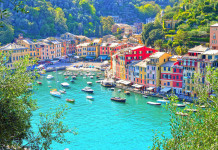
The Amalfi Coast is famous for towns such as:
- Amalfi
- Positano
- Ravello
- Praiano
- Sorrento
The scenery is spectacular, but summer crowds can be substantial.
A first-time visitor should not underestimate travel times in this area. Distances on a map may appear short, but mountainous roads, traffic and seasonal congestion can make journeys considerably longer than expected.
Sicily: Save Enough Time
Sicily is almost a country within a country.
Palermo, Catania, Taormina, Syracuse, Agrigento, Ragusa and the island’s smaller towns all offer something different.
Sicilian cuisine is also distinctive. Arancini, cannoli, pasta alla Norma, caponata, fresh seafood and granita are only a few examples.
If you have never been to Italy, you do not necessarily need to include Sicily in your first trip.
It is perfectly reasonable to visit Rome, Florence and Venice first and return for Sicily later.
In fact, returning to Italy is one of the best strategies for seeing the country properly.
How to Get Around Italy
For most first-time visitors, trains are the easiest way to travel between major cities.
Italy has an extensive rail network, including high-speed services linking major destinations. Italia.it notes that high-speed trains make travel between major cities particularly convenient.
For example, a typical first-time itinerary can be organized around:
Rome → Florence → Venice
without renting a car.
High-speed trains are generally comfortable, fast and convenient, and major stations are usually located relatively close to city centers.
For official schedules and tickets, consult Trenitalia.
Regional trains
Regional trains are useful for shorter journeys and excursions.
One important detail for visitors is that paper regional tickets must generally be validated before departure using the machines at the station. Digital regional tickets work differently and may be automatically validated according to the ticket type.
Never assume that a train ticket works exactly like an airline boarding pass.
Check the conditions for the specific ticket you purchase.
Should You Rent a Car?
The answer depends entirely on where you are going.
A car is useful for:
- Tuscany
- Umbria
- Puglia
- parts of Sicily
- rural northern Italy
- countryside wine regions
- small villages
A car is usually unnecessary for:
- Rome
- Florence
- Venice
- Milan
- Naples
Historic city centers can be difficult to navigate, parking can be expensive, and ZTL restrictions can result in fines.
Italia Mia’s Driving in Italy guide is worth reading before deciding to drive.
For many first-time visitors, the ideal combination is train between major cities and a rental car only for the countryside.
Italian Food: Don’t Expect the Same Menu Everywhere
One of the biggest misconceptions about Italy is that there is one Italian cuisine.
There isn’t.
Italy has hundreds of regional culinary traditions.
In Rome, try carbonara, cacio e pepe, amatriciana and saltimbocca.
In Florence and Tuscany, look for bistecca alla fiorentina, ribollita, pappa al pomodoro, pecorino and Tuscan-style crostini.
In Naples, pizza is essential.
In Bologna and Emilia-Romagna, look for tortellini, tagliatelle al ragù, lasagna and Parmigiano Reggiano.
In Sicily, try arancini, cannoli, caponata and seafood.
In the north, risotto, polenta and butter-based dishes become increasingly prominent.
Eat locally rather than searching for the same familiar dishes everywhere.
That is one of the easiest ways to make a first trip more memorable.
Coffee in Italy
Italian coffee culture can initially be confusing.
If you order un caffè, you will normally receive an espresso.
A cappuccino is generally associated with breakfast rather than a large afternoon beverage.
An espresso after lunch or dinner is completely normal.
Do not expect American-style coffeehouse culture everywhere. Italian bars often operate quickly: order, drink, pay and continue your day.
And remember that coffee prices and service practices can vary depending on whether you consume your drink standing at the bar or sitting at a table.
Gelato Is Not Simply Ice Cream
Trying authentic Italian gelato should be part of your first trip.
Look for gelaterie that emphasize natural colors and seasonal ingredients rather than enormous mountains of brightly colored product.
Pistachio, hazelnut, chocolate, stracciatella, lemon and seasonal fruit are excellent starting points.
And yes, you can eat gelato even when you are not technically hungry.
That is part of the Italian vacation experience.
Wine and Aperitivo
Italy’s wine culture is extraordinarily regional.
Tuscany is associated with Chianti and Brunello di Montalcino.
Piedmont is famous for Barolo and Barbaresco.
Veneto produces Prosecco and Amarone.
Sicily has developed a strong reputation for wines including Nero d’Avola and Etna varieties.
Aperitivo is another important part of Italian social life.
In the early evening, Italians may meet friends for a drink accompanied by small snacks or a more substantial selection of food.
It is less about getting drunk and more about socializing before dinner.
How Much Does Italy Cost?
Italy can be expensive, but it does not have to be.
Your budget will depend enormously on where you go and when you travel.
Rome, Venice, Milan and the Amalfi Coast can be expensive, particularly during peak season.
Smaller cities and inland areas can offer much better value.
You can control costs by:
- staying slightly outside the most famous tourist zones
- eating lunch at local restaurants
- using regional trains
- traveling during shoulder seasons
- booking accommodation early
- avoiding unnecessary taxis
- choosing apartments or smaller hotels for longer stays
- eating where locals eat rather than directly beside major monuments
Do not assume that an expensive restaurant automatically provides the most authentic Italian experience.
Some of the best meals can come from a modest trattoria on a side street.
When Should First-Time Visitors Go to Italy?
The ideal time depends on your priorities.
Spring
April and May are excellent for sightseeing.
Temperatures are generally pleasant, landscapes are green and outdoor activities become enjoyable.
Summer
June through August brings long days and warm weather, but it is also the busiest period in many destinations.
Rome, Florence, Venice, the Amalfi Coast and other famous destinations can become extremely crowded.
Autumn
September and October are among the best months for many travelers.
The weather is often pleasant, crowds can be less intense than in August, and the countryside becomes especially attractive during the harvest season.
Winter
Winter can be surprisingly rewarding.
Major cities are generally quieter, accommodation can be less expensive, and museums and monuments can be easier to visit.
The Alps and Dolomites, of course, become major winter destinations.
Italia Mia’s Ultimate Italy Travel Guide also provides a useful seasonal overview and suggestions for different types of travelers.
What Should You Pack?
For a first Italian vacation, pack less than you think you need.
Comfortable walking shoes are essential.
Many Italian historic centers have cobblestones, stairs and uneven pavement, and you may walk several miles every day without realizing it.
Useful items include:
- comfortable walking shoes
- lightweight clothing
- a light jacket
- compact umbrella
- sunglasses
- sunscreen
- reusable water bottle
- small crossbody bag
- universal travel adapter
- copies of important documents
- comfortable clothing for evenings
- modest clothing for churches
If visiting churches, especially major religious sites, remember that appropriate dress may be required.
Italian Churches Have Dress Codes
Italy’s churches are not simply tourist attractions.
They remain places of worship.
When visiting churches, basilicas and Vatican sites, avoid extremely short shorts, bare shoulders and beachwear.
A lightweight scarf or shawl can be useful because it takes almost no space in your luggage and can provide additional coverage when necessary.
How to Behave in Italian Restaurants
The Italian restaurant experience can be different from what visitors expect.
Meals are often longer and more structured.
A traditional meal may include:
Antipasto → primo → secondo → contorno → dolce → caffè
You do not have to order every course.
A first-time visitor can comfortably order a pasta dish and a glass of wine, or a main course with vegetables.
Do not feel obligated to reproduce an entire Italian family dinner every night.
Also remember that bread may appear on the table without being completely free, and a service charge or coperto may be included depending on the restaurant.
Always check the menu.
Tipping in Italy
Italy does not have the same tipping culture as the United States.
A tip is generally appreciated when service has been particularly good, but it is not normally expected at American levels.
Check the bill first.
If a service charge has already been included, you do not need to leave another large percentage simply because you are accustomed to doing so at home.
Cash or Credit Card?
Cards are widely accepted throughout Italy, particularly in hotels, restaurants, shops and tourist businesses.
Nevertheless, carrying a small amount of cash is sensible.
You may encounter small cafés, market stalls or businesses where cash is more convenient.
A good strategy is to carry a modest amount rather than large quantities.
Avoid keeping all your money and cards in one wallet.
Pickpockets and Tourist Scams
Italy is generally a safe destination, but tourist areas can attract pickpockets.
The greatest risk is usually not violent crime but opportunistic theft.
Be particularly attentive around:
- major railway stations
- crowded buses and metros
- major monuments
- busy squares
- airports
- crowded attractions
Keep your wallet in a secure location and do not leave phones or bags unattended on café tables.
Be especially careful when someone creates an unnecessary distraction around you.
Don’t Be Afraid of Italian
You can travel through much of Italy using English, especially in major tourist destinations.
However, learning a few Italian words will improve your experience.
Start with:
Buongiorno – Good morning / good day
Buonasera – Good evening
Per favore – Please
Grazie – Thank you
Prego – You’re welcome
Scusi – Excuse me
Dov’è…? – Where is…?
Quanto costa? – How much does it cost?
Il conto, per favore – The bill, please
Even imperfect Italian is usually appreciated.
And do not be surprised if an Italian immediately responds to your Italian attempt in English. It does not necessarily mean your pronunciation was terrible. Italians simply recognize that communicating efficiently is easier.
Don’t Try to See Everything
This is perhaps the most important advice for a first-time visitor.
Italy rewards slow travel.
You can spend an entire morning exploring a neighborhood in Rome, an afternoon sitting in a Florence piazza or an evening wandering through Venice without visiting another major attraction.
A vacation is not a competition.
If you spend your entire trip rushing from one famous monument to another, you may see Italy but never actually experience it.
Instead, build space into your itinerary.
For every major attraction, allow time to simply wander.
A Perfect Seven-Day First Trip to Italy
For someone visiting Italy for the first time, one of the easiest itineraries is:
Days 1–3: Rome
Arrive in Rome and concentrate on the historic center, ancient Rome and the Vatican.
Do not try to visit every museum.
Days 4–5: Florence
Take the high-speed train to Florence.
Explore the Duomo, Uffizi, Ponte Vecchio and historic center.
Use part of your second day for a Tuscan excursion if desired.
Days 6–7: Venice
Continue north by train.
Explore St. Mark’s, the Rialto area and the quieter neighborhoods.
Spend an evening walking after many day-trippers have left.
This itinerary provides three completely different versions of Italy:
Ancient Rome, Renaissance Florence and Venetian Italy.
It also avoids the need for a rental car.
An Alternative Seven-Day Italian Vacation
If you prefer scenery and food to major museums, consider:
Milan → Lake Como → Verona → Venice
This itinerary offers sophisticated urban Italy, spectacular lake scenery, romantic historic towns and Venice.
Another possibility is:
Naples → Pompeii → Sorrento → Amalfi Coast
This is particularly appealing for travelers interested in food, archaeology and dramatic coastal scenery.
What First-Time Visitors Often Get Wrong
Trying to visit too many cities
Three cities in seven days is already plenty.
Staying only in famous tourist areas
Major attractions are famous for a reason, but neighborhoods away from the tourist center often provide a much more authentic experience.
Renting a car everywhere
Cars are useful in the countryside but often more trouble than they are worth in historic cities.
Eating only pizza and pasta
Italian cuisine is much broader than its two most famous exports.
Expecting everything to operate like the United States
Opening hours, meal schedules, transportation, tipping and customer service can be different.
Spending the entire trip inside museums
Italy is an outdoor experience as much as an indoor one.
Visiting only in August
August can be wonderful, but it is hot, busy and expensive in many tourist destinations.
Scheduling every minute
Leave room for discovery.
Some of your best memories may come from a restaurant or piazza that was never included in your original itinerary.
Internal Italia Mia Resources
For additional planning, these Italia Mia articles are particularly useful:
- Ultimate Italy Travel Guide 2026 – broad overview of destinations, itineraries, food and transportation.
- Top Italian Destinations and Italian Cities – useful when deciding which cities and regions to include.
- Italy’s Top 10 Must-See Destinations – a concise introduction to some of Italy’s best-known destinations.
- A Day in Florence – additional ideas for experiencing Florence.
- Complete Guide to Tuscany – useful for extending a Florence trip into the Tuscan countryside.
- Visit Italy Now – ideas for couples, families, students and active travelers.
Final Advice for Your First Italian Vacation
Your first trip to Italy should not attempt to answer the question, “How much of Italy can I see?”
The better question is:
“Which part of Italy do I want to experience?”
If you love ancient history, choose Rome.
If art and Renaissance culture fascinate you, choose Florence and Tuscany.
If you dream of canals and romantic architecture, choose Venice.
If food and southern culture appeal to you, explore Naples and Campania.
If countryside, wine and medieval villages are your priority, spend time in Tuscany or Umbria.
If beaches, dramatic landscapes and Mediterranean culture attract you, consider Sicily, Sardinia, Puglia or the Amalfi Coast.
And if you cannot decide, come back.
That is perhaps the greatest advantage of falling in love with Italy: one trip is never enough.
Italy is not a country that should simply be checked off a bucket list. It is a place to return to, region by region, city by city, meal by meal.
External Links
- Italia.it – Official Italian Tourism Portal – official information on transportation and practical travel in Italy.
- Trenitalia – Official Italian Railway – train schedules, fares and tickets.
- Trenitalia Regional Train Information – important information about regional tickets and validation.
- European Union – Travel Documents and Entry Requirements – official EU travel and entry information.