
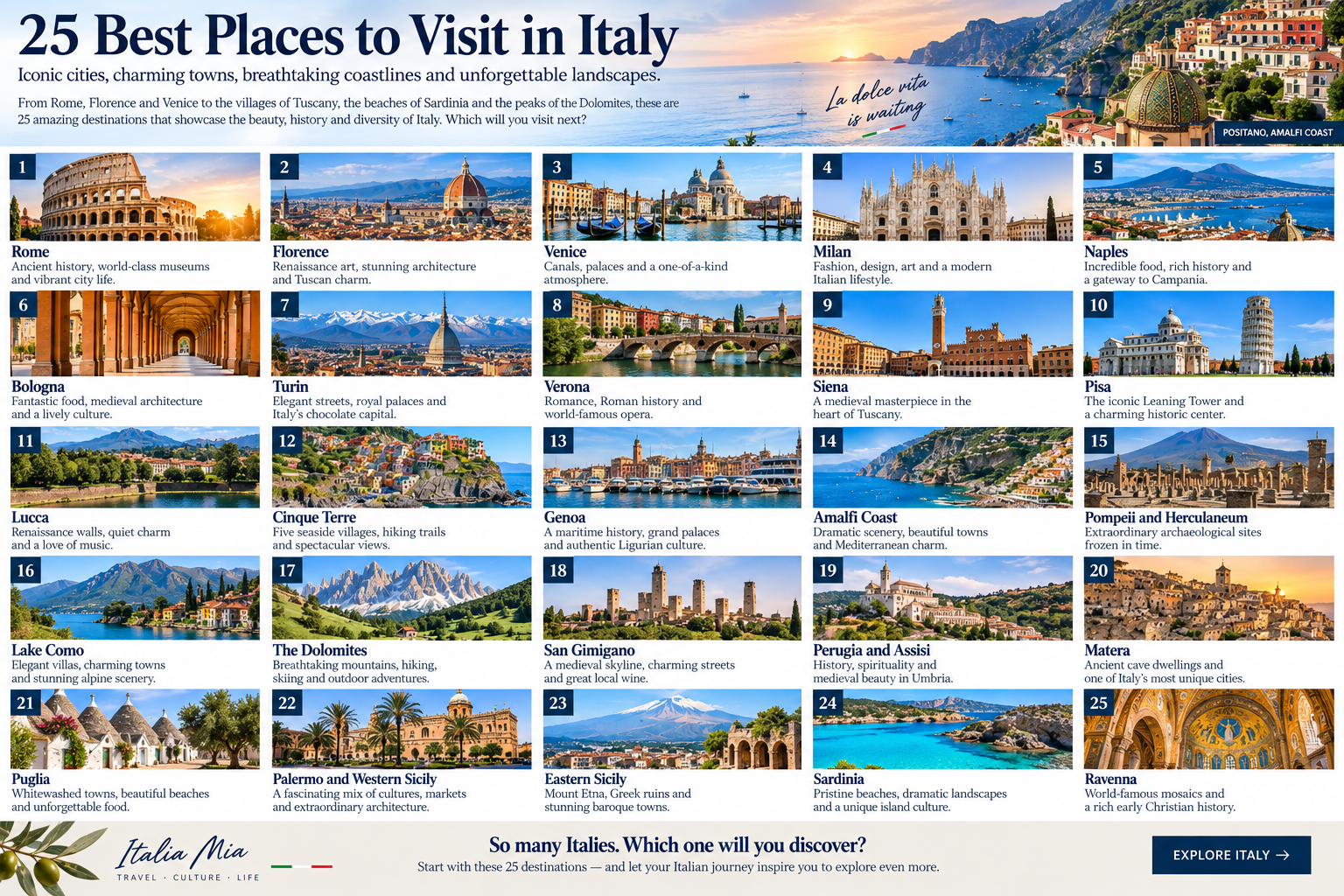
 25 Best Places to Visit in Italy
Where should you go in Italy?
For first-time visitors, the answer often begins with Rome, Florence and Venice. They are famous for good reason. Between them, these three cities contain an extraordinary concentration of ancient history, Renaissance art, architecture, museums and monuments.
But they represent only a small part of Italy.
Travel beyond the classic itinerary and you encounter Alpine villages beneath the Dolomites, medieval Tuscan towns, the lakes of Lombardy, volcanic landscapes in Sicily, whitewashed towns in Puglia and some of Europe’s most beautiful Mediterranean coastline.
Italy rewards repeat visits precisely because it isn’t one destination.
It is a collection of dramatically different regions, cities, landscapes, cuisines and traditions.
The following 25 destinations aren’t intended as a rigid ranking. Instead, think of them as a starting point for discovering which Italy you want to experience.
If you’re planning your first vacation, begin with our Italy for First-Time Visitors guide.
For an even shorter selection, see our 10 Must-See Destinations in Italy.
1. Rome — Best for Ancient History and a First Visit
There is nowhere quite like Rome.
The Italian capital contains nearly three millennia of history, yet it remains a vibrant modern city rather than an archaeological museum.
You can begin the morning at the Colosseum, walk through the Roman Forum, pass the Pantheon in the afternoon and finish the evening eating carbonara in Trastevere.
Then there is Vatican City, home to St. Peter’s Basilica, the Vatican Museums and Michelangelo’s Sistine Chapel.
1Don’t Miss
- Colosseum
- Roman Forum
- Palatine Hill
- Pantheon
- Trevi Fountain
- Piazza Navona
- Spanish Steps
- Vatican Museums
- St. Peter’s Basilica
- Trastevere
Ideal stay: 4–5 days
Best for: History, archaeology, art, food and first-time visitors.
Rome deserves time. Trying to see it in a day is one of the most common mistakes made by visitors to Italy.
2. Florence — Best for Renaissance Art
Florence changed the history of Western art.
Brunelleschi, Michelangelo, Leonardo da Vinci, Botticelli, Donatello and countless other artists and thinkers are connected with the city that became the center of the Renaissance.
The magnificent dome of Santa Maria del Fiore dominates Florence’s skyline, while the Uffizi Galleries contain one of the world’s great collections of Renaissance art.
Michelangelo’s original David can be seen at the Accademia Gallery.
But Florence isn’t only museums.
Cross the Ponte Vecchio into Oltrarno, explore artisan workshops, eat Tuscan food and climb to Piazzale Michelangelo toward sunset.
2Don’t Miss
- Florence Cathedral
- Brunelleschi’s Dome
- Uffizi Galleries
- Accademia Gallery
- Ponte Vecchio
- Palazzo Vecchio
- Santa Croce
- Oltrarno
- Piazzale Michelangelo
Ideal stay: 3–4 days
Best for: Art, architecture, history and food.
Florence also makes an excellent starting point for exploring Tuscany.
3. Venice — Best for a Completely Unique City
Venice is one of the few places where the reality can still seem stranger than the photographs.
Built across islands in the Venetian Lagoon, the city has canals instead of ordinary streets, boats instead of cars and extraordinary Gothic and Renaissance palaces rising directly from the water.
See St. Mark’s Basilica and the Doge’s Palace, cross the Rialto Bridge and travel along the Grand Canal.
Then leave the busiest areas behind.
Cannaregio, Castello and Dorsoduro reveal a quieter Venice of neighborhood squares, churches, canals and small restaurants.
The lagoon islands are also worth exploring. Murano remains famous for glassmaking, while Burano is known for colorful houses and lacemaking.
3Don’t Miss
- St. Mark’s Square
- St. Mark’s Basilica
- Doge’s Palace
- Grand Canal
- Rialto Bridge
- Cannaregio
- Dorsoduro
- Murano
- Burano
Ideal stay: 2–3 days
Best for: Architecture, romance, photography and history.
Stay overnight rather than experiencing Venice only as a day trip.
4. Milan — Best for Fashion, Design and Modern Italy
Milan shows visitors a different side of Italy.
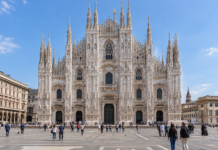
It is Italy’s leading center of fashion, finance, business and design, but it also contains major historical and artistic treasures.
The enormous Gothic Duomo di Milano dominates the city center. Nearby is the Galleria Vittorio Emanuele II, while Leonardo da Vinci’s Last Supper can be seen at Santa Maria delle Grazie with advance reservations.
Explore Brera, visit Castello Sforzesco and experience the Navigli district in the evening.
Fashion is fundamental to Milan’s international identity. Our guide to Milan Fashion Week explains how the city became one of the world’s fashion capitals.
4Don’t Miss
- Milan Cathedral
- Galleria Vittorio Emanuele II
- The Last Supper
- Brera
- Castello Sforzesco
- Teatro alla Scala
- Navigli
Ideal stay: 2–3 days
Best for: Fashion, design, shopping, art and contemporary Italy.
5. Naples — Best for Food and Street Life
Naples is one of Italy’s most fascinating cities precisely because it doesn’t feel like anywhere else.
Its enormous historic center contains churches, palaces, markets, narrow streets and layers of Greek, Roman, medieval and Baroque history.
Naples is also the birthplace of pizza.
Eating a proper Neapolitan pizza in Naples should be considered part of the sightseeing.
Visit the National Archaeological Museum, Cappella Sansevero and the streets around Spaccanapoli and Via dei Tribunali.
The city is also an excellent base for Pompeii, Herculaneum, Capri, Ischia and the Amalfi Coast.
5Don’t Miss
- Spaccanapoli
- Naples National Archaeological Museum
- Cappella Sansevero
- Santa Chiara
- Via dei Tribunali
- Castel dell’Ovo
- Naples waterfront
Ideal stay: 3 days
Best for: Food, history, street life and archaeology.
6. Bologna — Best for Food Lovers
Ask Italians where to eat well and Bologna frequently enters the conversation.
The capital of Emilia-Romagna sits in one of Italy’s great gastronomic regions.
This is the territory of Parmigiano Reggiano, Prosciutto di Parma, Mortadella, tortellini and traditional ragù.
But Bologna deserves attention beyond food.
Its historic center is characterized by kilometers of covered porticoes, medieval towers, beautiful churches and Europe’s oldest university.
6Don’t Miss
- Piazza Maggiore
- Basilica of San Petronio
- Bologna’s porticoes
- Two Towers
- Quadrilatero market district
- Santo Stefano
Ideal stay: 2–3 days
Best for: Food, architecture, university culture and city breaks.
7. Turin — Best for Palaces, Chocolate and Piedmont
Turin is one of Italy’s most underrated major cities.
It served as the first capital of unified Italy and retains an elegant collection of boulevards, arcades, cafés and former royal residences.
The city is also home to the remarkable Egyptian Museum, one of the world’s most important collections devoted to ancient Egypt.
Turin has deep connections to Italy’s automotive industry, cinema and café culture.
Then there is Piedmontese food: chocolate, gianduja, truffles and wines including Barolo and Barbaresco.
7Don’t Miss
- Egyptian Museum
- Mole Antonelliana
- Royal Palace
- Piazza Castello
- Historic cafés
- Museo Nazionale dell’Automobile
Ideal stay: 2–3 days
Best for: Museums, history, chocolate, wine and elegant city travel.
8. Verona — Best for Romance and Opera
Shakespeare made Verona synonymous with Romeo and Juliet, although the famous lovers were literary characters rather than residents of the balcony now visited by tourists.
Fortunately, Verona doesn’t need Shakespeare to be interesting.
Its magnificent Roman Arena remains in use for opera and concerts, while the historic center contains attractive piazzas, churches, bridges and streets.
8Don’t Miss
- Verona Arena
- Piazza delle Erbe
- Piazza Bra
- Castelvecchio
- Ponte Pietra
- Basilica of San Zeno
Ideal stay: 1–2 days
Best for: Romance, opera, Roman history and architecture.
9. Siena — Best Medieval City Experience
Florence embodies Renaissance Tuscany. Siena preserves a very different character.
Its historic center still feels distinctly medieval, centered on the extraordinary shell-shaped Piazza del Campo.
Twice each summer, the square becomes the setting for the Palio di Siena, a fiercely competitive horse race involving the city’s historic contrade.
Siena Cathedral is another highlight, with its striped marble exterior and richly decorated interior.
9Don’t Miss
- Piazza del Campo
- Siena Cathedral
- Torre del Mangia
- Palazzo Pubblico
- Medieval streets and contrade
Ideal stay: 1–2 days
Best for: Medieval history, architecture and Tuscany.
10. Pisa — Much More Than a Leaning Tower
Everyone knows the Leaning Tower.
What many visitors don’t realize is that it forms only one part of the monumental complex in the Piazza dei Miracoli, together with Pisa Cathedral, Baptistery and Camposanto.
Pisa is also a historic university city with attractive streets along the Arno and a compact center.
It combines particularly well with nearby Lucca.
10Don’t Miss
- Leaning Tower
- Pisa Cathedral
- Baptistery
- Camposanto
- Piazza dei Cavalieri
- Lungarni
Ideal stay: 1 day
Best for: Architecture, photography and a Tuscany itinerary.
11. Lucca — Best Relaxed Tuscan City
Lucca deserves far more than a quick stop after Pisa.
Its historic center remains enclosed by exceptionally well-preserved Renaissance walls. Today, the broad top of the walls forms a wonderful pedestrian and cycling route around the city.
Inside you’ll find churches, towers, cafés and the distinctive oval Piazza dell’Anfiteatro.
Lucca also has important musical associations as the birthplace of composer Giacomo Puccini.
11Don’t Miss
- Renaissance walls
- Piazza dell’Anfiteatro
- Guinigi Tower
- San Martino Cathedral
- Puccini Museum
Ideal stay: 1–2 days
Best for: Slow travel, cycling, music and Tuscany.
12. Cinque Terre — Best for Coastal Villages and Hiking
The Cinque Terre consists of five historic Ligurian villages:
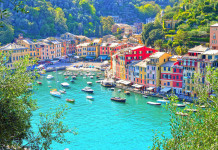
Monterosso al Mare, Vernazza, Corniglia, Manarola and Riomaggiore.
Their colorful buildings occupy an extraordinary landscape of cliffs, terraced vineyards and Mediterranean coastline.
Travel between the villages is easiest by train. Boats provide another perspective when conditions permit, while hiking trails connect parts of the coast.
Avoid driving between the villages.
12Don’t Miss
- Vernazza
- Manarola
- Riomaggiore
- Coastal hiking
- Local seafood
- Ligurian pesto
Ideal stay: 2–3 days
Best for: Hiking, coastal scenery and photography.
13. Genoa — Best for Maritime History
Genoa was once one of the Mediterranean’s great maritime powers.
Its wealth survives in the magnificent palaces of the Strade Nuove, while the historic center contains an extraordinary maze of narrow lanes known as caruggi.
The Porto Antico has been extensively redeveloped and includes the Aquarium of Genoa.
Genoa is also the capital of Liguria—the home of pesto Genovese, focaccia and a distinctive seafood cuisine.
13Don’t Miss
- Palazzi dei Rolli
- Via Garibaldi
- Porto Antico
- Genoa Cathedral
- Historic caruggi
- Boccadasse
Ideal stay: 2 days
Best for: Maritime history, architecture and Ligurian food.
14. Amalfi Coast — Best for Dramatic Coastal Scenery
Few coastlines are as instantly recognizable as the Costiera Amalfitana.
Mountains descend steeply toward the Mediterranean while towns cling to cliffs above the sea.
Positano may be the most photographed destination, but don’t overlook Amalfi, Ravello, Praiano, Atrani, Minori and Maiori.
Ravello’s position high above the coast provides some of the finest views.
14Don’t Miss
- Positano
- Amalfi
- Ravello
- Villa Rufolo
- Atrani
- Path of the Gods
Ideal stay: 3–4 days
Best for: Romance, scenery, swimming and coastal vacations.
Driving here can be challenging, especially during busy periods. Read our Driving in Italy for Tourists guide before deciding whether to rent a car.
15. Pompeii and Herculaneum — Best for Ancient Roman Life
When Mount Vesuvius erupted in AD 79, Pompeii and Herculaneum were buried.
The catastrophe created two of the world’s most extraordinary archaeological sites.
Pompeii reveals an entire Roman city—streets, houses, temples, baths, theaters and shops.
Herculaneum is smaller but preserves buildings and organic materials in remarkable condition.
Visit the Naples National Archaeological Museum as well, since many important objects excavated from the Vesuvian sites are displayed there.
Ideal visit: 1–2 days
Best for: Archaeology and Roman history.
16. Lake Como — Best for Villas and Alpine-Lake Scenery
Lake Como combines water, mountains, gardens and elegant historic villas.
Bellagio is the most famous town, but Varenna and Menaggio are equally useful bases for exploring the central lake.
Ferries make it possible to travel between towns without constantly relying on a car.
Historic villas and gardens are another major attraction.
15Don’t Miss
- Bellagio
- Varenna
- Menaggio
- Como
- Lakeside villas
- Ferry journeys
Ideal stay: 2–4 days
Best for: Relaxation, scenery, villas and romance.
17. The Dolomites — Best for Mountains and Outdoor Adventure
The Dolomites demonstrate just how geographically diverse Italy is.
Their dramatic pale-rock peaks rise above Alpine valleys, forests, mountain lakes and villages where Italian, German and Ladin cultural traditions meet.
Summer brings hiking, cycling and climbing.
Winter transforms the region into one of Europe’s premier skiing areas.
16Don’t Miss
- Cortina d’Ampezzo
- Tre Cime di Lavaredo
- Val Gardena
- Alpe di Siusi
- Alta Badia
- Val di Funes
Ideal stay: 4–7 days
Best for: Hiking, skiing, mountains and nature.
18. San Gimignano — Tuscany’s Medieval Skyline
San Gimignano is famous for the medieval towers that rise above its hilltop center.
Wealthy families once constructed dozens of them as symbols of prestige. A surviving group gives the town one of Italy’s most distinctive skylines.
Its popularity means daytime crowds can be considerable.
Visit early, stay into the evening or spend the night to experience a quieter town.
17Don’t Miss
- Piazza della Cisterna
- Piazza del Duomo
- Torre Grossa
- Medieval streets
- Vernaccia di San Gimignano wine
Ideal stay: 1 day or overnight
Best for: Medieval architecture, Tuscany and wine.
19. Perugia and Assisi — Best of Umbria
Umbria provides an excellent alternative for travelers attracted to Tuscany but interested in exploring somewhere different.
Perugia is the regional capital, an ancient hill city with Etruscan remains, medieval streets and a lively cultural scene.
Nearby Assisi is one of Italy’s most important religious destinations and the birthplace of St. Francis.
The Basilica of San Francesco contains extraordinary medieval frescoes and is part of a UNESCO World Heritage property.
18Don’t Miss
- Perugia historic center
- Rocca Paolina
- Basilica of San Francesco
- Assisi’s medieval streets
- Umbrian countryside
Ideal stay: 2–3 days
Best for: Medieval towns, spirituality, art and slower travel.
20. Matera — Best for an Ancient Urban Landscape
Matera has become one of southern Italy’s most compelling destinations.
Its famous Sassi districts consist of dwellings, churches and structures built into and around natural caves.
The resulting landscape looks unlike almost any other Italian city.
Once associated with extreme poverty and abandonment, the Sassi underwent extensive rehabilitation and today contain homes, hotels, restaurants and cultural spaces.
Matera was European Capital of Culture in 2019.
19Don’t Miss
- Sassi di Matera
- Rock churches
- Casa Grotta
- Matera Cathedral
- Murgia landscape
Ideal stay: 2 days
Best for: History, architecture and photography.
21. Puglia — Best for White Towns, Food and Beaches
Puglia occupies the heel of Italy’s boot and has become one of the country’s most sought-after regional destinations.
The region combines historic cities, olive groves, beaches, distinctive architecture and excellent food.
Lecce is famous for exuberant Baroque architecture.
Alberobello is known for its conical-roofed trulli.
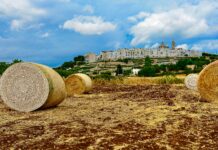
Ostuni rises as a whitewashed hill town above olive groves, while the Salento peninsula offers both Adriatic and Ionian coastlines.
20Don’t Miss
- Lecce
- Alberobello
- Ostuni
- Polignano a Mare
- Monopoli
- Valle d’Itria
- Salento
Ideal stay: 5–7 days
Best for: Road trips, beaches, food and small towns.
22. Palermo and Western Sicily — Best for Cultural Layers
Palermo reflects Sicily’s extraordinary history.
Phoenician, Arab, Norman, Byzantine, Spanish and Italian influences have all contributed to the city.
Its architecture can be spectacular, but Palermo is equally memorable for its street markets and food.
Nearby Monreale contains one of Italy’s great medieval cathedrals, famous for its glittering mosaics.
Farther west, destinations such as Cefalù, Trapani and the ancient site of Segesta make Palermo an excellent base for a broader Sicilian itinerary.
21Don’t Miss
- Palermo Cathedral
- Norman Palace
- Palatine Chapel
- Ballarò
- Capo Market
- Monreale
Ideal stay: 3–4 days
Best for: Food, history, architecture and street culture.
Explore the island further with our Sicily travel information.
23. Eastern Sicily — Best for Etna, Greek History and Baroque Towns
Eastern Sicily deserves its own place on this list because it offers an extraordinary concentration of destinations.
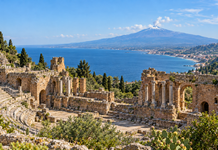
Taormina combines a spectacular ancient theater with views toward Mount Etna.
Catania provides a lively urban base beneath the volcano.
Syracuse and Ortigia preserve Greek history and one of Sicily’s most attractive historic centers.
Farther south are the Baroque towns of Noto, Modica, Ragusa and Scicli.
22Don’t Miss
- Mount Etna
- Taormina
- Catania
- Syracuse
- Ortigia
- Noto
- Ragusa
- Modica
Ideal stay: 5–7 days
Best for: Archaeology, volcanoes, food, architecture and road trips.
24. Sardinia — Best for Beaches
If beaches are the main purpose of your Italian vacation, Sardinia deserves serious consideration.
The island has some of the Mediterranean’s most beautiful water, ranging from glamorous Costa Smeralda to wild coves and long sandy beaches.
But Sardinia isn’t merely a beach resort.
Its archaeological heritage includes thousands of mysterious nuraghi, stone structures created by the ancient Nuragic civilization.
The island also has a strong cultural identity, distinctive cuisine and rugged interior landscapes.
23Don’t Miss
- Costa Smeralda
- La Maddalena Archipelago
- Gulf of Orosei
- Cagliari
- Alghero
- Su Nuraxi at Barumini
Ideal stay: 7 days or more
Best for: Beaches, swimming, nature and road trips.
25. Ravenna — Best for Byzantine Mosaics
Ravenna is one of Italy’s great art cities but receives a fraction of the international visitors seen in Florence or Venice.
For a period it served as a capital of the Western Roman Empire and later became an important center of Byzantine Italy.
Its early Christian monuments preserve some of the most spectacular mosaics in Europe.
The intense blues, greens and golds of Ravenna’s mosaics can seem astonishingly modern despite their age.
24Don’t Miss
- Basilica of San Vitale
- Mausoleum of Galla Placidia
- Basilica of Sant’Apollinare Nuovo
- Sant’Apollinare in Classe
- Dante’s Tomb
Ideal stay: 1–2 days
Best for: Byzantine art, mosaics and history.
And What About the Places That Didn’t Make the Top 25?
A list of 25 Italian destinations inevitably leaves out places that could easily deserve inclusion.
Trieste combines Italian and Central European culture on the Adriatic.
Parma is essential territory for food lovers.
Mantua has magnificent Gonzaga palaces and Renaissance architecture.
Ferrara is one of Italy’s great Renaissance cities.
Padua contains Giotto’s extraordinary Scrovegni Chapel.
Bergamo has one of northern Italy’s most attractive historic centers.
Urbino is a Renaissance jewel.
Orvieto rises spectacularly above the Umbrian countryside.
Abruzzo combines mountains, medieval villages and national parks.
And then there are hundreds of smaller towns that could become the highlight of a trip.
That’s precisely why Italy rewards returning visitors.
Best Italian Destinations by Type of Vacation
If you’re overwhelmed by the choices, start with what interests you.
Best for first-time visitors: Rome, Florence, Venice
Best for art: Florence, Rome, Venice, Ravenna
Best for ancient history: Rome, Pompeii, Sicily
Best for food: Bologna, Naples, Palermo, Turin
Best for wine: Tuscany, Piedmont, Sicily
Best for beaches: Sardinia, Puglia, Sicily, Amalfi Coast
Best for mountains: Dolomites
Best for romance: Venice, Lake Como, Amalfi Coast
Best for medieval towns: Siena, San Gimignano, Assisi
Best for fashion and design: Milan
Best for road trips: Tuscany, Sicily, Puglia, Sardinia
Best for hiking: Dolomites, Cinque Terre
Best for fewer international tourists: Ravenna, Perugia, Turin and parts of Puglia
How to Choose Where to Go in Italy
One of the biggest mistakes travelers make is trying to visit too many places.
Rome, Florence, Venice, Cinque Terre, Naples and the Amalfi Coast may all look close together on a map of Europe.
They don’t feel close when you spend half your vacation checking out of hotels and moving luggage between railway stations.
For most trips, fewer destinations and longer stays produce a better vacation.
7 Days in Italy
For a first visit:
Rome → Florence
or
Florence → Venice
or
Naples → Pompeii → Amalfi Coast
Trying to cover the entire country in seven days isn’t realistic.
10 Days in Italy
The classic first-time itinerary remains:
Rome → Florence → Venice
High-speed trains make this one of Italy’s easiest multi-city trips.
Alternatively:
Rome → Naples → Pompeii → Amalfi Coast
For countryside:
Florence → Siena → Val d’Orcia → Lucca
14 Days in Italy
Two weeks allow you to combine regions more comfortably.
For example:
Milan → Lake Como → Venice → Florence → Rome
or:
Rome → Naples → Pompeii → Amalfi Coast → Puglia
Sicily and Sardinia are generally better treated as substantial destinations rather than hurried additions to a mainland itinerary.
Should You Travel Around Italy by Train or Car?
It depends entirely on the itinerary.
Trains are usually best for:
- Rome
- Florence
- Venice
- Milan
- Bologna
- Naples
- Turin
A rental car becomes much more useful for:
- Rural Tuscany
- Puglia
- Sicily
- Sardinia
- Mountain regions
- Smaller villages
- Countryside itineraries
The best solution is often both.
Travel between major cities by train, then rent a car when entering the countryside.
Before renting, read our Driving in Italy for Tourists: What You Need to Know and our detailed Italian Autostrade Guide.
When Is the Best Time to Visit Italy?
Italy is a year-round destination, but the ideal season depends on where you’re going.
Spring — April to May
One of the best periods for Rome, Florence, Venice, Tuscany, Sicily and Puglia. Temperatures are generally comfortable and the countryside can be beautiful.
Early summer — June
Excellent weather and long days, but crowds and temperatures begin increasing.
High summer — July and August
Peak season for beaches and many mountain destinations. Major art cities can be very hot and crowded.
Autumn — September and October
One of the best periods for city sightseeing, countryside trips, wine regions and food-focused travel.
Winter — November to March
An excellent period for museums and city breaks, while the Alps and Dolomites attract skiers.
There is no universal “best month” for Italy. A February trip to Florence and a February trip to Sardinia have completely different objectives.
Discover Italy Region by Region
One of the best ways to move beyond the standard tourist itinerary is to stop thinking of Italy simply as a collection of famous cities.
Think in terms of regions.
Tuscany gives you Florence, Siena, Lucca, Pisa, San Gimignano, Chianti, Val d’Orcia and the Maremma.
Campania combines Naples, Pompeii, Herculaneum, Capri, Ischia and the Amalfi Coast.
Sicily can occupy an entire vacation by itself.
Puglia combines historic towns, countryside and two coastlines.
Piedmont offers Turin, the Langhe wine country, truffles and Alpine landscapes.
Veneto includes Venice, Verona, Padua and the Prosecco hills.
Emilia-Romagna connects Bologna, Parma, Modena, Ravenna and some of Italy’s greatest culinary traditions.
Browse our Regions of Italy to plan a trip around one part of the country rather than rushing from landmark to landmark.
Italy Beyond the Checklist
There is a reason travelers return to Italy again and again.
A first trip may be about seeing the Colosseum, Michelangelo’s David and Venice’s Grand Canal.
A second might involve driving through Puglia, exploring Sicily or hiking in the Dolomites.
Eventually, the places between the famous destinations become as interesting as the famous destinations themselves.
A village discovered accidentally on the road to Siena can become more memorable than an attraction planned months in advance. A small restaurant in Bologna can become the meal you remember years later. An evening ferry across Lake Como can matter more than another museum.
Use lists like this one to decide where to begin.
Then leave enough time in your itinerary to discover something that wasn’t on the list.
Related Italia Mia Guides
- 10 Must-See Destinations in Italy
- Italy for First-Time Visitors
- Regions of Italy
- Complete Guide to Tuscany
- Driving in Italy for Tourists
- Italian Autostrade Guide
External Links
For current transportation, admission, opening-hour and destination information: