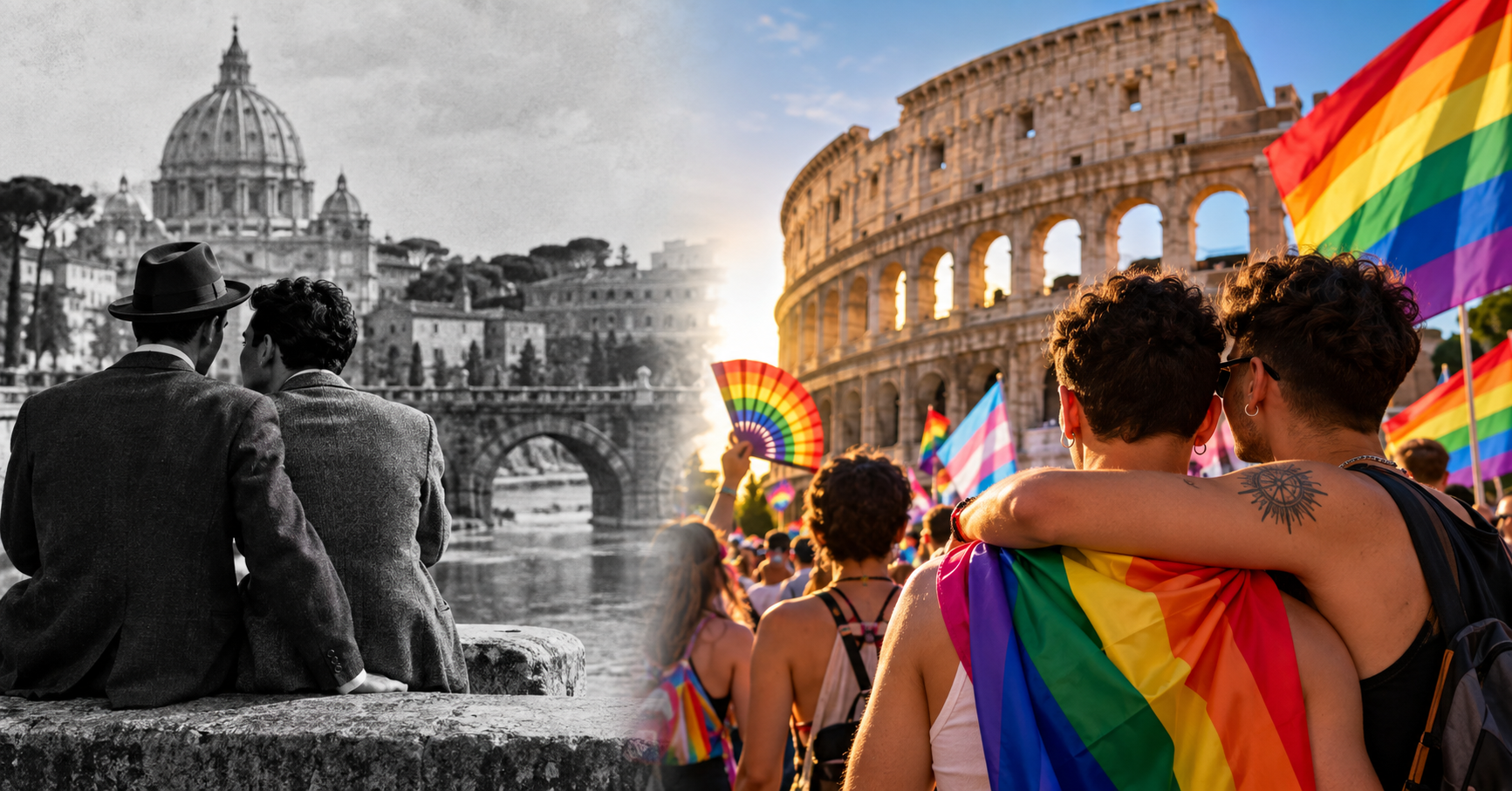
The history of gay life in Italy is not a simple progression from repression to freedom. It is a story of long periods of silence, social stigma and persecution, followed by cultural rebellion, political organization and increasingly visible LGBTQ+ communities.
Italy presents an interesting historical paradox. Same-sex relations between consenting adults have not been criminalized under the national penal code since Italian unification in the nineteenth century, yet gay men and lesbians lived for generations under intense social pressure. During Fascism, homosexual men could be targeted through police measures and internal exile even without a specific law criminalizing homosexuality.
After World War II, homosexuality remained largely invisible in public life. Then, beginning in the late 1960s and early 1970s, activists started challenging the idea that gay people should remain silent.
That movement eventually transformed Italian society.
Today Pride marches fill streets from Milan to Palermo, LGBTQ+ characters are familiar in Italian cinema and television, civil unions are legally recognized, and openly LGBTQ+ Italians participate throughout cultural and public life.
Yet legal equality remains incomplete.
To understand that contradiction, we need to look at how gay and LGBTQ+ life in Italy developed over more than a century.
Gay life in Italy before the modern LGBTQ+ movement
Modern labels such as gay, lesbian, bisexual, transgender and queer cannot simply be projected backward onto every historical period.
Same-sex relationships and gender nonconformity existed, of course, but the identities and communities familiar today developed much later.
Following Italian unification, the Zanardelli Penal Code of 1889 did not specifically criminalize consensual homosexual relations between adults. This distinguished Italy from countries where laws explicitly punished sexual relations between men.
But absence of a criminal prohibition did not mean social acceptance.
Homosexuality was frequently treated as a medical, psychiatric or criminological problem. Terms such as invertito and pederasta appeared in medical literature and popular discourse.
Family reputation was enormously important, particularly in smaller communities. For many people, discretion was essential to maintaining employment, social standing and family relationships.
At the same time, Italy acquired an unusual international reputation.
Foreign writers, artists and travelers were attracted to cities such as Rome, Florence, Venice and Naples. Italy’s classical past, artistic culture and Mediterranean lifestyle contributed to an image of the country as a place where foreigners could sometimes escape the stricter sexual conventions of northern Europe.
That apparent freedom, however, should not be confused with equality for Italians themselves.
Homosexuality under Fascism
The Fascist period is one of the most important chapters in the history of gay life in Italy.
Mussolini’s regime promoted an idealized image of masculine virility, marriage, motherhood and large families. Homosexuality conflicted directly with this vision of Fascist society.
When the Rocco Penal Code was introduced, homosexuality was not ultimately made a specific criminal offense.
That did not protect gay men from persecution.
The Fascist authorities could use police surveillance, administrative punishment and confino—internal exile—to remove people considered socially or politically undesirable from their communities.
Men suspected of homosexual behavior could be investigated, humiliated, deprived of employment opportunities or sent into internal exile.
The repression was therefore real even though Italy did not possess an equivalent of Germany’s Paragraph 175.
This distinction matters. Saying simply that homosexuality was either “legal” or “illegal” fails to describe how authoritarian power actually operated.
The regime could punish people without prosecuting them for a specific homosexual act.
Lesbian lives are considerably less visible in the surviving record. Fascist ideology was deeply concerned with women’s roles as wives and mothers, but relationships between women attracted different forms of official scrutiny and have left a smaller documentary trail.
The result was not freedom but invisibility.
After Fascism: silence rather than liberation
The collapse of Fascism and creation of the Italian Republic did not immediately produce a gay liberation movement.
Postwar Italy remained strongly influenced by Catholic morality, traditional family structures and conservative ideas about sexuality.
Homosexuality was rarely discussed openly.
For many gay men and lesbians, life depended upon separate worlds: a public identity acceptable to family, employers and neighbors, and a private life known only to trusted friends or partners.
Cinema, literature and popular entertainment occasionally acknowledged homosexuality, but representations were often coded, tragic or stereotypical.
This makes Italian cinema particularly valuable for understanding changing attitudes.
Our guide to Queer Italian Cinema: Directors, Films and Changing Representation follows this evolution from coded desire and marginalized characters to much more complex LGBTQ+ lives on screen.
Few individuals illustrate the tensions of postwar Italy more powerfully than Pier Paolo Pasolini.
Pier Paolo Pasolini and the contradictions of postwar Italy
Poet, novelist, filmmaker and political intellectual Pier Paolo Pasolini became one of the most important—and controversial—figures in twentieth-century Italian culture.
His sexuality was only one aspect of an extraordinarily complex life, but his experiences demonstrate how homosexuality could expose a person to public scandal, political condemnation and social exclusion.
In 1949 Pasolini became involved in a scandal in Friuli concerning sexual activity with young males. He was expelled from the Italian Communist Party, lost his teaching position and eventually moved with his mother to Rome.
Yet Pasolini refused to disappear.
Instead, he became one of Italy’s most provocative cultural voices, writing about sexuality, religion, consumerism, poverty, politics and the transformation of Italian society.
His films challenged conventional morality while his essays attacked both conservative institutions and aspects of the political left.
His life and work deserve more than being reduced to his sexuality. Read our full Pier Paolo Pasolini biography for the wider story of his literature, films, politics and controversial death.
Pasolini’s visibility was exceptional.
Most gay Italians of his generation had neither his public platform nor his ability to resist social pressure.
The 1960s begin to change Italy
During the 1960s, Italy itself was changing at extraordinary speed.
The economic boom transformed cities and employment. Television created a national popular culture. Young Italians challenged older social conventions. Feminism questioned traditional gender roles, while student and workers’ movements challenged established political authority.
Sexuality gradually became part of that wider cultural confrontation.
International developments mattered too.
Gay liberation movements were emerging in other Western countries, particularly after the Stonewall uprising in New York in 1969.
But Italy’s modern homosexual liberation movement developed its own organizations, personalities and political language.
One of the most important was FUORI!
FUORI! and the birth of organized gay liberation
In 1971, activists in Turin created FUORI!, generally regarded as Italy’s first major homosexual liberation organization.
The acronym stood for Fronte Unitario Omosessuale Rivoluzionario Italiano.
The word fuori also means “out,” making the name a powerful statement in itself.
Angelo Pezzana became one of the movement’s best-known founders and activists.
FUORI! represented something fundamentally different from earlier discussions of homosexuality.
Gay people were no longer simply objects to be examined by doctors, psychiatrists, police officers, priests or criminologists.
They were speaking for themselves.
That transformation became dramatically visible on April 5, 1972.
Sanremo 1972: a turning point
In Sanremo, activists protested against an international congress of sexology that approached homosexuality as a condition requiring treatment.
The demonstration has become one of the symbolic starting points of Italy’s modern LGBTQ+ movement.
For the first time, homosexual activists publicly confronted the institutions claiming authority over their lives and sexuality.
The message was radical for its time: homosexuality was not an illness requiring a cure.
The protest was small compared with today’s enormous Pride marches, but historically it represented a profound change.
Visibility itself had become political.
From liberation to a national movement
The 1970s produced numerous collectives and experiments in gay, lesbian and feminist activism.
There was no single unified LGBTQ+ movement resembling the organizations we know today. Groups frequently disagreed over politics, feminism, sexuality, revolutionary ideology and whether activists should cooperate with established political parties.
Nevertheless, something irreversible had happened.
Gay men and lesbians were creating organizations, publications, meeting places and public identities.
In 1979, Pisa hosted an important national homosexual demonstration, another milestone on the road toward today’s Pride movement.
Then tragedy accelerated the creation of a more organized national structure.
The Giarre tragedy and the emergence of Arcigay
In 1980, two young men were found dead near Giarre in Sicily.
The case became associated with the hostility and humiliation experienced by two young men whose relationship had become known in their community.
The deaths shocked activists and helped stimulate a new wave of organization.
The first ARCI Gay club was established in Palermo in December 1980.
Other groups followed.
Bologna became particularly important. In 1982 the city administration provided space at the Cassero di Porta Saragozza to an organization devoted to homosexual culture—an extraordinary institutional recognition for the period.
In 1985, organizations from across Italy came together to create a national Arcigay structure.
Arcigay would become one of the country’s most influential LGBTQ+ organizations, campaigning for civil rights while also developing cultural initiatives, social services and health programs.
The Italian gay movement was entering a new phase.
AIDS changes gay life in Italy
The arrival of HIV/AIDS during the 1980s transformed gay communities throughout Europe and the United States.
Italy was no exception.
Fear and misinformation were widespread. AIDS could reinforce existing prejudices by encouraging some people to associate homosexuality with disease.
But the crisis also demonstrated the importance of organized LGBTQ+ communities.
Arcigay and other organizations became involved in HIV/AIDS education, prevention, safer-sex campaigns and health services.
In 1985 Arcigay collaborated with Gruppo Abele on an early Italian book about AIDS, beginning a long involvement in HIV prevention and education.
For gay Italians, the epidemic was simultaneously a health crisis, a social crisis and another battle against stigma.
Lesbian and transgender voices become more visible
The expression “gay movement” is historically appropriate when discussing some early organizations, but it does not describe the entire history of LGBTQ+ Italy.
Lesbian activists had their own experiences of discrimination, feminism and political organization.
Transgender Italians also played an important role in campaigns for recognition.
A major legal development came in 1982 with Law 164, which created a legal framework for changing sex designation.
Over subsequent decades, the movement’s vocabulary expanded.
Gay and lesbian activism increasingly interacted with bisexual, transgender, intersex and queer identities. Organizations sometimes joined together and sometimes separated as different communities sought greater visibility for their own experiences.
That diversity is an important part of LGBTQ+ history rather than a departure from it.
Pride becomes visible across Italy
During the 1990s, public LGBTQ+ visibility grew dramatically.
Rome hosted Italy’s first national Gay Pride in 1994.
What had begun with small demonstrations and politically radical collectives was developing into a broad civil-rights movement.
The transformation became unmistakable in 2000 when Rome hosted World Pride.
Holding such an event in the city surrounding Vatican City gave it enormous symbolic importance and international attention.
Over time, Pride expanded far beyond Rome and Milan.
Today Pride events are held throughout Italy, including Turin, Bologna, Florence, Naples, Palermo and many smaller cities.
For current festivals and cultural gatherings, see our regularly updated LGBTQ+ Events in Italy and Europe calendar.
The geography matters.
Italian LGBTQ+ life is no longer exclusively a story of a few metropolitan neighborhoods.
Gay culture and everyday life
Political history tells only part of the story.
Gay life also developed through friendships, bars, discos, cultural associations, beaches, bookstores, saunas, film festivals and informal meeting places.
Cities developed distinct LGBTQ+ cultures.
Milan combined gay nightlife with fashion, publishing and international influences. Bologna became important because of its progressive political culture and organizations such as the Cassero. Rome developed a large and diverse scene alongside major national organizations. Turin played an essential role in the origins of FUORI!, while Florence, Naples and Palermo developed communities of their own.
Contemporary nightlife is considerably more visible.
Our current guide to LGBTQ+ bars, clubs and gay saunas in Italy covers established venues from northern Italy to the south.
These places should not be dismissed as separate from LGBTQ+ history.
For generations, spaces where people could meet safely were essential to the creation of community.
Cinema helps Italy talk about sexuality
Italian cinema provides another extraordinary record of changing attitudes.
Directors including Luchino Visconti, Pier Paolo Pasolini, Ferzan Özpetek and Luca Guadagnino approached sexuality and identity in very different ways and during very different periods.
Earlier films often relied on implication, ambiguity or stereotypes. Later filmmakers increasingly placed gay and lesbian characters at the center of their stories.
Films also began exploring chosen families, transgender lives, homophobia, desire, coming out and the collision between individual freedom and traditional expectations.
Our Queer Italian Cinema guide examines that history and recommends essential films for understanding the evolution of LGBTQ+ representation in Italy.
Culture sometimes moved faster than politics.
The long battle for legal recognition
By the late twentieth century, Italian LGBTQ+ organizations were increasingly focused on legal recognition.
In 1988, Socialist parliamentarian Alma Cappiello presented an early proposal concerning recognition of same-sex partnerships.
It would take nearly three more decades for national legislation to arrive.
During those years, proposals appeared, disappeared and became the subject of bitter political arguments.
The Catholic Church remained an influential voice in debates about marriage and family, while LGBTQ+ organizations argued that couples should not be denied legal protections because of their sexual orientation.
Italian society itself was changing more quickly.
Same-sex couples became increasingly visible in workplaces, entertainment, television and everyday community life.
Politics struggled to catch up.
2016: civil unions finally become law
The breakthrough came in 2016.
Law No. 76/2016, widely known as the Legge Cirinnà, established civil unions for same-sex couples.
It was one of the most important achievements in the history of LGBTQ+ rights in Italy.
Civil unions provide extensive legal protections involving inheritance, pensions, property, healthcare decisions and responsibilities between partners.
But they are not marriage.
The legislation also stopped short of establishing full equality in adoption and parenting.
Italia Mia covered the political struggle at the time in Italy Civil Unions Bill Passes but It Lacks Essential Rights.
For a current explanation of what civil unions provide—and what legal differences remain—see LGBTQ Rights in Italy in 2026: Laws, Adoption, Public Opinion and the State of Equality.
That distinction is important for this history.
The 2016 law was both a historic victory and evidence that the struggle for equality was unfinished.
LGBTQ+ Italy today
Contemporary LGBTQ+ life in Italy would have been almost unimaginable to activists protesting in Sanremo in 1972.
Same-sex couples live openly.
Pride events take place throughout the country.
LGBTQ+ organizations operate nationally and locally.
Queer film festivals, cultural associations, nightlife and community events are established parts of Italian urban culture.
Public attitudes toward same-sex relationships have also changed dramatically.
Yet the history has not reached a neat conclusion.
Italy still does not provide same-sex marriage, and important differences remain in adoption, family recognition and other areas. Anti-LGBTQ+ discrimination and violence have not disappeared.
For that reason, modern Italian LGBTQ+ history contains two realities at once.
Italy has changed enormously, and full equality has still not been achieved.
From invisibility to community
Perhaps the greatest transformation in the history of gay life in Italy is not a particular law.
It is visibility.
For much of modern Italian history, survival often meant remaining invisible.
Under Fascism, authorities could use surveillance and internal exile against homosexual men. In postwar Italy, social respectability encouraged silence. Gay and lesbian people frequently built private lives that could not safely be acknowledged in public.
Then people began speaking for themselves.
FUORI! challenged medical and social definitions of homosexuality.
The Sanremo protest of 1972 placed homosexual liberation visibly in the public square.
Activists in Palermo, Bologna, Turin, Rome, Milan and elsewhere created organizations and meeting spaces.
Arcigay built a national network.
Pride moved LGBTQ+ identity into Italy’s streets.
Writers, filmmakers, musicians, actors and activists brought sexuality into Italian culture.
And in 2016, after decades of campaigning, same-sex couples finally received national legal recognition through civil unions.
The story continues.
Anyone who wants to understand LGBTQ+ Italy today should therefore look beyond a simple question such as whether Italy is “gay-friendly.”
Modern Italy is the product of more than a century of tension between private life and public morality, individual freedom and social conformity, cultural change and political resistance.
The difference is that LGBTQ+ Italians are no longer invisible participants in that history.
They are among the people writing it.
External Sources
Arcigay – A Community on Display: History of the LGBTQIA+ Movement
Arcigay – LGBTQIA+ Movement History and the 1972 Sanremo Protest