

Alberto Sordi did more than make Italy laugh. Across a career spanning radio, theatre, dubbing, cinema and television, he created a gallery of characters who exposed the country’s vanities, compromises and contradictions. His boastful soldiers, petty officials, opportunists, failed seducers and respectable hypocrites were funny because audiences recognized them—and sometimes uncomfortable because the resemblance was so exact.
Known affectionately as Albertone, Sordi became one of the defining faces of Italian cinema and one of the essential figures of commedia all’italiana. Yet the warmth Italians felt toward him can obscure how sharp his work really was. Sordi rarely played an uncomplicated hero. He specialized in men who talked grandly, shifted loyalties, abused small privileges and protected themselves at other people’s expense. At his best, he could move from farce to humiliation, fear or tragedy without changing character.
A Roman Childhood and an Unmistakable Voice
Alberto Sordi was born in Rome on June 15, 1920, in the popular district of Trastevere. His father, Pietro, played bass tuba in the orchestra of the Teatro dell’Opera di Roma, while his mother, Maria Righetti, was an elementary-school teacher. Music and performance entered his life early: as a boy he sang in church choirs, including the choir of the Sistine Chapel, until his voice changed.
As a teenager, Sordi went to Milan to study acting and diction at the Accademia dei Filodrammatici. His strong Roman accent was judged unsuitable, and he did not complete the course. The rejection later became one of the most satisfying ironies in Italian entertainment: the voice he was expected to correct would become one of the most recognizable voices in the country.
He worked his way through minor theatrical appearances, variety shows and small film roles. In 1937 he appeared as an extra in Scipione l’Africano and won a Metro-Goldwyn-Mayer competition to provide the Italian voice of Oliver Hardy. Paired with Mauro Zambuto as Stan Laurel, Sordi helped make “Stanlio e Ollio” beloved by generations of Italian viewers.
His dubbing work extended well beyond comedy, but Hardy’s high, musical Italian voice remains the most famous example of Sordi’s extraordinary vocal inventiveness.
Radio Fame Before Cinema Success
Before film producers trusted him as a leading man, radio audiences already knew him. During the 1940s, Sordi developed comic personalities such as Mario Pio, the pompous Conte Claro and the sanctimonious compagnuccio della parrocchietta. These were not simply collections of jokes. Each had a rhythm, social identity and way of speaking that revealed an entire personality.
The RAI program Vi parla Alberto Sordi, broadcast from 1948, brought these creations to a national audience. Radio taught him how much character could be conveyed through timing, hesitation, verbal aggression and changes in pitch. Those skills later distinguished his screen acting, where a confident speech could collapse into panic with a single change in tone.
His first starring vehicle, Mamma mia, che impressione! (1951), adapted the parish-boy character for cinema. The film failed commercially. Sordi’s early screen persona was abrasive and unusual, and producers remained convinced that audiences would not accept him as a film star. Federico Fellini saw something they did not.
Fellini and the Breakthrough Years
Fellini cast Sordi as Fernando Rivoli, the ludicrous hero of romantic photo stories in The White Sheik (Lo sceicco bianco, 1952). The film was not an immediate box-office success, but Sordi’s entrance on a giant swing—vain, theatrical and faintly ridiculous—announced a new comic presence.
Fellini stood by him again with I Vitelloni (1953). Sordi played Alberto, an immature provincial idler still dependent on his mother and sister. Producers reportedly resisted his casting, yet the film became an international success and Sordi won a Nastro d’Argento for best supporting actor. His performance combined flamboyant humor with the melancholy of a man incapable of growing up.
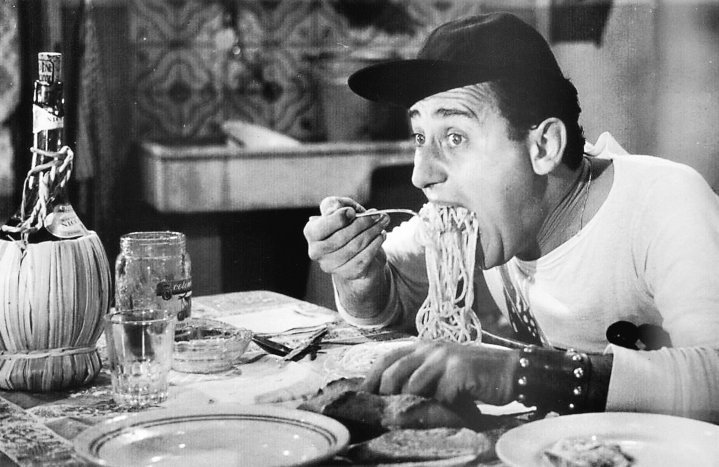
The same year, Un giorno in pretura introduced Nando Mericoni, a Roman youth intoxicated by an absurd fantasy of America. The character returned as the protagonist of An American in Rome (Un americano a Roma, 1954), one of Sordi’s most enduring popular comedies.
Nando mangles English, imitates Hollywood behavior and rejects the food and habits around him—until hunger defeats his pose. Beneath the famous gags, the film captures postwar Italy’s fascination with American abundance and mass culture.
These successes transformed Sordi from a supposedly difficult performer into one of Italy’s busiest stars. He appeared in twelve films in 1954 alone. The speed of production varied, but he was steadily refining the screen type that would define much of his career: a man skilled at self-justification and blind to the damage he causes.
Alberto Sordi and Commedia all’Italiana
Sordi became central to the development of commedia all’italiana, the cycle of comedies that examined Italy’s social transformation from the postwar years through the economic boom and beyond.
Alongside Vittorio Gassman, Nino Manfredi, Ugo Tognazzi and Marcello Mastroianni, he demonstrated that comedy could be entertaining without flattering its audience.
In The Art of Getting Along (L’arte di arrangiarsi, 1954), directed by Luigi Zampa, Sordi’s character repeatedly changes political allegiance whenever a new position offers an advantage. In Antonio Pietrangeli’s The Bachelor (Lo scapolo, 1955), he turns masculine freedom into a study of loneliness and emotional immaturity.
Dino Risi’s The Widower (Il vedovo, 1959) pairs him brilliantly with Franca Valeri. He is an incompetent businessman inflated by vanity; she is the intelligent, wealthy wife whose judgment he resents and whose money he needs.
These men are often called embodiments of the “average Italian,” but that description is too gentle. Sordi enlarged recognizable weaknesses until they became grotesque. His characters do not represent every Italian; they dramatize impulses that polite society prefers to conceal—cowardice, greed, conformism, status anxiety and the instinct to seek influence rather than justice.
War, Reconstruction and Moral Compromise
Two major films expanded the emotional and historical range of Sordi’s acting.
Mario Monicelli’s The Great War (La grande guerra, 1959) stars Sordi and Vittorio Gassman as reluctant soldiers during the First World War. Their characters are neither patriotic statues nor traditional military heroes. They grumble, improvise and try to survive, yet finally arrive at an act of courage. The film’s mixture of comedy and death helped change the way mainstream Italian cinema represented war.
In Luigi Comencini’s Everybody Go Home! (Tutti a casa, 1960), Sordi plays Lieutenant Alberto Innocenzi, an officer left bewildered after the armistice of September 8, 1943. His journey through a collapsing country becomes a moral education.
He begins by clinging to orders and personal safety, but the chaos of occupation, resistance and civil conflict forces him to choose a position. Sordi’s ability to move within a scene from comic confusion to grief and resolve gives the film much of its power.
Dino Risi’s A Difficult Life (Una vita difficile, 1961) offered him one of his richest roles. Silvio Magnozzi is a former partisan and struggling left-wing journalist whose principles collide with family responsibilities and the temptations of Italy’s new prosperity.
He is more sympathetic than many Sordi characters, but never idealized. The film turns one man’s compromises into a portrait of the country’s passage from Resistance hopes to consumer society.
The Italian Economic Miracle—with the Mask Removed
During the 1960s, Sordi’s films examined the darker side of rapid modernization.
In Alberto Lattuada’s Mafioso (1962), he plays Antonio Badalamenti, a Sicilian factory supervisor living in northern Italy who returns home with his family and is drawn into a terrifying obligation. Sordi’s cheerful efficiency gradually becomes the instrument of a criminal system; the film’s tonal shift from social comedy to nightmare depends on his performance.
Vittorio De Sica’s The Boom (Il boom, 1963) is an equally ruthless satire of status and debt. Sordi’s Giovanni Alberti has built a luxurious life he cannot afford and becomes willing to sacrifice part of himself to preserve appearances.
In Elio Petri’s The Teacher of Vigevano (Il maestro di Vigevano, 1963), the promise of prosperity corrodes domestic life and personal dignity.
Sordi also demonstrated international appeal. In Gian Luigi Polidoro’s To Bed or Not to Bed (Il diavolo, 1963), his Italian businessman travels through Sweden projecting fantasies onto the women he meets. The performance won him the Golden Globe for best actor in a musical or comedy.
He also appeared with David Niven in The Best of Enemies (1961) and joined the international cast of Those Magnificent Men in Their Flying Machines (1965).
From Actor to Director
Sordi began directing with Fumo di Londra in 1966, playing an Italian visitor infatuated with British manners. He followed it with Scusi, lei è favorevole o contrario?, a satire about an outwardly respectable businessman who opposes divorce while maintaining a complicated private life.
As a director, Sordi remained chiefly interested in vehicles built around his own comic personality. His films are uneven, but several add important dimensions to his career.
Amore mio aiutami (1969), co-starring Monica Vitti, explores jealousy and marital breakdown. Polvere di stelle (1973), again with Vitti, looks back at the hardships and illusions of wartime variety theatre.
The celebrated episode Le vacanze intelligenti from Where Are You Going on Holiday? (1978) follows a working-class couple through a culturally improving vacation planned by their children, using modern art and elite tourism to satirize both pretension and social condescension.
Later directorial works included Il tassinaro (1983), which sent Sordi’s Roman taxi driver through a series of encounters with public figures and ordinary passengers, and Nestore, l’ultima corsa (1994), a melancholy story about an aging cab driver and his horse.
These films may be less formally ambitious than his greatest collaborations with Monicelli, Risi, Comencini, De Sica or Lattuada, but they show his determination to control the setting and meaning of his screen persona.
The Dramatic Depth of His Later Performances
Sordi’s gift for unpleasant comedy never prevented him from becoming a formidable dramatic actor.
Nanni Loy’s In Prison Awaiting Trial (Detenuto in attesa di giudizio, 1971) subjects an innocent man to the impersonal machinery of the justice system. At first, Giuseppe Di Noi assumes that a reasonable explanation will restore order. As he is transferred, isolated and psychologically broken, Sordi strips away every protective mannerism.
The performance earned him the Silver Bear for best actor at the 1972 Berlin International Film Festival.
In Luigi Comencini’s The Scientific Cardplayer (Lo scopone scientifico, 1972), Sordi and Silvana Mangano play a poor Roman couple invited to gamble against a wealthy American woman, played by Bette Davis. Their hope of escaping poverty becomes a ritual of dependence and humiliation.
Mario Monicelli’s An Average Little Man (Un borghese piccolo piccolo, 1977) pushed Sordi into still darker territory. His character, Giovanni Vivaldi, is a minor civil servant willing to exploit connections to secure his son’s future. After a devastating act of violence, his petty conformism mutates into vengeance.
The film begins in the territory of social satire and ends as a bleak study of grief and moral collapse.
Sordi returned to broad historical comedy in Monicelli’s The Marquis of Grillo (Il marchese del Grillo, 1981). As an aristocratic prankster in papal Rome, he combines privilege, cruelty and irresistible charm. The film produced some of his most quoted dialogue and confirmed that his Roman identity could be both intensely local and nationally understood.
Essential Alberto Sordi Films
For newcomers, these ten films offer a strong route through his career:
- I Vitelloni (1953): Fellini’s bittersweet portrait of provincial idleness gave Sordi his decisive breakthrough.
- An American in Rome (1954): The fullest expression of Nando Mericoni and postwar Italy’s comic obsession with America.
- The Great War (1959): A landmark mixture of antiheroic comedy, historical realism and tragedy.
- The Widower (1959): A merciless comedy of male vanity, sharpened by Franca Valeri’s performance.
- Everybody Go Home! (1960): A journey through the confusion and moral choices following Italy’s 1943 armistice.
- A Difficult Life (1961): One of the finest films about ideals, compromise and the postwar economic boom.
- Mafioso (1962): A comedy that gradually reveals a chilling system of coercion and violence.
- The Boom (1963): De Sica and Sordi turn consumer aspiration into grotesque social horror.
- In Prison Awaiting Trial (1971): A devastating portrait of institutional injustice and psychological destruction.
- An Average Little Man (1977): Perhaps Sordi’s darkest performance, where satire gives way to tragedy.
Viewers should also seek out The Scientific Cardplayer, The Marquis of Grillo, Il vigile, Il medico della mutua, The Bachelor and the “Le vacanze intelligenti” episode.
Availability varies by country and platform; physical editions and imported releases can be found through Amazon’s Alberto Sordi film listings.
Alberto Sordi and Rome
No city is more closely associated with Sordi than Rome. His accent, timing and physical confidence belonged to the capital, but his Rome was never merely picturesque. It was a theatre of bureaucracy, family loyalties, social ambition, traffic, privilege and survival.
Taxi drivers, policemen, office workers, aristocrats and hustlers all became part of his cinematic map.
Travellers can explore locations connected with his films through the official Turismo Roma itinerary dedicated to Sordi.
His former villa near the Baths of Caracalla houses the Fondazione Museo Alberto Sordi and its archive. The villa is currently visitable for events organized by the foundation while preparations for regular public opening continue. Visitors should therefore consult the official museum visit page before making plans.
Sordi is buried in the Monumental Cemetery of Verano. Rome also commemorates him in the Galleria Alberto Sordi on Piazza Colonna, renamed in his honor in 2003.
Awards and Public Recognition
Sordi received numerous David di Donatello and Nastro d’Argento awards during his career. His most important international acting honors included the 1964 Golden Globe for To Bed or Not to Bed and the 1972 Silver Bear for In Prison Awaiting Trial. In 1995, the Venice Film Festival awarded him the Golden Lion for lifetime achievement.
On his eightieth birthday, June 15, 2000, Rome made him honorary mayor for a day. The gesture was more than a publicity event. Few performers had become so closely identified with the city or had documented so many stages of modern Italian life.
Private Life, Philanthropy and Final Years
Sordi never married and guarded his private life closely. Public curiosity often produced gossip, but his lasting importance lies in the work rather than speculation about relationships he chose not to discuss.
He also supported charitable and social causes. In 2001 he established a foundation intended to help young people facing economic difficulty enter professional life. His sister Aurelia later created the Fondazione Museo Alberto Sordi to preserve his home, personal archive and cultural legacy.
Alberto Sordi died in Rome on February 24, 2003, at the age of 82, after suffering from lung cancer. His funeral at the Basilica of San Giovanni in Laterano became an extraordinary expression of public affection. Rome mourned not only a famous actor but a figure who had narrated the city and the country for more than half a century.
Why Alberto Sordi Still Matters
Sordi’s films remain valuable because the behavior they expose has not disappeared. The bureaucrat who hides behind procedure, the consumer who confuses debt with success, the public moralist with a private double standard, and the citizen who changes principles when power changes hands are not relics of postwar Italy.
His comedy also resists easy sentimentality. Even when his characters earn sympathy, Sordi seldom asks viewers to excuse them. He understood that laughter could reveal a society more precisely than solemn commentary. The result is a body of work that functions as both popular entertainment and an unofficial social history of modern Italy.
The affectionate name Albertone suggests familiarity, almost kinship. But Sordi’s greatest achievement was not that Italians felt close to him. It was that, through him, they saw themselves—sometimes generously, often mercilessly, and almost always with laughter.
External Links
- Alberto Sordi – Dizionario Biografico degli Italiani, Treccani
- Alberto Sordi centenary special – Rai Cultura
- Fondazione Museo Alberto Sordi
- Alberto Sordi awards profile – Golden Globes
- Alberto Sordi’s Rome film locations – Turismo Roma