

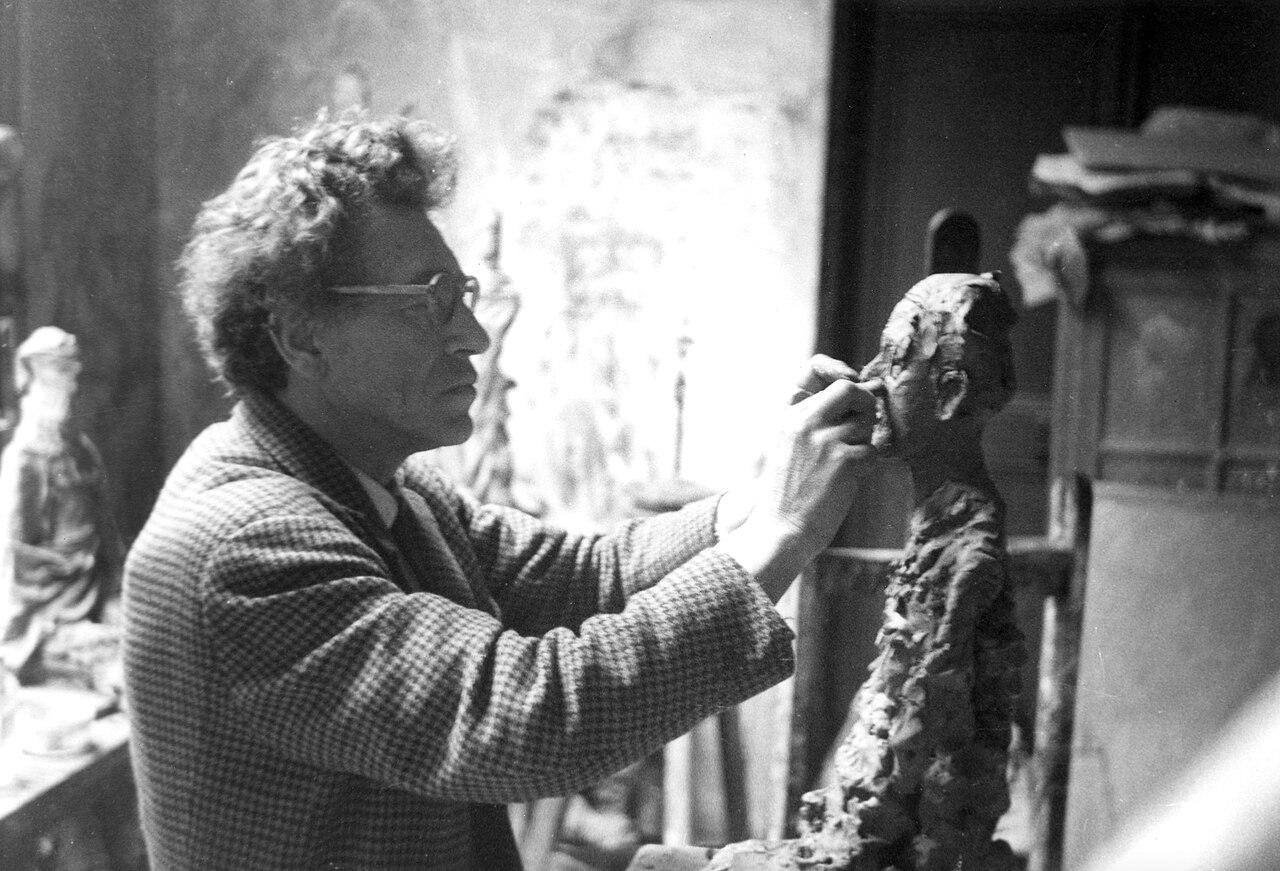
 Alberto Giacometti transformed the human figure into one of the most haunting images of twentieth-century art. His tall, attenuated men and women seem fragile enough to dissolve, yet they remain upright, alert and unexpectedly resilient. Their rough surfaces catch the light, while the empty space around them becomes almost as important as the bronze itself.
Although Giacometti is often associated with Surrealism and postwar Existentialism, neither label fully defines him. He was a Swiss sculptor, painter, draftsman and printmaker from the Italian-speaking Val Bregaglia, close to the border with Italy. His career moved between the Alpine landscapes of his childhood, the museums of Italy and the crowded streets and studios of Paris.
His lifelong subject was perception: how another person appears across a room, on a street, in memory or under the intense pressure of prolonged observation.
Childhood in Italian-Speaking Switzerland
Alberto Giacometti was born on October 10, 1901, in Borgonovo, a village near Stampa in Switzerland’s Val Bregaglia. The valley belongs to the canton of Graubünden but is culturally and linguistically Italian. This borderland identity helps explain why Giacometti belongs simultaneously to Swiss, Italian-speaking and Parisian cultural histories.
Art was part of everyday family life. His father, Giovanni Giacometti, was a respected Swiss Post-Impressionist painter and engraver. Alberto’s godfather, Cuno Amiet, was another important Swiss artist, while Ferdinand Hodler served as godfather to his younger brother Bruno.
Giacometti began drawing as a child and produced his first painted still life and a sculpted portrait of his brother Diego at approximately fourteen. Diego would become much more than a sibling. He was Alberto’s assistant, closest collaborator, studio companion and most frequently represented male model.
The family lived in Stampa and spent time in Maloja, near Lake Sils. The mountains, narrow valleys and sharply defined distances of this landscape left a lasting mark on Giacometti’s sense of scale and space.
Artistic Training and the Journey Through Italy
In 1919, Giacometti studied at the École des Beaux-Arts and the École des Arts et Métiers in Geneva. The following year, he traveled with his father to Venice, where Giovanni had been invited to participate in the Biennale.
Alberto subsequently remained in Italy for an extended period, visiting Padua, Florence, Assisi, Naples and Rome. He studied Egyptian, Etruscan, Roman and Renaissance works in museums and churches. Ancient Egyptian sculpture particularly impressed him because of its frontal stillness, concentrated gaze and apparent resistance to time.
Italy therefore played a formative role in his education. He encountered the disciplined observation of the human body found in classical art while also studying the innovations of artists who had reshaped Western sculpture. Readers interested in that longer history can see how sculptors such as Donatello transformed the human figure during the Renaissance and how Umberto Boccioni later attempted to represent modern movement and space.
Paris and Antoine Bourdelle
Giacometti arrived in Paris in 1922 and enrolled at the Académie de la Grande Chaumière, where he studied under Antoine Bourdelle, a former assistant of Auguste Rodin. Bourdelle offered rigorous instruction in modeling and monumental sculpture, but Giacometti increasingly questioned whether traditional naturalism could reproduce what the eye actually sees.
In 1926, he rented a small studio at 46 rue Hippolyte-Maindron in Montparnasse. The roughly 23-square-meter space was uncomfortable and poorly equipped, yet he kept it for the rest of his life. Its stained walls, accumulated plaster and severe simplicity became inseparable from his public image.
During the 1920s, Giacometti experimented with flattened and geometric forms influenced by Cubism, ancient sculpture and artworks from Africa and Oceania. Important early works include The Couple and Spoon Woman, whose monumental concave body evokes both a human figure and a ceremonial object.
These works brought him into contact with Parisian critics, dealers and writers. His brother Diego joined him permanently in Paris in 1930 and helped with casting, construction, materials and the practical running of the studio.
Giacometti and Surrealism
By the end of the 1920s, Giacometti had entered the circle surrounding André Breton. He officially joined the Surrealist movement in 1931 and quickly became one of its most original sculptors.
Instead of creating conventional statues, he constructed unsettling objects that suggest desire, violence, dreams and psychological confinement. Suspended Ball places a moving spherical form above a curved wedge, creating a mechanical image charged with erotic tension. Woman with Her Throat Cut spreads across the floor like a combination of human body, insect and broken trap.
The Palace at 4 A.M., created in 1932, is perhaps his most poetic Surrealist construction. Made from wood, glass, wire and string, it resembles a fragile architectural stage occupied by enigmatic forms. Its open framework turns emptiness into part of the sculpture, anticipating Giacometti’s later fascination with the relationship between figures and surrounding space.
Giacometti’s Surrealist period was brief but decisive. It established his international reputation and produced some of the movement’s most memorable objects. However, he gradually became dissatisfied with working entirely from imagination.
The Return to the Human Model
Around 1935, Giacometti returned to drawing and sculpting directly from life. This decision led to his exclusion from Breton’s Surrealist group, which viewed traditional observation with suspicion.
For Giacometti, however, the return to the model was not conservative. It created a radical new problem. The longer he looked at a person, the less certain the figure seemed. A head might appear small in relation to the surrounding room, while individual features shifted or seemed impossible to fix permanently.
He repeatedly modeled heads, destroyed them and began again. Many sculptures became smaller and smaller, sometimes shrinking to only a few centimeters. He was not trying to make miniatures for decorative effect. He wanted to preserve the perceived distance between himself and the person he was observing.
This struggle became the central drama of his art. He no longer treated sculpture as the reproduction of a solid body. Instead, he attempted to record the unstable experience of seeing another human being.
The War Years in Switzerland
When German forces occupied Paris, Giacometti left for Switzerland in December 1941. He spent most of the war in Geneva, Stampa and Maloja. The sculptures he produced during this period were often tiny enough to fit inside matchboxes.
In Geneva, he met Annette Arm, who would become one of his most important models. She moved to Paris after the war, and the couple married in 1949. Giacometti created numerous sculptures, paintings and drawings of Annette, frequently presenting her as a frontal, immobile figure whose physical presence emerges from an intricate network of lines.
Giacometti returned to his Paris studio in September 1945. Diego had protected the space and its contents during his absence.
The Elongated Postwar Figures
Between 1945 and 1947, Giacometti developed the elongated sculptural language for which he is best known. The figures became extremely thin, their bodies built up from unevenly worked plaster or clay before being cast in bronze.
The change reportedly grew partly from Giacometti’s experience of seeing people at a distance. A person observed across a square or along a street does not fill the viewer’s vision like a traditional life-size statue. The figure appears narrow, isolated and inseparable from the space surrounding it.
Walking Man, Standing Woman and Man Pointing are not anatomical studies in the conventional sense. Their proportions are distorted, but their stance and orientation create an intense impression of human presence. The rough surfaces preserve evidence of Giacometti’s hands, revisions and repeated attempts to capture what he saw.
These sculptures are frequently interpreted through postwar Existentialism. Giacometti knew Jean-Paul Sartre and Simone de Beauvoir, and Sartre wrote influential essays about his work. The solitary figures certainly evoke isolation, uncertainty and the vulnerability of life after the Second World War.
Yet loneliness is not their only meaning. The figures also possess endurance. However eroded or distant they appear, they continue to stand and walk. Their fragility is accompanied by a remarkable refusal to disappear.
The City Square and Figures in Space
Giacometti often arranged several figures on a shared platform without allowing them to communicate directly. City Square presents people moving in different directions, as if crossing an urban plaza while remaining enclosed in their separate worlds.
Three Men Walking similarly explores physical proximity without emotional contact. The figures occupy the same environment, but each appears absorbed in an individual trajectory.
These compositions demonstrate that Giacometti was not simply making thin bodies. He was sculpting relationships among people, distances and empty space. The platform establishes a world in miniature, while the spaces between the figures create a psychological tension comparable to silence in music.
The Women of Venice
In 1956, Giacometti was invited to exhibit in the French Pavilion at the Venice Biennale. For the exhibition, he produced a group of standing female figures now known as the Women of Venice.
The sculptures developed from a continuous process of modeling, alteration and remaking. Rather than forming a simple edition of one figure, each woman possesses a distinct surface, balance and degree of solidity. Some appear slender and remote; others have heavier bases or more pronounced torsos.
Presented together, the Women of Venice reveal how obsessively Giacometti reconsidered the same basic subject. A frontal standing woman could generate numerous independent solutions because every act of looking produced a different visual experience.
The series also brought his career back to the city he had first visited with his father in 1920. Venice became the setting for two major moments in his life: his youthful encounter with Italian art and his mature international recognition.
Portraits of Diego, Annette and Other Models
Although Giacometti’s figures can appear anonymous, much of his mature work depended on a small circle of identifiable models. Diego posed for him throughout his career. Annette became his principal female model, while the Japanese philosopher Isaku Yanaihara endured exceptionally long sessions in the studio during the late 1950s and early 1960s.
The writer Jean Genet also posed for Giacometti and later wrote an influential account of the artist’s studio. Caroline, a young woman Giacometti met in 1958, became another recurring subject during his final years.
His portrait sessions could continue for weeks or months. Giacometti repeatedly scraped away and rebuilt painted faces or pressed and cut into sculpted heads. He was less interested in producing a flattering likeness than in capturing the concentrated presence of a particular person.
Giacometti as a Painter and Draftsman
Giacometti’s fame as a sculptor can obscure the importance of his paintings and drawings. He worked across all three media throughout his career, and each supported the others.
His paintings are usually dominated by gray, brown, black and ochre tones. Faces and bodies emerge from dense webs of searching lines. Rooms, chairs and studio walls are repeatedly redrawn, creating uncertain enclosures around the model.
The process is especially visible in portraits of Diego and Annette. Giacometti would establish the eyes first and then construct the rest of the head around their gaze. The resulting faces seem simultaneously immediate and remote.
His drawings show the same refusal to accept a single contour. Lines accumulate around heads, objects and interiors as the artist tests alternative positions. Drawing was not merely preparatory work for Giacometti; it was another means of investigating how vision operates.
Major Works by Alberto Giacometti
Spoon Woman
Created in the 1920s, Spoon Woman combines a simplified female body with the form of a ceremonial spoon. Its monumental shape reflects Giacometti’s early engagement with non-European sculpture and abstraction.
Suspended Ball
This 1930–1931 construction uses movement and implied contact to create a disturbing combination of attraction and aggression. It helped establish Giacometti within Surrealism.
The Palace at 4 A.M.
This fragile, open structure from 1932 resembles a dream translated into architecture. It is now one of the defining sculptures of the Surrealist movement.
Woman with Her Throat Cut
Made in 1932, this horizontal work transforms the female body into an unsettling hybrid form. Its violent imagery and floor-level presentation challenge the conventions of freestanding sculpture.
Man Pointing
Created in 1947, Man Pointing is one of Giacometti’s most recognizable postwar figures. Its extended arms suggest communication or direction, yet its exact gesture remains ambiguous.
City Square
Five figures share a platform while moving independently. The work turns the ordinary act of crossing a public space into a meditation on distance and human separation.
The Women of Venice
Produced for the 1956 Venice Biennale, these standing women demonstrate how Giacometti continually revised a single subject without arriving at one definitive version.
Walking Man I
The forward-moving figure has become a universal image of human vulnerability and determination. Its narrow body appears physically precarious, but the extended stride conveys purpose and survival.
Recognition, Final Years and Death
International recognition grew rapidly during Giacometti’s final two decades. His postwar work was presented at the Pierre Matisse Gallery in New York, the Galerie Maeght in Paris and major museums in Europe and the United States.
In 1962, Giacometti was the guest artist at the Venice Biennale and received its Grand Prize for Sculpture. The award confirmed his position as one of the leading artists of the twentieth century.
He underwent surgery for stomach cancer in 1963 but continued working. In 1964, he received the Guggenheim International Award for Painting, recognition that underlined the importance of his work beyond sculpture.
Giacometti died of cardiac exhaustion at a hospital in Chur, Switzerland, on January 11, 1966. He was buried in the cemetery at Borgonovo, near the landscape of his childhood.
Where to See Giacometti’s Art
The Fondation Giacometti and Institut Giacometti in Paris preserve the artist’s archives and the world’s largest collection of his works and related objects. The Institut includes a reconstruction of his legendary Montparnasse studio.
The Kunsthaus Zürich holds the most important museum collection of Giacometti’s work, covering sculpture, painting, drawing and printmaking.
Visitors can also find major works at the Museum of Modern Art in New York, the Tate in London, the Guggenheim Museum, the Metropolitan Museum of Art and the Fondation Maeght in Saint-Paul-de-Vence.
Museum displays change, and some works may be on loan, so visitors should check the official collection pages before planning a trip.
Giacometti’s Legacy
Giacometti changed modern sculpture by rejecting the idea that monumentality depends on physical mass. Even his smallest or thinnest figures can dominate a room because of the psychological intensity they create.
His influence can be seen in later sculptors concerned with the body, space, memory and vulnerability. His art also continues to attract writers, filmmakers and philosophers because it refuses to resolve the mystery of human presence.
Giacometti’s figures remain powerful because they seem to inhabit two conditions at once. They are solitary but universal, delicate but persistent, distant yet unmistakably alive. They do not offer an idealized image of humanity. They show the human being as something continually perceived, questioned, reduced and rebuilt.
For a broader view of sculpture and painting across the centuries, see Italia Mia’s guide to Italian art movements and periods and its selection of places to see important artworks and sculpture in Italy.
Books About Alberto Giacometti
Readers who want to examine his sculptures, paintings and drawings in greater detail can browse books about Alberto Giacometti on Amazon.com. Exhibition catalogues from the Fondation Giacometti, Tate, MoMA and the Kunsthaus Zürich are especially useful because they reproduce works from every stage of his career.
External Sources
Fondation Giacometti – Official biography and research resources
Fondation Giacometti – Biographical timeline
Kunsthaus Zürich – Museum collection
Museum of Modern Art – Alberto Giacometti
Solomon R. Guggenheim Museum – Alberto Giacometti
Metropolitan Museum of Art – Works by Alberto Giacometti