

Orazio and Artemisia Gentileschi occupy a unique place in the history of Italian Baroque art. Father and daughter were both shaped by the revolutionary example of Caravaggio, yet they transformed his dramatic realism in markedly different ways.
Orazio developed an increasingly refined style distinguished by luminous color, carefully arranged figures and sumptuous fabrics. Artemisia retained the intensity of Caravaggio’s lighting while creating a more forceful and emotionally direct language of her own. Her biblical and historical heroines possess intelligence, physical strength and psychological presence rarely encountered in seventeenth-century European painting.
Their careers extended far beyond Rome. Orazio worked for powerful patrons in Genoa, Turin, Paris and London. Artemisia established herself in Florence, Rome, Venice, Naples and London, overcoming restrictions that made a professional artistic career exceptionally difficult for a woman.
Together, their lives illuminate the international reach of Italian Baroque painting and the changing status of the artist in seventeenth-century Europe.
Orazio Gentileschi: From Pisa to Rome
Orazio Gentileschi was born in Pisa in 1563 as Orazio Lomi. He later adopted the surname Gentileschi from his maternal family. His older half-brother Aurelio Lomi was also a painter, and the young Orazio probably received some of his earliest training within this artistic environment.
By the late 1570s or early 1580s, Orazio had moved to Rome. The city was undergoing an enormous transformation as popes, cardinals and religious orders commissioned new churches, chapels and decorative programs. He initially worked within the conventions of late Mannerism, contributing figures to large fresco projects and collaborating with other painters.
These early commissions required technical discipline, but Orazio had not yet developed the distinctive style for which he would become famous. That transformation occurred after his encounter with the work of Michelangelo Merisi da Caravaggio.
Orazio and Caravaggio
Caravaggio rejected the idealized figures and artificial elegance favored by many late-sixteenth-century painters. He worked from living models, placed sacred events in recognizable surroundings and used sharply directed light to give physical and emotional immediacy to his scenes.
Orazio became one of the most important artists to respond to this new approach. The two painters knew one another personally, although their friendship was not always peaceful. Orazio even appeared as a witness in the notorious 1603 libel proceedings involving Caravaggio and the painter Giovanni Baglione.
Orazio adopted Caravaggio’s naturalism, close observation and dramatic illumination, but he did not simply imitate him. Caravaggio’s compositions can feel confrontational and compressed, whereas Orazio’s mature paintings often appear quieter and more lyrical. His figures are carefully modeled, his colors can be unusually delicate, and his treatment of silk, linen and velvet gives his paintings an elegant material beauty.
Works such as Saint Francis Supported by an Angel, The Lute Player and David with the Head of Goliath demonstrate how he softened Caravaggio’s visual language without sacrificing its emotional power.
Readers interested in the wider period can place both artists within ItaliaMia’s guide to Italian art movements and periods.
Orazio’s International Career
During the 1610s, Orazio worked in Rome and the Marche. In the following decade his reputation brought increasingly prestigious commissions outside central Italy.
Around 1621 he moved to Genoa, where he worked for Giovanni Antonio Sauli and other members of the city’s wealthy aristocracy. Paintings associated with this period include Danaë, Lot and His Daughters and versions of the Penitent Magdalene. These works reveal a growing interest in richly colored textiles, graceful gestures and carefully controlled light.
Orazio also received commissions connected with the court of Carlo Emanuele I, Duke of Savoy. His magnificent Annunciation, now in Turin’s Galleria Sabauda, is one of his finest altarpieces. The angel’s brilliant robes, the restrained architecture and the Virgin’s startled movement combine spiritual drama with courtly elegance.
In 1624 Orazio traveled to Paris, where he worked for Queen Marie de’ Medici. Two years later he entered the service of Charles I of England, one of Europe’s most ambitious royal collectors.
At the English court, Orazio produced religious paintings, portraits and an elaborate series of allegorical canvases for the Queen’s House at Greenwich. His sons Francesco and Giulio assisted him, demonstrating that the Gentileschi workshop remained a family enterprise even after Artemisia had established her independent career.
Orazio died in London in 1639. By then, his daughter had become an internationally recognized painter in her own right.
Artemisia Gentileschi’s Early Life and Training
Artemisia Gentileschi was born in Rome on July 8, 1593. She was the only daughter of Orazio and Prudentia Montone Gentileschi. After her mother died in 1605, Artemisia grew up in a household dominated by her father’s workshop.
Women were generally excluded from the academies, apprenticeships and systems of artistic patronage available to men. Orazio therefore trained Artemisia privately, teaching her to prepare pigments, draw figures, arrange compositions and paint directly from models.
Her earliest securely dated painting, Susanna and the Elders of 1610, shows an astonishing level of accomplishment for a teenager. The biblical story had often been treated as an opportunity to display an attractive female nude. Artemisia instead emphasized Susanna’s distress as she recoils from the two men invading her space.
The painting already demonstrates qualities that would distinguish Artemisia’s mature work: convincing anatomy, dramatic gestures, psychological tension and an ability to tell familiar stories from the woman’s point of view.
The Agostino Tassi Trial
In 1611 Artemisia was raped by Agostino Tassi, a painter who collaborated with Orazio and had been engaged to teach her perspective. Orazio brought legal proceedings against Tassi in 1612 after promises of marriage—which could have restored Artemisia’s social standing under the conventions of the period—proved false.
The surviving trial documents record Artemisia’s testimony and the invasive physical examination and judicial torture inflicted upon her as supposed tests of truthfulness. Tassi was convicted and sentenced to banishment from Rome, although the punishment was apparently never meaningfully enforced.
The trial is essential to Artemisia’s biography and to understanding the severe disadvantages women faced within the legal and social systems of seventeenth-century Italy. It should not, however, be treated as the sole explanation for her art.
Her paintings emerged from professional training, biblical literature, theatrical culture, patronage and sustained experimentation. Reading every forceful heroine as a direct act of personal revenge reduces a sophisticated career to a single traumatic event. Artemisia was not merely a survivor who painted: she was an ambitious artist who competed successfully in the demanding world of Baroque patronage.
Florence and the Accademia del Disegno
Soon after the trial, Artemisia married the Florentine painter Pierantonio Stiattesi and moved to Florence. The city gave her access to Medici patronage and an intellectually stimulating circle of artists, writers, musicians and collectors.
She worked for Grand Duke Cosimo II de’ Medici and Grand Duchess Maria Maddalena of Austria. She also knew the scientist Galileo Galilei and maintained correspondence with him.
In 1616 Artemisia became the first woman admitted to Florence’s prestigious Accademia delle Arti del Disegno. Membership gave her professional recognition and helped her conduct business independently, acquire artistic materials and negotiate commissions.
Her Florentine works include Judith and Her Maidservant, the Penitent Magdalene and the Allegory of Inclination painted for Casa Buonarroti. In these paintings, luxurious fabrics and vivid colors reveal both Orazio’s influence and Artemisia’s growing independence.
Her figures have a physical and psychological weight distinct from her father’s more restrained elegance. They do not simply pose; they deliberate, resist and act.
Judith Beheading Holofernes
Artemisia’s most famous subject is the biblical heroine Judith, who saves her people by entering the tent of the Assyrian general Holofernes and killing him after he falls asleep.
Two major versions of Judith Beheading Holofernes survive. An earlier painting is in the Museo e Real Bosco di Capodimonte in Naples, while a larger version painted around 1620 belongs to the Uffizi Galleries in Florence.
The Uffizi painting presents the action at brutally close range. Judith and her maidservant Abra work together with determination, leaning into the physical struggle. Strong diagonal movements, concentrated expressions and sharply directed light intensify the scene.
The picture owes something to Caravaggio’s earlier interpretation of the subject, but Artemisia’s Judith is more physically committed to the act. She is not a hesitant observer. She is the central agent of the narrative.
The painting can be discussed in relation to Artemisia’s personal experiences, but its significance extends further. Judith was understood as a symbol of courage, divine justice and the defense of a community against tyranny. Artemisia transformed that established tradition into one of the most unforgettable images of the Baroque.
Visitors can reserve Uffizi Gallery tickets through Weekend in Italy or consult ItaliaMia’s guide to the best museums in Italy.
Rome, Venice and Naples
Artemisia returned to Rome around 1620. Although she found patrons and maintained connections with artists and collectors, the city did not provide all the opportunities she sought. She later spent time in Venice, where the city’s coloristic tradition appears to have reinforced her taste for luminous fabrics and rich surfaces.
By 1630 she had settled in Naples, then one of Europe’s largest cities and an important center of Spanish imperial power. Naples possessed a thriving market for religious art, and Artemisia received commissions from aristocrats, churches and foreign patrons.
Her Neapolitan career demonstrates her range. She created large altarpieces as well as intimate cabinet paintings, collaborated with assistants and directed a productive workshop. Works from this extended period include the Annunciation, Corisca and the Satyr, David and Bathsheba, and several interpretations of female saints and heroines.
To see the earlier version of Judith Beheading Holofernes, visitors can reserve Capodimonte Museum tickets through Weekend in Italy. ItaliaMia’s guide to Naples provides additional ideas for exploring the city’s art and historic center.
Artemisia in London
Artemisia traveled to London around 1638, where she joined Orazio at the court of Charles I. The precise extent of their collaboration remains a subject of study, but Artemisia may have assisted with projects connected to the decorative cycle for the Queen’s House.
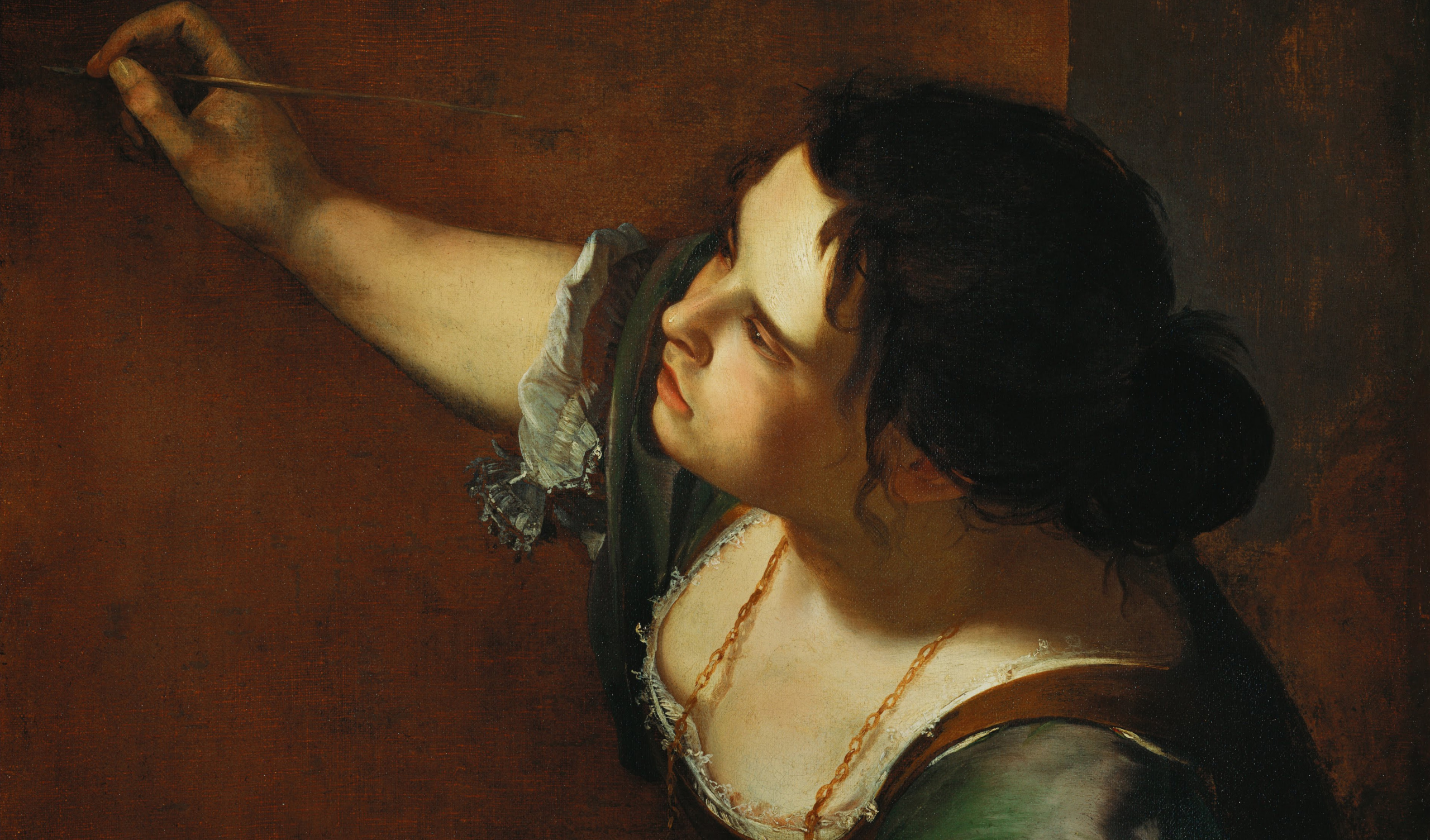
Her celebrated Self-Portrait as the Allegory of Painting is generally associated with this period. In the work, Artemisia presents herself actively painting, her body leaning forward and her arm raised toward an unseen canvas.
The composition draws upon the traditional personification of Painting as a woman. Because Artemisia was both a woman and a painter, she could embody the allegory in a way unavailable to male artists. The result is simultaneously a self-portrait, a statement of professional identity and an assertion of painting as an intellectual and creative art.
Following Orazio’s death in 1639, Artemisia returned to Naples. Documents establish that she was still active in the 1650s, but the exact date and circumstances of her death remain uncertain. She is generally believed to have died in Naples in 1654 or sometime afterward.
Father and Daughter: Similarities and Differences
Orazio and Artemisia shared a foundation in Caravaggesque naturalism, but their mature paintings are readily distinguishable.
Orazio favored measured compositions, harmonious color and polished surfaces. His figures often inhabit quiet spaces in which light reveals the delicate texture of skin, cloth and hair. Even his dramatic subjects can possess an atmosphere of contemplation.
Artemisia used many of the same technical resources to create greater urgency. Her figures twist, struggle, whisper, recoil or make decisive choices. She repeatedly explored stories involving threatened, courageous or intellectually resourceful women, including Susanna, Judith, Esther, Lucretia, Cleopatra and Mary Magdalene.
These differences should not be simplified into a contrast between a gentle father and an angry daughter. Orazio could produce powerful drama, while Artemisia could paint tender motherhood, elegant portraiture and spiritual reflection. Their careers reveal two independent responses to the same Roman artistic revolution.
Where to See Their Paintings in Italy
Florence
The Uffizi Gallery displays Artemisia’s monumental Judith Beheading Holofernes. The Palatine Gallery in Palazzo Pitti preserves her richly dressed Saint Mary Magdalene.
Visitors can reserve Palazzo Pitti tickets through Weekend in Italy. Those planning an art-centered visit may also want to explore ItaliaMia’s guide to Italy’s greatest art cities.
Rome
The Galleria Spada contains an especially valuable group of Gentileschi paintings. Orazio’s David with the Head of Goliath is displayed alongside Artemisia’s Madonna and Child and Saint Cecilia Playing the Lute.
This grouping allows visitors to compare their approaches directly: Orazio’s monumental classicism and landscape setting contrast with Artemisia’s intimate human observation and vivid characterization.
Naples
The Museo e Real Bosco di Capodimonte holds Artemisia’s earlier Judith Beheading Holofernes and other important examples of seventeenth-century painting. Several Neapolitan churches also contain altarpieces connected with her long residence in the city.
Important Works by Orazio Gentileschi
- David with the Head of Goliath
- The Lute Player
- Saint Francis Supported by an Angel
- Danaë
- Lot and His Daughters
- The Annunciation
- The Finding of Moses
- Rest on the Flight into Egypt
Important Works by Artemisia Gentileschi
- Susanna and the Elders
- Judith Beheading Holofernes
- Judith and Her Maidservant
- Self-Portrait as Saint Catherine of Alexandria
- Self-Portrait as the Allegory of Painting
- Esther Before Ahasuerus
- Lucretia
- Saint Mary Magdalene
- Jael and Sisera
- The Annunciation
Reputation and Rediscovery
Orazio enjoyed considerable international prestige during his lifetime, particularly during his later court career. Artemisia was also successful, but her reputation declined after her death as art history increasingly marginalized women artists.
Interest in her work revived during the twentieth century. Feminist scholars played an essential role in recovering her biography and reconstructing her catalogue. More recent research has broadened the discussion by examining her workshop, patrons, letters, business practices, collaborations and changing style.
Attribution remains an active field of study. Paintings produced within workshops, repeated compositions and collaborations with other artists can make authorship difficult to determine. As scholarship and conservation techniques advance, works continue to be reassessed.
Artemisia is now recognized as one of the leading painters of seventeenth-century Europe—not simply as the most famous woman influenced by Caravaggio. Orazio, meanwhile, is admired as one of the most original and technically refined interpreters of Caravaggio’s revolution.
Readers can find both painters within ItaliaMia’s overview of famous Italian artists and its broader introduction to Italian art and artists.
Recommended Books
The Metropolitan Museum of Art’s exhibition catalogue Orazio and Artemisia Gentileschi provides a substantial scholarly study of both painters and their relationship to Baroque culture.
Find books about Orazio and Artemisia Gentileschi on Amazon.com
For a study centered on Artemisia’s career, paintings and historical significance:
Find Artemisia Gentileschi books on Amazon.com
As an Amazon Associate, ItaliaMia may earn from qualifying purchases. ItaliaMia may also receive a commission from eligible Weekend in Italy reservations, without increasing the customer’s price.
The Gentileschi Legacy
Orazio and Artemisia Gentileschi should be understood together without allowing one career to become merely a footnote to the other.
Orazio transformed Caravaggio’s realism into an elegant, luminous style suited to aristocratic and royal patrons across Europe. Artemisia absorbed lessons from both men but developed an independent visual language distinguished by narrative intelligence, dramatic concentration and an exceptional understanding of human resolve.
Their paintings connect Rome, Florence, Genoa, Naples, Paris and London. They also reveal how artistic ideas traveled through workshops, courts, family relationships and international systems of patronage.
Artemisia’s life remains an extraordinary story of perseverance, but her lasting importance rests on the paintings themselves. Orazio’s career deserves equal care: he was not simply Artemisia’s teacher, but one of the most distinctive painters of the Italian Baroque.
External Sources
Artemisia Gentileschi — National Gallery, London
Orazio Gentileschi — National Gallery, London
Orazio and Artemisia Gentileschi — Metropolitan Museum of Art
Judith Beheading Holofernes — Uffizi Galleries
Saint Mary Magdalene — Uffizi Galleries and Palazzo Pitti
Gentileschi Collection — Galleria Spada, Rome
Self-Portrait as the Allegory of Painting — Royal Collection Trust


