

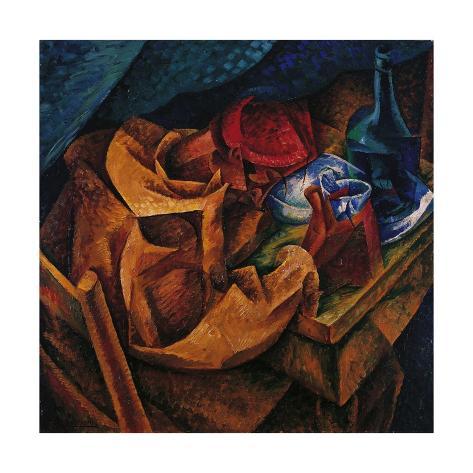
Umberto Boccioni was the most forceful visual artist and theorist of Italian Futurism. During a career cut short at the age of thirty-three, he transformed the energy of modern cities, machines and moving bodies into paintings and sculptures that helped redefine European art.
Works such as The City Rises, States of Mind, Materia and Unique Forms of Continuity in Space do not simply illustrate movement. They attempt to dissolve the boundaries between an object, its surroundings and the person observing it. Boccioni wanted art to communicate the sensation of living in a rapidly changing industrial world.
His achievement becomes even more remarkable when we remember that his mature Futurist period lasted barely six years.
Early Life and Artistic Training
Umberto Boccioni was born on October 19, 1882, in Reggio Calabria. His father worked for the Italian government, and the family moved frequently during Boccioni’s childhood. He spent important formative years in Forlì, Genoa, Padua and Catania, where he completed his technical education and began contributing drawings to local publications.
In 1899, Boccioni moved to Rome to pursue an artistic career. He initially studied with Giovanni Maria Mataloni, an illustrator and designer known for advertising posters. This early experience in commercial art encouraged the strong compositions and bold visual effects that would later distinguish Boccioni’s paintings.
Around 1902, he entered the studio of Giacomo Balla, where he met Gino Severini. Balla introduced the two young artists to Divisionism, an approach in which separate strokes of color were placed beside one another so that they appeared to blend in the viewer’s eye.
Boccioni never became a conventional Divisionist. Nevertheless, the technique taught him to use color and light as active forces rather than merely descriptive elements. Its influence remains visible in his early portraits, landscapes and urban scenes.
Paris, Venice and the Discovery of the Modern City
Boccioni traveled to Paris in 1906. The French capital exposed him to an international avant-garde and to a metropolitan environment very different from the historical atmosphere of Rome.
He subsequently traveled through Russia and Central Europe before settling temporarily in Venice, where he studied printmaking. His etchings and drawings from this period frequently portray friends, neighbors and members of his family.
One of his most persistent subjects was his mother, Cecilia Forlani. Her figure appears repeatedly throughout his career, from intimate early portraits to experimental Futurist works such as Materia and the sculptural portrait known as Antigraceful.
In August 1907, Boccioni moved to Milan. The city’s construction sites, electric lights, factories, trams and expanding suburbs provided the environment he needed. Milan was becoming one of Italy’s principal industrial centers, and its transformation gave Boccioni both a subject and a visual language.
The modern city was not simply a setting in his art. It became a living organism composed of buildings, workers, crowds, animals, vehicles, noise and light.
Readers interested in the wider development of Italian modernism can also consult ItaliaMia’s guide to Italian art movements and periods.
Boccioni and the Birth of Futurism
The Futurist movement was launched publicly by the poet Filippo Tommaso Marinetti, whose founding manifesto appeared in the Paris newspaper Le Figaro in February 1909. It called for a rejection of cultural complacency and celebrated speed, technology, danger, youth and the energy of modern life.
Boccioni soon became one of the movement’s principal visual artists. In 1910, he joined Carlo Carrà and Luigi Russolo in drafting the Manifesto of the Futurist Painters. Giacomo Balla and Gino Severini also signed the document.
The group followed it with the Technical Manifesto of Futurist Painting, which attempted to explain how Futurist ideas could be expressed visually. The artists wanted to move beyond static representations and communicate continuous change.
Boccioni’s role was especially important because he combined artistic experimentation with theoretical ambition. He did not merely paint in a new style; he tried to define why modern life required an entirely new kind of art.
The City Rises
Completed in 1910 and originally titled Lavoro, or Labor, The City Rises was Boccioni’s first major Futurist painting.
The large canvas depicts workers attempting to control powerful horses within a turbulent urban construction site. Buildings and industrial structures appear in the background, but the painting’s real subject is collective energy.
Bodies, animals, light and space are drawn into a swirling composition. The horse at the center seems to pull the workers and the surrounding city into its movement. Bright reds, blues and yellows intensify the sensation of heat, noise and physical struggle.
Although Futurism is often associated with automobiles and machinery, Boccioni chose a horse to embody the force of modernization. The result is a modern history painting in which anonymous laborers replace the military commanders, rulers and saints of traditional monumental art.
Today, The City Rises belongs to the Museum of Modern Art in New York.
States of Mind
The 1911 triptych States of Mind demonstrates Boccioni’s growing interest in the psychological experience of movement. Its three parts—The Farewells, Those Who Go and Those Who Stay—evoke the emotional atmosphere of a railway station.
Rather than depicting a single, easily understood event, Boccioni combined fragments of people, trains, steam, railway structures and repeated lines. The paintings communicate separation, anxiety and loneliness as much as physical movement.
Boccioni created two versions of the triptych. In the second, now at MoMA, the influence of Cubism is more apparent. Figures and objects are broken into intersecting planes, while numbers and other details resemble elements of Cubist collage.
However, Boccioni did not simply imitate Pablo Picasso or Georges Braque. Cubism often examined an object from multiple viewpoints, whereas Boccioni used fractured planes and “force-lines” to suggest duration, emotion and motion through space.
The Influence of Cubism
Boccioni encountered important Cubist works during a visit to Paris in late 1911. The experience helped him move beyond the luminous brushwork of Divisionism.
Cubism offered a way to break solid forms apart, but Boccioni objected to what he regarded as its stillness. He wanted to put fragmented forms back into motion and connect them to their surroundings.
In paintings such as Elasticity, the horse and rider seem to merge with pylons, buildings and the landscape. The spectator is no longer positioned safely outside the scene but is visually pulled into it.
This relationship between subject and environment became central to Boccioni’s concept of “plastic dynamism.” An object could no longer be treated as an isolated form. It had to be represented together with the forces acting upon it.
Materia: Portrait and Metropolis
Painted in 1912, Materia is one of Boccioni’s most complex works. It depicts his mother seated on a balcony, with her enormous interlocked hands occupying the center of the composition.
The portrait, balcony railing, neighboring buildings and light from the street are fused into a network of intersecting planes. Interior and exterior space overlap, while the sitter appears both monumental and transparent.
The title is deliberately suggestive. In Italian, materia means matter, but it also contains the word mater, or mother. The painting therefore unites a personal portrait with Boccioni’s investigation of physical substance and space.
The mother’s body is not separated from Milan. She and the city seem to penetrate one another, turning a domestic portrait into a powerful statement about modern perception.
Boccioni’s Revolution in Sculpture
Boccioni began concentrating intensely on sculpture in 1912. In April of that year, he published the Technical Manifesto of Futurist Sculpture.
He rejected the idea that sculpture should consist of a self-contained figure surrounded by empty space. Instead, he proposed opening the figure and allowing its environment to enter it.
Boccioni experimented with glass, wood, iron, cardboard, hair and other unconventional materials. Many of these mixed-media sculptures were later destroyed, making it difficult to appreciate the full radicalism of his sculptural work.
The surviving sculptures nevertheless demonstrate how dramatically he challenged academic traditions.
Development of a Bottle in Space
In Development of a Bottle in Space, Boccioni transformed an ordinary bottle, plate and tabletop into a spiraling arrangement of volumes.
The sculpture does not merely show an object from several angles. Its interior and exterior surfaces appear to unfold into the surrounding space. The bottle remains recognizable, but its form has been opened and reconstructed as a continuous movement.
By choosing a familiar household object, Boccioni demonstrated that dynamism did not depend exclusively on fast-moving subjects. Even an apparently motionless bottle possessed an internal energy that sculpture could reveal.
The Metropolitan Museum of Art’s collection page provides photographs and additional information about the work.
Unique Forms of Continuity in Space
Created in plaster in 1913, Unique Forms of Continuity in Space became Boccioni’s best-known sculpture and one of the defining images of twentieth-century modernism.
The work represents a striding human figure, but its anatomy has been reshaped by movement. The legs expand into sweeping aerodynamic forms, while the body seems to be modeled by wind, pressure and speed.
Boccioni did not show several successive positions, as other Futurists sometimes did. He compressed the complete experience of walking into a single continuous form. Figure, atmosphere and movement become inseparable.
The sculpture was originally made in plaster. The familiar bronze versions were cast after Boccioni’s death. Examples are held by several museums, including MoMA, the Metropolitan Museum of Art and Milan’s Museo del Novecento.
Its importance in Italian culture is reflected in its appearance on the Italian twenty-cent euro coin. The sculpture has become a national symbol of innovation, even though Boccioni created it in deliberate opposition to traditional monuments.
A decorative reproduction of Unique Forms of Continuity in Space is available on Amazon.com. Purchases made through this link may earn ItaliaMia a commission at no additional cost to the buyer.
Other Important Works
Riot in the Gallery
Painted in 1910, Riot in the Gallery turns a nighttime disturbance beneath electric lights into a concentrated explosion of color. The work shows Boccioni beginning to transform Divisionist technique into an urban language of agitation and collective movement.
The Laugh
In The Laugh, figures gathered in a modern interior dissolve into fractured colors and shifting planes. Rather than offering a conventional society scene, Boccioni creates an unstable environment shaped by sound, light and social energy.
Elasticity
The horse and rider in Elasticity merge with the surrounding landscape and industrial structures. The work demonstrates how Boccioni adapted Cubist fragmentation to express motion rather than stillness.
Dynamism of a Soccer Player
Created in 1913, Dynamism of a Soccer Player pushes the human figure toward abstraction. The player is almost lost within overlapping arcs, sharp angles and brilliant colors that convey athletic force.
A framed reproduction of Dynamism of a Cyclist can be found on Amazon.com. ItaliaMia may receive a commission from qualifying purchases.
For additional Futurist wall art, visit ItaliaMia’s collection of Futurism prints and posters.
Antigraceful
This sculptural portrait of Boccioni’s mother deliberately rejects conventional elegance. The head is modeled as an irregular, expanding structure, challenging expectations about portraiture, beauty and finished form.
Dynamism of a Speeding Horse + Houses
This mixed-media construction combines a horse with architectural elements. Its painted wood, metal and cardboard components provide a rare indication of how experimental Boccioni’s now-lost assemblages must have been.
Boccioni, War and Political Contradictions
Like several Futurists, Boccioni supported Italian intervention in the First World War. The movement had long glorified conflict as a force capable of sweeping away the past. Such rhetoric remains one of Futurism’s most troubling characteristics.
In 1915, Boccioni volunteered for the Italian Army’s Lombard Battalion of Volunteer Cyclists and Motorists, together with other Futurists. The experience of military service was far removed from the movement’s romanticized vision of war.
After the unit was dissolved, Boccioni briefly returned to painting. His late works suggest a renewed interest in Paul Cézanne and in more solidly constructed forms. Whether this represented a permanent rejection of Futurism or another stage in its development cannot be known.
It is also important not to place Boccioni directly within Italian Fascism, which had not yet come to power during his lifetime. Later Futurists formed relationships with Fascism, but Boccioni died years before Mussolini’s March on Rome.
His Accidental Death
Boccioni returned to military duty in 1916 and was assigned to an artillery regiment near Verona.
During a cavalry exercise on August 16, his horse was reportedly startled and threw him to the ground. Boccioni suffered severe injuries and died the following day, August 17, 1916, in Sorte near Verona. He was thirty-three years old.
His death deprived Futurism of its most significant visual theorist at a crucial moment. The original movement continued, but no other participant combined painting, sculpture and theory with quite the same intensity.
Where to See Boccioni’s Art
Museo del Novecento, Milan
The Museo del Novecento is the most important destination in Italy for understanding Boccioni and the wider Futurist movement. Its collections include Unique Forms of Continuity in Space, Elasticity and the first version of States of Mind.
The museum stands beside Milan Cathedral, making it easy to include in an art-focused visit to the city. Before traveling, consult the museum’s current displays because individual works may occasionally be moved or loaned.
You can compare accommodation near the museum and Milan’s historic center through Trip.com.
Pinacoteca di Brera, Milan
The Pinacoteca di Brera owns Riot in the Gallery, an important transitional work connecting Boccioni’s Divisionist background with his developing Futurist style.
Peggy Guggenheim Collection, Venice
The Peggy Guggenheim Collection holds important works associated with Italian Futurism, including Boccioni’s remarkable mixed-media sculpture Dynamism of a Speeding Horse + Houses.
Museum of Modern Art, New York
MoMA owns The City Rises, the second version of States of Mind, Dynamism of a Soccer Player and important Boccioni sculptures and studies.
Metropolitan Museum of Art, New York
The Met holds the largest collection of Boccioni’s paintings, sculptures and works on paper outside Italy. Its collection is especially valuable for tracing his development from early drawings to mature Futurism.
Museum displays change, so visitors should always check the relevant collection page before planning a trip around a particular artwork.
For a broader itinerary, see ItaliaMia’s guide to where to see Italy’s greatest artworks.
Boccioni’s Legacy
Boccioni’s influence extends far beyond the original Futurist movement. His attempt to merge figures with their surroundings anticipated later developments in abstract sculpture, kinetic art and representations of speed in graphic design, photography and cinema.
His paintings changed the way motion could be communicated on a stationary surface. His sculptures questioned the traditional boundary between an object and the space around it. His writings insisted that an artist must respond to the conditions of the present rather than repeat inherited formulas.
At the same time, a responsible assessment of Boccioni must acknowledge the aggressive nationalism and glorification of war associated with early Futurism. The movement’s political rhetoric cannot be separated entirely from its artistic ambitions.
Boccioni’s art survives this contradiction because it communicates more than an ideology. It expresses the excitement, anxiety, instability and sensory overload of modern existence. Cities, technologies and patterns of movement have changed since his lifetime, but the experience of being transformed by them remains strikingly familiar.
To place Boccioni within the wider story of the country’s creativity, continue with ItaliaMia’s overview of Italian art and artists and its collection of famous Italian artists.
Frequently Asked Questions
What was Umberto Boccioni famous for?
Boccioni was a leading painter, sculptor and theorist of Italian Futurism. He is best known for The City Rises and the sculpture Unique Forms of Continuity in Space.
What did Boccioni mean by dynamism?
For Boccioni, dynamism was more than visible physical movement. It described the interaction between an object, its internal energy, its environment and the forces acting upon it.
Was Boccioni influenced by Cubism?
Yes. His encounter with Cubist art in Paris influenced his use of fragmented planes and multiple viewpoints. However, he adapted those techniques to express movement, emotion and continuity rather than static analysis.
Why are Boccioni’s sculptures dated 1913 but cast later?
Boccioni created many of his original sculptures in plaster or mixed media. Several familiar bronze versions were produced after his death from surviving plaster models.
Where is Unique Forms of Continuity in Space?
Bronze casts are held by several institutions, including Milan’s Museo del Novecento, the Museum of Modern Art and the Metropolitan Museum of Art. The work also appears on Italy’s twenty-cent euro coin.
External Sources
- The Metropolitan Museum of Art — Umberto Boccioni biography and career
- Museum of Modern Art — Umberto Boccioni collection
- MoMA — Unique Forms of Continuity in Space
- The Metropolitan Museum of Art — Development of a Bottle in Space
- Museo del Novecento — Futurism collection
- Peggy Guggenheim Collection — Online collection
- Pinacoteca di Brera — Official museum website