

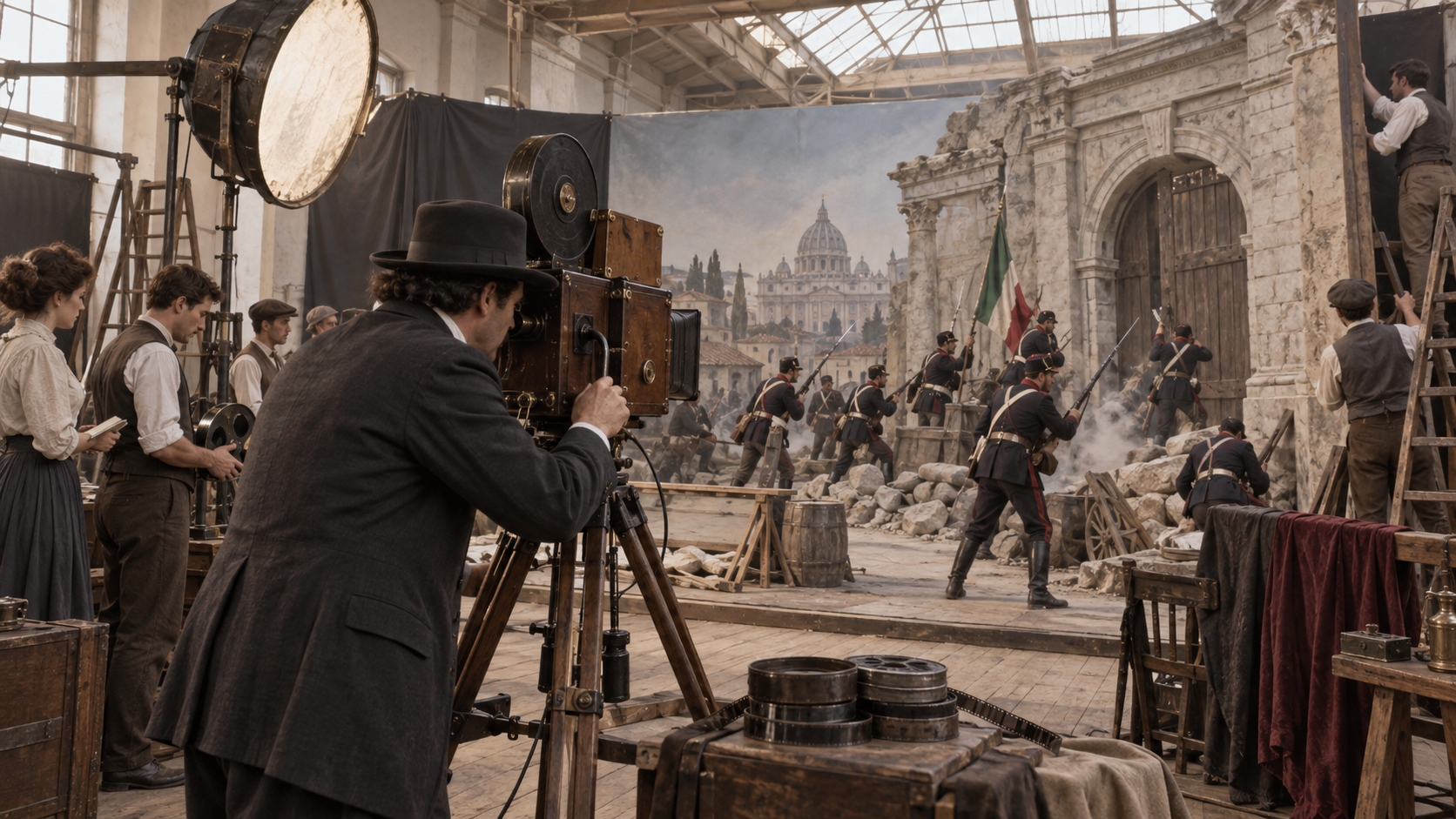
 The Italian film industry did not begin with a single director, invention or screening. It emerged gradually during the final years of the nineteenth century, when inventors, photographers, projectionists and entrepreneurs began experimenting with moving images.
Some imported the technology developed by the Lumière brothers. Others constructed their own cameras, recorded brief scenes of Italian life or transformed existing theaters into places where the public could watch films.
By 1905, these scattered experiments were becoming an organized industry. Production companies opened studios, filmmakers moved from documentary “views” to fictional stories, and Italian cinema began developing the historical spectacles that would soon make it internationally famous.
The period between 1895 and 1909 therefore represents more than a list of disputed “firsts.” It marks the transformation of cinema in Italy from a technological curiosity into a new form of popular culture and commercial entertainment.
Before the Italian Film Industry
Cinema reached Italy within months of the Lumière brothers’ celebrated public screening in Paris on December 28, 1895.
Italy, however, was not simply waiting for a foreign invention. Italian photographers and technicians were already interested in devices capable of recording and projecting movement.
One of the most important was Filoteo Alberini, a former military cartographer and inventor. Alberini developed an apparatus that could record, print and project moving images. He patented it in 1895 under the name kinetografo Alberini.
The patent makes Alberini an important Italian cinema pioneer, but it does not establish him as the sole inventor of cinema in Italy. Early motion-picture technology developed almost simultaneously in several countries, and Alberini’s machine did not create the commercial network that the Lumière cinematograph quickly achieved.
Italian cinema should therefore be understood as the result of several overlapping experiments rather than the invention of one person.
The First Public Film Screenings in Italy
Lumière representatives began presenting the cinematograph in Italian cities in 1896.
According to the chronology reported by Treccani, Lumière screenings began in Rome on March 12, 1896. Presentations followed in Milan on March 29, Naples on March 30, Genoa on May 30, Venice in July and Bologna in August.
These early programs were not shown in purpose-built movie theaters. Films appeared in photographic clubs, music halls, theaters, cafés, fairgrounds and other entertainment venues.
The films themselves were usually extremely short. Known at the time as vedute, or “views,” they showed trains, streets, ceremonies, crowds, military exercises, members of the royal family and other fragments of contemporary life.
For audiences who had never seen photographed movement projected on a screen, an ordinary scene could be astonishing. Cinema’s attraction initially came less from storytelling than from the apparent miracle of capturing life and replaying it.
Who Was Italy’s First Filmmaker?
The frequently repeated question “Who was the first Italian filmmaker?” has no completely satisfactory single answer.
Several pioneers performed different roles during the same formative period.
Vittorio Calcina was a photographer and an Italian representative of the Lumière company. He helped organize screenings and filmed members of the Italian royal family and other public events.
Italo Pacchioni, a photographer from Milan, constructed his own motion-picture apparatus and made some of Italy’s earliest independently produced films. His surviving and documented work includes brief staged comic scenes as well as actuality footage.
Filoteo Alberini invented and patented a motion-picture system, became a producer and directed the film most closely associated with the beginning of organized Italian production.
Giuseppe Filippi, another Lumière operator, participated in some of Italy’s earliest screenings and recorded scenes in different Italian cities.
Rather than awarding an absolute title to one individual, it is more accurate to describe Calcina, Pacchioni, Alberini and Filippi as pioneers whose activities helped introduce filming, projection and production to Italy.
Correcting the Story of Pope Leo XIII
For many years, histories of early Italian cinema stated that Vittorio Calcina filmed Pope Leo XIII in the Vatican Gardens in 1896. The surviving footage was consequently presented as one of the earliest Italian films and sometimes as the oldest surviving Italian production.
Archival research has overturned that attribution.
Research presented at the Vatican Film Library in 2023 identified the cameraman as William Kennedy Laurie Dickson, the British-born American motion-picture pioneer who worked with the American Mutoscope and Biograph Company. The filming took place in 1898, not 1896.
Dickson recorded several views of Leo XIII, including the pontiff seated in the Vatican Gardens, arriving by carriage and blessing the camera.
The footage remains historically extraordinary because it records the first pope to appear in motion pictures. However, it should no longer be used as evidence that Calcina was Italy’s first director or that the sequence was an Italian-produced film from 1896.
The correction is also a useful reminder that early cinema history remains an active area of research. Film prints were lost, catalogues were incomplete and surviving material was sometimes given the wrong date or attribution.
Filoteo Alberini and the Move Toward Production
Alberini’s decisive contribution came when Italian cinema began moving beyond isolated experiments.
In 1905, Alberini and businessman Dante Santoni founded the Alberini & Santoni production company in Rome. The company established a studio and began manufacturing films systematically rather than treating them as occasional photographic experiments.
In 1906, the business was reorganized as Cines, which became one of the most important companies in the history of early Italian cinema.
Alberini’s role is therefore best described precisely: he was a pioneering inventor, director and producer who helped establish Italy’s first organized film-manufacturing enterprise.
That description is more defensible than calling him, without qualification, Italy’s first filmmaker.
La presa di Roma and the Birth of an Industry
The foundational production of Alberini & Santoni was La presa di Roma, known in English as The Capture of Rome.
Directed by Alberini in 1905, the film reconstructed the Italian army’s capture of Rome in September 1870. That event ended papal rule over the city and completed a decisive stage in Italian unification.
The original film was approximately 250 meters long and divided into seven scenes. Only part of it survives.
Its episodes included negotiations between the Italian and papal forces, the bombardment of the Aurelian Walls, the breach at Porta Pia and the entry of the Bersaglieri into Rome. The production combined studio sets, exterior photography, actors and numerous military participants.
A documented public screening took place in Livorno on September 16, 1905. A highly symbolic presentation followed near Porta Pia in Rome on September 20, the thirty-fifth anniversary of the event portrayed.
La presa di Roma was not the first moving image photographed in Italy. It is more accurately described as Italy’s first major industrially produced fiction film, its first important historical reconstruction and the work that announced the beginning of an organized national film industry.
Its subject also established a pattern that would become central to early Italian cinema. Producers recognized that Roman history, the Risorgimento, classical literature and spectacular recreations of the past could distinguish Italian films in the growing international market.
From Traveling Attraction to Film Industry
During cinema’s first years, exhibitors frequently traveled from town to town with projectors and collections of short films. A program might combine foreign and Italian views with live music, theatrical performances or variety acts.
This system gradually changed as permanent exhibition venues appeared and audiences began expecting regular programs.
Production also became more structured. Companies needed studios, cameras, laboratories, sets, costumes, performers, technicians, distributors and reliable access to cinemas. Film was becoming a business that required substantial investment and organization.
Rome was important, particularly through Alberini & Santoni and its successor Cines, but the early industry was not concentrated in the capital.
Turin became one of Europe’s most energetic production centers. Arturo Ambrosio moved from photographic work into filmmaking, while companies such as Ambrosio Film, Itala Film and Aquila Film helped turn the city into an international center of silent cinema.
Milan supported filmmakers and companies including Luca Comerio, who became known for documentaries, news films and technically ambitious productions.
Naples developed its own distinctive cinema culture. Producers drew upon the city’s theater, popular music and intensely local stories. Elvira Notari, working with Nicola Notari and their company Dora Film, would become one of the most important filmmakers to emerge from this environment.
Venice and other cities also participated in production and exhibition. This decentralized development was one of the defining characteristics of early Italian cinema.
The Growth of Fiction Films
The earliest programs were dominated by brief records of reality, but filmmakers soon recognized the commercial appeal of staged stories.
Historical subjects were particularly attractive. They gave producers opportunities to use recognizable monuments, elaborate costumes, military action and stories already familiar from schoolbooks, popular novels and national history.
Comedies also became essential. Short comic films required fewer resources than historical spectacles and could be understood by audiences without spoken dialogue. Physical humor crossed linguistic borders easily, making these films suitable for international distribution.
Melodramas, literary adaptations, religious stories and reconstructions of current events expanded the industry’s repertoire.
By the end of the decade, films were growing longer and more narratively complex. Actors were becoming recognizable screen personalities, directors were developing more sophisticated staging techniques, and production companies were learning how to sell films outside Italy.
This development prepared the way for the spectacular expansion examined in Italian Cinema’s Golden Age, 1910–1914.
Italy’s Early Cinemas and the Problem of the “Oldest” Theater
Claims about Italy’s oldest cinema require careful wording because different venues qualify under different definitions.
Genoa’s Sala Sivori hosted a Lumière presentation on May 30, 1896, making it one of Italy’s earliest surviving venues associated with film exhibition. However, it had originally opened as a concert hall rather than as a purpose-built cinema.
Film screenings were held at Pisa’s Caffè dell’Ussero from 1899. A dedicated cinema opened in the adjoining complex in 1905 and became known as the Cinema Lumière. The historic space later ceased operating solely as a conventional movie theater and has also been used for concerts and cultural events.
Rome’s Cinema Moderno, opened in 1904, is frequently identified as one of Italy’s first purpose-built cinemas.
For these reasons, stating that one particular venue is unquestionably “Italy’s oldest operating cinema” can be misleading. It is better to explain whether a claim refers to the earliest film screening, the oldest surviving building, the first purpose-built cinema or the longest period of continuous operation.
The 1906 Sound Experiment in Pisa
Another often-repeated claim concerns a presentation made by Professor Pietro Pierini at Pisa’s Cinema Lumière on October 19, 1906.
Pierini developed a system intended to synchronize projected film with recorded sound. The demonstration was an important early experiment in combining moving pictures and audio.
It was not, however, Italy’s first sound feature film in the modern sense. The system belonged to a wider international period of experimentation in which inventors attempted to coordinate phonographs or other sound devices with film projectors.
Sound reproduction, reliable synchronization, dialogue recording and commercial distribution were separate technical problems. Early demonstrations did not establish a sustainable sound-film industry.
The title conventionally recognized as the first Italian sound feature released to cinemas is Gennaro Righelli’s La canzone dell’amore, presented in Rome in October 1930.
Pierini’s 1906 achievement should therefore be described as an early Italian sound-synchronization experiment, not as the first Italian sound film.
By 1909, a National Cinema Had Emerged
By the end of the decade, Italy possessed the foundations of a genuine film industry.
Production companies were operating in several cities. Studios were creating fictional films in growing numbers. Permanent cinemas were becoming established, and Italian companies were developing distribution networks at home and abroad.
The industry had also begun to identify the qualities that would make Italian silent cinema internationally successful: historical spectacle, ambitious production design, expressive acting and stories drawn from Italy’s immense cultural inheritance.
The transition from short views to organized production happened quickly, but it did not occur through one film or one filmmaker. It was the combined result of inventors, photographers, exhibitors, technicians, actors and entrepreneurs working across the country.
To continue chronologically, visit the complete History of the Cinema of Italy or read about Italian Cinema’s Golden Age and the later birth of Futurist cinematography.
For a wider introduction covering the major periods, genres and directors, see ItaliaMia’s guide to Italian movies and the cinema of Italy.
Books About Italian Cinema
Readers interested in exploring the subject in greater depth can browse books about Italian cinema history on Amazon.com.
Availability, editions and prices may change, so check the individual book listing before ordering.
External Sources
Treccani: The Development of Early Cinema
Treccani: The History of Cinema Exhibition
Centro Sperimentale di Cinematografia: Italian Silent Cinema, 1905–1909
Vatican News: New Attribution of the First Film of Pope Leo XIII
Municipality of Pisa: Palazzo Agostini and Cinema Lumière
Metropolitan City of Genoa: The History of Sala Sivori
Treccani: Gennaro Righelli and Italy’s First Sound Film