

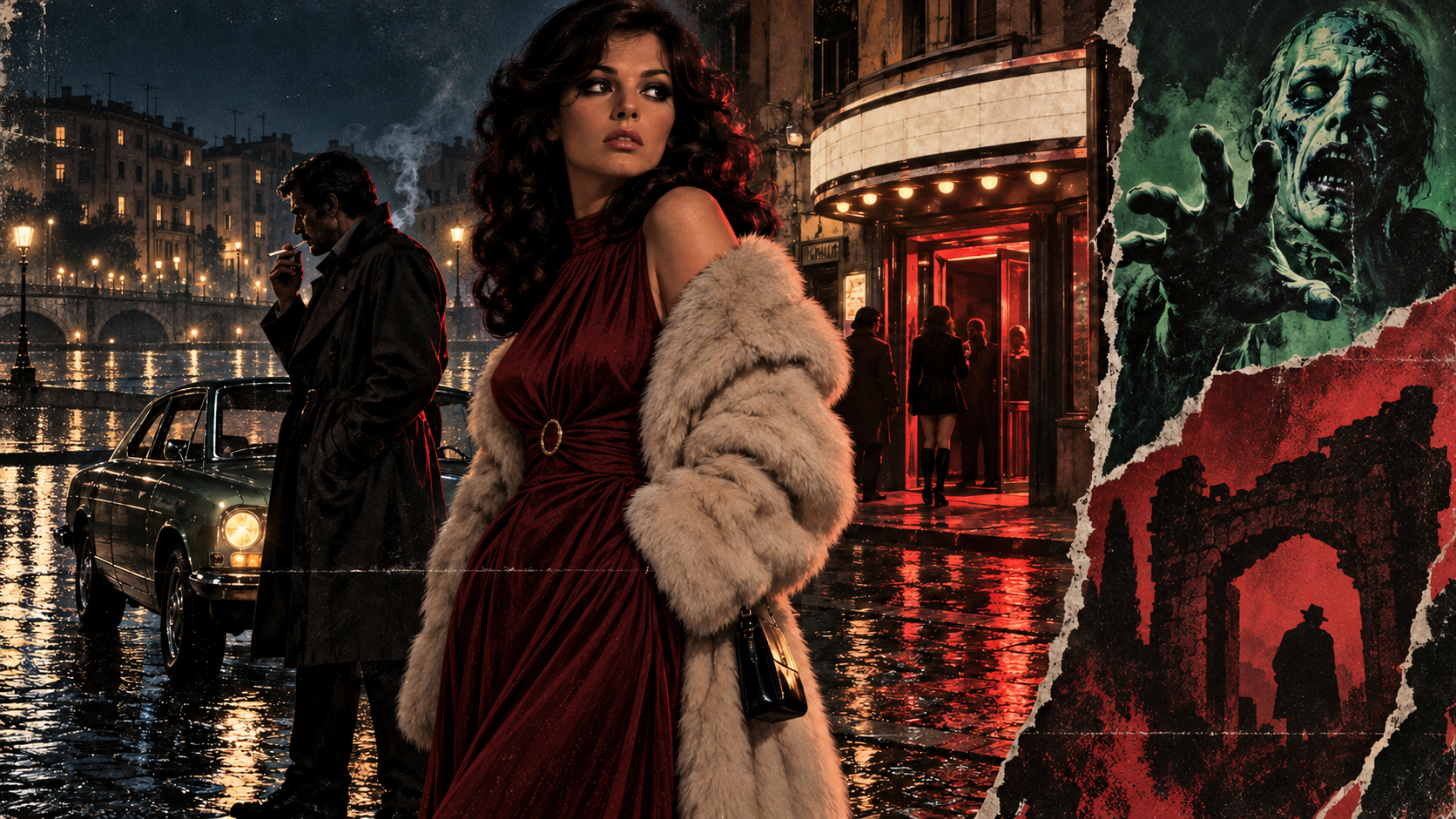
 Italian cinema is celebrated internationally for Neorealism, Federico Fellini and the great postwar auteurs. Yet another, very different industry flourished alongside prestigious productions: a fast-moving world of horror, crime thrillers, erotic comedies, zombie films, historical adventures and other popular genres.
Especially from the 1960s through the early 1980s, Italian producers became remarkably skilled at recognizing international trends and transforming them for new audiences. Films were frequently made as European co-productions, performed by multinational casts, dubbed into several languages and distributed abroad under alternative titles. Directors and actors often adopted English-sounding names to make the productions appear more international.
Some of these films were inexpensive imitations. Others transformed familiar formulas through striking cinematography, inventive practical effects, memorable music and distinctly Italian social anxieties. Many productions once dismissed as disposable entertainment have since attracted restorations, retrospectives and serious critical study.
The broad description “cult and exploitation cinema” is therefore more useful than the dismissive label “trash.”
What Does Exploitation Cinema Mean?
Exploitation cinema is not a single genre. The term describes films marketed around an immediately recognizable attraction: violence, sexuality, horror, scandal, crime, exotic locations or a currently fashionable subject.
Italian exploitation filmmakers worked in cycles. A successful western, police thriller or zombie film could quickly inspire numerous related productions. Posters, trailers and international titles often emphasized sensational elements more aggressively than the films themselves.
This commercial system could produce repetition, but it also encouraged experimentation. Filmmakers worked quickly, reused locations and adapted sets, yet sometimes achieved extraordinary results with limited resources. A director might move from comedy to westerns, from thrillers to horror and then to science fiction without treating those categories as separate artistic identities.
“Cult cinema,” by contrast, usually describes what happened later. Films acquired devoted audiences through repertory screenings, late-night television, VHS, DVD, Blu-ray and restoration programs. Cult status is a form of reception, not a genre or production method.
Why “Trash Cinema” Is the Wrong Description
“Trash” is sometimes used affectionately by fans, but it is too vague for a serious history of Italian film. It combines traditions that developed for different audiences and under very different cultural conditions.
A commedia sexy all’italiana starring Edwige Fenech, a politically charged crime film by Fernando Di Leo and a supernatural horror film by Lucio Fulci cannot be understood as examples of one genre. Their financing and marketing may have shared characteristics, but their subjects, styles and historical contexts were not interchangeable.
The term can also obscure craftsmanship. Italian genre productions employed accomplished cinematographers, editors, composers, stunt performers, set designers and special-effects artists. Even a derivative screenplay could become visually distinctive through the work of these professionals.
Italian Splatter, Zombies and Supernatural Horror
Splatter describes horror that makes physical destruction—blood, wounds, mutilation and bodily decay—a central visual attraction. It is not another name for all Italian horror, nor is it interchangeable with the giallo.
The giallo generally combines murder mystery, psychological thriller and stylized violence. Splatter places greater emphasis on graphic effects and the vulnerability of the human body. Gothic horror depends more heavily on atmosphere, supernatural menace and decaying environments. Individual films may combine these traditions, but the distinctions remain useful.
For a broader account of Mario Bava, Dario Argento, the giallo and Gothic horror, see our guide to Italian horror and thriller cinema.
Lucio Fulci became the central figure in Italian splatter through films such as Zombi 2—released internationally as Zombie Flesh Eaters—City of the Living Dead, The Beyond and The House by the Cemetery. Fulci used extreme effects, but his best horror films also possess dreamlike photography, disorienting narratives and an atmosphere of cosmic hopelessness.
Zombi 2 was marketed in Italy as a sequel to Zombi, the Italian release title for George A. Romero’s Dawn of the Dead, despite having no direct narrative connection. The title illustrates how Italian producers used familiar international successes as commercial starting points.
Other important figures included Joe D’Amato, whose unusually varied career encompassed horror, erotic cinema and adventure films; Umberto Lenzi, who moved among crime, thriller and horror cycles; and Lamberto Bava, whose Demons combined graphic horror, rock music and the self-referential setting of a cinema invaded by the monsters appearing on its screen.
These films were frequently censored or released in substantially different versions. Their international reputations were shaped not only by theatrical screenings but also by the “video nasty” controversy in Britain and the later circulation of uncut home-video editions.
Erotic Comedy and the Commedia Sexy all’Italiana
The commedia sexy all’italiana became one of the most commercially visible forms of Italian popular cinema during the 1970s and early 1980s. It combined sexual situations and partial nudity with farce, misunderstandings, regional stereotypes and slapstick comedy.
The cycle developed partly from changing censorship standards and from the enormous success of films built around attractive stars and familiar comic performers. Recurring settings included schools, hospitals, military barracks, provincial towns and crowded apartment buildings.
Edwige Fenech became the genre’s most internationally recognized star. Laura Antonelli, Gloria Guida, Barbara Bouchet, Nadia Cassini, Lando Buzzanca, Renzo Montagnani and Alvaro Vitali were also strongly associated with Italian erotic comedy, although several had substantial careers beyond it.
Films such as Salvatore Samperi’s Malizia offered more visual and psychological sophistication than the genre’s later formulaic productions. Sergio Martino, Mariano Laurenti, Nando Cicero and Michele Massimo Tarantini became prolific directors within the broader cycle.
Erotic comedy must not be confused with Commedia all’Italiana. The earlier movement used comedy to expose class conflict, political hypocrisy, economic transformation and the moral compromises of postwar Italy. The commedia sexy generally favored physical humor, voyeurism and easily repeated situations, although the two traditions occasionally overlapped.
Many erotic comedies now appear deeply dated. Women were frequently presented as objects of male desire, while harassment, adultery and unequal power relationships became sources of humor. A historical assessment should acknowledge the popularity and industrial importance of these films without overlooking their restrictive gender politics.
Poliziotteschi and the Violence of the 1970s
The poliziottesco was the Italian crime and police film that flourished during the 1970s. High-speed car chases, kidnappings, bank robberies, political corruption and violent confrontations gave these films their commercial energy.
Their popularity also reflected contemporary fears. Italy was experiencing terrorism, organized crime, political extremism, public disorder and distrust of state institutions during the period known as the Years of Lead.
Fernando Di Leo brought unusual depth to the criminal underworld in Milano calibro 9 and The Boss. Enzo G. Castellari delivered muscular action in High Crime and The Big Racket. Umberto Lenzi directed several hard-edged crime films with Tomas Milian, while Maurizio Merli became identified with the uncompromising police commissioner who ignores procedure to confront criminals directly.
Some poliziotteschi offered serious criticism of corruption and institutional failure. Others exploited public anxiety through vigilante fantasies and escalating violence. The cycle consequently occupies an ambiguous space between social commentary, action entertainment and political reaction.
It should also be distinguished from Italian political cinema by directors such as Francesco Rosi, Elio Petri and Damiano Damiani. Although crime films could address similar subjects, the poliziottesco normally placed greater emphasis on pursuit, confrontation and physical action.
Mondo Films and the Cannibal Cycle
The mondo film presented sensational documentary footage as a tour of strange, shocking or supposedly hidden behavior. Mondo Cane, directed by Gualtiero Jacopetti, Franco Prosperi and Paolo Cavara, became an international success in 1962 and inspired numerous imitations.
Mondo productions blurred observation, reconstruction and spectacle. Their claims to documentary truth were often questionable, and their treatment of non-European cultures could be patronizing or exploitative. Nevertheless, their editing, marketing and promise of forbidden sights influenced later shock documentaries and reality-based entertainment.
The Italian cannibal cycle pushed exploitation into still more controversial territory. Ruggero Deodato’s Cannibal Holocaust used recovered-footage techniques and a film-within-a-film structure to question media sensationalism, but its production included the real killing of animals. That fact remains inseparable from any responsible discussion of the film.
Umberto Lenzi’s Man from Deep River and Cannibal Ferox were also central to the cycle. These films combined jungle adventure, violence and fabricated ideas of cultural primitivism. Their technical influence and notoriety can be studied without ignoring their racism, animal cruelty and treatment of indigenous people as exotic threats.
Historical Adventures, Post-Apocalyptic Films and Imitation Cycles
Italian popular cinema had been responding to successful formulas long before the splatter era. The sword-and-sandal or peplum cycle filled screens with mythological heroes during the late 1950s and early 1960s. Eurospy adventures followed the international success of James Bond, while the Spaghetti Western reinvented the American frontier through European landscapes, morally ambiguous heroes and operatic violence.
During the 1980s, Italian producers turned toward post-apocalyptic action, barbarian adventures, futuristic gladiators, urban-war stories and underwater thrillers. Enzo G. Castellari’s 1990: The Bronx Warriors, Sergio Martino’s 2019: After the Fall of New York and Joe D’Amato’s Endgame openly borrowed from successful American films while creating their own rough, energetic visual worlds.
Imitation was part of the business model, but it did not eliminate creativity. Italian filmmakers frequently combined several sources, improvised around limited resources and introduced stylistic excess that made the resulting films very different from their inspirations.
Filmmakers Who Crossed Genre Boundaries
The mobility of directors is one of the defining characteristics of Italian popular cinema.
Lucio Fulci directed comedies, musicals, westerns, gialli and historical drama before becoming internationally identified with horror. Sergio Martino moved among gialli, erotic comedies, crime films, westerns and science fiction. Umberto Lenzi worked in adventure, war, crime, thriller and horror. Enzo G. Castellari directed westerns, police thrillers, war films and post-apocalyptic action.
Joe D’Amato—born Aristide Massaccesi—worked as a cinematographer and director across an even wider range of productions. Mario Bava began as a cinematographer and special-effects specialist, while Antonio Margheriti became known for achieving ambitious science-fiction, horror and adventure imagery on restricted budgets.
These careers reveal why rigid classifications can be misleading. Italian genre cinema was an interconnected production culture rather than a collection of isolated movements.
Essential Films for Understanding Italian Exploitation Cinema
Mondo Cane (1962), directed by Gualtiero Jacopetti, Franco Prosperi and Paolo Cavara — the international success that established the mondo cycle.
Malizia (1973), directed by Salvatore Samperi — an influential meeting of eroticism, comedy and family drama starring Laura Antonelli.
Milano calibro 9 (1972), directed by Fernando Di Leo — a bleak, tightly constructed example of Italian crime cinema.
High Crime (1973), directed by Enzo G. Castellari — fast, violent urban action that helped define the poliziottesco.
Zombi 2 (1979), directed by Lucio Fulci — the film that established Fulci as an international master of graphic horror.
Cannibal Holocaust (1980), directed by Ruggero Deodato — formally influential but ethically indefensible in its use of real animal killings.
Antropophagus (1980), directed by Joe D’Amato — a notorious example of low-budget Italian splatter.
The Beyond (1981), directed by Lucio Fulci — surreal, apocalyptic horror in which atmosphere becomes more important than conventional logic.
1990: The Bronx Warriors (1982), directed by Enzo G. Castellari — an energetic example of Italy’s post-apocalyptic action cycle.
Demons (1985), directed by Lamberto Bava — a self-aware combination of demonic horror, graphic effects and 1980s popular music.
Decline, Rediscovery and Cult Reputation
The traditional Italian genre-film industry weakened during the 1980s. Television changed domestic viewing habits, theatrical audiences declined and international distribution became more difficult. The production system that had supported continuous cycles of westerns, thrillers, comedies and horror films gradually disappeared.
Home video later gave many of these films a second life. Collectors searched for uncut versions, critics reconsidered neglected directors and specialist distributors restored films from surviving materials. Festivals and cinematheques began presenting Italian genre cinema as part of film history rather than merely as nostalgic entertainment.
The rediscovery has not transformed every production into a lost masterpiece. Italian exploitation cinema includes inspired filmmaking, routine imitation and work that remains ethically troubling. Its historical importance lies precisely in that complexity.
These films show how a commercially pressured industry reacted to censorship, changing sexual attitudes, political violence, international competition and the demands of global audiences. Studied on their own terms—and separated into their proper traditions—they form an essential chapter in the history of Italian cinema.
Books for Further Reading
Beyond Terror: The Films of Lucio Fulci by Stephen Thrower examines Fulci’s long career, including his horror films, thrillers, comedies and westerns.
Perverse Titillation: The Exploitation Cinema of Italy, Spain and France, 1960–1980 by Danny Shipka places Italian popular cinema within the wider European exploitation industry.
External Sources
British Film Institute: Italian Cinema
British Film Institute: Where to Begin with Dario Argento
International Film Festival Rotterdam: Italian Exploitation Movies
OpenEdition Journals: Exploiting Exploitation Cinema—An Introduction
The Guardian: The Gruesomely Elegant World of Lucio Fulci