
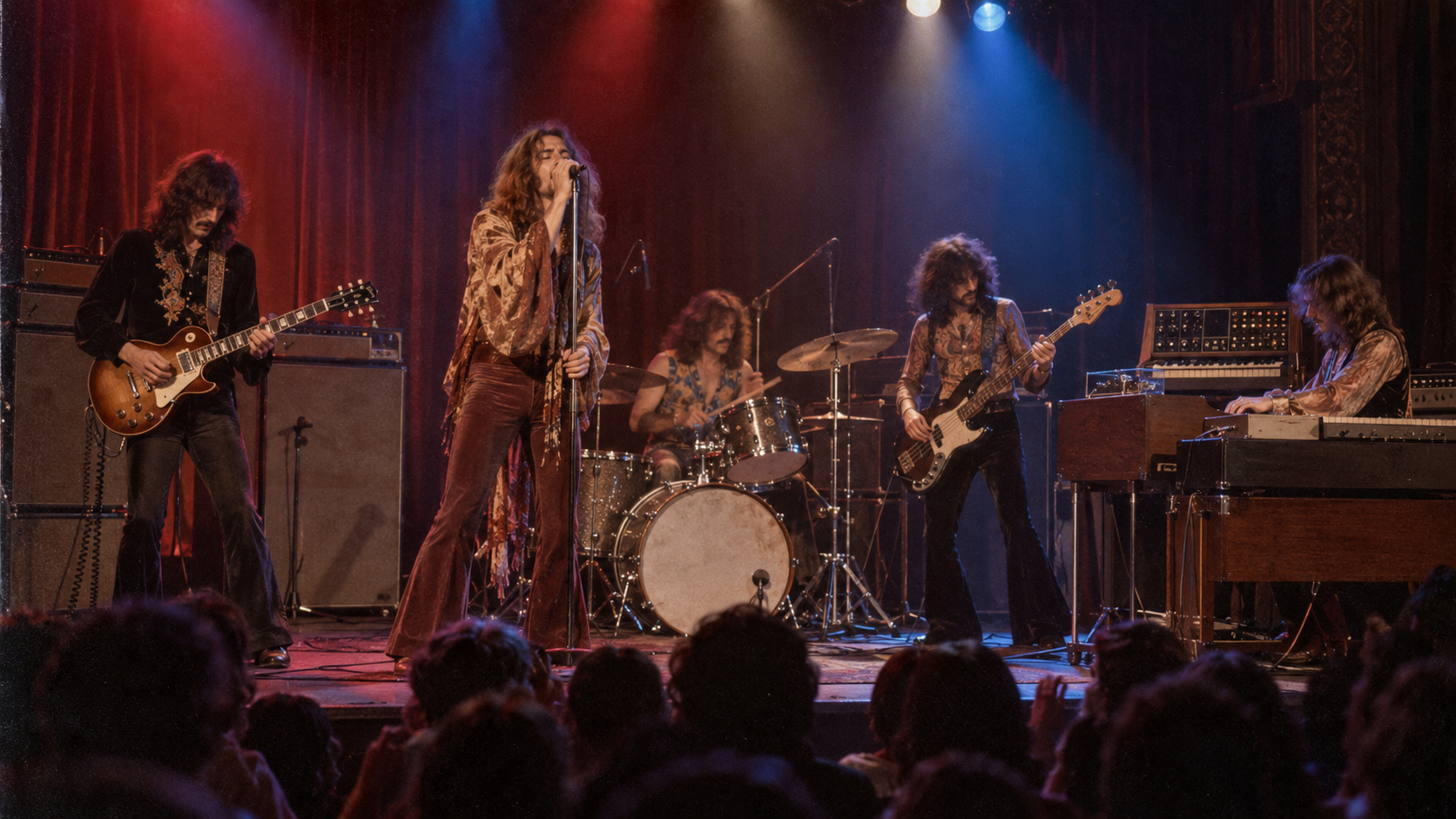
 Italian progressive rock is one of the most adventurous chapters in Italy’s modern musical history. Known internationally as Rock Progressivo Italiano, or RPI, the genre flourished during the early 1970s, when Italian musicians transformed the influence of British progressive rock into something unmistakably their own.
Bands such as Premiata Forneria Marconi, Banco del Mutuo Soccorso and Le Orme combined electric guitars, synthesizers and elaborate rhythms with Italian classical music, opera, jazz, folk traditions and theatrical storytelling. Other groups moved in more experimental directions, from the political jazz-rock of Area to the dark cinematic sound of Goblin.
The result was not simply an Italian imitation of Genesis, King Crimson, Emerson, Lake & Palmer or Yes. At its best, Italian progressive rock was more melodic, dramatic and rooted in local culture, with Italian-language lyrics and an emotional intensity that distinguished it from its British counterparts.
For a broader introduction to the country’s musical traditions, read our guide to Italian music.
What Makes Italian Progressive Rock Different?
Progressive rock rejected the idea that a song had to last three minutes or follow a simple verse-and-chorus structure. Compositions could occupy an entire side of an LP, change tempo repeatedly and move between gentle acoustic passages, heavy rock, jazz improvisation and symphonic climaxes.
Italian groups adopted these ideas but gave them a distinctive character. Common elements included:
- Prominent Hammond organ, piano, Mellotron and early synthesizers
- Flute, violin, saxophone and classical instruments
- Operatic or highly expressive vocals
- Lyrics inspired by philosophy, history, politics and literature
- Influences from Italian folk and Mediterranean music
- Elaborate album artwork and concept-album narratives
- Sudden transitions between delicate melodies and powerful rock passages
The Italian language itself contributed to the music’s identity. Its rhythm, open vowels and dramatic possibilities suited singers capable of moving from a whisper to an operatic declaration within the same composition.
The Rise of Rock Progressivo Italiano
Italian progressive rock grew out of the beat and psychedelic scenes of the late 1960s. Young musicians listened closely to British groups, but Italy also possessed a strong classical tradition, an influential avant-garde and a thriving culture of politically engaged songwriting.
By the beginning of the 1970s, Italian record labels were willing to release ambitious concept albums, while festivals provided emerging bands with large audiences. The LP became more than a collection of songs: it could function as a complete musical and visual work.
The most celebrated period lasted roughly from 1971 to 1976. Dozens of albums appeared during those years, including several one-off releases that later became highly prized by collectors. Although only a few bands achieved lasting commercial success, the depth and variety of the Italian scene were extraordinary.
PFM: Italy’s Most International Progressive Rock Band
Premiata Forneria Marconi, generally known as PFM, became the Italian progressive band with the greatest international reach.
Its musicians were already experienced session players before forming PFM. The group combined sophisticated arrangements with memorable melodies, violin, flute, acoustic instruments, keyboards and powerful ensemble playing.
The debut album, Storia di un minuto, arrived in 1972 and included “Impressioni di settembre,” one of the defining songs of Italian progressive rock. Its famous synthesizer melody helped demonstrate that complex music could also be immediate and emotionally accessible.
PFM released Per un amico later that year. More intricate and atmospheric than its predecessor, it included “Appena un po’,” “Generale,” “Il banchetto” and the title track. For many listeners, this remains the best starting point for the band.
PFM subsequently signed with Manticore Records, the label established by Emerson, Lake & Palmer. Peter Sinfield, known for his work with King Crimson, supplied English lyrics for Photos of Ghosts. Released in 1973, the album introduced PFM to audiences outside Italy and entered the American album chart—an unusual achievement for an Italian rock group at the time.
L’isola di niente, released in 1974, expanded the group’s sound further with choral writing, jazz-rock passages and some of its most ambitious arrangements.
Essential PFM albums:
- Storia di un minuto (1972)
- Per un amico (1972)
- Photos of Ghosts (1973)
- L’isola di niente (1974)
- Chocolate Kings (1975)
You can listen to PFM on Spotify or look for Per un amico on CD or vinyl at Amazon.com.
Fabrizio De André and PFM: When the Cantautore Met Progressive Rock
One of PFM’s most important contributions to Italian music came through its collaboration with Fabrizio De André.
De André was already one of Italy’s most respected cantautori, admired for poetic songs about outsiders, injustice, war, religion and personal freedom. His recordings had generally emphasized words, voice and acoustic arrangements. PFM gave those songs a new musical dimension.
During their celebrated 1978–1979 concert project, PFM rearranged De André’s repertoire for a full rock ensemble. Songs including “Bocca di Rosa,” “La guerra di Piero,” “Un giudice,” “Il pescatore” and “Amico fragile” gained electric guitars, keyboards, violin and extended instrumental passages without losing the force of De André’s lyrics.
The collaboration was documented on Fabrizio De André in concerto – Arrangiamenti PFM, released in 1979, followed by a second volume in 1980. The performances demonstrated that Italian canzone d’autore and progressive rock could coexist naturally.
This was not a superficial encounter between a singer and a backing group. PFM approached the songs as interpreters, reshaping their dynamics and atmosphere. “Il pescatore,” in particular, acquired an energetic arrangement that became one of the best-known versions of the song.
The connection continued through individual musicians. Mauro Pagani, a founding member of PFM, later became one of De André’s most important collaborators and worked with him on Crêuza de mä, the groundbreaking 1984 album inspired by Mediterranean sounds and sung largely in the Genoese language.
Read more about the songwriter’s life and music in our Fabrizio De André biography.
You can also find Fabrizio De André and PFM recordings on Amazon.com.
Banco del Mutuo Soccorso: Drama, Poetry and Powerful Keyboards
Banco del Mutuo Soccorso developed one of the most recognizably Italian sounds in progressive rock.
The group was built around the keyboards of brothers Vittorio and Gianni Nocenzi and the extraordinary voice of Francesco Di Giacomo. His commanding presence and expressive, almost operatic delivery gave Banco a theatrical power unlike that of most British progressive bands.
The self-titled Banco del Mutuo Soccorso, released in 1972, immediately established the group’s style. Darwin!, also released in 1972, used Charles Darwin’s theory of evolution as the basis for an ambitious concept album. Its mixture of philosophical ideas, dramatic singing and complex instrumental writing made it a landmark of the genre.
Io sono nato libero followed in 1973 and included the extended “Canto nomade per un prigioniero politico.” The album balances grand keyboard passages with moments of restraint and lyrical reflection.
Essential Banco albums:
- Banco del Mutuo Soccorso (1972)
- Darwin! (1972)
- Io sono nato libero (1973)
- Come in un’ultima cena (1976)
Listeners new to Banco should begin with Darwin! and Io sono nato libero. Find Banco del Mutuo Soccorso albums on Amazon.com.
Le Orme: From Psychedelia to Symphonic Rock
Le Orme began during the Italian beat era before evolving into one of the country’s leading progressive groups. Their best-known formation operated as a trio, inviting comparisons with Emerson, Lake & Palmer, but their music was generally warmer and more melodic.
Collage, released in 1971, marked the group’s decisive move toward progressive rock. Uomo di pezza followed in 1972 and contained “Gioco di bimba,” one of Le Orme’s most recognizable songs.
Their masterpiece is generally considered Felona e Sorona, a 1973 concept album about two imaginary planets—one radiant and flourishing, the other dark and desolate. Its concise storytelling, melodic keyboards and recurring themes make it one of the easiest classic Italian progressive albums for newcomers to approach.
An English-language version was produced with lyrics by Peter Hammill of Van der Graaf Generator, helping the album reach listeners beyond Italy.
Essential Le Orme albums:
- Collage (1971)
- Uomo di pezza (1972)
- Felona e Sorona (1973)
- Contrappunti (1974)
Find Felona e Sorona and other Le Orme albums on Amazon.com.
Area: Jazz, Experimentation and Political Energy
Area—International POPular Group occupied a more radical position within the Italian progressive scene. The band combined progressive rock with jazz, electronic experimentation, Balkan and Mediterranean influences and politically charged ideas.
At the center of Area’s sound was Demetrio Stratos, one of the most original vocalists in European experimental music. Rather than treating the voice simply as a vehicle for lyrics, Stratos investigated its physical possibilities, including overtones, unusual registers and multiphonic techniques.
Area’s debut, Arbeit macht frei, appeared in 1973. Its title deliberately invoked the phrase placed above the entrances to Nazi concentration camps, while the music confronted conflict, oppression and social unrest.
Caution Radiation Area and Crac! pushed the group further into improvisation and rhythmic experimentation. Area could be demanding, but its music captures the intellectual and political turbulence of 1970s Italy more directly than the work of most contemporary bands.
Essential Area albums:
- Arbeit macht frei (1973)
- Caution Radiation Area (1974)
- Crac! (1975)
- Maledetti (Maudits) (1976)
Find classic Area recordings on Amazon.com.
Goblin: Progressive Rock Meets Italian Horror Cinema
Goblin brought progressive rock into the cinema and created some of the most distinctive soundtracks in Italian film history.
The group’s breakthrough came with the music for Dario Argento’s Profondo Rosso in 1975. Its combination of keyboards, pounding rhythms, whispered voices and unsettling melodies became inseparable from the film’s atmosphere.
Goblin followed it with the instrumental album Roller and the soundtrack for Argento’s Suspiria. The latter used synthesizers, percussion, bells, distorted voices and childlike melodies to create a sound that was simultaneously beautiful and threatening.
Unlike conventional film music, Goblin’s scores often moved to the foreground. The repeated themes were not merely accompaniment; they became active participants in the films’ suspense.
Essential Goblin albums and soundtracks:
- Profondo Rosso (1975)
- Roller (1976)
- Suspiria (1977)
- Zombi/Dawn of the Dead (1978)
Listen to Goblin on Spotify or find Goblin soundtracks on Amazon.com.
Osanna and the Sound of Naples
Osanna brought a strong Neapolitan identity to progressive rock. The band mixed heavy guitar, flute, theatrical performance and Mediterranean traditions, sometimes appearing onstage with painted faces and elaborate costumes.
L’uomo, released in 1971, moved between hard rock, acoustic passages and folk influences. Palepoli, from 1973, was even more ambitious. Its title referred to the ancient city of Naples, and the album blended progressive structures with Neapolitan rhythms, street sounds and cultural references.
Osanna also worked with composer Luis Bacalov on the soundtrack Milano calibro 9, an important meeting between progressive rock and Italian film composition.
Essential Osanna albums:
- L’uomo (1971)
- Palepoli (1973)
- Landscape of Life (1974)
Find Osanna albums on Amazon.com.
Other Essential Italian Progressive Bands
The Italian scene extended far beyond its most famous names.
New Trolls collaborated with Luis Bacalov on Concerto grosso per i New Trolls, combining a rock band with Baroque-inspired orchestral writing.
Il Balletto di Bronzo created the intense and challenging Ys, an album filled with aggressive keyboards, abrupt changes and a dark conceptual atmosphere.
Museo Rosenbach released Zarathustra in 1973. Inspired partly by Friedrich Nietzsche, it later became one of the most internationally admired albums in the RPI catalog.
Quella Vecchia Locanda used violin and classical influences to produce an elegant form of symphonic progressive rock.
Perigeo specialized in sophisticated jazz-rock, while Alphataurus, Semiramis, Maxophone, Celeste and Locanda delle Fate each produced albums that gained cult reputations far beyond their original commercial reach.
Other groups worth investigating include:
- Acqua Fragile
- Stormy Six
- Picchio dal Pozzo
- Il Rovescio della Medaglia
- Metamorfosi
- Raccomandata con Ricevuta di Ritorno
- Napoli Centrale
- Arti e Mestieri
The sheer number of these groups helps explain why collectors regard Italy as one of the richest progressive-rock countries of the 1970s.
Essential Italian Progressive Rock Albums
For a manageable introduction, begin with these ten recordings:
- PFM — Per un amico
- Banco del Mutuo Soccorso — Darwin!
- Le Orme — Felona e Sorona
- Area — Arbeit macht frei
- Goblin — Profondo Rosso
- Osanna — Palepoli
- Museo Rosenbach — Zarathustra
- Il Balletto di Bronzo — Ys
- New Trolls — Concerto grosso per i New Trolls
- Quella Vecchia Locanda — Quella Vecchia Locanda
Together, these albums reveal the genre’s principal directions: symphonic rock, jazz fusion, theatrical storytelling, political experimentation, Mediterranean folk influences and cinematic horror.
Listen to Italian Progressive Rock
The easiest way to understand RPI is to hear how dramatically its bands differed from one another.
Start with this Italian Progressive Rock playlist on Spotify, featuring PFM, New Trolls, Le Orme, Banco del Mutuo Soccorso and other major groups.
For a deeper journey through the classic period, try the Italian Prog Rock 70s playlist on Spotify.
A useful starter listening sequence is:
- PFM — “Impressioni di settembre”
- Le Orme — “Gioco di bimba”
- Banco del Mutuo Soccorso — “R.I.P.”
- PFM — “Appena un po’”
- Area — “Luglio, agosto, settembre (nero)”
- Goblin — “Profondo Rosso”
- Museo Rosenbach — “Zarathustra”
- Osanna — “Oro caldo”
- New Trolls — “Concerto grosso”
- Fabrizio De André and PFM — “Il pescatore”
- Il Balletto di Bronzo — “Introduzione”
- Locanda delle Fate — “Forse le lucciole non si amano più”
You can also browse Italian progressive rock playlists and full albums on YouTube.
The Decline and Revival of Italian Progressive Rock
By the end of the 1970s, the original progressive-rock era was losing momentum. Musical fashions changed, punk and new wave rejected the perceived excesses of progressive music, and the Italian recording industry became less willing to support expensive, elaborate albums.
Some groups dissolved, while others adopted more direct pop-rock styles. PFM, Banco del Mutuo Soccorso and Le Orme continued through changing lineups and musical periods, preserving a direct connection with the original movement.
International interest never disappeared completely. Collectors in Japan, Europe and the Americas sought rare Italian LPs, encouraging reissues and the rediscovery of bands whose original albums had received limited distribution.
From the 1990s onward, a new generation of Italian musicians embraced the RPI tradition. Groups such as La Maschera di Cera, Il Bacio della Medusa, Logos and Unreal City combined vintage keyboard sounds and Italian-language storytelling with modern recording techniques.
Its Lasting Influence
Italian progressive rock demonstrated that ambitious rock music did not need to be written in English or separated from local culture. Its musicians absorbed international influences while drawing upon opera, classical composition, folk traditions, cinema and Italy’s politically charged cultural environment.
PFM showed that an Italian band could reach audiences abroad. Banco del Mutuo Soccorso brought theatrical Italian singing into complex rock arrangements. Le Orme proved that conceptual music could remain melodic and concise. Area expanded the boundaries of the human voice and political experimentation, while Goblin changed the relationship between progressive rock and horror cinema.
The collaboration between Fabrizio De André and PFM also created an important bridge between the cantautore tradition and the language of rock. It remains one of the clearest examples of how progressive musicianship could strengthen great songwriting rather than overwhelm it.
Half a century after its golden period, Rock Progressivo Italiano continues to attract new listeners. Its finest albums still sound imaginative because they were never merely exercises in technique. They were attempts to build complete musical worlds—dramatic, poetic, unsettling and unmistakably Italian.
External Sources
Fabrizio De André in concerto – Arrangiamenti PFM
Demetrio Stratos Archive and vocal research