

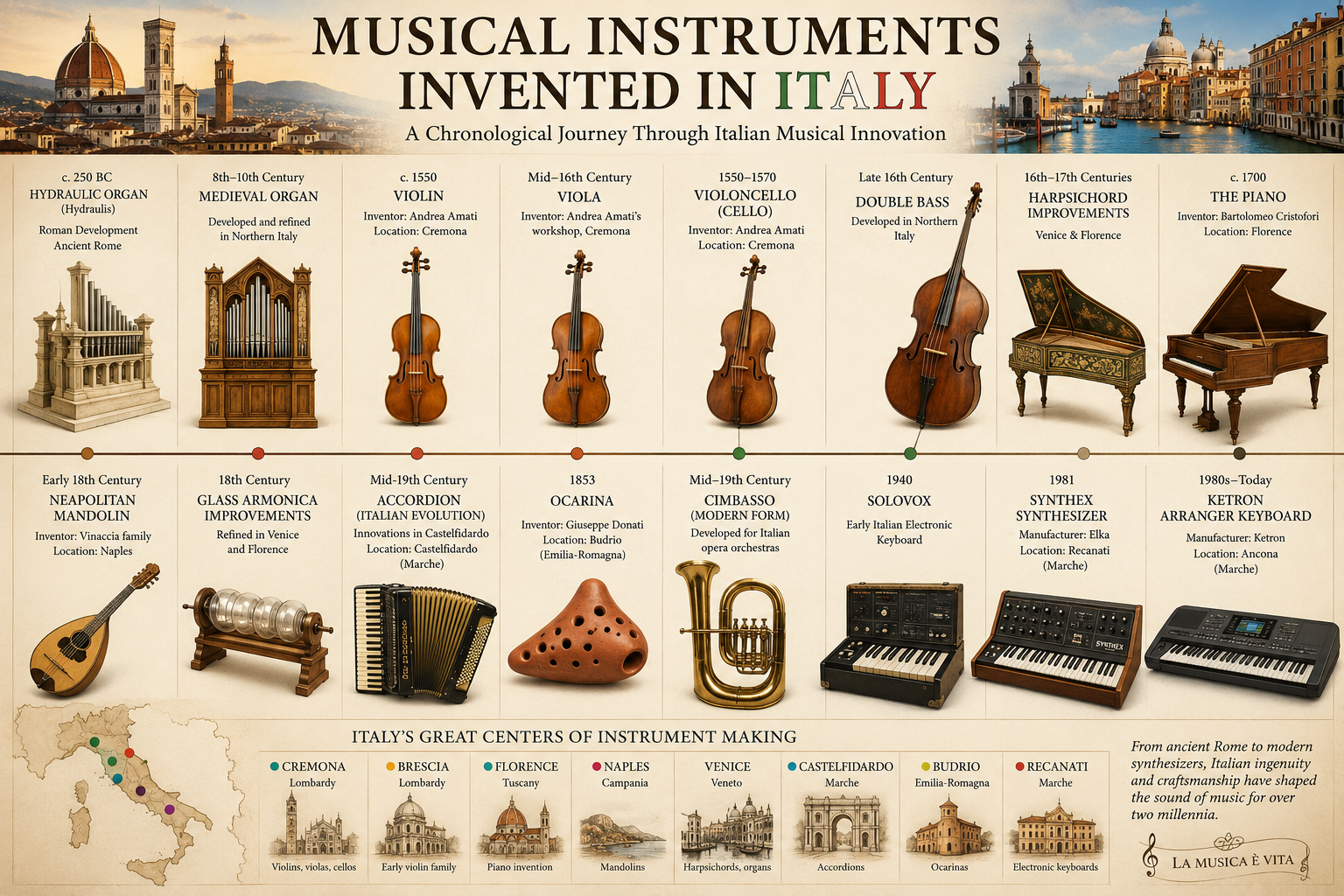
Italy has shaped the history of music more than perhaps any other country. While composers such as Claudio Monteverdi, Antonio Vivaldi, Gioachino Rossini, Giuseppe Verdi, and Giacomo Puccini transformed musical language, Italian inventors and craftsmen also created many of the instruments that define Western music today.
From ancient Roman hydraulic organs to the modern electronic synthesizer, Italy has repeatedly been at the forefront of musical innovation. Some inventions became staples of orchestras worldwide, while others remained fascinating historical curiosities.
Here is a chronological journey through the most important musical instruments invented in Italy, including their inventors, places of origin, and historical impact.
1. The Hydraulic Organ (Hydraulis)
Date: Around 250 BC (developed during Roman times)
Inventor: Ctesibius of Alexandria
Italian Development: Ancient Rome
Although invented in Hellenistic Egypt, the hydraulis reached its greatest popularity and technical refinement throughout Ancient Rome. Roman engineers improved its design, making it one of the earliest keyboard instruments widely used in Europe.
Water pressure regulated the air supply, producing remarkably stable tones.
Where it was used
- Amphitheaters
- Public ceremonies
- Gladiator games
- Wealthy Roman villas
Numerous archaeological remains have been discovered in Pompeii and other Roman sites across Italy.
2. The Medieval Organ
Date: 8th–10th centuries
Location: Northern Italy
Italian craftsmen greatly improved church organs during the early Middle Ages. By the Renaissance, cities such as Venice, Florence, and Bologna had become Europe’s leading organ-building centers.
The Italian organ became famous for:
- Bright principal stops
- Elegant wooden cases
- Mechanical precision
Many Renaissance organs still survive today.
3. The Violin
Date: Around 1550
Inventor: Usually attributed to Andrea Amati
Location: Cremona
Perhaps Italy’s greatest contribution to music, the violin evolved from earlier bowed instruments but reached its modern form in Cremona.
Andrea Amati established the proportions, construction methods, and sound characteristics that remain the foundation of violin making today.
His workshop inspired generations of master luthiers.
Later masters included
- Antonio Stradivari
- Giuseppe Guarneri del Gesù
- Nicolò Amati
Modern orchestras still rely on this Italian design.
4. The Viola Family
Date: Mid-16th century
Inventor: Andrea Amati’s workshop
Location: Cremona
Alongside the violin, Italian craftsmen standardized the viola.
Different sizes were initially produced before settling on the modern alto viola.
Its warm middle register became indispensable in chamber music and orchestras.
5. The Violoncello (Cello)
Date: Around 1550–1570
Inventor: Andrea Amati and later refined by Andrea Guarneri
Location: Cremona
The cello evolved from larger bass violins.
Italian makers gradually reduced its size while improving resonance and playability.
By the eighteenth century, the modern cello had emerged almost exactly as it exists today.
6. The Modern Double Bass
Date: Late 16th century
Location: Northern Italy
Although influenced by the viola da gamba family, the modern orchestral double bass owes much of its development to Italian workshops in Brescia and Cremona.
Its design eventually became standardized across Europe.
7. The Harpsichord Improvements
Date: 16th–17th centuries
Location: Venice and Florence
Italian builders did not invent the harpsichord but dramatically improved it.
Venetian workshops became famous for producing exceptionally light, responsive instruments with brilliant tone.
Italian harpsichords influenced instrument makers throughout Europe.
8. The Piano
Date: Around 1700
Inventor: Bartolomeo Cristofori
Location: Florence
No Italian invention has influenced music more profoundly than the piano.
Cristofori solved a problem that had frustrated instrument makers for centuries:
How could a keyboard produce both soft and loud sounds depending on the player’s touch?
His revolutionary hammer mechanism replaced plucked strings with felt-covered hammers.
The result was the “gravicembalo col piano e forte,” later shortened to pianoforte.
Every modern acoustic piano descends directly from Cristofori’s invention.
9. The Mandolin (Neapolitan Mandolin)
Date: Early 18th century
Inventor: Developed by the Vinaccia family
Location: Naples
Earlier mandolin-like instruments existed, but the Neapolitan mandolin established the modern standard.
Its features included:
- Bowl-shaped body
- Eight metal strings
- Bright, clear tone
- Plectrum playing technique
It became one of Italy’s best-known folk instruments.
10. The Glass Armonica Improvements
Date: 18th century
Italian artisans in Venice and Florence refined the manufacture of glass musical instruments inspired by earlier European designs, improving tuning precision and resonance.
Although not an Italian invention, Italian glassmaking played an important role in its development.
11. The Accordion (Italian Evolution)
Date: Mid-19th century
Location: Castelfidardo
The accordion itself originated in Central Europe, but Italy transformed it into the instrument known worldwide today.
Beginning in the 1860s, manufacturers in Castelfidardo introduced major innovations:
- Piano keyboard models
- Improved reeds
- Chromatic systems
- Enhanced bellows
- Lighter construction
Castelfidardo remains one of the world’s accordion capitals.
12. The Ocarina
Date: 1853
Inventor: Giuseppe Donati
Location: Budrio
One of Italy’s most charming inventions, the modern ocarina was created by Giuseppe Donati, who redesigned traditional clay whistles into a fully chromatic wind instrument.
Its sweet, haunting sound later inspired composers and eventually became famous in film music and video games.
13. The Cimbasso (Modern Form)
Date: Mid-19th century
Location: Northern Italy
The cimbasso was developed for Italian opera orchestras, particularly those performing the works of Giuseppe Verdi.
It provided a powerful brass bass voice matching trombones more effectively than the ophicleide.
Today it has returned to prominence in opera performances worldwide.
14. The Solovox
Date: 1940
Location: Milan
Italian engineers working with electronic music contributed to early keyboard electronics, although commercial production involved international collaboration.
The Solovox anticipated many later electronic keyboard concepts.
15. The Synthex Synthesizer
Date: 1981
Manufacturer: Elka
Location: Recanati
The Elka Synthex became one of the greatest analog synthesizers ever built.
Its rich analog sound made it famous after being used by artists including Jean-Michel Jarre.
Collectors today regard it as one of the finest synthesizers of the analog era.
16. The Ketron Arranger Keyboard
Date: 1980s onward
Manufacturer: Ketron
Location: Ancona
Italian company Ketron pioneered highly realistic arranger keyboards featuring live-style accompaniment and advanced audio technologies.
Professional performers continue to value Ketron instruments for live entertainment.
Italy’s Great Centers of Instrument Making
Several Italian cities became internationally renowned for musical craftsmanship:
| City | Famous For |
|---|---|
| Cremona | Violins, violas, cellos |
| Brescia | Early violin family |
| Florence | Piano invention |
| Naples | Mandolins |
| Venice | Harpsichords, organs |
| Castelfidardo | Accordions |
| Budrio | Ocarinas |
| Recanati | Electronic keyboards |
Italy’s Enduring Legacy
Few countries have contributed as profoundly to the evolution of musical instruments as Italy. From the violin family crafted in Cremona to Cristofori’s revolutionary piano in Florence, Italian ingenuity reshaped the sound of Western music. Later innovations—from the Neapolitan mandolin and Budrio’s ocarina to the analog synthesizers and arranger keyboards of the Marche region—demonstrate that Italy’s tradition of musical craftsmanship spans more than two millennia.
Whether carved from maple and spruce or built with electronic circuitry, Italian instruments share a common legacy: a pursuit of expressive sound, meticulous craftsmanship, and innovations that continue to influence musicians across the globe.