
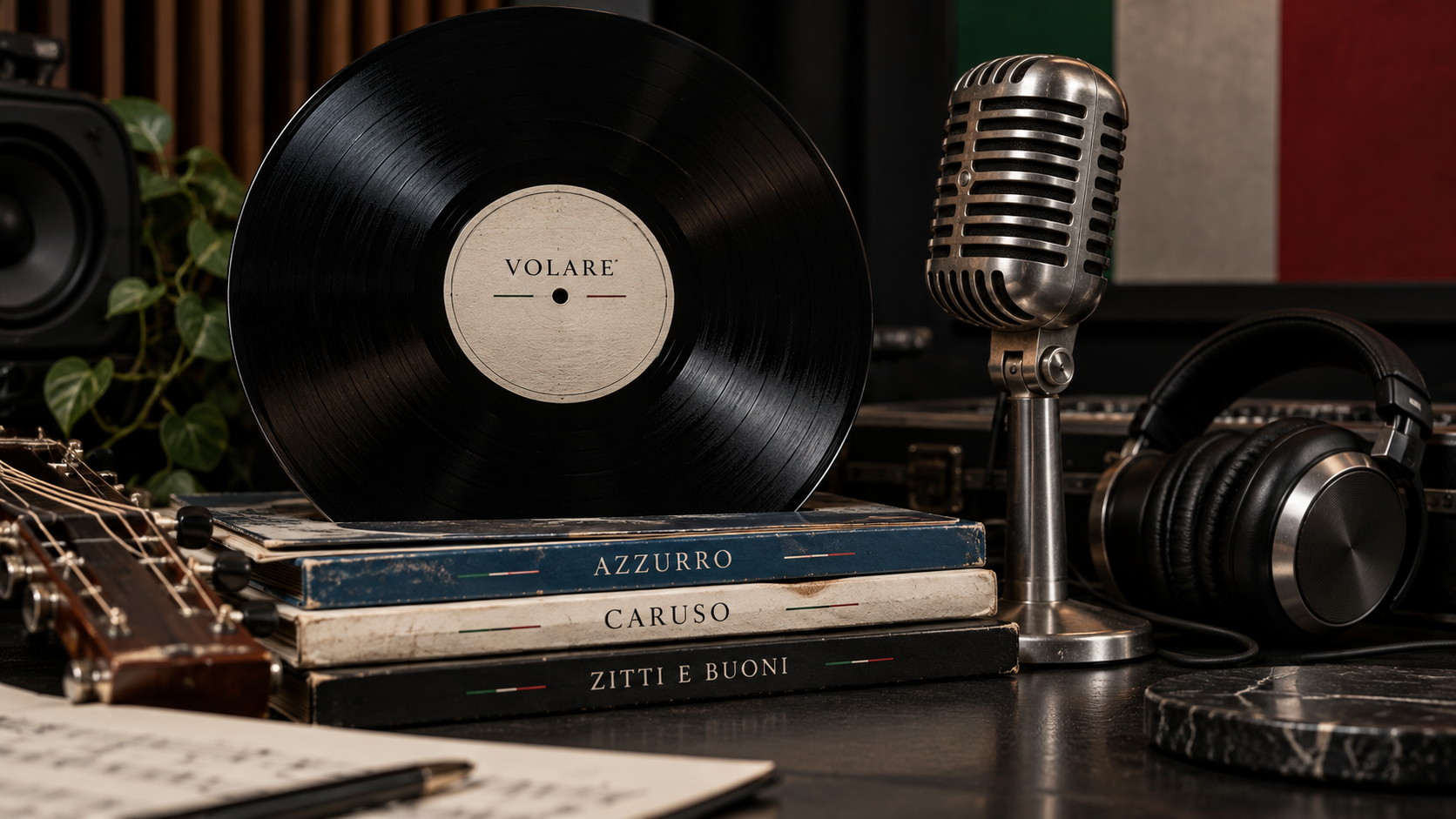
 Italian songs have traveled remarkably well. Some became international standards, some crossed borders through translated versions, and others remain inseparable from Sanremo, summer holidays, football celebrations, family parties and everyday life in Italy.
This updated selection follows Italian popular music from the 1950s through 2026. It is not a strict sales ranking. Historical influence, enduring popularity, international recognition, chart performance and cultural significance all contributed to the choices.
The refresh also corrects several mistakes in the previous version. “L’italiano,” for example, was released in 1983—not 1979—while Umberto Tozzi’s “Ti amo” dates from 1977 and Matia Bazar’s “Ti sento” from 1985.
For more background, explore our Italian music articles, our guide to Italian singers and bands and our introduction to emerging Italian music artists.
Listen While You Read
The Spotify player below offers a broad selection of classic Italian songs. Because it is a public Spotify playlist, its contents may occasionally be updated by its creator.
You can also play this 100-song Italian classics collection on YouTube.
The 1950s: Sanremo and the Birth of Modern Italian Pop
The Sanremo Music Festival, founded in 1951, helped establish the modern Italian popular song. Melodic vocals and orchestral arrangements dominated the decade, but performers such as Renato Carosone also introduced humor, swing and international rhythms.
- “Grazie dei fiori” — Nilla Pizzi (1951). The winner of the first Sanremo Music Festival. Listen on YouTube
- “Tu vuò fà l’americano” — Renato Carosone (1956). A witty Neapolitan classic about the fascination with American culture. Listen on YouTube
- “Nel blu dipinto di blu (Volare)” — Domenico Modugno (1958). Arguably the most internationally recognized Italian-language song ever recorded. Listen on YouTube
- “Piove (Ciao, ciao bambina)” — Domenico Modugno (1959). Modugno’s second consecutive Sanremo winner. Listen on YouTube
- “Marina” — Rocco Granata (1959). A cheerful international hit recorded in numerous languages. Listen on YouTube
The 1960s: Mina, Celentano and the Cantautori
During the 1960s, Italian music moved beyond traditional festival ballads. Mina became the country’s defining pop voice, Adriano Celentano mixed rock and social observation, and singer-songwriters such as Gino Paoli, Luigi Tenco and Fabrizio De André transformed the lyrics of popular songs.
- “Il cielo in una stanza” — Mina (1960). Written by Gino Paoli and immortalized by Mina’s expressive recording. Listen on YouTube
- “24 mila baci” — Adriano Celentano (1961). An early example of Italian rock-and-roll energy. Listen on YouTube
- “Quando, quando, quando” — Tony Renis (1962). An international standard later recorded by performers around the world. Listen on YouTube
- “Mi sono innamorato di te” — Luigi Tenco (1962). A restrained and emotionally direct cantautore masterpiece. Listen on YouTube
- “Sapore di sale” — Gino Paoli (1963). One of Italy’s quintessential summer songs. Listen on YouTube
- “Città vuota” — Mina (1963). Mina’s dramatic interpretation of “It’s a Lonely Town.” Listen on YouTube
- “Cuore” — Rita Pavone (1963). A youthful Italian adaptation of “Heart.” Listen on YouTube
- “Una lacrima sul viso” — Bobby Solo (1964). One of the most recognizable Italian ballads of the decade. Listen on YouTube
- “Non ho l’età (per amarti)” — Gigliola Cinquetti (1964). Winner of both Sanremo and the Eurovision Song Contest. Listen on YouTube
- “Io che non vivo (senza te)” — Pino Donaggio (1965). The Italian original behind the international hit “You Don’t Have to Say You Love Me.” Listen on YouTube
- “La canzone di Marinella” — Fabrizio De André (1964). An early landmark in Italian narrative songwriting. Listen on YouTube
- “Il ragazzo della via Gluck” — Adriano Celentano (1966). A song about urban growth, disappearing green spaces and memory. Listen on YouTube
- “L’immensità” — Don Backy (1967). A sweeping Sanremo-era ballad that remains frequently covered. Listen on YouTube
- “Azzurro” — Adriano Celentano (1968). Written by Paolo Conte and Vito Pallavicini, it became an unofficial Italian anthem. Listen on YouTube
- “La bambola” — Patty Pravo (1968). A defining statement of independence in 1960s Italian pop. Listen on YouTube
The 1970s: The Golden Age of Italian Songwriting
The 1970s brought together progressive pop, political songwriting, romantic ballads and highly personal cantautore music. Lucio Battisti, Lucio Dalla, Francesco De Gregori, Rino Gaetano and many others produced songs that still feel central to Italian culture.
- “La prima cosa bella” — Nicola Di Bari (1970). A simple, enduring declaration of love. Listen on YouTube
- “Che sarà” — Ricchi e Poveri and José Feliciano (1971). Both performers presented the song at Sanremo under the festival’s dual-performance rules. Listen on YouTube
- “Pensieri e parole” — Lucio Battisti (1971). One of the essential Battisti–Mogol collaborations. Listen on YouTube
- “Il cuore è uno zingaro” — Nicola Di Bari and Nada (1971). The two performers’ versions jointly won Sanremo. Listen on YouTube
- “Piccolo uomo” — Mia Martini (1972). The breakthrough that established one of Italy’s most emotionally powerful voices. Listen on YouTube
- “Io vagabondo (che non sono altro)” — Nomadi (1972). A multigenerational singalong and one of the band’s signature songs. Listen on YouTube
- “Questo piccolo grande amore” — Claudio Baglioni (1972). A landmark Italian romantic ballad. Listen on YouTube
- “Anima mia” — I Cugini di Campagna (1973). Instantly recognizable for its falsetto vocal and nostalgic melody. Listen on YouTube
- “E penso a te” — Lucio Battisti (1972). An intimate song whose emotional restraint made it a standard. Listen on YouTube
- “Minuetto” — Mia Martini (1973). A dramatic ballad written by Franco Califano and composed by Dario Baldan Bembo. Listen on YouTube
- “Sei bellissima” — Loredana Bertè (1975). A passionate performance that became Bertè’s signature ballad. Listen on YouTube
- “Ma il cielo è sempre più blu” — Rino Gaetano (1975). A socially observant song that later became a collective anthem. Listen on YouTube
- “Ancora tu” — Lucio Battisti (1976). Battisti successfully brought disco rhythms into his distinctive songwriting. Listen on YouTube
- “La donna cannone” — Francesco De Gregori (1983). Although released in the following decade, it belongs to the great cantautore tradition shaped during the 1970s. Listen on YouTube
- “Ti amo” — Umberto Tozzi (1977). A major European hit, frequently—but incorrectly—dated to 1981. Listen on YouTube
- “Figli delle stelle” — Alan Sorrenti (1977). One of the great Italian disco songs. Listen on YouTube
- “Gianna” — Rino Gaetano (1978). An unconventional Sanremo hit full of Gaetano’s playful word combinations. Listen on YouTube
- “Gloria” — Umberto Tozzi (1979). An international hit later adapted into English for Laura Branigan. Listen on YouTube
The 1980s: Stadium Anthems, Pop Stars and International Hits
Italian pop became bigger, brighter and increasingly international during the 1980s. The period produced some of the songs most readily associated with Italy outside the country.
- “Solo noi” — Toto Cutugno (1980). Cutugno’s Sanremo-winning romantic ballad. Listen on YouTube
- “Sarà perché ti amo” — Ricchi e Poveri (1981). One of the world’s most recognizable Italian pop choruses. Listen on YouTube
- “Maledetta primavera” — Loretta Goggi (1981). A Sanremo runner-up that outlived many festival winners. Listen on YouTube
- “Non sono una signora” — Loredana Bertè (1982). A forceful song of identity and resistance. Listen on YouTube
- “Felicità” — Al Bano and Romina Power (1982). A joyful duet with lasting popularity throughout Europe. Listen on YouTube
- “Vita spericolata” — Vasco Rossi (1983). Initially placed near the bottom at Sanremo but became an enduring rock anthem. Listen on YouTube
- “L’italiano” — Toto Cutugno (1983). Released in 1983, this portrait of Italian identity became a worldwide favorite. Listen on YouTube
- “Vacanze romane” — Matia Bazar (1983). Elegant electronic pop with one of Antonella Ruggiero’s defining performances. Listen on YouTube
- “Ci sarà” — Al Bano and Romina Power (1984). The winning song of Sanremo 1984. Listen on YouTube
- “Terra promessa” — Eros Ramazzotti (1984). Ramazzotti’s breakthrough winner in Sanremo’s newcomers section. Listen on YouTube
- “Ti sento” — Matia Bazar (1985). Released in 1985, not 2000, and driven by Antonella Ruggiero’s extraordinary range. Listen on YouTube
- “Una storia importante” — Eros Ramazzotti (1985). A major European success from Ramazzotti’s early career. Listen on YouTube
- “Caruso” — Lucio Dalla (1986). A modern standard recorded by artists across pop, classical and operatic music. Listen on YouTube
- “Adesso tu” — Eros Ramazzotti (1986). The winner of Sanremo 1986. Listen on YouTube
- “Gente di mare” — Umberto Tozzi and Raf (1987). Italy’s third-place Eurovision entry and a lasting maritime anthem. Listen on YouTube
- “Senza una donna” — Zucchero (1987). Later turned into a major international duet with Paul Young. Listen on YouTube
- “Perdere l’amore” — Massimo Ranieri (1988). Ranieri’s dramatic Sanremo-winning performance. Listen on YouTube
- “Almeno tu nell’universo” — Mia Martini (1989). One of the most admired vocal performances in Italian popular music. Listen on YouTube
The 1990s: Italian Voices Go Global
The 1990s transformed artists such as Laura Pausini, Andrea Bocelli, Eros Ramazzotti and Zucchero into international stars. At home, rock, dance music and a new generation of singer-songwriters broadened the definition of Italian pop.
- “Vattene amore” — Amedeo Minghi and Mietta (1990). A memorable Sanremo duet famous for its “trottolino amoroso” refrain. Listen on YouTube
- “Insieme: 1992” — Toto Cutugno (1990). Winner of the 1990 Eurovision Song Contest. Listen on YouTube
- “Se bastasse una canzone” — Eros Ramazzotti (1990). One of Ramazzotti’s best-loved international ballads. Listen on YouTube
- “Gli uomini non cambiano” — Mia Martini (1992). A commanding late-career performance that placed second at Sanremo. Listen on YouTube
- “La solitudine” — Laura Pausini (1993). Pausini’s international breakthrough and Sanremo newcomers winner. Listen on YouTube
- “Cose della vita” — Eros Ramazzotti (1993). Originally released as a solo recording; the well-known Tina Turner duet followed in 1997. Listen on YouTube
- “Il mare calmo della sera” — Andrea Bocelli (1994). Bocelli’s breakthrough victory in Sanremo’s newcomers category. Listen on YouTube
- “La mia storia tra le dita” — Gianluca Grignani (1994). An Italian hit that also found a large audience in Spanish-speaking countries. Listen on YouTube
- “Con te partirò” — Andrea Bocelli (1995). Later adapted as “Time to Say Goodbye,” one of the world’s best-selling singles. Listen on YouTube
- “Certe notti” — Ligabue (1995). A cornerstone of Italian stadium rock. Listen on YouTube
- “L’ombelico del mondo” — Jovanotti (1995). An energetic mixture of pop, rap and global rhythms. Listen on YouTube
- “Vivo per lei” — Andrea Bocelli and Giorgia (1995). The Italian duet version turned devotion to music into a love song. Listen on YouTube
- “Laura non c’è” — Nek (1997). A major success in Italy, Europe and Latin America. Listen on YouTube
- “E dimmi che non vuoi morire” — Patty Pravo (1997). Written by Vasco Rossi, Gaetano Curreri and Roberto Ferri, it marked a celebrated comeback. Listen on YouTube
The 2000s: Pop, Rock and New Songwriting Voices
Italian music in the 2000s ranged from polished international pop to intimate songwriting and alternative rock. Several Sanremo performances from this period quickly entered the national songbook.
- “L’ultimo bacio” — Carmen Consoli (2000). The title song associated with Gabriele Muccino’s successful film. Listen on YouTube
- “Luce (Tramonti a nord est)” — Elisa (2001). The winner of Sanremo 2001 and one of Elisa’s defining Italian-language songs. Listen on YouTube
- “Di sole e d’azzurro” — Giorgia (2001). A vocally demanding Sanremo favorite. Listen on YouTube
- “Salirò” — Daniele Silvestri (2002). Intelligent, playful pop accompanied by an unforgettable Sanremo performance. Listen on YouTube
- “Gocce di memoria” — Giorgia (2003). Written for Ferzan Özpetek’s film “Facing Windows.” Listen on YouTube
- “Non me lo so spiegare” — Tiziano Ferro (2003). One of Ferro’s most enduring early ballads. Listen on YouTube
- “Come se non fosse stato mai amore” — Laura Pausini (2004). A showcase for Pausini’s powerful and immediately recognizable voice. Listen on YouTube
- “Sei nell’anima” — Gianna Nannini (2006). A modern Italian rock ballad with lasting radio appeal. Listen on YouTube
- “A te” — Jovanotti (2008). A direct declaration of love that became popular at weddings and dedications. Listen on YouTube
- “La verità” — Povia (2009). A widely discussed narrative song inspired by the story of Eluana Englaro. Listen on YouTube
The 2010s: Streaming, Sanremo and a Changing Italy
Streaming and social media changed how Italian songs reached listeners. Traditional ballads remained popular, but rap, electronic production and multicultural perspectives moved firmly into the mainstream.
- “Follia d’amore” — Raphael Gualazzi (2011). A jazz-influenced Sanremo winner and Eurovision runner-up. Listen on YouTube
- “La notte” — Arisa (2012). An intimate Sanremo ballad that became one of Arisa’s best-known songs. Listen on YouTube
- “L’essenziale” — Marco Mengoni (2013). The song that gave Mengoni his first Sanremo victory. Listen on YouTube
- “Grande amore” — Il Volo (2015). A dramatic operatic-pop hit that won Sanremo and placed third at Eurovision. Listen on YouTube
- “Occidentali’s Karma” — Francesco Gabbani (2017). A satirical Sanremo winner whose dancing gorilla became internationally recognizable. Listen on YouTube
- “Non mi avete fatto niente” — Ermal Meta and Fabrizio Moro (2018). A song about refusing to surrender to fear and terrorism. Listen on YouTube
- “Una vita in vacanza” — Lo Stato Sociale (2018). A playful critique of work and contemporary life. Listen on YouTube
- “Soldi” — Mahmood (2019). A groundbreaking Sanremo winner that finished second at Eurovision. Listen on YouTube
- “Calipso” — Charlie Charles featuring Sfera Ebbasta, Mahmood and Fabri Fibra (2019). A major collaboration connecting Italian rap, trap and pop. Listen on YouTube
- “Andromeda” — Elodie (2020). Released for Sanremo 2020, it helped establish Elodie as one of contemporary Italian pop’s central figures. Listen on YouTube
The 2020s: Italy’s New Global Sound
Italian music in the 2020s is stylistically diverse. Rock, rap, Neapolitan influences, electronic pop and classic festival ballads now coexist in the charts. Måneskin’s Eurovision victory gave Italian rock extraordinary international visibility, while streaming created faster routes from Sanremo to a worldwide audience.
- “Fai rumore” — Diodato (2020). The Sanremo winner became especially poignant when Italians sang it from balconies during the pandemic lockdown. Listen on YouTube
- “Zitti e buoni” — Måneskin (2021). Winner of both Sanremo and Eurovision, launching Måneskin’s global breakthrough. Listen on YouTube
- “Musica leggerissima” — Colapesce and Dimartino (2021). Retro-styled pop whose cheerful arrangement conceals more reflective lyrics. Listen on YouTube
- “Brividi” — Mahmood and BLANCO (2022). The Sanremo 2022 winner and Italy’s Eurovision entry. Listen on YouTube
- “Due vite” — Marco Mengoni (2023). Mengoni’s second Sanremo-winning song, finishing fourth at Eurovision. Listen on YouTube
- “La noia” — Angelina Mango (2024). The Sanremo 2024 winner combines contemporary pop with cumbia-inspired rhythms. Watch the official video
- “Tuta Gold” — Mahmood (2024). Italy’s number-one single on FIMI’s official year-end chart for 2024. Listen on YouTube
- “Balorda nostalgia” — Olly (2025). The Sanremo 2025 winner and the leading song on Italy’s official midyear singles chart. Listen on YouTube
- “La cura per me” — Giorgia (2025). A major Sanremo and streaming success that introduced Giorgia’s voice to another generation. Listen on YouTube
- “Per sempre sì” — Sal Da Vinci (2026). The winner of the 76th Sanremo Music Festival and Italy’s Eurovision 2026 entry. Watch the Sanremo performance
What Is the Most Famous Italian Song?
If international recognition is the main criterion, “Nel blu dipinto di blu,” universally known as “Volare,” remains the strongest answer. Domenico Modugno’s recording crossed language barriers and became one of the songs most closely associated with Italy.
Other plausible answers depend on the listener’s generation. “Azzurro,” “L’italiano,” “Sarà perché ti amo,” “Caruso,” “Con te partirò,” “Soldi” and “Zitti e buoni” each represent a different period of Italian music.
Why Is Sanremo So Important?
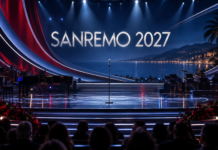
Sanremo is not the whole story of Italian music, but its influence is impossible to ignore. The festival introduced or elevated many of the songs on this list, from “Volare” and “Non ho l’età” to “Soldi,” “Zitti e buoni,” “Due vite” and “La noia.”
Eurovision itself was inspired by the Sanremo format. Italy’s festival entries therefore connect the country’s postwar musical history with today’s international pop audience.
Italian Music Beyond the Famous Hits
No list of 100 songs can represent every important Italian tradition. Neapolitan song, opera, folk music, progressive rock, punk, electronic music, jazz, film soundtracks and regional dialect music could each support a separate collection.
The list also inevitably leaves out major compositions by important artists. Fabrizio De André, Franco Battiato, Paolo Conte, Pino Daniele, Francesco Guccini, Lucio Battisti, Mina, Vasco Rossi and Lucio Dalla alone created enough essential music to fill several additional playlists.
Think of these 100 selections as an accessible route through more than seven decades of Italian popular culture—not as the final word on the subject.
Frequently Asked Questions
Are all the songs performed in Italian?
Nearly all are primarily in Italian, although the list reflects regional language, Neapolitan pronunciation and the growing international character of contemporary Italian music.
What is the difference between the Sanremo and Eurovision versions of a song?
Artists may shorten a song, change its arrangement or modify the staging to comply with Eurovision rules. The commercial studio recording may also differ slightly from either televised performance.
Why are some famous Italian singers represented more than once?
Artists such as Mina, Lucio Battisti, Mia Martini, Eros Ramazzotti and Domenico Modugno shaped more than one period or produced several culturally important songs. Their repeated inclusion reflects that influence.
Why are recent hits included beside established classics?
A list extending “to today” should represent the music Italians currently hear and share. Recent inclusions were chosen using Sanremo results, Eurovision participation and official Italian market data. Their long-term status will naturally become clearer with time.
External Sources
- Festival di Sanremo — Official RAI website
- Italy’s participation history — Official Eurovision website
- FIMI official annual music charts
- FIMI music charts and certification database
- Spotify Italian classics playlist