
 There is a moment in the Italian day when work is finished, dinner is approaching or already over, the temperature begins to fall, and the streets suddenly become more interesting.
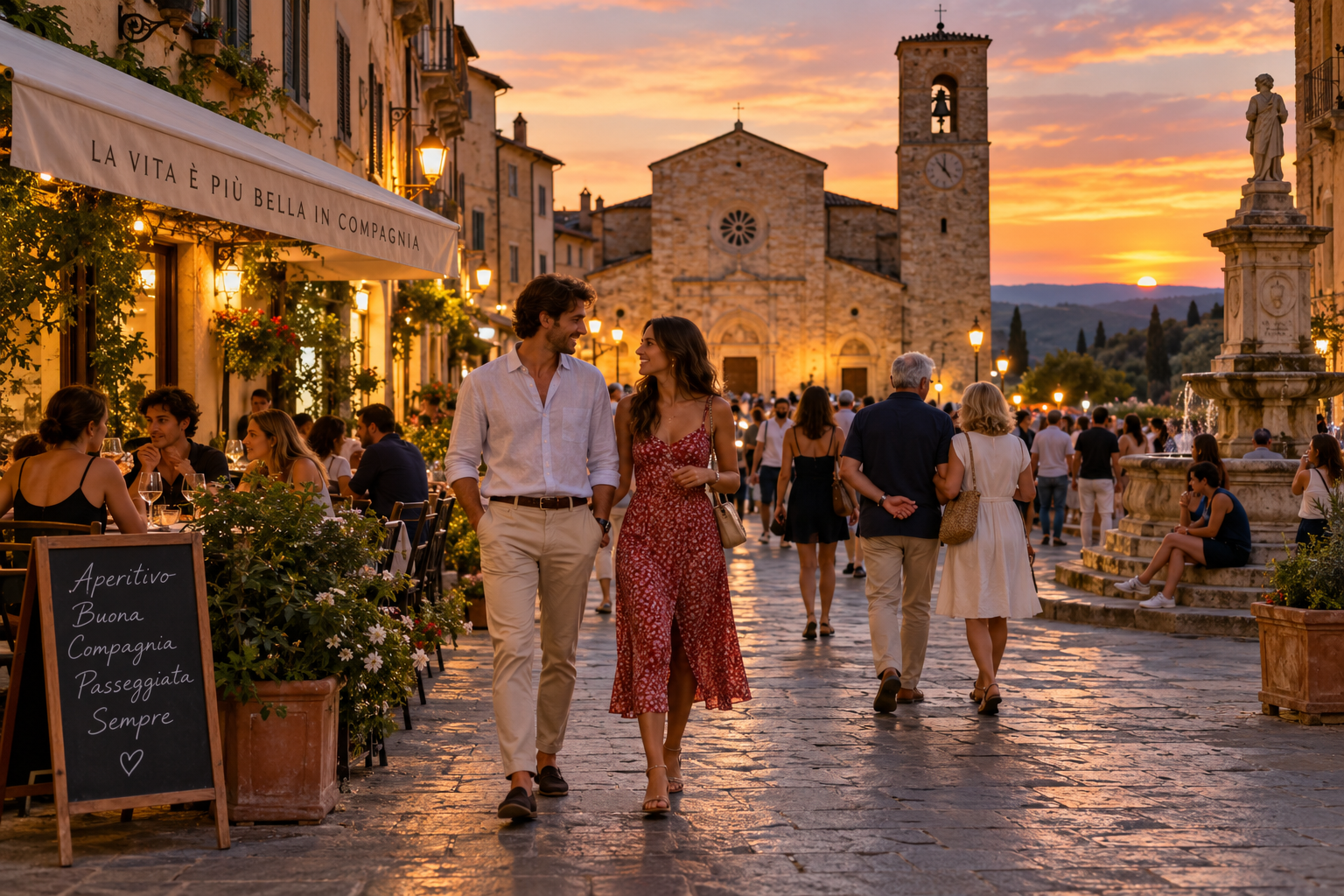
People emerge from their homes. Families walk together. Couples stroll arm in arm. Teenagers meet friends. Older residents sit outside cafés or stand talking to neighbors. Shop windows glow beneath historic façades, children run through the piazza, and the local bar begins to fill.
Nobody appears to be in a hurry.
This is la passeggiata—the Italian evening stroll—and it is one of the simplest yet most revealing expressions of Italian life.
The passeggiata is not really about getting somewhere. It is about being somewhere.
It is walking without urgency, seeing people and being seen, exchanging greetings, stopping for conversation, looking at shop windows, enjoying a gelato or aperitivo, and participating in the life of a neighborhood or town.
For visitors to Italy, understanding the passeggiata can reveal something that guidebooks often miss: Italian public life is not confined to restaurants, museums and monuments. Much of it happens outdoors, in the streets and piazzas, simply through people being together.
What Exactly Is a Passeggiata?
The Italian word passeggiata comes from passeggiare, meaning to walk or stroll. Treccani defines it broadly as the act of strolling, generally for exercise, fresh air or recreation, as well as the route taken while walking.
But the cultural meaning goes much further.
A passeggiata is usually a leisurely, social walk through a town, city center, piazza, seaside promenade or neighborhood. There may be no particular destination.
You are not walking to the supermarket.
You are not rushing to catch a train.
You are not necessarily exercising.
You are going for a walk because going for a walk is what people do.
In many communities, particularly smaller towns and villages, the traditional passeggiata takes place in the early evening. In summer, it may continue well after dinner, when streets and piazzas remain lively because of the warm weather.
The route might be the town’s main street—the corso—or a loop connecting several piazzas.
Sometimes the walk lasts twenty minutes.
Sometimes it lasts two hours.
And very often, the most important part is what happens along the way.
A Tradition With Ancient Roots
Walking as a social activity is certainly not uniquely Italian. Ancient Greek and Roman societies placed considerable importance on walking, public spaces and social interaction.
During the Roman period, walking through public spaces could be part of everyday urban life. The Roman adoption of Greek traditions of walking beneath arcades and around public spaces also contributed to the development of architectural environments that encouraged strolling.
The modern Italian passeggiata, however, developed over many centuries.
During the Renaissance, strolling became associated not only with recreation but also with public display. Wealthy and influential people could demonstrate their social position through clothing, appearance and participation in public life. According to historical accounts of the tradition, this helped establish the connection between walking and “seeing and being seen.”
The Baroque period added another dimension.
Italian cities increasingly developed grand streets, promenades and public spaces that encouraged people to walk and socialize.
Over time, what had once been associated partly with social status became something much more democratic.
Today, the passeggiata belongs to everyone.
Seeing and Being Seen
One of the most important elements of the passeggiata is the idea of vedere e farsi vedere—seeing and being seen.
This does not necessarily mean vanity.
It means participating in the community.
You see friends.
You see relatives.
You see your neighbors.
You notice who has returned from vacation, whose children have grown, who has opened a new business and who has bought a new car.
You may stop to say ciao.
You may exchange a few words.
You may continue walking.
The interaction doesn’t need to be profound.
That is precisely the point.
The passeggiata creates hundreds of small social connections that collectively reinforce a sense of community.
The Corso: Italy’s Social Runway
In many Italian towns, the natural stage for the passeggiata is the corso.
The corso is typically the principal street through the historic center. It may contain clothing shops, cafés, bars, restaurants, bakeries, churches and small businesses.
During the day it can be busy with shopping and errands.
In the evening, its function changes.
It becomes a social space.
People walk up and down the same stretch of street repeatedly, often encountering the same people several times.
A visitor might initially wonder why someone would walk from one end of a street to the other and then turn around and do it again.
The answer is simple:
The destination isn’t the point.
The walk is the destination.
The Piazza as the Heart of the Passeggiata
The passeggiata is inseparable from another defining feature of Italian urban life: the piazza.
Italy’s historic squares were designed for public life, commerce, religious celebrations, political events and social interaction. Today they remain some of the country’s most important gathering spaces.
This is one reason a visit to an Italian city or village can feel dramatically different after sunset.
During the afternoon, a piazza may seem primarily architectural.
In the evening, it becomes human.
A fountain becomes a meeting place.
Church steps become informal seating.
Café terraces fill with conversation.
Children play while their parents talk.
Young people gather in groups.
Older residents occupy their favorite benches.
The architecture remains spectacular, but it becomes the backdrop rather than the main attraction.
Italia Mia’s exploration of The Italian Piazza: History, Architecture and the Heart of Italian Life looks more closely at how these extraordinary public spaces developed and why they remain so important to Italian culture.
From Aperitivo to Passeggiata
The passeggiata frequently overlaps with another beloved Italian ritual: aperitivo.
Around the end of the working day, Italians may meet friends for a drink and something small to eat before dinner.
Aperitivo can be as simple as a glass of wine, prosecco, beer or a classic cocktail accompanied by snacks. In some places it has evolved into the more substantial apericena, combining aperitivo with enough food to function almost as dinner. Italia Mia’s guide to Italian apericena explores this increasingly popular variation in more detail.
The two traditions work beautifully together.
You meet someone for aperitivo.
You have a drink.
You talk.
Eventually someone says, “Facciamo una passeggiata?”
Let’s take a walk.
And suddenly the evening continues into the streets.
Why Italians Dress for the Passeggiata
One of the most charming aspects of the traditional passeggiata is that people often make an effort with their appearance.
This is particularly noticeable in smaller towns.
Someone may change clothes after work.
A man might put on a good shirt.
A woman might choose a dress or carefully coordinated outfit.
Shoes matter.
Hair matters.
Accessories matter.
It is not necessarily formal dressing. Rather, it reflects an Italian idea that going into public space is worth a little preparation.
The passeggiata is social.
You will encounter people you know.
You may meet someone unexpectedly.
You might stop at a café.
You may enter a shop.
You may run into an old friend.
There is therefore a subtle connection between the passeggiata and Italian style.
Fashion is not restricted to fashion shows or special occasions.
It becomes part of everyday public life.
The Passeggiata in Small Towns
The tradition is particularly easy to appreciate in Italy’s smaller towns.
In a village of a few thousand residents, there may be one principal street, one central piazza and a handful of cafés.
As evening arrives, the same people appear.
A group of elderly men might occupy a bench.
Teenagers gather outside a bar.
Families walk with children.
Couples stroll together.
Neighbors stop in the middle of the street to talk.
The entire town can seem to become one large living room.
This is one reason small Italian towns can feel surprisingly lively despite having relatively few inhabitants.
The public realm remains important.
People don’t necessarily retreat indoors as soon as their workday ends.
They go outside.
They walk.
They talk.
They watch.
They participate.
The Passeggiata by the Sea
In coastal Italy, the passeggiata often moves from the historic center to the lungomare—the seafront promenade.
This creates a slightly different version of the tradition.
Instead of walking between medieval buildings and piazzas, people stroll beside the sea.
Families stop for gelato.
Children ride bicycles or scooters.
Teenagers meet friends.
Older couples walk together.
Restaurants and bars spill onto the sidewalks.
In summer, the passeggiata may continue late into the evening.
The Italian coastline is therefore not simply a place for daytime beach culture.
After sunset, the promenade becomes another stage for community life.
From Liguria to Tuscany, Campania, Puglia, Calabria, Sicily and Sardinia, seaside promenades provide some of Italy’s most atmospheric places for an evening walk.
The Passeggiata in Italian Cities
Large cities have their own versions of the tradition.
In Rome, neighborhoods such as Trastevere come alive in the evening, with narrow streets, piazzas, restaurants, bars and fountains creating an ideal environment for wandering. Italia.it describes Piazza Trilussa and the surrounding streets as important meeting areas, particularly in the evening.
In Florence, the historic center provides an extraordinary setting. The streets around Piazza Santa Croce and Via dei Calzaiuoli can become particularly lively in the evening, when residents and visitors mingle among cafés, shops and historic buildings.
In Pisa, the combination of the historic center, university population and Arno riverfront provides numerous opportunities for evening walking. The city’s atmosphere changes considerably once the day’s sightseeing crowds begin to diminish.
In Bologna, the city’s famous porticoes provide an especially useful setting. Even when the weather isn’t perfect, people can walk beneath miles of covered arcades while moving between streets and piazzas.
In Naples, the tradition can be louder and more exuberant. Walking along the waterfront, through historic streets or around busy piazzas becomes an experience involving food, conversation, music and the extraordinary energy of the city.
And in Milan, the passeggiata has evolved alongside a more sophisticated urban lifestyle, often blending shopping, aperitivo, fashion and nightlife.
The locations change.
The principle remains.
The Passeggiata and Italian Villages
Some of the best places to experience the tradition are not the famous cities at all.
A small hill town in Tuscany or Umbria can offer a much more intimate experience.
The historic center may have only a few streets.
A bell tower marks the evening.
Shutters begin to close.
The temperature drops.
A few lights appear in the windows.
Then people start walking.
Italia Mia’s guide to Peccioli in Tuscany, for example, describes its narrow medieval streets, small squares and intimate historic center—precisely the type of environment in which walking slowly becomes part of the experience rather than merely a means of transportation.
Likewise, Italy’s many borghi offer something that major tourist destinations sometimes cannot: the opportunity to observe ordinary life rather than simply visit attractions.
Italia’s official tourism portal emphasizes the value of walking through historic villages as a slower and more immersive way to encounter local traditions, architecture and community life.
A Passeggiata Is Not a Hike
This distinction is important.
The Italian word passeggiata does not imply serious physical exercise.
There is no special equipment.
No hiking boots.
No fitness tracker is required.
No personal record needs to be broken.
You can walk slowly.
You can stop.
You can turn around.
You can sit down.
You can have a drink.
You can eat gelato.
You can talk for ten minutes with someone you haven’t seen for three months.
The goal is not to maximize distance.
It is to maximize experience.
This is one reason the passeggiata fits so naturally into Italian life.
It doesn’t require scheduling an exercise session.
It doesn’t require joining a gym.
It simply requires leaving the house.
Why the Passeggiata Feels So Relaxed
Modern life often divides time into clearly defined categories.
Work.
Exercise.
Entertainment.
Shopping.
Family time.
Socializing.
The passeggiata blurs those boundaries.
It can be exercise, but isn’t primarily exercise.
It can be socializing, but doesn’t require an appointment.
It can involve shopping, but shopping isn’t necessary.
It can lead to dinner, but dinner isn’t the purpose.
It can be romantic, but couples don’t have to be alone.
It can involve children, grandparents, friends and strangers simultaneously.
The passeggiata therefore represents something larger than walking.
It is a way of using public space.
The Social Importance of Walking
One of the most interesting aspects of the passeggiata is that it creates repeated, low-pressure social contact.
You don’t have to organize a party to see your neighbors.
You don’t need to make an appointment with every friend.
You simply go outside.
This can be especially important in smaller communities.
A person who walks every evening becomes part of the visible life of the town.
People recognize one another.
They exchange greetings.
They maintain relationships through hundreds of brief interactions.
That social continuity is difficult to measure, but it contributes to the distinctive feeling of many Italian communities.
The Passeggiata and the Italian Concept of Time
The passeggiata also reflects a broader Italian appreciation for tempo—the rhythm and quality of everyday life.
Italy is often associated with the expression dolce vita, but the phrase can be misunderstood.
It isn’t simply about luxury.
It can mean enjoying ordinary experiences.
A good meal.
A conversation.
A coffee.
A sunset.
A glass of wine.
A walk.
The passeggiata fits perfectly into this philosophy because it transforms an ordinary part of the day into something worth enjoying.
You don’t need an extraordinary event.
You need time.
The Passeggiata in Summer
Summer is arguably the perfect season for the Italian evening stroll.
During the hottest part of the day, many people remain indoors or seek shade.
Then, as the sun begins to disappear, the streets become comfortable again.
Shops remain open.
Restaurants prepare outdoor tables.
Gelaterie become busy.
Children play.
Musicians sometimes perform.
Piazzas fill.
The entire rhythm of the town changes.
In coastal communities, the combination of warm air, sea breezes and evening light makes the passeggiata particularly memorable.
During August, the tradition can become even more pronounced as Italians take their summer holidays and communities organize concerts, festivals, outdoor performances and local celebrations.
Italia Mia’s coverage of Italian summer events illustrates how frequently cultural life moves outdoors during this period.
The Passeggiata in Winter
The tradition does not disappear when summer ends.
Winter simply changes the atmosphere.
People wear coats and scarves.
The streets are quieter.
Christmas lights may illuminate historic centers.
Bars and cafés become more important.
The walk may be shorter.
But the principle remains.
In mountain towns, the evening passeggiata can be particularly atmospheric, with historic buildings illuminated against dark skies and cold mountain air.
Even ski resorts maintain the tradition. After the day’s activities, visitors and residents stroll through town, browse shops and gather in cafés.
How to Experience the Passeggiata as a Visitor
If you’re visiting Italy and want to experience the passeggiata authentically, don’t overplan it.
In fact, planning too much can defeat the purpose.
Instead, choose a town or neighborhood with a walkable historic center.
Around sunset, have an aperitivo.
Then simply start walking.
Look for the street where local people appear to be going.
Follow the crowd.
Walk toward the main piazza.
Stop at a gelateria.
Sit on a bench.
Continue walking.
Watch how people interact.
Listen to the conversations around you.
Notice the architecture.
Look at the shop windows.
Pay attention to what happens between the famous sights.
That is where the real experience often begins.
A Perfect Italian Evening
For someone experiencing the tradition for the first time, a classic evening might look something like this:
6:30 p.m. — Aperitivo
Meet friends at a neighborhood bar and order a spritz, glass of wine or another drink.
7:30 p.m. — Begin the passeggiata
Walk toward the historic center.
8:00 p.m. — Piazza
Spend some time in the main square. Watch children play and people meet.
8:30 p.m. — Gelato
Stop at a gelateria.
9:00 p.m. — Continue walking
Explore side streets you might otherwise have ignored.
9:30 p.m. — Dinner
Choose a restaurant where people are eating outside.
11:00 p.m. — Another walk
In many Italian towns, the evening is still young.
The important thing is that none of these activities needs to be rushed.
What Not to Do
There is really only one major rule:
Don’t rush.
Don’t turn the passeggiata into a walking tour.
Don’t constantly check your phone.
Don’t worry about how many kilometers you’ve covered.
Don’t feel that you need to reach a particular attraction.
Don’t photograph everything.
And don’t assume that the most important part of the evening is the famous monument at the end of the street.
Sometimes the most memorable moment is simply watching an elderly couple slowly walk past a fountain while three generations of another family sit together at a café.
The passeggiata is about the life happening around you.
The Passeggiata and Romance
There is also an undeniable romantic dimension.
For generations, the evening stroll has provided opportunities for young people to meet, flirt and observe one another.
A stroll through the corso allows people to encounter one another naturally.
You might see someone you know.
You might meet someone new.
You might walk beside someone for a while.
The tradition even appears repeatedly in Italian cinema, where the public street becomes a stage for romance, jealousy, gossip and social observation.
The passeggiata is therefore not only a physical journey.
It can also be a social and emotional one.
The Passeggiata and Italian Cinema
Italian filmmakers have long understood the visual power of people walking through historic streets.
A procession of ordinary people beneath old buildings tells a story without dialogue.
The clothes reveal personality.
The architecture provides historical context.
The crowd establishes social relationships.
The street becomes a stage.
From classic Italian cinema to contemporary films and television, the image of Italians walking through villages and cities is deeply embedded in the country’s visual identity.
Perhaps one of the best-known cinematic examples is Giuseppe Tornatore’s Malèna, in which Monica Bellucci’s character becomes the object of intense attention as she walks through her Sicilian town. The scene demonstrates how the act of walking through a small community can itself become a form of social theater.
The Passeggiata and Community Identity
Every town has its own version.
In one place, the main route might run from the cathedral to the piazza.
In another, it might follow the seaside.
Elsewhere, people may walk beneath medieval arcades.
The route is local.
The ritual is universal.
This is one reason the passeggiata can tell you something about a town’s identity.
A seaside town will have a different passeggiata from a Tuscan hill town.
A major city will feel different from a village.
A university town will have a younger rhythm.
A resort town may become dramatically busier during summer.
Yet everywhere, the same fundamental idea survives:
go outside and share the evening.
Why the Passeggiata Matters More Than It Seems
At first glance, the passeggiata can appear almost trivial.
People are simply walking.
But ordinary rituals often reveal the deepest aspects of a culture.
The passeggiata demonstrates the importance many Italians place on:
- Community
- Family
- Public space
- Conversation
- Appearance
- Food and drink
- Leisure
- Walking
- Social connection
- Enjoyment of everyday life
It also reveals something important about Italian cities.
Historic centers were not designed solely to be photographed.
They were designed to be inhabited.
The narrow streets, piazzas, fountains, arcades and promenades still function as social spaces centuries after they were built.
The Passeggiata in Modern Italy
Technology has changed Italian life.
Shopping habits have changed.
Work patterns have changed.
Cars and public transportation have transformed cities.
Social media has changed how people communicate.
Yet the passeggiata survives.
It may look slightly different today.
A teenager may check a smartphone while walking.
A younger couple may meet through social media.
A modern café may replace an old bar.
Tourists may now join the local crowd.
But the fundamental behavior remains remarkably familiar.
People still go outside.
They still walk.
They still meet.
They still talk.
They still watch the world go by.
The tradition has even attracted international attention as an example of slow, socially connected living. Recent discussions have linked the passeggiata with walking, well-being and the rediscovery of slower forms of urban life.
How to Make the Passeggiata Part of Your Life
You don’t have to live in Italy to adopt the idea.
The underlying principle is simple.
After work, after dinner or in the early evening, leave the house.
Walk without a destination.
Don’t listen to a podcast.
Don’t make the walk another productivity exercise.
Don’t measure your performance.
Talk to someone.
Look around.
Say hello to people you know.
Stop for a coffee or drink.
Sit somewhere.
Then walk home.
The point is not to imitate Italy superficially.
It is to rediscover something that modern life often eliminates: unstructured time spent in public with other people.
The Italian Lesson: Slow Down
Perhaps the greatest lesson of the passeggiata is not about walking at all.
It is about slowing down enough to notice where you are.
Modern life rewards speed.
The faster we work, travel, communicate and consume, the more productive we are assumed to be.
The passeggiata rejects that logic.
It says that sometimes there is value in doing something without trying to accomplish anything.
You walk.
You talk.
You observe.
You breathe.
You enjoy the evening.
And then you go home.
Nothing extraordinary happened.
And yet the evening was worthwhile.
Where to Experience the Best Passeggiata
There is no single “best” place because the character of the tradition depends on the community.
Nevertheless, some particularly atmospheric settings include:
Rome — Trastevere, the historic center and the areas around Piazza Navona and the Tiber.
Florence — Piazza Santa Croce, the historic center and streets around the Duomo.
Bologna — the porticoes and historic center.
Siena — Piazza del Campo and the surrounding medieval streets.
Lucca — the historic center and the Renaissance walls.
Pisa — the Arno riverfront and central streets.
Naples — the historic center and waterfront.
Palermo — historic streets and piazzas, particularly on warm evenings.
Lecce — Baroque streets and piazzas provide an exceptional setting for an evening stroll.
Cefalù — the historic center and Piazza Duomo become particularly atmospheric after sunset.
Small Tuscan villages — often the best choice if you want to experience the tradition with fewer tourists.
Italia Mia’s guides to Tuscany, Italian art cities, Pisa, and Italy’s many historic towns provide excellent starting points for discovering places where walking is part of the experience rather than merely a way to move between attractions.
The Passeggiata Is Italy in Miniature
Italy is famous for its extraordinary achievements.
The Colosseum.
The Renaissance.
Michelangelo.
Leonardo.
Opera.
Fashion.
Ferrari.
Italian cuisine.
The great cathedrals and museums.
But Italy is also defined by much smaller things.
A coffee at the bar.
A conversation across a balcony.
A plate of pasta shared with family.
An aperitivo before dinner.
Children playing in a piazza.
And people walking together at the end of the day.
The passeggiata belongs to this quieter Italy.
It isn’t a monument.
It isn’t a museum.
It isn’t something you buy a ticket to see.
It is simply part of everyday life.
And perhaps that is exactly why it is so important.
The Art of Doing Nothing in Particular
Ultimately, the passeggiata is an art form built around a deceptively simple idea:
You don’t always need somewhere to go.
Sometimes you can simply walk.
Walk through the piazza.
Walk along the corso.
Walk beside the sea.
Walk beneath the arcades.
Walk past the church.
Walk toward the sound of people talking.
Stop.
Say hello.
Have a gelato.
Continue.
Watch the sunset.
And for a little while, allow the evening to unfold without asking it to accomplish anything.
That is the real art of the Italian passeggiata.
It is not about walking faster.
It is about living more slowly.
And in a world that is increasingly connected, hurried and distracted, there may be few traditions more valuable.
Related Italia Mia Articles
- The Italian Piazza: History, Architecture and the Heart of Italian Life — A companion exploration of the public squares where much of the passeggiata takes place.
- Discover the Italian Love for Apericena — An ideal companion to the section on aperitivo and evening social life.
- Italian Culture: An Introduction — A broader look at the cultural traditions that shape everyday Italian life.
- Walking in Italy: The Best Hiking Trails to Explore — For readers interested in the broader Italian culture of walking.
- Peccioli Tuscany: Medieval Village, Contemporary Art and Hidden Gems — An example of a Tuscan town particularly suited to exploring on foot.
- Italy and its Art Cities — A guide to Italy’s major cultural cities and their extraordinary historic centers.
- Region of Tuscany: A Complete Travel Guide — Useful for discovering Tuscan destinations where the evening stroll remains part of local life.
- The Main Differences Between Living in USA and Italy — Includes a comparison of Italian and American attitudes toward strolling, public space and everyday life.
External Links
- Italia.it — Official Italian Tourism Website
- Italia.it — Art & Culture in Italy
- Treccani — Definition of Passeggiata
- ITALY Magazine — Want to Prioritize Your Mental Health? Start With a Passeggiata
- ITALY Magazine — The Passeggiata and National Day of Urban Trekking