

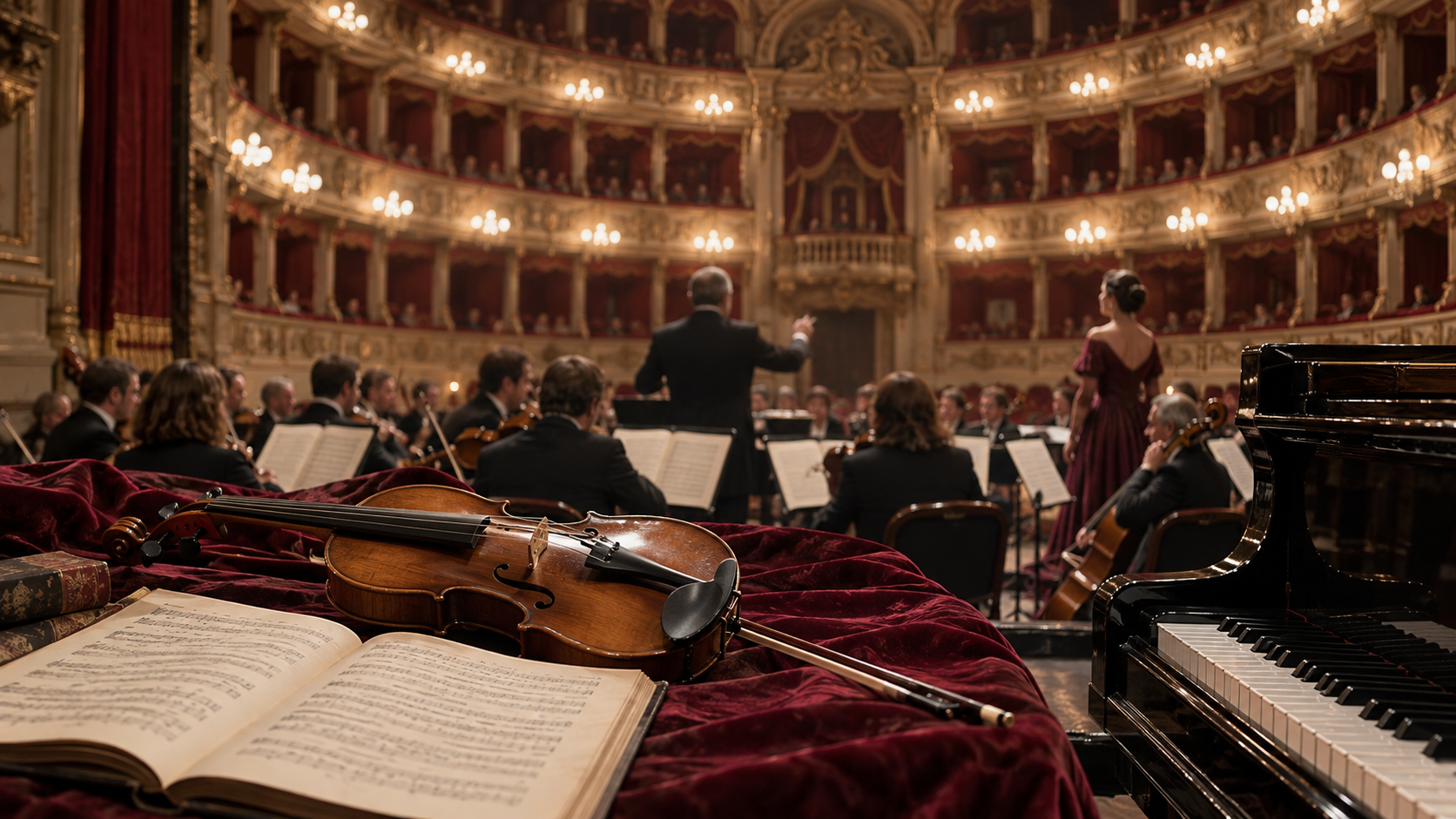
 Italy’s influence on classical music is so extensive that many of its words have become the international language of musicians. Allegro, adagio, crescendo, concerto, sonata, opera and virtuoso are not translations: orchestras and performers around the world use the original Italian terms.
That vocabulary reflects centuries of musical innovation. Italian composers helped shape sacred polyphony, the madrigal, opera, the concerto, violin technique, bel canto and modern experimental music. Italian instrument makers also transformed the sound of Western music, particularly through the violins of Stradivari, Guarneri and Amati and the early development of the piano by Bartolomeo Cristofori.
Opera may be Italy’s most visible contribution, but Italian classical music is much broader. It encompasses medieval chant, Renaissance church music, Baroque concertos, chamber music, symphonic works, virtuoso instrumental writing, twentieth-century modernism and today’s contemporary composers.
Medieval Italy: Chant, Sacred Music and the First Secular Composers
Music in medieval Italy was closely connected to the Church. Plainchant—monophonic sacred singing without instrumental accompaniment—formed an essential part of worship. The term “Gregorian chant” is traditionally associated with Pope Gregory I, although the repertory developed gradually over several centuries rather than being created by one person.
An important breakthrough came with Guido of Arezzo, an eleventh-century Benedictine monk and music theorist. His teaching methods helped singers read unfamiliar melodies more efficiently. The syllables ut, re, mi, fa, sol and la, the ancestors of modern solfège, were drawn from a Latin hymn. Guido is also associated with the development of staff notation and the “Guidonian hand,” a visual method for teaching musical intervals.
By the fourteenth century, secular composition had become increasingly sophisticated. The Italian Trecento produced its own form of the Ars Nova, with madrigals, ballate and cacce written for courtly and urban audiences.
The best-known composer of this period is Francesco Landini, a Florentine organist, poet and singer. His graceful ballate demonstrate that medieval Italian music was not limited to religious chant: it could also be lyrical, rhythmically lively and emotionally expressive.
The Renaissance: Palestrina, Madrigals and Venetian Splendor
During the Renaissance, Italy became one of Europe’s most important musical centers. Courts, churches and wealthy cities supported composers, singers, instrumentalists and music publishers. The development of printing made musical works easier to circulate, while the growth of humanism encouraged closer attention to poetry and emotional expression.
Palestrina and Roman sacred music
Giovanni Pierluigi da Palestrina became the emblematic composer of Roman Catholic sacred polyphony. His masses and motets are admired for their balance, clarity and controlled interweaving of vocal lines.
The Missa Papae Marcelli is often associated with the musical reforms surrounding the Council of Trent. The popular claim that Palestrina single-handedly “saved church music” is an exaggeration, but his style did demonstrate that complex polyphony could coexist with dignity and greater textual clarity.
The Italian madrigal
The madrigal was one of the Renaissance’s most influential secular forms. Composers used several voices to express the meaning, rhythm and emotional color of Italian poetry. Musical gestures could illustrate individual words—rising for “heaven,” falling for “death” or becoming dissonant at moments of grief.
Important madrigal composers active in Italy included Luca Marenzio, Carlo Gesualdo and Claudio Monteverdi. Gesualdo’s unusually intense chromatic harmonies still sound startlingly modern, while Monteverdi’s madrigals reveal the transition from Renaissance polyphony to the more theatrical language of the Baroque.
Venice and music for space
Venice developed a particularly brilliant musical culture around St Mark’s Basilica. Andrea Gabrieli and his nephew Giovanni Gabrieli wrote works for separated groups of singers and instruments positioned in different parts of the church.
This cori spezzati, or divided-choir tradition, used the architecture of St Mark’s to create antiphonal and spatial effects. Giovanni Gabrieli’s music also shows an increasing concern with instrumental color, dynamics and precisely designated ensembles—important steps toward Baroque orchestration.
The Birth of Opera
Opera emerged in Italy around the end of the sixteenth century. Florentine scholars and musicians attempted to recreate what they believed had been the union of speech, music and drama in ancient Greek theatre.
Jacopo Peri’s Dafne, first performed in the 1590s, is generally regarded as the earliest opera, although most of its music has been lost. His Euridice, performed in Florence in 1600, is the earliest surviving opera whose music remains substantially complete.
These experiments introduced recitative, a flexible style of singing that follows the natural rhythm of speech and allows a dramatic story to advance. Recitative would be paired with more structured and melodic arias, establishing one of opera’s fundamental contrasts.
Claudio Monteverdi and the first operatic masterpiece
Claudio Monteverdi transformed these experiments into compelling musical drama. L’Orfeo, first performed at the Mantuan court in 1607, uses voices, instruments, choruses and recurring musical colors to tell the myth of Orpheus.
Monteverdi later worked in Venice, where public opera houses opened the genre to paying audiences rather than only aristocratic courts. His L’incoronazione di Poppea combines historical characters, sensuality, political ambition and psychological complexity.
Opera was no longer simply an intellectual reconstruction of ancient drama. It had become living theatre.
For a closer look at its major figures, see Italia Mia’s guide to the most famous Italian opera composers.
The Baroque: Corelli, Scarlatti and Vivaldi
The Baroque period, approximately 1600–1750, saw Italian composers influence nearly every major European musical center. Opera expanded rapidly, but instrumental music also assumed unprecedented importance.
Arcangelo Corelli
Arcangelo Corelli helped establish the trio sonata, solo sonata and concerto grosso. His output was relatively small, but his influence was enormous. His clear formal design and expressive violin writing provided models for composers throughout Europe.
Corelli also contributed to the rise of the violin as a leading solo instrument. Italian violin makers in Cremona—including the Amati, Stradivari and Guarneri families—were simultaneously creating instruments whose sound and craftsmanship became legendary.
Alessandro and Domenico Scarlatti
Alessandro Scarlatti was a major figure in the development of Neapolitan opera. He helped consolidate conventions such as the da capo aria, in which an opening section returns after a contrasting middle section and gives the singer an opportunity for ornamentation.
His son, Domenico Scarlatti, is remembered principally for more than 500 keyboard sonatas. Many were written during his years in Portugal and Spain and contain rapid repeated notes, crossed hands, bold dissonances and rhythms suggestive of Iberian music.
Antonio Vivaldi
Venetian composer and violinist Antonio Vivaldi brought extraordinary energy to the solo concerto. His frequent use of a recurring orchestral refrain, or ritornello, alternating with freer solo episodes helped give the concerto structural clarity and dramatic momentum.
The Four Seasons, published in 1725 as part of Il cimento dell’armonia e dell’inventione, consists of four violin concertos accompanied by descriptive sonnets. The music depicts storms, birds, hunting, summer heat, icy winds and a fireside refuge, making it a celebrated example of early program music.
Vivaldi also composed sacred works, chamber music and dozens of operas. The familiar separation between “instrumental Vivaldi” and Italian opera is therefore misleading: theatrical rhythm, contrast and characterization run throughout his music.
Listen to Vivaldi’s complete Four Seasons on YouTube.
The Classical Period: Italy Beyond Opera
During the later eighteenth century, opera remained dominant in Italy, but Italian composers also contributed to the symphony, keyboard sonata, string music and the development of modern performance technique.
Giovanni Battista Sammartini’s symphonies helped establish the independent concert symphony before Haydn and Mozart brought the form to maturity. Luigi Boccherini, a virtuoso cellist who spent much of his career in Spain, wrote elegant chamber music, including numerous string quintets that gave the cello a prominent role.
Muzio Clementi was one of the period’s most important pianists, teachers and keyboard composers. His sonatas and instructional collection Gradus ad Parnassum influenced generations of pianists.
Luigi Cherubini, who built much of his career in Paris, was admired for the dramatic power and craftsmanship of works such as Médée. His sacred compositions were also highly respected by Beethoven.
Italian instrumental virtuosity reached a new level with Niccolò Paganini. His dazzling violin technique—including harmonics, left-hand pizzicato and extreme leaps—created the image of the Romantic virtuoso as an almost superhuman performer. His 24 Caprices for Solo Violin remain both a technical challenge and a source of inspiration for later composers.
Bel Canto: Rossini, Bellini and Donizetti
In early nineteenth-century Italian opera, bel canto placed exceptional demands on breath control, legato phrasing, agility, ornamentation and vocal expression. The phrase means “beautiful singing,” but the style involves far more than producing an attractive tone.
Gioachino Rossini
Gioachino Rossini combined rhythmic vitality, vocal brilliance and theatrical precision. His famous “Rossini crescendo” repeats and intensifies musical material to generate excitement and comic momentum.
The Barber of Seville remains one of the most frequently performed comic operas, but Rossini also wrote ambitious serious works, including Semiramide and Guillaume Tell. His reforms gave the orchestra a more active dramatic role and influenced the generation that followed.
Vincenzo Bellini
Vincenzo Bellini was celebrated for long, expressive melodic lines. Operas such as Norma, La sonnambula and I puritani demand both technical control and sustained emotional intensity.
Bellini’s melodies also impressed instrumental composers. Chopin admired his vocal writing, and the idea of making the piano “sing” owes much to the bel canto tradition.
Gaetano Donizetti
Gaetano Donizetti moved easily between comedy and tragedy. L’elisir d’amore and Don Pasquale demonstrate his comic timing, while Lucia di Lammermoor explores psychological collapse through some of the most challenging vocal writing in the repertory.
Rossini, Bellini and Donizetti did not treat vocal virtuosity as decoration alone. At its best, their music uses technical difficulty to reveal character, instability, joy, desire or desperation.
Giuseppe Verdi: Opera as Human Drama
Giuseppe Verdi brought Italian opera toward greater dramatic unity. Rather than treating an opera primarily as a succession of opportunities for vocal display, he increasingly shaped melody, orchestration, pacing and ensemble writing around the dramatic situation.
His long career extended from early works associated with the atmosphere of the Risorgimento to the psychological complexity of his final operas.
Among his defining works are:
- Nabucco, with the celebrated chorus “Va, pensiero”
- Rigoletto, a tragedy of power, cruelty and paternal love
- Il trovatore, known for its concentrated melodic intensity
- La traviata, an intimate drama centered on Violetta Valéry
- Don Carlo, combining private conflict and political authority
- Aida, both monumental and deeply personal
- Otello, an extraordinarily continuous Shakespearean tragedy
- Falstaff, Verdi’s final opera and a brilliant ensemble comedy
Verdi’s choruses became associated with Italian national identity, although the political meaning attached to them has sometimes been simplified. His enduring power lies as much in his understanding of human contradiction as in patriotic symbolism.
Read more in Italia Mia’s profile of Giuseppe Verdi and his operatic legacy.
Verismo and Puccini
Late nineteenth-century opera moved toward verismo, a style concerned with direct emotion, violent conflict and characters outside the aristocratic or mythological worlds traditionally favored by opera.
Pietro Mascagni’s Cavalleria rusticana and Ruggero Leoncavallo’s Pagliacci became the best-known examples. Other significant composers included Umberto Giordano, Francesco Cilea and Alfredo Catalani.
Giacomo Puccini
Giacomo Puccini shared some qualities with verismo but developed a more individual and cosmopolitan style. His operas combine memorable vocal lines with precise orchestration, recurring motifs and a keen awareness of theatrical timing.
La bohème, Tosca, Madama Butterfly, Gianni Schicchi and Turandot remain central to the international repertory. Puccini could move rapidly between intimate conversation, comedy, public spectacle and emotional catastrophe.
He also incorporated musical materials intended to evoke the settings of his dramas. In Madama Butterfly he used Japanese melodies, while Turandot incorporates Chinese tunes. Modern productions and scholarship increasingly examine how these works combine musical imagination with the exoticizing attitudes of their period.
Italia Mia’s biography of Giacomo Puccini explores his life and principal operas in greater detail.
Opera Singers and the Italian Vocal Tradition
Italian opera depends not only on composers but also on a performance tradition passed between singers, coaches, conductors and theatres.
Historic Italian voices include Enrico Caruso, Beniamino Gigli, Tito Schipa, Toti Dal Monte and Rosa Ponselle, who was born in the United States to Italian immigrant parents. Later generations included Renata Tebaldi, Franco Corelli, Mario Del Monaco, Mirella Freni, Renata Scotto and Magda Olivero.
Luciano Pavarotti brought the Italian tenor repertory to an enormous international audience. His clarity of diction, ringing upper register and seemingly effortless phrasing made him particularly celebrated in Donizetti, Verdi and Puccini.
Maria Callas was born in New York to Greek parents and should not be described as Italian. Nevertheless, her career was inseparable from Italy, especially La Scala, and her performances helped revive interest in demanding bel canto operas by Bellini, Donizetti and Rossini.
In 2023, UNESCO inscribed the practice of opera singing in Italy on the Representative List of the Intangible Cultural Heritage of Humanity. UNESCO describes it as a combination of physiologically controlled singing, music, drama, acting, gesture and staging—not simply a collection of famous arias.
The Italian Opera House as a Musical Institution
Italy’s opera houses helped shape both repertory and public culture.
Teatro alla Scala in Milan became closely connected with Rossini, Bellini, Donizetti, Verdi and Puccini. Venice’s Teatro La Fenice hosted important premieres, including Verdi’s Rigoletto and La traviata. Teatro di San Carlo in Naples, opened in 1737, predates both La Scala and La Fenice and played a central role in the Neapolitan operatic tradition.
Other important institutions include Teatro Regio in Turin, Teatro Comunale di Bologna, Teatro Massimo in Palermo, Teatro dell’Opera di Roma and the open-air Arena di Verona.
These theatres were historically more than entertainment venues. They were places where artistic taste, civic identity, social status and sometimes political feeling converged.
Travelers interested in La Scala can also consult Italia Mia’s guide to exploring Milan on foot.
The Twentieth-Century Instrumental Revival
Opera’s extraordinary popularity sometimes obscures Italy’s twentieth-century instrumental composers.
Ottorino Respighi achieved international success through brilliantly orchestrated works such as Fountains of Rome, Pines of Rome and Roman Festivals. He drew upon early Italian music, Gregorian chant and modern orchestral color rather than simply imitating nineteenth-century opera.
Ferruccio Busoni, an Italian-born pianist and composer who spent much of his career in German-speaking Europe, explored the relationship between tradition and musical modernism. Alfredo Casella and Gian Francesco Malipiero helped renew Italian interest in orchestral, chamber and earlier Italian music.
Ildebrando Pizzetti developed a personal style influenced by ancient drama and Italian vocal traditions, while Goffredo Petrassi moved through neoclassicism toward a more modern harmonic language.
Italian Modernism: Dallapiccola, Nono and Berio
Italian composers played a major role in the musical avant-garde after the Second World War.
Luigi Dallapiccola adapted twelve-tone techniques to an intensely lyrical and recognizably personal language. His opera Il prigioniero examines oppression, hope and psychological cruelty.
Luigi Nono combined experimental composition with political and ethical concerns. His work explored electronic sound, spatial performance, fractured texts and the act of listening itself.
Bruno Maderna was influential as both a composer and conductor, helping introduce new European music to wider audiences. Luciano Berio investigated the voice, language, quotation and instrumental possibility in works such as Sequenza III, written for Cathy Berberian, and the orchestral Sinfonia.
The Centro Studi Luciano Berio provides a biography, catalogue of works, bibliography, discography and video resources devoted to the composer.
Later and contemporary figures include Franco Donatoni, Salvatore Sciarrino, Sylvano Bussotti, Fabio Vacchi, Ivan Fedele and Luca Francesconi. Their music demonstrates that Italian composition did not end with Puccini and is not confined to an operatic past.
Film Music and the Classical Tradition
Italian film composers occupy a neighboring world rather than a separate musical universe. Nino Rota, best known internationally for his collaborations with Federico Fellini and for The Godfather, also composed operas, ballets, concertos and chamber music.
Ennio Morricone studied composition at the Conservatory of Santa Cecilia and wrote concert music alongside his celebrated film scores. His ability to combine unusual instruments, human voices, popular idioms and orchestral writing reflects the continued flexibility of the Italian musical tradition.
Film scores should not replace Monteverdi, Vivaldi or Verdi in a history of Italian classical music, but Rota and Morricone demonstrate how classical training continued to influence globally recognized Italian music.
An Essential Italian Classical Music Listening Guide
The following sequence offers a manageable journey through approximately seven centuries:
- Francesco Landini – Ecco la primavera
A concise introduction to the graceful secular music of the Trecento. - Giovanni Pierluigi da Palestrina – Missa Papae Marcelli
Renaissance sacred polyphony shaped by clarity and balance. - Giovanni Gabrieli – In ecclesiis
Venetian ceremonial music with voices and contrasting instrumental groups. - Claudio Monteverdi – L’Orfeo
The first enduring operatic masterpiece. - Arcangelo Corelli – Concerti grossi, Op. 6
A foundation of Baroque string writing. - Antonio Vivaldi – The Four Seasons
Virtuoso violin concertos filled with dramatic and descriptive effects. - Domenico Scarlatti – Selected keyboard sonatas
Short, inventive works full of rhythmic and technical surprises. - Luigi Boccherini – String Quintet in E major, Op. 11 No. 5
Best known for its elegant minuet, but rewarding in its entirety. - Niccolò Paganini – 24 Caprices
A landmark in the history of violin virtuosity. - Gioachino Rossini – The Barber of Seville
Comic opera driven by rhythmic energy and ensemble precision. - Vincenzo Bellini – Norma
Bel canto melody joined to tragic drama. - Gaetano Donizetti – Lucia di Lammermoor
Vocal brilliance used to portray psychological disintegration. - Giuseppe Verdi – La traviata or Otello
Two different stages in Verdi’s development as a musical dramatist. - Giacomo Puccini – Tosca or La bohème
Exceptional examples of theatrical pacing and orchestral atmosphere. - Pietro Mascagni – Cavalleria rusticana
A compact and emotionally concentrated example of verismo. - Ottorino Respighi – Pines of Rome
A spectacular demonstration of twentieth-century orchestral color. - Luigi Dallapiccola – Il prigioniero
Modernist technique combined with urgent human drama. - Luciano Berio – Sinfonia
A layered encounter with language, memory and Western musical history.
Spotify playlist
Listen to the Italian Classical Music playlist on Spotify. It includes works by Vivaldi, Corelli, Verdi, Puccini and other Italian composers.
YouTube listening
For a visual introduction, YouTube performances and institutional channels can complement the Spotify playlist:
- Vivaldi: The Four Seasons—complete performance
- Teatro alla Scala’s official YouTube channel
- Metropolitan Opera’s official YouTube channel
- UNESCO video: The Practice of Opera Singing in Italy
Recordings differ considerably in tempo, instrumentation, vocal style and dramatic interpretation. Comparing two performances of the same work is one of the best ways to understand how a written score becomes a living musical experience.
Why Italian Classical Music Still Matters
Italian classical music cannot be reduced to a few famous arias or The Four Seasons. Its history connects medieval notation, Renaissance polyphony, Venetian spatial sound, the invention of opera, the development of the concerto, bel canto singing, Romantic drama, orchestral modernism and electronic experimentation.
Its influence survives whenever musicians follow Italian performance directions, violinists study Paganini, singers train in bel canto or opera companies stage Verdi and Puccini.
The tradition is historic, but it is not frozen in history. Every new production, interpretation and composition renews the conversation between music, language, theatre and Italian culture.
Authoritative Sources and Further Reading
- Treccani – History of Music
- Treccani – History and Development of Opera
- UNESCO – The Practice of Opera Singing in Italy
- Library of Congress – Music History from Primary Sources
- Teatro alla Scala – History of the Theatre
- Archivio Storico Ricordi – Opera and Musical Archives
- Centro Studi Luciano Berio
- Metropolitan Opera – Composer Timeline: Gioachino Rossini