

Updated for October 2026 · Practical guide for employees and foreign residents in Italy
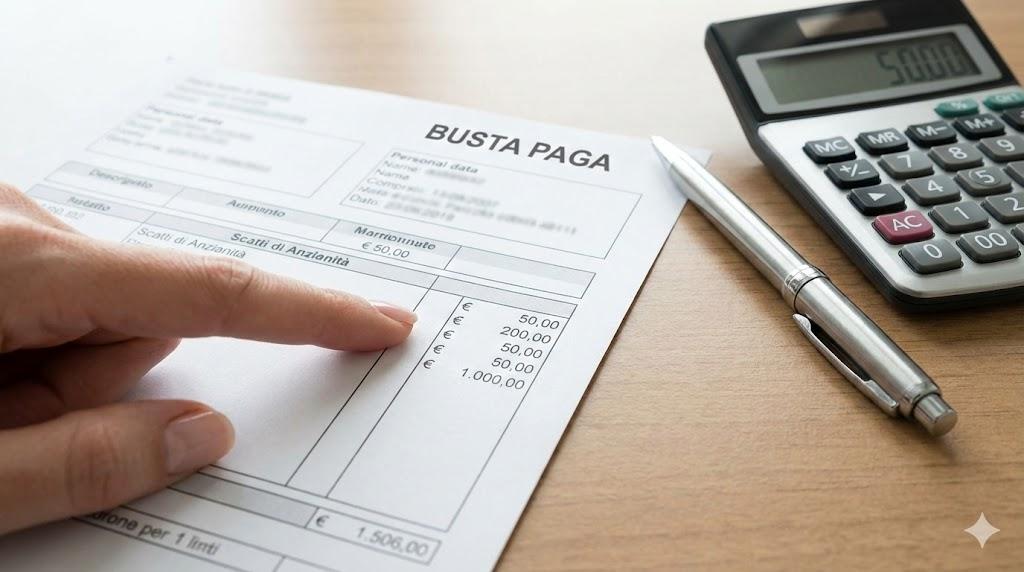 For anyone working in Italy, understanding a busta paga is one of the most useful financial skills to develop.
Your Italian payslip contains much more information than the amount deposited into your bank account. It records your gross salary, taxes, social security contributions, overtime, holiday entitlement, employment classification and, in many cases, the severance pay you are accumulating.
Unfortunately, it can also be confusing.
Even Italians sometimes struggle to understand their monthly cedolino, especially when the figures change because of tax adjustments, bonuses, absences or additional salary payments.
For foreigners who have moved to Italy, the terminology creates another obstacle. Words such as imponibile, trattenute, conguaglio and ratei may be unfamiliar, even to someone who already speaks conversational Italian.
This guide explains how to read an Italian payslip, understand the difference between gross and net salary, recognize the main deductions and identify possible mistakes.
It also covers the Italian tax rates applicable in 2026.
What Is a Busta Paga in Italy?
The busta paga, also called a cedolino paga or prospetto paga, is the document that explains how an employee’s salary has been calculated.
It is normally provided every month by an employer, either on paper or electronically.
Italian legislation, particularly Law No. 4 of January 5, 1953, establishes the obligation to provide employees covered by that law with a statement detailing their remuneration and individual deductions.
The law was updated in 2026 to require identification of the applicable national collective employment agreement, known as the CCNL, using its unique alphanumeric code.
A typical Italian payslip contains three main sections:
- Employee and employer information: Your personal details, employment contract, job classification and payment period.
- Earnings and deductions: Your basic salary, allowances, overtime, social security contributions and income tax.
- Totals and accumulated balances: Your net salary, vacation entitlement, other leave balances and information about severance pay.
The format may vary depending on the employer, payroll provider and employment sector.
However, the underlying principles are broadly similar.
The Top of Your Payslip: Understanding Your Employment Details
Before looking at your salary, examine the information at the top of the document.
This section identifies the employer, the employee and the contractual conditions used to calculate the payment.
Employer Information
The company section may include:
- Ragione sociale: The employer’s registered business name.
- Codice fiscale: The employer’s Italian tax identification number.
- Partita IVA: The company’s VAT number, when applicable.
- Matricola INPS: The employer’s social security registration reference.
- Posizione INAIL: Information related to workplace accident insurance.
These details help identify the organization responsible for your salary and employment contributions.
Employee Information
Your personal section normally includes:
- Nome e cognome: Your full name.
- Codice fiscale: Your personal Italian tax identification number.
- Data di assunzione: Your employment start date.
- Qualifica: Your professional classification.
- Livello: Your contractual grade or level.
- Tipo di contratto: The type of employment relationship.
- Periodo di paga: The month and year covered by the payslip.
Check your employment start date and contractual level carefully.
An incorrect level can affect your basic salary and other contractual entitlements.
What Does CCNL Mean?
One of the most important abbreviations on an Italian payslip is CCNL.
It stands for Contratto Collettivo Nazionale di Lavoro, or National Collective Employment Agreement.
Italy’s employment system relies heavily on collective agreements negotiated for particular industries and occupations.
Examples include agreements covering commerce, tourism, metalworking, construction and other sectors.
Your CCNL can establish essential conditions such as minimum contractual pay, working hours, job grades, overtime premiums, additional monthly payments, leave arrangements and notice periods.
Two employees with similar jobs may receive different remuneration because they are covered by different agreements or contractual grades.
Before accepting employment, it is important to understand which agreement applies.
For additional information about employment opportunities and contracts, read our Finding a Job in Italy: In-Demand Jobs and Expat Guide.
Understanding Your Gross Salary: Retribuzione Lorda
The next step is identifying your retribuzione lorda, or gross remuneration.
This represents the salary and other earnings calculated before the applicable employee deductions.
Your gross monthly pay may consist of several different elements.
Paga Base or Minimo Tabellare
The paga base is your basic contractual salary.
It usually depends on your CCNL and job classification.
For example, an employee classified at one level under a commerce agreement may have a different contractual minimum from an employee at a higher level.
Your basic salary is therefore not necessarily the same as your complete gross salary.
Superminimo
A superminimo is additional remuneration paid above the contractual minimum.
It may be individually negotiated or otherwise established through the employment relationship.
Two terms are particularly important:
Superminimo assorbibile: An increase in contractual minimum pay may be offset against this additional amount under the applicable terms.
Superminimo non assorbibile: The additional amount is protected against that form of absorption under the applicable agreement.
This distinction matters when collective agreements are renewed and minimum salaries increase.
Scatti di Anzianità
These are seniority-related salary increases.
Depending on the employment agreement, employees may become entitled to additional amounts after completing specified periods of service.
The timing and value of these increases depend on the relevant CCNL.
Contingenza and EDR
Some payslips contain historical salary components such as indennità di contingenza and Elemento Distinto della Retribuzione (EDR).
The contingenza originated in earlier wage-adjustment systems.
In many agreements, these items have been incorporated into broader salary figures or are displayed as separate components.
Do not assume that every payslip must show identical salary headings.
Indennità
An indennità is an allowance or additional payment connected with employment conditions.
Examples may include compensation for shifts, night work, specific responsibilities, travel assignments or other contractual circumstances.
Some payments are taxable salary, while qualifying expense reimbursements may receive different treatment.
The distinction depends on the nature of the payment and applicable rules.
Overtime, Bonuses and Other Variable Earnings
Not every component of your salary remains the same from month to month.
Variable earnings may include:
Straordinario: Overtime compensation for qualifying work beyond normal working hours.
Lavoro notturno: Compensation for night work.
Lavoro festivo: Compensation for working on holidays, subject to the contractual rules.
Premio di produzione: A performance or productivity bonus.
Provvigioni: Sales commissions.
Arretrati: Payments relating to previous payroll periods, often following contractual increases or corrections.
These amounts can produce noticeable differences between consecutive payslips.
If your net salary suddenly rises, look for overtime, bonuses or other additions before assuming your permanent salary has increased.
Conversely, a lower payment may reflect fewer variable earnings rather than a reduction in your contractual wage.
Gross Salary vs Net Salary: The Most Important Difference
Many people moving to Italy are surprised by the difference between their agreed salary and the amount arriving in their bank account.
The explanation begins with two terms:
Lordo means gross.
Netto means net.
Your gross salary represents earnings before the employee’s applicable deductions.
Your net salary is the amount remaining after those deductions and any relevant payroll adjustments.
The basic calculation is:
Gross earnings − employee contributions − taxes − other deductions + applicable net adjustments = net pay
The exact calculation depends on your contract, tax circumstances and the payments included in that month.
Example: Reading a Sample Italian Payslip
Imagine an employee receiving the following monthly salary:
| Payslip item | Amount |
|---|---|
| Paga base — Basic salary | €2,100 |
| Superminimo — Additional salary | €150 |
| Straordinario — Overtime | €150 |
| Total gross earnings | €2,400 |
| Employee social contributions | −€225 |
| IRPEF withheld after applicable tax credits | −€280 |
| Regional and municipal tax deductions | −€30 |
| Net salary | €1,865 |
This is a simplified illustration, not an actual 2026 payroll calculation. The deduction amounts are hypothetical and should not be used to estimate what a particular employee would receive.
In this example, the employee earns €2,400 gross but receives €1,865 after the listed deductions.
The difference is €535.
The example also demonstrates why comparing salaries between countries can be misleading.
A job advertised at €30,000 gross annually does not mean the employee will receive €30,000 in their bank account over the year.
What Are INPS Contributions?
One of the principal deductions appearing on an Italian payslip concerns social security.
INPS stands for Istituto Nazionale della Previdenza Sociale, Italy’s national social security institution.
Social security contributions help finance pensions and other protections, according to the worker’s employment category and insurance coverage.
For ordinary employment, contributions are divided between the employer and employee.
The employer is responsible for paying the relevant contributions to INPS, including the employee portion withheld through payroll.
On your payslip, you may encounter abbreviations such as:
- Contributi INPS: Social security contributions.
- IVS: Invalidità, Vecchiaia e Superstiti — disability, old-age and survivors’ insurance.
- Imponibile previdenziale: Earnings used to calculate social security contributions.
- Contributi a carico del dipendente: Contributions charged to the employee.
For many ordinary private-sector employees, the standard pension contribution charged to the worker is around 9.19%, although the actual rate and total contribution treatment can differ according to sector, employment category, applicable funds and specific legislation.
Do not assume that every worker has exactly the same percentage deducted.
What About INAIL?
INAIL is Italy’s national institution responsible for compulsory insurance against occupational accidents and certain work-related diseases.
Unlike ordinary employee INPS deductions, compulsory INAIL insurance premiums are generally paid by the employer.
You may see INAIL references in the administrative information on the payslip without a corresponding employee deduction.
Can You Check Your INPS Contributions?
Yes.
INPS provides online services through which workers can consult their contribution records.
You can access the institution using an accepted digital identity, such as SPID or CIE, and consult the relevant contribution-account service.
For private-sector employees, INPS also provides services allowing consultation of information reported by employers.
Checking your contribution history periodically is particularly important if you have changed employers, worked on temporary contracts or spent part of your career outside Italy.
IRPEF: Understanding Italian Income Tax in 2026
After social security contributions, income tax is one of the most important deductions.
IRPEF stands for Imposta sul Reddito delle Persone Fisiche, Italy’s personal income tax.
For the 2026 tax year, the principal national IRPEF brackets are:
| Annual taxable income | Marginal IRPEF rate |
|---|---|
| Up to €28,000 | 23% |
| Above €28,000 to €50,000 | 33% |
| Above €50,000 | 43% |
The important word is marginal.
If your taxable income is €35,000, the entire amount is not taxed at 33%.
Instead, the first €28,000 falls within the 23% bracket, and the remaining €7,000 falls within the 33% bracket.
For an illustrative annual taxable income of €35,000, national IRPEF before applicable tax credits and other adjustments would therefore be:
- €28,000 × 23% = €6,440
- €7,000 × 33% = €2,310
- Total before tax credits = €8,750
The amount ultimately payable can be lower because of eligible tax credits and other provisions.
A major change introduced for 2026 reduced the second national IRPEF rate from 35% to 33%.
Imponibile Fiscale
Another term worth understanding is imponibile fiscale.
This is the taxable income figure used for income-tax calculations.
For ordinary employment earnings, it will often differ from gross pay because employee social security contributions generally reduce the taxable amount.
However, the exact calculation depends on the type of earnings, benefits and applicable tax rules.
Detrazioni per Lavoro Dipendente
These are tax credits available in connection with employment income.
They can reduce the income tax otherwise payable, subject to eligibility and income-dependent rules.
The amount may vary according to your projected annual income and other circumstances.
Do not confuse a detrazione, which generally reduces tax, with a deduzione, which generally reduces taxable income.
Addizionale Regionale and Addizionale Comunale
Italy also applies regional and municipal income-tax surcharges.
These may appear as:
Addizionale regionale IRPEF
Addizionale comunale IRPEF
The amount depends on the applicable regional and municipal rules and your taxable income.
Consequently, two employees receiving identical gross salaries in different municipalities may have different final tax deductions.
For a broader explanation, including tax residence and foreign income, see our Taxes in Italy for Expats and Foreign Residents.
Tredicesima and Quattordicesima: Why Some Italians Receive 13 or 14 Salaries
An important difference between Italian employment and many foreign payroll systems concerns additional monthly salary payments.
Tredicesima Mensilità
The tredicesima is an additional salary installment commonly paid in December.
It is a standard feature of many Italian employment arrangements.
The amount depends on the employee’s qualifying remuneration and the period worked during the year.
Someone who begins employment partway through the year will generally accrue a proportional entitlement, subject to the applicable rules.
Quattordicesima Mensilità
Some employees also receive a quattordicesima, or fourteenth-month salary.
This additional payment depends on the employment agreement and is commonly associated with certain sectors.
It is not automatically owed to every Italian employee.
Why Annual Gross Salary Matters
Suppose an employment contract offers €28,000 in annual gross remuneration, distributed in 14 equal installments.
That corresponds to €2,000 gross per installment.
By contrast, €28,000 distributed in 13 equal installments corresponds to approximately €2,153.85 gross per installment.
The annual amount remains €28,000 in both examples.
However, the normal monthly payment and the timing of additional installments differ.
When comparing Italian job offers, always ask for the RAL, or Retribuzione Annua Lorda.
This is the annual gross salary figure normally used when discussing employment compensation.
Also confirm which remuneration components are included in the quoted RAL.
Additional payments may not produce the same net amount as ordinary monthly salary because payroll tax credits and withholding calculations can differ.
Holidays, Leave and Absences on Your Payslip
Your Italian payslip may also function as a record of working time and leave.
These entries can be particularly confusing because employers may calculate and display entitlements in days or hours.
Ferie
Ferie means paid annual vacation.
Under Italian law, employees generally have a minimum entitlement of four weeks of paid annual leave.
A CCNL can provide more favorable conditions.
Payslips commonly show several figures:
Ferie maturate: Vacation entitlement accrued.
Ferie godute: Vacation already taken.
Ferie residue: Remaining vacation entitlement.
Ferie anno precedente: Leave carried forward from a previous year, where separately recorded.
For example, if your available vacation balance was 15 days and you took five qualifying days of leave, the remaining balance would normally fall to ten days, before accounting for additional leave accrued during that period.
Remember that an employee’s ordinary statutory annual leave cannot generally be replaced by a cash payment while employment continues, except where the law permits payment upon termination.
ROL and Permessi
ROL stands for Riduzione Orario di Lavoro.
These are working-time reduction hours or permits made available under relevant contractual arrangements.
You may also see permessi retribuiti, meaning paid leave permissions.
The amounts and conditions depend on the contract and the particular type of leave.
Ex Festività
Some agreements provide leave connected with certain former public holidays.
These may appear on a payslip as ex festività.
Malattia
Malattia means sickness or sick leave.
An absence due to illness may affect the payslip according to statutory rules, the CCNL, any applicable waiting period, INPS benefits and employer-paid supplements.
A lower net payment during illness is not automatically an error, but it should be understandable from the entries shown.
What Is TFR? Understanding Italian Severance Pay
One of the most important concepts in Italian employment is TFR.
It stands for Trattamento di Fine Rapporto.
TFR is a form of deferred remuneration that generally becomes payable when employment ends, subject to the rules governing advances, pension funds and other applicable arrangements.
It is not simply an ordinary monthly bonus.
Under the statutory calculation, the annual TFR accrual broadly begins with the remuneration relevant for TFR purposes divided by 13.5, with further statutory adjustments and revaluation rules applying.
Depending on the employment arrangement and the worker’s choices, TFR may remain within the legally applicable employer or Treasury Fund arrangement, or be directed to supplementary pension provision.
A payslip may contain entries such as:
- TFR maturato: TFR accrued.
- TFR anno: TFR accrued during the year.
- TFR progressivo: Accumulated TFR information.
- Fondo pensione: Supplementary pension fund.
These entries do not necessarily represent money being paid into your bank account that month.
In particular, do not subtract an ordinary TFR accrual from net salary unless the payroll actually records a corresponding employee deduction or other adjustment.
TFR deserves attention because it can represent a substantial amount after several years of employment.
Conguaglio: Why Your December Payslip May Look Different
Another important Italian payroll term is conguaglio.
It means a reconciliation or adjustment.
Employers calculate income-tax withholding during the year using available information and projected annual figures.
At year-end, or when employment ends, the employer may need to reconcile the amounts previously withheld against the correct calculation for the relevant employment income.
This may produce a credit or an additional deduction.
That explains why a December payslip can sometimes contain unexpected figures.
A conguaglio fiscale is an income-tax reconciliation.
A conguaglio previdenziale concerns social-security contribution adjustments.
You may also encounter adjustments resulting from your annual tax return.
For example, a refund or additional amount due following a Modello 730 may appear through payroll if the relevant withholding and adjustment procedures apply.
A payroll adjustment is not necessarily a penalty or a mistake.
Nevertheless, if a large amount appears, you should ask what period and calculation it relates to.
Understanding Your Certificazione Unica and Modello 730
Your monthly payslips are closely connected with two other important Italian tax documents.
The Certificazione Unica, commonly called CU, summarizes relevant income, tax withholdings and other information reported by the employer or another withholding agent for the reference year.
The Modello 730 is an income-tax declaration frequently used by employees and pensioners.
These documents serve different purposes.
Your payslip explains an individual payroll period.
The CU summarizes relevant annual information.
The 730 is used to declare and reconcile tax information when applicable.
If you have multiple employers, other taxable income, foreign assets or financial circumstances outside ordinary employment, your tax position may require additional attention.
Not everyone with an Italian payslip automatically has exactly the same tax-filing obligations.
If you need assistance, our guide to CAF and Patronato in Italy explains where to seek help with taxes, pensions, contributions and administrative paperwork.
A Quick Italian Payslip Glossary
Here are the expressions you are most likely to encounter.
| Italian term | English meaning |
|---|---|
| Busta paga / Cedolino | Payslip |
| Retribuzione lorda | Gross pay |
| Netto in busta | Net take-home pay |
| Paga base | Basic salary |
| Superminimo | Additional salary above the contractual minimum |
| Competenze | Earnings and amounts credited |
| Trattenute | Deductions |
| Imponibile previdenziale | Social-security contribution base |
| Imponibile fiscale | Taxable income base |
| Contributi INPS | Social security contributions |
| IRPEF | Personal income tax |
| Detrazioni | Tax credits |
| Straordinario | Overtime |
| Ferie residue | Remaining vacation leave |
| Permessi | Leave permissions |
| Tredicesima | Thirteenth salary installment |
| Quattordicesima | Fourteenth salary installment |
| TFR | Severance pay entitlement |
| Conguaglio | Reconciliation or adjustment |
| Arretrati | Back pay |
| Ratei | Accrued portions of future entitlements |
| Progressivo | Cumulative figure |
| RAL | Annual gross salary |
Keeping this table accessible can make the first few months of Italian employment considerably easier.
How to Check Your Italian Payslip for Mistakes
You do not need to be an accountant to recognize potential payroll problems.
I recommend examining your payslip every month rather than looking only at the final amount deposited.
Here is a practical checklist:
- Confirm your personal information. Check your name, codice fiscale and employment start date.
- Check the CCNL and level. Make sure your contractual classification matches your employment agreement.
- Verify basic salary. Compare it with the amount established by your contract and applicable pay tables.
- Review overtime and bonuses. Confirm that eligible additional work and payments have been recorded.
- Check absences. Make sure sickness, vacation and unpaid leave entries correspond to actual events.
- Compare leave balances. Look for unexpected changes to accumulated vacation or permissions.
- Review deductions. Ask about new or unusually large tax, social-security or other withholding entries.
- Check your net payment. Compare the payslip’s payment amount with the actual bank transfer, allowing for any separately documented adjustments.
- Review cumulative information. Examine annual taxable earnings, relevant TFR records and other progressive totals.
- Keep copies. Save your payslips, contract, CU documents and important payroll correspondence.
One payslip may look unusual because of an annual adjustment. Repeated unexplained discrepancies deserve further investigation.
What Should You Do If Your Employer Makes a Payroll Mistake?
If you believe a deduction or salary calculation is incorrect, begin by asking for an explanation.
Your first contact will normally be the payroll department, human resources office, employer or external payroll consultant.
Explain the specific entry you do not understand.
For example:
Vorrei un chiarimento su questa trattenuta nella mia busta paga.
“I would like clarification about this deduction on my payslip.”
Or:
Potete verificare il calcolo delle ore di straordinario?
“Could you check the overtime calculation?”
Ask for a written explanation if the matter is significant.
If the problem remains unresolved, you may consult a trade union, employment adviser, qualified labour consultant (consulente del lavoro) or employment lawyer.
A patronato can also help with certain social-security and contribution matters, although it is not necessarily the appropriate institution for every wage dispute.
Do not ignore repeated discrepancies simply because the amount appears small.
Small monthly differences can become significant over time.
Special Considerations for Foreign Employees in Italy
Foreign workers face some additional practical issues.
The first is language.
An employment contract may be discussed in English, but the payslip will normally use Italian payroll terminology.
The second is understanding what the salary offer actually means.
A company may quote annual gross salary, while an employee from another country assumes the amount refers to annual take-home pay.
Always clarify this before accepting a job.
You should also ask how many salary installments you will receive during the year.
If you are working for an Italian company while maintaining financial ties with another country, remember that payroll deductions do not necessarily settle all your international tax obligations.
Italian tax residence, overseas income, foreign tax credits and international social-security rules may need separate analysis.
Remote employment for a foreign company while living in Italy can be particularly complex because the correct payroll and social-security arrangements depend on the circumstances.
In those situations, a commercialista or other appropriately qualified professional with cross-border experience may be necessary.
Frequently Asked Questions About Italian Payslips
Is my busta paga proof of employment?
A payslip can provide useful evidence of an employment relationship and remuneration.
Banks, landlords and other organizations may request recent payslips when assessing income.
However, they may also require an employment contract, CU or other documents.
Why is my net salary different every month?
Common explanations include overtime, bonuses, absences, additional payments, tax adjustments, local income-tax surcharges and changes to payroll deductions.
Compare the individual entries rather than looking only at the net figure.
Does everyone in Italy receive a thirteenth and fourteenth salary?
No.
The thirteenth installment is widespread, while the fourteenth depends on the relevant contractual arrangements.
Always check your CCNL and employment contract.
Is TFR deducted from my monthly salary?
Ordinary TFR accrual is generally deferred remuneration rather than a standard employee deduction from take-home salary.
Pension-fund contributions and other arrangements can create separate payroll entries.
Can I calculate my net salary directly from the gross figure?
You can estimate it, but a reliable calculation requires information about the worker’s social-security position, annual taxable income, tax credits, local tax rules, number of salary installments and other circumstances.
A single universal gross-to-net percentage is not accurate.
What happens if I do not receive a payslip?
Ask your employer for the document. For employment relationships covered by the legal obligation, a payslip must be provided when remuneration is paid.
If the employer refuses or repeatedly fails to provide the required documentation, consider assistance from a trade union, labour adviser or competent labour authority.
Understanding Your Salary Gives You More Control
An Italian payslip may look intimidating at first, but its purpose is straightforward.
It explains what you earned, how that remuneration was calculated, which amounts were withheld and what you ultimately received.
The most important figures to understand are your gross salary, employee social security contributions, income-tax withholding, net pay, leave balances and accumulated TFR information.
Your CCNL and employment classification are equally important because they help determine whether your salary and entitlements are correct.
Once you recognize the vocabulary, reading a busta paga becomes much easier.
Whether you have just accepted your first job in Italy or have worked here for years, checking your payslip regularly is a practical way to protect your income, understand your employment rights and avoid unpleasant surprises.
External Sources
- Normattiva — Law No. 4/1953: Rules on Employee Payslips
- INPS — Personal Income Tax Reduction in 2026
- INPS — Social Security Contributions
- INPS — Consult Your Social Security Contribution Record
- Italian Ministry of Labour — Annual Leave
- Agenzia delle Entrate — Italian Tax Authority