
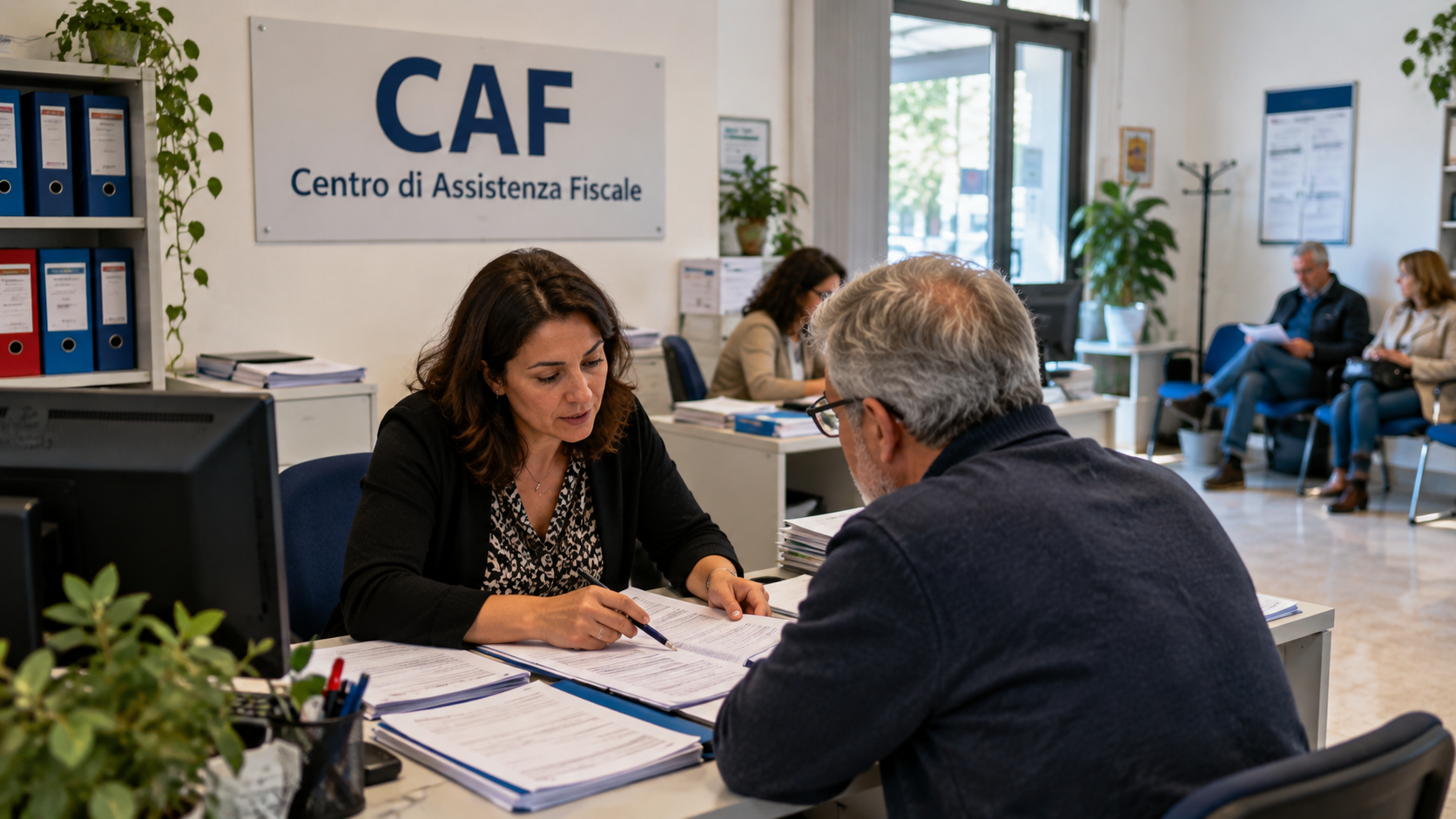
 Moving to Italy means learning a new vocabulary. Some words are obvious enough, while others seem to appear only when you are already standing in front of a bureaucratic problem.
Two of the most useful words to learn are CAF and patronato.
You will see their offices in almost every Italian city and town. They may be connected with a trade union, workers’ association, professional organization, or other national network. Sometimes a CAF and a patronato even operate from the same building.
They are not the same thing, however.
In simple terms, a CAF is mainly associated with taxes, income declarations and financial documentation, while a patronato is primarily concerned with pensions, social security, benefits and other dealings with public institutions such as INPS.
For anyone living in Italy, understanding the difference can save considerable time, especially if your Italian is limited or you are unfamiliar with the country’s administrative system.
What Is a CAF in Italy?
CAF stands for Centro di Assistenza Fiscale, or Tax Assistance Center.
CAF offices are authorized organizations that help individuals with a range of tax and financial-administration procedures. For many Italians, going to a CAF is a normal part of dealing with annual paperwork.
One of the most familiar services is assistance with the Modello 730, the income-tax return commonly used by employees and pensioners.
A CAF can help collect the necessary information, prepare the declaration, identify relevant deductions and submit the documentation through the appropriate system.
CAF offices are also closely associated with the ISEE, or Indicatore della Situazione Economica Equivalente.
The ISEE is an indicator used to assess the economic situation of a household. It can affect eligibility for or the cost of numerous benefits and public services.
INPS and CAF organizations continue to operate under formal arrangements for ISEE certification. INPS confirmed a specific CAF agreement for ISEE certification for 2026.
Depending on the office and your circumstances, a CAF may assist with matters such as:
- Modello 730 tax returns
- ISEE applications
- income and household financial documentation
- certain IMU-related calculations and declarations
- tax deductions and deductible expenses
- rental-contract tax matters
- other fiscal declarations and forms
Exactly which services are available can vary between CAF networks and individual offices.
For foreigners living in Italy, the CAF can be particularly useful because the Italian tax system may be very different from the one in your home country.
However, a CAF is not necessarily a substitute for a commercialista, or accountant, especially when your financial situation is complicated.
What Is a Patronato?
A patronato has a different role.
Italy’s patronati are legally recognized organizations that provide information, assistance and protection in matters involving social security and related public benefits.
According to Italy’s Ministry of Labour and Social Policies, patronati can assist employees, self-employed workers, pensioners, Italian citizens, foreign citizens and stateless people present in Italy. Their role includes assistance concerning social-security benefits as well as certain immigration and emigration matters.
That makes the patronato particularly important when you are dealing with INPS, Italy’s national social-security institution.
Typical patronato work may involve:
- pension applications
- social-security contributions
- disability and certain welfare benefits
- unemployment-related procedures
- family and social benefits
- maternity-related benefits
- contribution records
- survivor benefits
- some immigration-related procedures
- communication and applications involving INPS
INPS itself maintains digital services specifically intended for patronati, illustrating how these organizations function as intermediaries between citizens and the social-security administration.
The Ministry of Labour maintains the official list of recognized patronati. Major organizations include Patronato ACLI, INCA-CGIL, INAS-CISL and ITAL-UIL, alongside numerous other recognized institutions.
You do not have to choose a patronato solely according to your political views or union membership. If one office cannot deal with your particular case, you can contact another recognized patronato.
CAF vs Patronato: Which One Do You Need?
The easiest way to understand the difference is to start with the problem you are trying to solve.
| You need help with… | Usually start with… |
|---|---|
| Modello 730 income-tax return | CAF |
| ISEE | CAF |
| Tax deductions | CAF |
| Basic tax documentation | CAF |
| Pension application | Patronato |
| INPS pension problem | Patronato |
| Social-security contributions | Patronato |
| Certain unemployment benefits | Patronato |
| Survivor pension | Patronato |
| Certain disability or welfare benefits | Patronato |
| Some immigration/social-assistance procedures | Patronato |
| Complex business or professional taxation | Commercialista |
There is some overlap.
A large organization may operate both a CAF and a patronato, and the person at reception will often direct you to the appropriate department.
Therefore, if you are not sure which one you need, do not worry too much about choosing incorrectly. Explain what you need when making the appointment.
When You Need a Commercialista Instead
A common mistake among foreigners is assuming that a CAF can handle every tax problem.
It cannot.
A commercialista is a qualified professional whose role is closer to that of an accountant and tax adviser.
If you are an employee with a relatively straightforward Italian tax situation, a CAF may be sufficient for your annual declaration. If you run a business, work as a freelancer, have a partita IVA, own substantial investments, receive income from several countries or have complicated foreign assets, professional tax advice may be necessary.
This distinction becomes especially important for international residents.
Italy has specific rules governing tax residence, foreign income and foreign assets. Simply having paid tax in another country does not automatically mean that you have no reporting or tax obligations in Italy.
If you have moved to Italy from the United States, United Kingdom or another country while retaining investments, property, pensions, businesses or other assets abroad, it is prudent to consult a commercialista experienced in international taxation rather than relying exclusively on general CAF assistance.
The same applies if you are moving to Italy and need to understand the financial consequences of becoming an Italian tax resident.
What Is ISEE and Why Will You Hear About It So Often?
Sooner or later, many people living in Italy encounter the acronym ISEE.
The Indicatore della Situazione Economica Equivalente provides an assessment of a household’s economic circumstances. It takes into account various elements of income, assets and family composition.
It is not simply another income-tax return.
Instead, the ISEE is used to establish access to, or determine conditions for, a variety of social benefits and subsidized services.
Depending on the benefit involved, an ISEE may be requested for matters involving university fees, family assistance, social programs and other income-related services.
CAF offices play an important role in this process. INPS’s 2026 agreement with participating CAF organizations specifically covers ISEE certification activity.
For foreigners, preparing an ISEE can require extra attention when income or assets exist outside Italy. Do not assume that foreign bank accounts or property are irrelevant simply because they are located abroad.
Ask the CAF exactly which documents are required for your household and your circumstances before your appointment.
Going to a CAF or Patronato: What Should You Bring?
Italian bureaucracy rewards preparation.
The exact documents depend on the procedure, so ask the office for a checklist when booking your appointment.
As a starting point, you may be asked for documents such as your:
Codice fiscale – your Italian tax identification number.
Identity document – usually a passport or Italian/EU identity card.
Residence documentation – if relevant to the procedure.
Permesso di soggiorno – for non-EU citizens when relevant.
Income documentation – such as the Certificazione Unica, pension statements or other evidence of income.
Bank and investment information – particularly for ISEE or tax-related procedures.
Property documentation – if real estate is relevant.
Family information – when benefits or household calculations are involved.
INPS correspondence – if you are visiting a patronato about a pension or benefit.
Bring any letter, email or official notification related to the problem.
This last point is important. Do not try to summarize an INPS or Agenzia delle Entrate letter from memory. Bring the actual document.
Are CAF and Patronato Services Free?
This is one area where it is better not to make assumptions.
Many patronato activities connected with their institutional role are provided without a direct charge to the citizen because patronati operate within a legally regulated and publicly funded framework. The Ministry of Labour oversees these institutions and their activities.
However, not every possible service offered through an organization or associated office is necessarily free.
CAF services can also vary. Certain activities may be covered under institutional arrangements, while other services may involve a fee, membership arrangement or charge depending on the organization and the work required.
The safest approach is simple:
Ask whether the service is free and, if not, what it will cost before authorizing the work.
Do not assume that every CAF or patronato follows exactly the same pricing policy.
Do You Need to Belong to a Trade Union?
Not necessarily.
Many of Italy’s best-known CAF and patronato networks are associated with trade unions or national organizations. This explains why you may see names such as CGIL, CISL, UIL and ACLI attached to offices.
But the Ministry of Labour recognizes a much broader range of patronato organizations.
For the person seeking assistance, the practical questions are usually more important: does the office handle your procedure, when can it see you, and does it have experience with your particular situation?
If your case involves foreign income, an overseas pension or immigration documentation, mention this when booking.
An office that routinely assists international residents may be much more useful than one that rarely handles such cases.
Can Foreigners Use a Patronato?
Yes.
This is particularly worth emphasizing because some newcomers assume patronati are only for Italian workers or pensioners.
The Ministry of Labour explicitly describes patronato assistance as covering Italian citizens, foreign citizens and stateless people present in Italy, including assistance in areas of social security and immigration.
For a foreign resident trying to navigate an unfamiliar administrative system, that can make a patronato one of the most useful places to know.
If you are still dealing with the residency process itself, see our section on Moving & Residency in Italy for more practical guides.
What About Pensions From Another Country?
International pensions can become complicated quickly.
A person retiring in Italy may have worked in Italy, another EU country, the United States, the United Kingdom or several countries during their career.
A patronato is often a sensible first stop when the issue concerns Italian pension rights, contribution records or international social-security coordination.
However, pension administration and taxation are two separate questions.
A patronato may help you understand or claim pension rights, while a CAF or commercialista may be needed to determine how pension income should be declared and taxed.
This is an important distinction for anyone considering retirement and healthcare in Italy.
Do not assume that the institution helping you obtain a pension is also providing comprehensive tax advice about that pension.
How to Find a CAF or Patronato Near You
In most Italian cities, finding one is not difficult.
Searching for “CAF + your town” or “patronato + your town” will normally produce several options.
For patronati, you can also consult the official list maintained by the Italian Ministry of Labour and Social Policies. The Ministry currently lists recognized organizations including ACLI, INCA, INAS, ITAL, ENAPA, EPACA, INAC and others.
Before simply walking in, call or check whether an appointment is required.
Demand can become particularly heavy around tax deadlines and periods when applications for major benefits are due.
When making an appointment, describe the service you need rather than simply saying, “I need help with paperwork.”
For example:
“I need to prepare my ISEE.”
“I need help with my 730.”
“I need to apply for my pension.”
“I need to check my INPS contributions.”
This allows the office to book you with the correct person and tell you what documentation to bring.
Language Can Be the Biggest Challenge
CAF and patronato offices are designed to make bureaucracy easier, but they are still part of an overwhelmingly Italian-language administrative environment.
Do not assume that English will be spoken.
In larger cities and areas with substantial international populations, finding an English-speaking employee may be easier. In smaller towns, you may need to conduct the appointment in Italian.
If your Italian is limited, ask when booking whether someone speaks English.
For an important procedure, consider bringing an Italian-speaking person you trust if the office permits it. For formal representation or submission of documents on another person’s behalf, specific authorization or delegation requirements may apply, so ask in advance.
Most importantly, make sure you understand what is being submitted in your name.
A Practical Part of Everyday Life in Italy
CAF and patronato offices may not be among the glamorous aspects of moving to Italy, but knowing how to use them can make everyday life considerably easier.
Italy’s administrative system can appear fragmented because different institutions handle taxation, pensions, benefits, residence and other obligations. The trick is often not knowing the answer yourself, but knowing where to ask the question.
For taxes and fiscal paperwork, think CAF.
For pensions, social security, INPS and many benefit-related procedures, think patronato.
For complex taxation, business matters or international financial affairs, think commercialista.
And when you are unsure, ask.
It is completely normal in Italy to seek assistance with official paperwork rather than attempting to navigate every government portal alone. CAF and patronato offices exist precisely because the country’s tax and social-security systems can be difficult for ordinary citizens to manage without assistance.
For newcomers in particular, learning how these offices work is one of those small steps that makes everyday life in Italy much easier.
External Sources
INPS – ISEE 2026 and CAF agreement
Italian Ministry of Labour – Patronato institutions
Italian Ministry of Labour – Supervision and role of patronati
INPS – Pension and social-security services