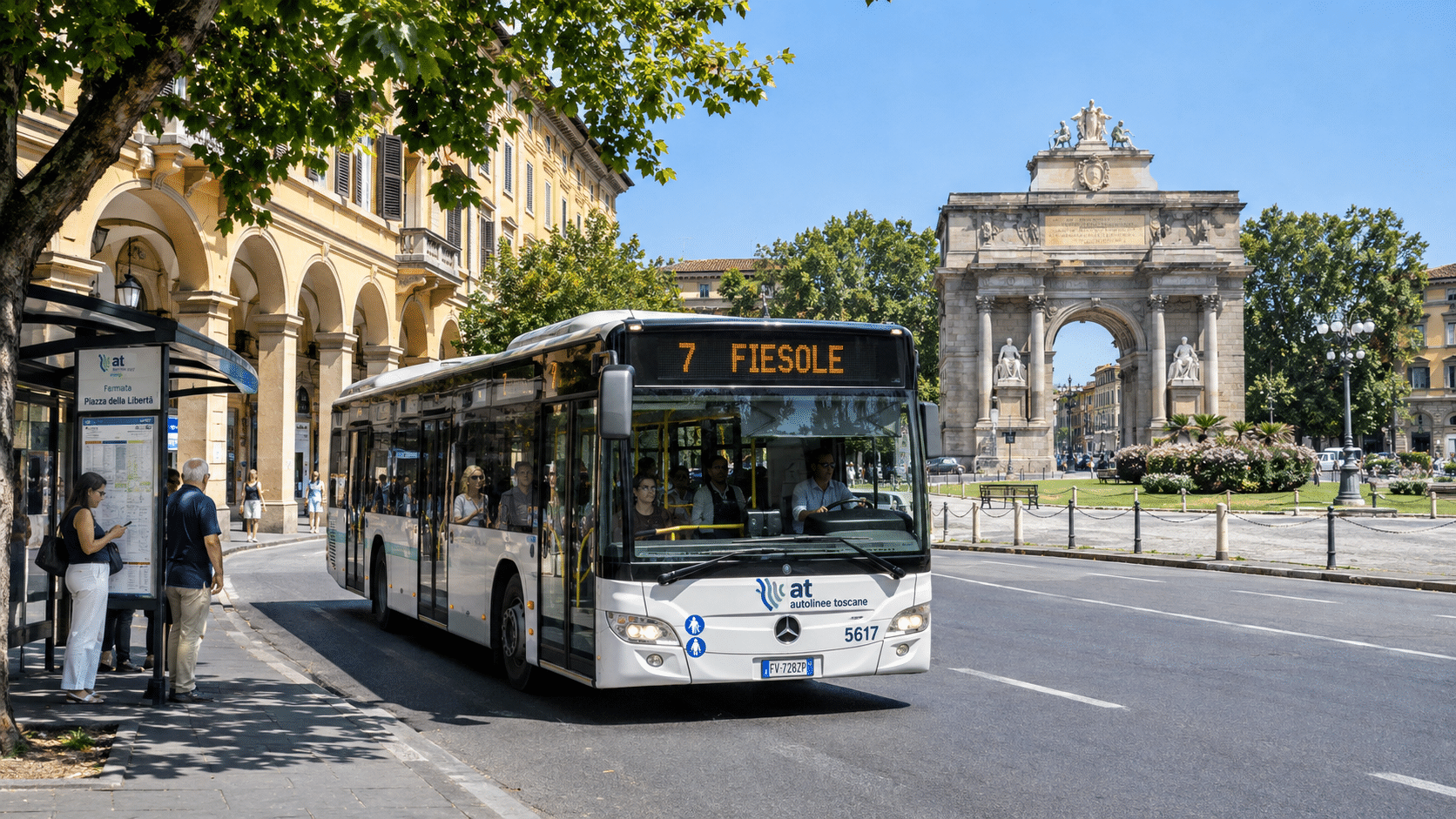
Florence looks compact on a map. On the ground, a day of museums, stone pavements, queues and bridges can feel considerably longer. Add the climb to Piazzale Michelangelo and the walk back to your hotel, and a supposedly gentle itinerary becomes a demanding one.
Public transport can take some of that effort out of the day. The trick is to use trams for the main connections, buses for selected destinations and short walks for individual neighborhoods. You will still need to cover the final distance to many sights, but you do not need to cross the entire city on foot between them.
This guide focuses on those practical choices: arriving at Santa Maria Novella or the airport, reaching the San Marco area, taking a bus uphill and choosing accommodation that makes the return journey easier.
Transport information checked November 10, 2026. Fares, stops and diversions can change; check the linked operators before traveling. Walking distances below are approximate planning estimates, not accessibility assessments.
Affiliate disclosure: Italia Mia may earn a commission from qualifying purchases or bookings through affiliate links in this article, at no additional cost to you. As an Amazon Associate, we earn from qualifying purchases.
What Florence’s Trams Can—and Cannot—Do
Florence’s operating tram network has two main lines useful to visitors:
- T1: Villa Costanza–Careggi, serving Santa Maria Novella and the western side of the city, including the Cascine area.
- T2: Peretola Aeroporto–San Marco–Università, linking the airport, the station area, Piazza della Libertà and San Marco.
The T2 extension means that older advice describing Piazza dell’Unità Italiana as the line’s final destination is out of date. Follow current platform signs and the destination on the tram.
Neither line provides a doorstep service to the Uffizi, Ponte Vecchio, Palazzo Pitti or Santa Croce. For those sights, decide whether a short walk, a suitable bus connection or a taxi best matches your energy and mobility needs.
| Your destination | Useful transport approach | What remains on foot |
|---|---|---|
| Santa Maria Novella railway station | T1 or T2; choose the appropriate station-area stop | The distance between the platform, station entrance and your train |
| Accademia and San Marco Museum | T2 to San Marco–Università | A short local approach, roughly 100–300 meters depending on the entrance |
| Duomo area | T2 to San Marco, followed by a walk south | Roughly 600–800 meters, depending on the destination and route |
| Uffizi and Piazza della Signoria | Plan a bus or taxi approach if the walk from the station or San Marco is too long | Check the actual arrival point and museum entrance; the tram does not reach this area |
| Piazzale Michelangelo | Check buses 12 and 13 for your origin and travel time | A local walk from the operating stop to the viewpoint |
| Fiesole | Bus 7 from Libertà Porta San Gallo to Fiesole Piazza Mino | The square is close to the terminus; further sightseeing can involve slopes |
For a first visit, this transport plan works best alongside a selective sightseeing schedule. Italia Mia’s guide to Italy for first-time visitors explains how to leave enough time for each city.
From Florence Airport: Take T2 Toward San Marco
At Florence’s Amerigo Vespucci Airport, also called Peretola, follow signs for the tram. GEST describes the airport stop as about a two-minute walk from arrivals and departures; allow longer with luggage or at a slower pace.
Take T2 toward San Marco–Università. For accommodation near Santa Maria Novella, use the station-area stop that best matches your hotel. If you are staying near San Marco, continuing on the tram may save a substantial walk with bags.
Be careful with the often-quoted “20 minutes to Florence” description. This is useful as an approximate airport-to-station-area journey, but the municipal tram website lists about 35 minutes for the full airport–San Marco route. Add waiting time and the journey from the stop to your accommodation.
The airport journey uses the ordinary Florence urban ticket: there is no separate airport supplement for T2.
For an early flight or late arrival, check the GEST timetable for the specific direction. A network closing time is not the last departure from every stop. If a flight delay puts the final tram in doubt, have a taxi option available.
From Santa Maria Novella: Choose Your First Stop Carefully
Arriving by train does not mean you need to start walking immediately toward the Duomo. First identify the part of Florence where you want to spend the next few hours.
For San Marco or the Accademia, T2 toward San Marco can remove much of the approach on foot. It follows a circuit through the northern side of the center, so it is a useful way to reduce walking rather than necessarily the fastest door-to-door option.
For Santa Maria Novella church and nearby streets, staying in the station neighborhood may be simpler than taking transport. For the Uffizi or Oltrarno, check the current bus planner or consider a taxi if walking across the center would use too much of your energy.
Station-area stops are spread around different sides of the railway station. “Near SMN” is not precise enough when every extra hundred meters matters. Use the named stop, direction and map pin shown in your journey plan.
Florence Tickets: €2 for 90 Minutes
The standard Florence urban ticket costs €2 and is valid for 90 minutes from validation or activation, covering urban buses and the tram within the applicable network. The fare increased on August 1, 2026, so older references to €1.70 should not guide your budget.
The operator currently lists a 10-journey urban carnet at €18.20. Compare that with your actual plans: a visitor making only two separately charged journeys a day would spend €4 on ordinary singles. A carnet is more relevant when you expect to use most or all ten journeys.
Paying contactless
The tip tap system lets you pay with a supported contactless bank card, phone or wearable on buses and trams.
- Tap when you board and wait for a successful green confirmation.
- Tap again when changing to another urban bus or tram.
- Use the same card or device throughout the journey so the system recognizes the transfer within the ticket’s validity.
- Each device pays for one passenger at a time. For a group, use separate payment devices or buy individual tickets through the app.
A phone wallet and the physical card linked to it should not be treated as interchangeable during the same journey. Present the same payment medium if an inspector checks your ticket.
On Florence’s tram and urban buses, you do not tap out. Other bus categories, including mixed-fare and extraurban services, have different rules and require an exit tap. Check the service type before boarding.
Paper and app tickets
Tram stops have ticket machines, and tickets are also available through authorized sellers and the at bus app. Validate a paper ticket immediately on boarding; activate an app ticket when starting your journey, following the app’s instructions. Buying a ticket in advance does not by itself make it valid for travel.
Keep the ticket for the entire journey. If a contactless payment fails, arrange a valid alternative rather than assuming the attempted tap is enough.
See the official fare list and tip tap instructions before traveling.
Piazzale Michelangelo Without the Climb
The panorama from Piazzale Michelangelo is an obvious reason to use the bus. Save your walking for the viewpoint instead of using it all on the uphill approach.
Routes 12 and 13 serve Piazzale Michelangelo, written “Michelangiolo” in the operator’s route titles. They follow different routes, so choose according to your starting point and the current journey planner rather than taking the first familiar number you see.
At the November 2026 check, both lines carried service-change notices, including notices related to the closure of Ponte Vespucci. This makes a fixed instruction such as “always board outside the station at this stop” unreliable.
Before leaving, open the official route 12 or route 13 page and check:
- The operating boarding stop near you.
- The direction and expected journey time to the viewpoint.
- The return stop and departures for the time you intend to leave.
Plan to return by bus as well. Walking downhill can be tiring, particularly on uneven surfaces, and is not automatically the easier choice. A sunset visit also means checking the return before darkness and crowds make it harder to locate an unfamiliar stop.
Do not automatically add San Miniato al Monte: it is a separate uphill outing beyond the main viewpoint. Decide on it according to the walking and steps you are comfortable with that day.
Fiesole by Bus: Start at Piazza della Libertà
For a hill-town outing, bus 7 runs from Libertà Porta San Gallo to Fiesole Piazza Mino. Older instructions sending visitors to catch it at San Marco are no longer the right starting point.
From the station area, T2 provides an approach to Piazza della Libertà. Check the short walking connection between the tram stop and the bus terminus; they are separate boarding points.
The bus removes the climb from Florence, but Fiesole itself is not entirely flat. A gentle visit can center on Piazza Mino, a seated break and a modest amount of nearby exploration. Routes toward higher viewpoints and San Francesco add gradients. The archaeological area also needs its own access assessment.
Check both directions on the official bus 7 page. Avoid combining Fiesole, a major museum and Piazzale Michelangelo into one day if the purpose of the trip is to reduce fatigue.
How to Use Buses Without Adding Unnecessary Walking
Florence’s one-way streets mean the return bus stop may be somewhere different from the outward stop. Roadworks can also shift stops or alter a route.
Use the at bus journey planner with your actual starting address, destination and departure time. Look beyond the total journey time: compare the walk to the first stop, any interchange and the walk after getting off. A route with a longer ride may suit you better if it has fewer transfers and shorter approaches.
Check again shortly before leaving, especially on Sundays, holidays or during disruptions. Ask your hotel to help identify the correct boarding point if the map is unclear. Photographing the stop name can make it easier to explain where you are.
For a very short central journey, waiting for a bus may be less comfortable than a brief walk with a café break. For a longer cross-city journey after a museum visit, a taxi may be worth including in the budget. Tell the driver your destination and any walking limitation so you can agree on the closest permitted drop-off point.
Walking Less and Step-Free Travel Are Different Plans
GEST states that its trams and platforms are accessible to passengers with mobility or visual difficulties, with wheelchair spaces on every tram. This makes the tram a useful starting point for planning, but the complete journey also includes pavement crossings, the route to the attraction and the attraction’s own entrance.
If you need wheelchair access on a bus, confirm the specific vehicle and boarding and alighting stops with Autolinee Toscane. Its dedicated mobility assistance number is 800 14 24 25, operating daily from 08:00 to 20:00. The operator provides an accessibility planning service and a booking process for journeys requiring arrangements; contact it ahead of your visit to establish what applies to your route.
Crowded vehicles may also mean standing. Travel outside the busiest periods when possible, leave time for the next departure and build seated breaks into the day. Museum visits can involve significant standing and indoor walking even when the transport connection is excellent.
Three Ways to Build a Gentler Florence Day
San Marco and one museum: Travel to San Marco by T2, visit the Accademia or San Marco Museum, then have lunch nearby. Add a short neighborhood stroll only if you feel comfortable. Return by tram instead of turning the afternoon into a walk across the city.
One central attraction and a viewpoint: Choose a single main visit, allow a proper lunch break, then use a checked bus connection to Piazzale Michelangelo. Return by bus or taxi. Leave flexibility between a timed museum reservation and the bus outing.
Fiesole as the main excursion: Reach Piazza della Libertà, take bus 7 and keep the visit centered on the lower part of town. Return before you are exhausted and leave the evening close to your accommodation.
These are separate options, not three stages of one itinerary. The most useful transport saving is often the journey back to your hotel before you have reached your limit.
Where to Stay for Easier Journeys
For a short stay, compare accommodation around Santa Maria Novella, San Marco and Piazza della Libertà according to the places you most want to visit.
The station area is convenient for train arrivals and airport connections. San Marco suits the Accademia and nearby museums. Piazza della Libertà can work well for T2 and the Fiesole bus, but it is farther from the riverside sights.
A lower-priced hotel farther along a tram line can also work. Calculate the entire daily journey before booking, including the walk from the stop and the final approach to your sights.
Ask the property about the actual entrance, steps before the lift, room access and luggage storage. “Central” and “near public transport” do not tell you whether the route will be comfortable for you.
Book Your Florence Stay and Experiences
Compare Florence accommodation with Expedia. Enter Florence, Tuscany, Italy, choose your dates and use the map to compare properties near the transport stops that fit your plans. Confirm the street address and entrance arrangements directly with the property before booking.
For guided experiences, check the stated walking distance, standing time, meeting point and finishing point before paying. “Skip the line” describes admission arrangements; it does not establish that a tour involves little walking.
For a printed companion, browse Florence travel guides on Amazon.com or Florence guidebooks on Amazon.it. Choose a recent edition, while using the transport operators for current routes and fares.
External Links
- Florence tram network: official city information
- T2: current route and journey information
- GEST: airport tram
- GEST: timetables
- GEST: accessibility and services
- Autolinee Toscane: fares
- Autolinee Toscane: contactless payments
- Bus 7: Libertà–Fiesole
- Bus 12: current route and notices
- Bus 13: current route and notices
- Autolinee Toscane: accessibility planning