
Italy is famous for its mountains, lakes and long Mediterranean coastline, but its rivers have been just as important in shaping the country. They supplied ancient settlements with water, created fertile agricultural plains, powered mills and industries, defined trade routes and became inseparable from cities such as Rome, Florence, Turin and Verona.
Italian rivers tend to be shorter than the great waterways of continental Europe because the Alps and Apennines divide the peninsula into relatively compact drainage basins. Yet several rivers have had an influence far beyond their size.
Five stand out for their combination of geography, history, culture and economic importance: the Po, Adige, Tiber, Arno and Piave.
The Po: Italy’s Longest River
At approximately 652 kilometers (405 miles), the Po is Italy’s longest river. It rises at Pian del Re on Monte Viso in the Cottian Alps of Piedmont and travels eastward across northern Italy before reaching the Adriatic Sea through the extensive Po Delta.
More than any other river, the Po defines the geography of northern Italy.
Its drainage basin encompasses much of the Po Valley, or Pianura Padana, the enormous plain stretching between the Alps and the Apennines. Major tributaries include the Ticino, Adda, Oglio, Mincio and Tanaro.
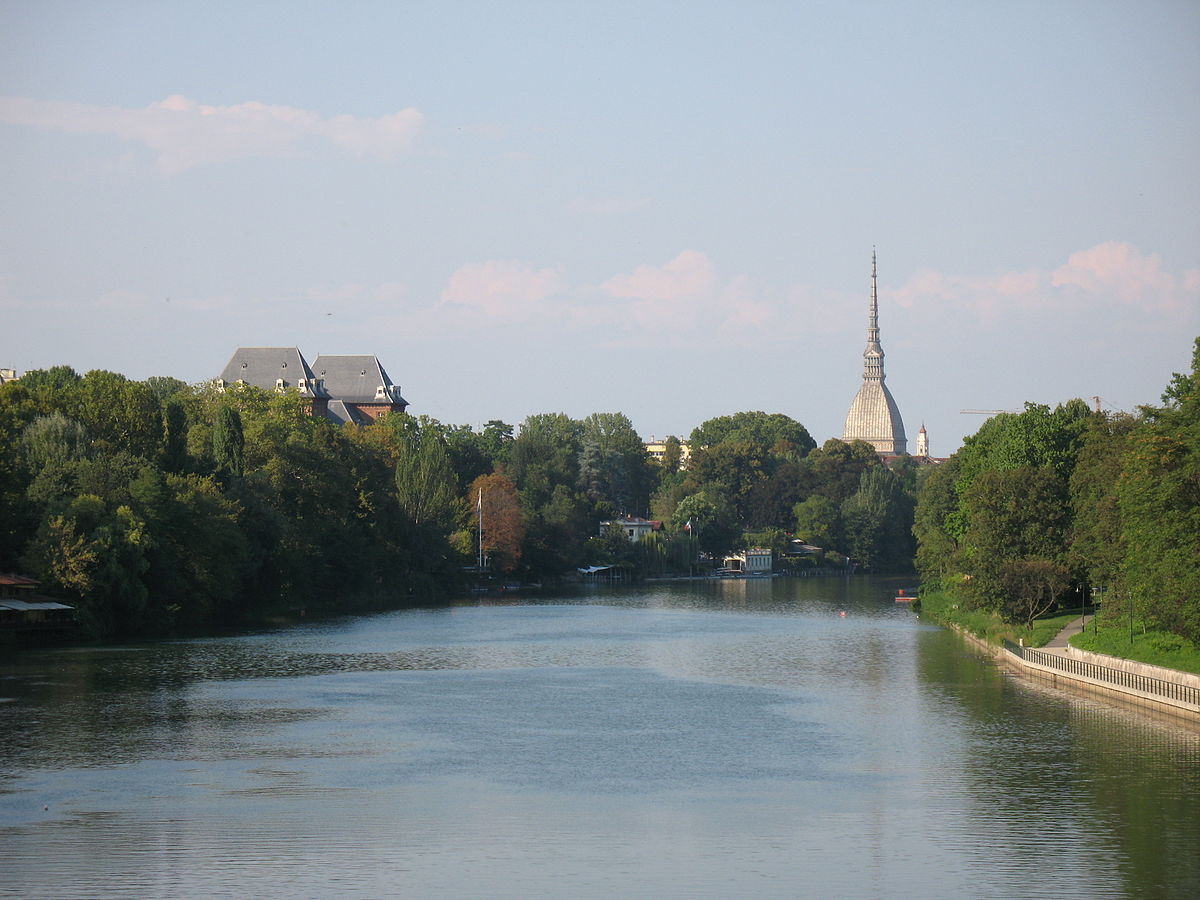
The river passes through or close to some of northern Italy’s most important agricultural and industrial areas. Turin stands directly on the Po, while cities including Piacenza, Cremona and Ferrara are closely connected with the river and its history.
The Po Valley and Italian Agriculture
The Po Valley contains some of Italy’s most productive farmland. The river and its tributaries have supported irrigation for centuries, helping create landscapes associated with rice, maize, wheat, fruit, vegetables and livestock farming.
Rice paddies are particularly characteristic of parts of Piedmont and Lombardy, especially around Vercelli, Novara and Pavia.
The Po basin also lies at the heart of Italy’s industrial north, making management of its water resources important not only for agriculture but also for cities, manufacturing and energy production.
The Po Delta
Near the Adriatic, the Po divides into several branches and creates one of Italy’s most distinctive wetland environments.
The Po Delta is a landscape of lagoons, marshes, dunes, canals, fishing ponds and agricultural land. It is especially important for migratory and resident birds and has become a major destination for cycling, birdwatching and nature tourism.
The Po Delta is recognized by UNESCO as a Biosphere Reserve, highlighting its exceptional ecological importance.
For travelers, the river offers a different view of northern Italy: less about famous monuments and more about wetlands, agricultural landscapes, historic river towns and slow travel.
The Adige: From the Alps to the Adriatic
The Adige is Italy’s second-longest river, running for about 410 kilometers (255 miles).
It begins near the Resia Pass in South Tyrol and flows through the Val Venosta before passing Merano, Bolzano, Trento and Rovereto. It then continues through Verona and across the Venetian plain before reaching the Adriatic.
The upper Adige passes through one of Italy’s most dramatic Alpine landscapes, surrounded by mountains, orchards and vineyards.
Its course also reflects the cultural complexity of northeastern Italy. In South Tyrol, where both German and Italian are widely spoken, the river is known in German as the Etsch.
The Adige in Verona
Few Italian cities are as visually connected with a river as Verona.
The Adige curves through the historic city center, crossed by bridges that have become part of Verona’s identity. Among the best known is Ponte Pietra, whose origins date to Roman times, although the bridge has been reconstructed repeatedly during its long history.
Castelvecchio and its fortified bridge provide another striking encounter between the city and the river.
Farther north, the Adige Valley has long provided an important natural corridor through the Alps. Today, much of the valley can also be explored by bicycle along the Adige cycle route.
The Tiber: The River of Rome
No Italian river has a stronger association with a single city than the Tiber — the Tevere in Italian.
Rising in the Apennines at Monte Fumaiolo, the river travels through central Italy before crossing Rome and eventually reaching the Tyrrhenian Sea near Ostia.
Its importance to Rome extends back more than two thousand years.
According to Rome’s foundation legend, the twins Romulus and Remus were abandoned on the Tiber before being rescued and suckled by a she-wolf. Whether legend or history, the story demonstrates how deeply the river was embedded in Roman identity.
The Tiber and Ancient Rome
The location of Rome on the Tiber was strategically important. The river provided access toward the sea while the surrounding hills offered defensible positions.
As Rome expanded, the Tiber became an essential transportation and commercial route. Goods arriving from across the Mediterranean could move inland from the port of Ostia toward the capital.
The river also presented a constant danger. Flooding affected Rome repeatedly throughout its history. Following particularly destructive floods, large embankments were constructed along the river during the late 19th and early 20th centuries.
These walls helped protect the city but also physically separated modern Rome from its river to a greater degree than in earlier centuries.
Seeing the Tiber Today
Visitors can still follow the river past some of Rome’s most recognizable landmarks.
Ponte Sant’Angelo crosses the Tiber near Castel Sant’Angelo, while Isola Tiberina — Tiber Island — sits in the middle of the river between the historic center and Trastevere.
Walking or cycling along sections of the riverbank provides an unusual perspective on Rome, away from its busiest streets.
The Arno: The River of Florence and Pisa
The Arno is the great river of Tuscany and one of the waterways most closely associated with Italian art and architecture.
Rising in the Apennines on Monte Falterona, it travels across Tuscany through areas including the Casentino and the cities of Florence and Pisa before entering the Ligurian Sea.
Although considerably shorter than the Po, Adige or Tiber, the Arno has played an extraordinary role in Italian cultural history.
Florence and the Arno
Florence developed on both banks of the Arno, and the river became an important part of the city’s commercial life.
The best-known crossing is the Ponte Vecchio, lined with shops and instantly recognizable as one of Florence’s landmarks. Other historic bridges connect neighborhoods on either side of the river and provide some of the city’s finest views.
The Arno also influenced industries that contributed to Florence’s prosperity, including textile production and other crafts that required abundant water.
But the relationship between Florence and its river has not always been peaceful.
The Florence Flood of 1966
On November 4, 1966, the Arno overflowed its banks and inundated large sections of Florence.
Water, mud and fuel entered churches, museums, libraries, shops and homes. Thousands of works of art, manuscripts and books were damaged.
Volunteers arrived from Italy and abroad to help rescue the city’s cultural heritage. They became known as the “Mud Angels,” and their work became an important chapter in the history of art conservation.
The flood remains one of the defining modern events in Florence’s relationship with the Arno.
The Arno at Pisa
After Florence, the Arno continues west toward Pisa.
The river divides Pisa’s historic center, where elegant buildings line the Lungarni — the streets and promenades running along its banks.
Although Pisa is internationally associated with the Leaning Tower, a walk beside the Arno reveals another side of the city and its centuries of maritime and commercial history.
The Piave: Italy’s Historic River of World War I
The Piave is shorter than the other rivers on this list, running for roughly 220 kilometers (137 miles), but its place in modern Italian history makes it particularly significant.
It rises in the Alps in the province of Belluno and flows south through Veneto before reaching the Adriatic northeast of Venice.
The Piave is best known for its role during World War I.
The Piave and World War I
Following the disastrous Italian defeat at Caporetto in 1917, Italian forces retreated toward the Piave.
The river became a crucial defensive line against the Austro-Hungarian army. In June 1918, the Battle of the Piave River marked the failure of a major Austro-Hungarian offensive.
Later that year, the Italian victory at Vittorio Veneto contributed to the collapse of the Austro-Hungarian war effort.
As a result, the Piave acquired enormous symbolic importance in Italy. The patriotic song “La leggenda del Piave,” written after the war, helped transform the river into a national symbol of sacrifice and resistance.
Visitors interested in military history can still find monuments, memorials and museums connected with the First World War throughout this part of Veneto.
Five Rivers, Five Different Italies
These rivers reveal how varied Italy’s landscape really is.
The Po belongs to the vast agricultural and industrial plain of northern Italy. The Adige descends from Alpine valleys through Trentino-Alto Adige and Veneto. The Tiber is inseparable from Rome and the history of the ancient world. The Arno flows through the artistic heart of Tuscany, while the Piave carries the memory of some of the most important events in modern Italian history.
They are not simply geographical features. They have determined where cities developed, how farmland was irrigated, where goods were transported and, at times, where armies fought.
Which Is the Longest River in Italy?
The Po is the longest river in Italy at approximately 652 kilometers.
It is followed by the Adige at about 410 kilometers and the Tiber at just over 400 kilometers. Exact measurements can vary slightly depending on the geographical source and the method used to define a river’s course.
The Arno is approximately 240 kilometers long, while the Piave extends for about 220 kilometers.
Length, however, does not necessarily determine importance. The relatively short Arno, for example, has an exceptional place in European cultural history because of its connection with Florence and Pisa.
Exploring Italy Through Its Rivers
Italy’s rivers can also provide travelers with an alternative way to understand the country.
In Turin, visitors can walk beside the Po and see the city framed by the Alps. Along the Adige, cycling routes pass through vineyards, orchards and Alpine valleys before reaching historic cities such as Trento and Verona.
In Rome, a walk along the Tiber connects ancient history with neighborhoods such as Trastevere. In Florence, crossing the Arno at different bridges reveals some of the most memorable views of the Renaissance city. And along the Piave, travelers encounter both the landscapes of Veneto and places associated with the First World War.
For nature lovers, the Po Delta offers one of the richest river environments in Italy, combining wetlands, wildlife, fishing communities and quiet landscapes close to the Adriatic.
Italian Rivers and the Environment
Italy’s rivers also face significant environmental pressures.
Periods of drought can reduce water availability, particularly in heavily cultivated areas. Floods remain a serious risk in several river basins, while pollution, intensive water use, habitat modification and changing weather patterns place additional pressure on aquatic ecosystems.
Managing these rivers therefore involves a difficult balance between agriculture, drinking water, hydroelectric power, flood protection, biodiversity and the needs of cities and industry.
The Po illustrates the scale of that challenge particularly well. Its enormous basin supports millions of people and some of Italy’s most productive agricultural areas, while its delta contains wetlands of international ecological importance.
Frequently Asked Questions About Italian Rivers
What is the longest river in Italy?
The Po is Italy’s longest river, running approximately 652 kilometers from the Cottian Alps to the Adriatic Sea.
What is the second-longest river in Italy?
The Adige is generally recognized as Italy’s second-longest river, at approximately 410 kilometers.
What river runs through Rome?
The Tiber, called the Tevere in Italian, flows through the center of Rome before reaching the Tyrrhenian Sea near Ostia.
What river runs through Florence?
The Arno flows through Florence and passes beneath the city’s famous Ponte Vecchio before continuing toward Pisa and the sea.
Why is the Piave River famous?
The Piave played a crucial military role during World War I, particularly after the Italian retreat from Caporetto and during the Battle of the Piave River in 1918.
What is the most important river in northern Italy?
The Po is the dominant river system of northern Italy because of the size of its drainage basin and its importance to agriculture, industry, ecosystems and settlement.
A Landscape Shaped by Water
From the Alpine source of the Po to the bridges of Florence and Rome, rivers have helped create the Italy we know today.
They have carried merchants and armies, watered fields, powered economic development and inspired legends, songs, paintings and literature. They have also flooded cities and forced generations of Italians to find new ways of managing water and protecting the communities built along their banks.
Traveling along Italy’s rivers therefore means following more than water toward the sea. It means following some of the country’s oldest routes through geography, history and culture.
External Sources
Italian Civil Protection – The Po River
UNESCO – Po Delta Biosphere Reserve