

Italy’s most famous destinations are famous for good reason. Venice, Lake Como and the Amalfi Coast offer extraordinary scenery, architecture and history. Their popularity, however, can also mean crowded streets, expensive accommodation, packed transportation and an experience increasingly shaped by mass tourism.
You do not have to abandon Italy’s beauty to escape the largest crowds. Treviso, Lake Orta, Trieste, Cilento, Ravenna and the Marche offer canals, lakes, beaches, art and historic towns with more room to breathe.
These destinations are not completely undiscovered. Beaches can become busy in August, while festivals and summer weekends attract Italian visitors. Nevertheless, they generally provide a slower, more relaxed experience than Italy’s most heavily visited locations.
Some accommodation and shopping links in this article are affiliate links. Italia Mia may earn a commission from qualifying reservations or purchases at no additional cost to you.
Treviso Instead of Venice
Treviso is sometimes treated merely as an arrival point for travelers heading directly to Venice. Its airport even uses Venice in its name. However, Treviso is a rewarding destination in its own right and a practical alternative for travelers who want to experience the Veneto without staying in the busiest parts of Venice.
Inside Treviso’s historic walls, waterways pass beneath arcaded streets and between frescoed buildings. The setting is smaller and more intimate than Venice, with residents still dominating the markets, cafés and neighborhood osterie.
Begin in Piazza dei Signori, the social heart of the city, and continue toward the Canale dei Buranelli. This picturesque waterway is lined with old houses, small bridges and shaded walkways. Nearby, the Pescheria fish market occupies its own little island in the Cagnan River.
Treviso also has excellent culinary credentials. Radicchio rosso di Treviso, local cheeses, sopressa, prosecco and tiramisù all belong on the itinerary. The city is an ideal starting point for a day trip through the Prosecco Hills of Conegliano and Valdobbiadene.
Treviso does not reproduce the grandeur of Venice, and that is precisely its advantage. You can explore without following a procession of tour groups and enjoy an evening aperitivo surrounded mainly by local residents.
Travelers who still want to visit Venice can usually reach it by regional train in approximately 30 to 40 minutes. This makes it possible to spend a day among Venice’s canals and return to Treviso for a quieter and often more affordable evening.
Compare hotels in Treviso on Trip.com
Best for: canals, food, markets, prosecco and convenient access to Venice.
Recommended stay: two or three nights.
Lake Orta Instead of Lake Como
Lake Como is one of Italy’s most celebrated landscapes, but its best-known towns can become congested during the warmer months. Ferries are crowded, hotels are expensive and restaurants in the most popular areas frequently require advance reservations.
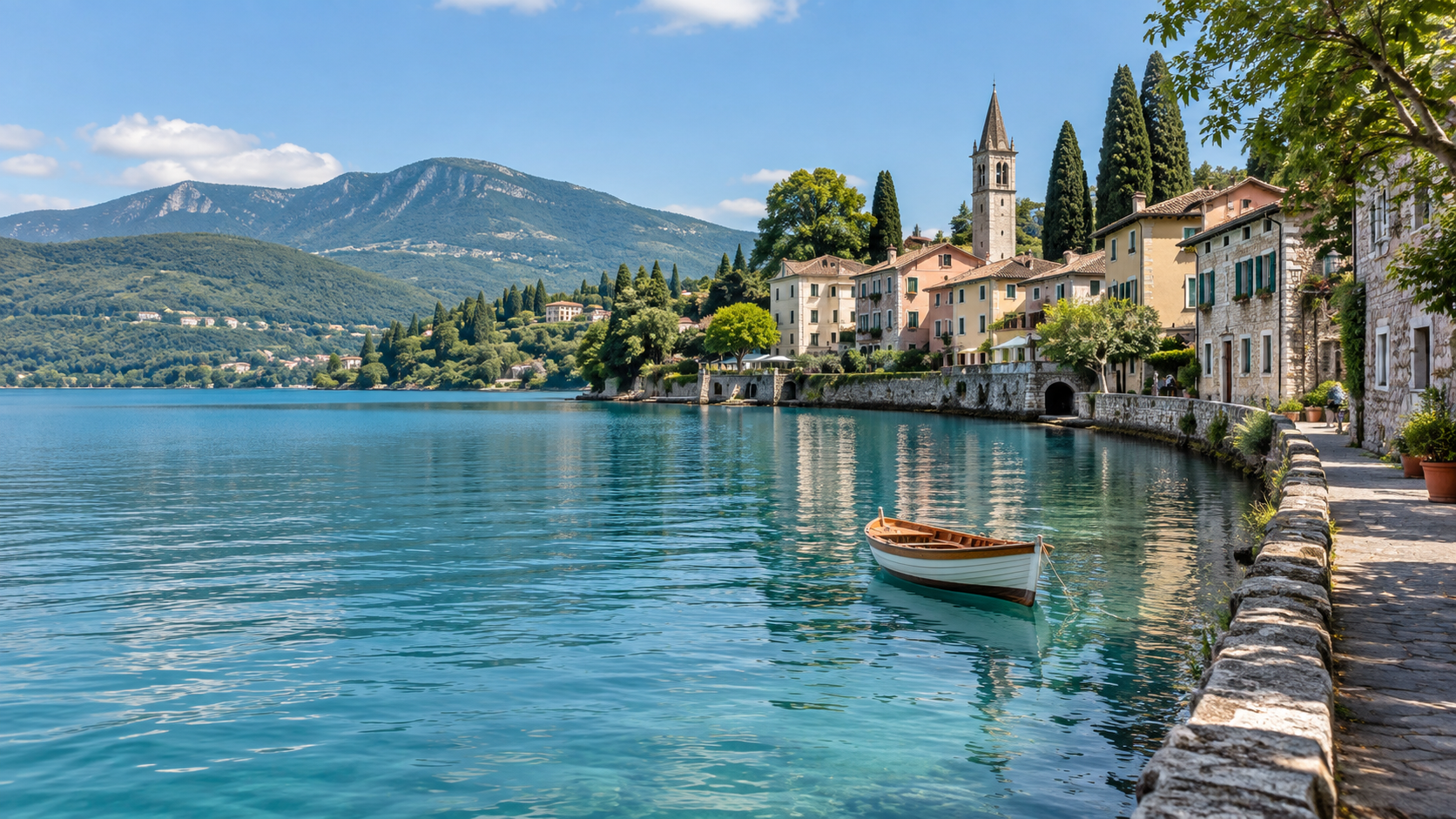
Lake Orta, west of Lake Maggiore in Piedmont, offers a smaller and more intimate lake experience. Its principal destination is Orta San Giulio, a medieval village centered around Piazza Motta.
Narrow lanes climb from the waterfront between stone buildings, small hotels and family-run restaurants. Boats cross the lake to Isola San Giulio, where visitors can see the Romanesque basilica and walk along a short route traditionally known as the Way of Silence.
Above Orta San Giulio, the Sacro Monte di Orta contains a group of chapels dedicated to the life of Saint Francis of Assisi. The wooded hillside provides attractive views across the lake toward the island.
Lake Orta is particularly suited to couples, walkers and travelers who prefer small-scale accommodation and unhurried meals beside the water. It feels romantic without the international luxury scene associated with parts of Lake Como.
Omegna, at the lake’s northern end, offers another possible base. It has a more contemporary, lived-in atmosphere and is associated with Italian writer Gianni Rodari.
Public transportation around Lake Orta requires more planning than at Lake Como. Orta-Miasino is the closest railway station to Orta San Giulio, but travelers should verify current train schedules and arrange the final transfer before arriving. A car provides greater flexibility for visiting villages on both sides of the lake.
Compare hotels in Orta San Giulio on Trip.com
Best for: romantic stays, lake views, peaceful villages and gentle walking.
Recommended stay: two or three nights.
Trieste Instead of Another Crowded Day in Venice
Trieste is not a smaller version of Venice. It offers a completely different Adriatic experience shaped by Italian, Austrian, Slovenian and Jewish influences.
Piazza Unità d’Italia opens dramatically toward the sea and provides an impressive introduction to the city. Behind it, streets of Habsburg-era buildings lead toward historic cafés, bookshops, churches and the Grand Canal.
Trieste has a particularly strong literary identity. James Joyce lived here for extended periods, while Italo Svevo and Umberto Saba are closely connected with the city. Travelers can visit cafés once frequented by writers or simply absorb the atmosphere with coffee and a newspaper.
The hill of San Giusto offers views across Trieste and contains the city’s cathedral and castle. Lower down, the former Jewish quarter and Roman remains reveal different layers of the city’s history.
Outside the center, Miramare Castle occupies a spectacular coastal position overlooking the Gulf of Trieste. Its gardens and waterfront setting make it an easy half-day excursion.
Travelers with additional time can explore the Karst plateau, where walking trails connect stone villages, vineyards and traditional osmize. These temporary local establishments serve wine, cheese, cured meats and other products made by the families who operate them.
Trieste can be reached by direct train from Venice, although it deserves at least two nights rather than a hurried day trip. It is especially appealing to travelers who prefer cities with a strong identity, excellent food and fewer organized tour groups.
Compare hotels in Trieste on Trip.com
Best for: historic cafés, literature, architecture, seafood and Central European culture.
Recommended stay: two or three nights.
Cilento Instead of the Amalfi Coast
The Amalfi Coast’s villages and cliffs are unforgettable, but visiting during the high season can be stressful. Roads become congested, buses are crowded and accommodation prices rise considerably.
Farther south in Campania, the Cilento coast offers clear water, seaside towns, archaeological sites and a vast protected landscape. It is one of the best choices for travelers looking for an alternative to the Amalfi Coast.
Agropoli is a practical northern base with railway connections, beaches and an attractive historic center. Its old town rises above the sea and is entered through a monumental gateway.
Farther south, Santa Maria di Castellabate combines beaches and a pleasant waterfront with access to the hilltop village of Castellabate. Acciaroli is known for its compact harbor and relaxed atmosphere, while Palinuro and Marina di Camerota provide access to coves, sea caves and boat excursions.
Cilento is much more than a beach destination. The Cilento, Vallo di Diano and Alburni National Park includes mountains, forests, walking routes and historic inland villages. Travelers can combine time on the coast with visits to places such as Castellabate, Pisciotta and the medieval village of San Severino di Centola.
The archaeological site of Paestum is another major reason to visit. Its remarkably preserved Greek temples are among the most impressive ancient monuments in Italy. Paestum can be included at the beginning or end of a Cilento itinerary.
A car provides the greatest freedom, especially if you want to combine beaches with inland villages. Travelers relying on trains and buses should consider staying in Agropoli or another town with reliable transportation connections. Bus and boat schedules can be seasonal, so they should always be confirmed in advance.
Compare hotels in Agropoli and the Cilento area on Trip.com
Best for: beaches, boat trips, archaeology, hiking and longer summer vacations.
Recommended stay: four to seven nights.
Ravenna Instead of Italy’s Busiest Art Cities
Ravenna contains one of Italy’s greatest collections of early Christian and Byzantine art, yet it is often overlooked by visitors traveling between Venice, Florence and Bologna.
The city’s UNESCO-listed monuments contain some of the most extraordinary mosaics in Europe. The Basilica of San Vitale, Mausoleum of Galla Placidia, Basilica of Sant’Apollinare Nuovo and Arian Baptistery can be visited without experiencing the enormous crowds found at Italy’s most famous museums.
The mosaics are not confined to a single attraction. They form a route through the historic center, encouraging visitors to explore Ravenna on foot between churches, museums, cafés and quiet streets.
Ravenna is also closely associated with Dante Alighieri. The poet spent the final years of his life in the city and is buried near the Basilica of San Francesco. His tomb and the surrounding area provide another important stop for visitors interested in Italian literature.
The city center is compact and largely pedestrian-friendly. It is possible to see several important monuments in one day, but staying overnight allows for a more relaxed experience after day-trippers leave.
The Adriatic coast is only a short distance away. Visitors with more time can combine Ravenna with the Basilica of Sant’Apollinare in Classe, the nearby pine forests or the natural areas and wetlands of the Po Delta.
Ravenna is not an exact alternative to Venice or Florence. It is a destination for travelers who want exceptional art without spending most of the day in lines or crowded museum corridors.
Compare hotels in Ravenna on Trip.com
Best for: mosaics, history, Dante, cycling and a compact cultural break.
Recommended stay: two or three nights.
The Marche Instead of Tuscany’s Most Crowded Towns
The Marche stretches from the Apennines to the Adriatic and offers an appealing alternative for travelers attracted to Tuscany’s hills, medieval towns, Renaissance art and regional food.
Urbino is the region’s best-known cultural destination. Its Palazzo Ducale houses the Galleria Nazionale delle Marche, while the surrounding streets preserve the atmosphere of a historic university town. Urbino is associated with Raphael, who was born there, and with Federico da Montefeltro, one of the most influential Renaissance patrons.
Ascoli Piceno is known for its travertine buildings, elegant Piazza del Popolo and regional specialty, olive all’ascolana. Macerata, Fermo, Recanati and Offida offer historic centers that receive far fewer international visitors than Siena or San Gimignano.
The countryside between these towns is characterized by farmland, vineyards and rolling hills. Agriturismi provide an opportunity to stay outside the main centers and experience local food and rural traditions.
Nature is another important part of the Marche. The Sibillini Mountains offer hiking, mountain scenery and small villages, while the Conero Riviera combines wooded cliffs with Adriatic beaches. Farther north, coastal towns such as Pesaro and Senigallia provide different styles of seaside vacation.
The Marche is easiest to explore by car. Railway service is useful along the Adriatic coast, but reaching smaller inland towns usually requires buses, careful scheduling or private transportation.
Instead of changing hotels every night, consider choosing an agriturismo or small-town base for several days. This makes it possible to take day trips while still enjoying the slower rhythm that makes the region so appealing.
Compare hotels in Urbino and the Marche on Trip.com
Best for: road trips, Renaissance art, hill towns, beaches and regional cuisine.
Recommended stay: five to seven nights.
When to Visit Italy With Fewer Crowds
Choosing a less famous destination helps, but timing remains important. July and August are busy throughout coastal Italy, including Cilento and the Marche. Italian travelers also take vacations during August, especially around Ferragosto on August 15.
Late April through June and September through early October usually provide a good balance of pleasant weather, open attractions and manageable visitor numbers. Treviso, Trieste, Ravenna and Urbino can also be rewarding in late autumn or winter.
Spring is particularly attractive for walking, cultural visits and countryside itineraries. September is a good choice for the coast because the sea is often still warm, although seasonal transportation may become less frequent toward the end of the month.
Visit major monuments early in the morning, stay overnight rather than arriving with day-trippers and avoid building an itinerary around a different famous attraction every day. Slower travel is often the most effective way to experience Italy without feeling surrounded by tourism.
Useful Italy Guidebooks
A printed guide can be particularly valuable in less-visited regions, where online transportation details and English-language visitor information may be fragmented.
Shop for Rick Steves Italy guidebooks on Amazon.com
Shop for Lonely Planet Italy guidebooks on Amazon.com
Find guidebooks about hidden Italy on Amazon.com
Check the publication date before ordering. Transportation schedules, admission procedures and opening hours can change, so practical information should always be confirmed through official websites.
Choosing the Right Alternative
Choose Treviso if you want canals, Veneto food and convenient access to Venice. Select Lake Orta for a romantic lakeside stay without Lake Como’s international luxury scene.
Trieste is ideal for travelers interested in cafés, literature and borderland history. Cilento is the strongest alternative to the Amalfi Coast for beaches, boat trips and a longer seaside vacation.
Ravenna offers world-class art in a manageable city, while the Marche is best for an independent road trip combining Renaissance towns, mountains, countryside and the Adriatic.
These destinations do not reproduce Venice, Lake Como or the Amalfi Coast. They offer their own landscapes, histories and traditions—and that is precisely why they are worth visiting.
External Sources
Visit Treviso – Official tourism information
Turismo FVG – Official Friuli Venezia Giulia tourism website
Italia.it – Official Italian tourism website
Ravenna Turismo – Official tourist information
Let’s Marche – Official Marche tourism website