
Robert Francis Prevost became Pope Leo XIV on May 8, 2025, following the death of Pope Francis. His election was historic in several respects: he became the first pope born in the United States, the first member of the Order of Saint Augustine to lead the Catholic Church and the first pope to hold both American and Peruvian citizenship.
Yet describing Leo XIV simply as the first American pope overlooks much of the experience that prepared him for the papacy. Before his election, Prevost spent many years as a missionary, seminary educator and bishop in Peru. He also governed the worldwide Augustinian order and later served in Rome as prefect of the Dicastery for Bishops.
His life has consequently been shaped by three distinct worlds: the United States of his birth, Latin America’s missionary Church and the international responsibilities of the Roman Curia.
Childhood and Education in the United States
Robert Francis Prevost was born in Chicago, Illinois, on September 14, 1955. He was the youngest of three sons born to Louis Marius Prevost and Mildred Agnes Martínez.
His father served in the United States Navy during the Second World War before becoming a teacher and school principal. His mother worked as a school librarian. Both parents were actively involved in the parish of Saint Mary of the Assumption, and the family’s religious life played an important role in Prevost’s early formation.
After attending Saint Mary School of the Assumption, he studied at Saint Augustine Seminary High School in Holland, Michigan. In 1973, he enrolled at Villanova University in Pennsylvania, an institution founded by the Augustinians.
Prevost graduated from Villanova in 1977 with a degree in mathematics and also studied philosophy. His mathematical training is an unusual element in the background of a modern pope, although it would be misleading to draw conclusions about his personality or governing style from that fact alone.
Joining the Augustinians
On September 1, 1977, Prevost entered the novitiate of the Order of Saint Augustine in Saint Louis. He made his first religious profession in 1978 and his solemn profession in 1981.
He completed theological studies at the Catholic Theological Union in Chicago before moving to Rome to study canon law at the Pontifical University of Saint Thomas Aquinas, commonly known as the Angelicum.
Prevost was ordained a priest on June 19, 1982. He received a licentiate in canon law in 1984 and later completed a doctorate. His dissertation examined the role and authority of the local prior within the Augustinian order.
His formation combined theology, law, community life and administration—areas that would remain central throughout his service to the Church.
Missionary Work in Peru
In 1985, Prevost was assigned to the Augustinian mission in Chulucanas, in the Piura region of northern Peru. He served as parochial vicar of the Cathedral of the Holy Family and as chancellor of the Territorial Prelature of Chulucanas.
After returning briefly to the United States in 1987, he went back to Peru the following year. This second period of missionary service, based largely in Trujillo, lasted for more than a decade.
Prevost directed the Augustinian formation house serving candidates from several Peruvian vicariates. He was also a community prior, director of formation and master of professed brothers.
His work extended beyond the Augustinian community. At the Major Seminary of San Carlos and San Marcelo, he taught canon law, moral theology and patristics and served as director of studies and acting rector. He also worked as a judicial vicar and participated in the governance of the Archdiocese of Trujillo.
Alongside these institutional responsibilities, Prevost remained active in parish ministry. He served at Our Lady Mother of the Church, which later became Saint Rita of Cascia Parish, and administered Our Lady of Montserrat Parish.
These years were more than a temporary overseas assignment. Peru became a defining part of his life and ecclesiastical identity. He eventually acquired Peruvian citizenship in 2015.
Leader of the Worldwide Augustinian Order
Prevost returned to the United States in 1998 after being elected provincial prior of the Augustinian Province of Our Mother of Good Counsel, based in Chicago.
In 2001, the General Chapter of the Order of Saint Augustine elected him prior general. He was elected to a second term in 2007, giving him responsibility for the order’s communities and missions around the world for a total of 12 years.
The position required extensive international travel and contact with Augustinians working in different cultural, political and pastoral environments. It also gave him considerable experience in religious governance, mediation and the administration of an international institution.
After completing his second term in 2013, he returned to Chicago, where he worked in Augustinian formation and served as provincial vicar.
Bishop of Chiclayo
Pope Francis appointed Prevost apostolic administrator of the Diocese of Chiclayo, Peru, and titular bishop of Sufar on November 3, 2014. He was ordained a bishop on December 12 of that year, the Feast of Our Lady of Guadalupe.
His episcopal motto, In Illo Uno Unum, comes from Saint Augustine’s commentary on Psalm 127. It expresses the belief that although Christians are many, they become one in Christ.
In September 2015, Pope Francis formally appointed him Bishop of Chiclayo. Prevost subsequently served as second vice-president of the Peruvian Episcopal Conference and participated in its work on education, culture and economic affairs.
In 2020, he was also asked to serve temporarily as apostolic administrator of the Diocese of Callao.
Appointment to the Roman Curia
Prevost’s experience as a missionary, religious superior and diocesan bishop brought him increasingly important responsibilities in Rome.
Pope Francis appointed him a member of the Congregation for the Clergy in 2019 and a member of the Congregation for Bishops in 2020.
On January 30, 2023, Francis selected him to lead the Dicastery for Bishops, the Vatican department that helps evaluate and recommend candidates for episcopal appointments in much of the Catholic world. Prevost also became president of the Pontifical Commission for Latin America.
He was created a cardinal by Pope Francis on September 30, 2023. In February 2025, he was promoted to the rank of cardinal bishop.
His position at the Dicastery for Bishops placed him near the center of the universal Church’s decision-making process. It required reviewing local conditions, consulting apostolic nuncios and bishops and helping identify priests considered suitable for episcopal leadership.
Election as Pope Leo XIV
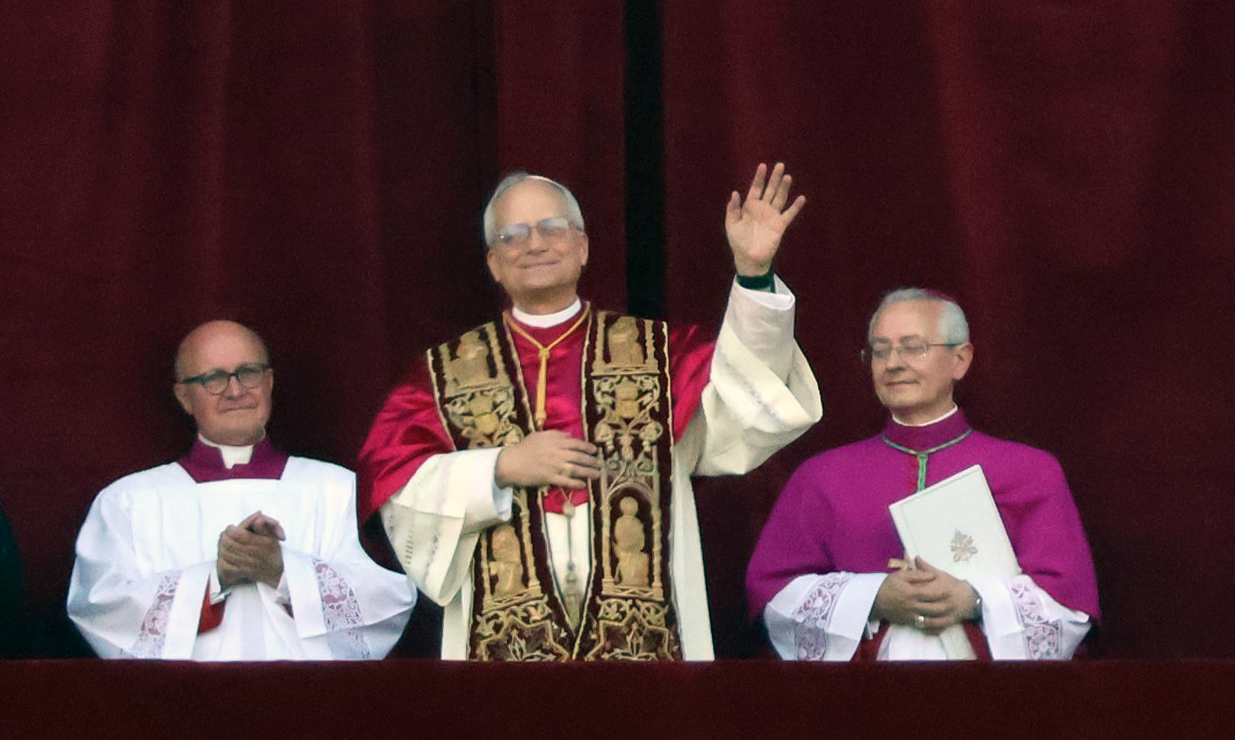
The conclave that followed the death of Pope Francis began on May 7, 2025. Cardinal Prevost was elected pope the following day and appeared on the central balcony of Saint Peter’s Basilica as Leo XIV.
He began his first address with the words “Peace be with you,” presenting peace, dialogue and unity as central themes of his new ministry.
On May 18, he celebrated the Mass inaugurating his pontificate in Saint Peter’s Square. In his homily, he described papal authority as a form of service founded on love rather than domination. He called for a united and missionary Church capable of engaging the world without erasing cultural or personal differences.
Leo XIV is officially recognized as the 267th pope and successor of Saint Peter.
Why He Chose the Name Leo
Leo XIV explained his choice of name during a meeting with the College of Cardinals on May 10, 2025.
The principal reference was Pope Leo XIII, whose 1891 encyclical Rerum Novarum addressed the rights and conditions of workers during the Industrial Revolution. Leo XIV connected that earlier social transformation with the challenges created by artificial intelligence, automation and new forms of economic power.
The name therefore signalled an intention to apply Catholic social teaching to technological change, employment, human dignity and economic justice. It was not merely a historical tribute but an early indication of one of the new pontificate’s priorities.
Continuity with Pope Francis
Leo XIV did not present his election as a rejection of the previous pontificate. In his early address to the cardinals, he explicitly affirmed the Church’s continuing commitment to the Second Vatican Council and highlighted several priorities associated with Pope Francis.
These included missionary renewal, collegiality, synodality, care for people who are poor or marginalized and dialogue with the contemporary world.
Nevertheless, every pontificate develops its own vocabulary and emphasis. Leo XIV’s Augustinian spirituality has given particular prominence to communion and unity. His episcopal motto and inaugural homily both draw on Saint Augustine’s understanding of the Church as a community whose members become one in Christ.
His experience in Peru also gives his papacy a perspective that cannot be described as exclusively American or European.
The First Major Papal Documents
Leo XIV’s first apostolic exhortation, Dilexi Te, was promulgated on October 4, 2025. The document is devoted to Christian love for people experiencing poverty and connects care for the poor with the heart of the Gospel.
Rather than treating charitable work as an optional activity, the exhortation presents solidarity with the poor as an essential test of Christian faith. It also demonstrates continuity with themes emphasized throughout the pontificate of Pope Francis.
In May 2026, Leo issued his first encyclical, Magnifica Humanitas, addressing the protection of the human person in the age of artificial intelligence. The encyclical develops the connection he had made between Leo XIII’s response to industrialization and the Church’s responsibility to examine the consequences of modern technology.
The document considers questions such as human responsibility, work, inequality, automated decision-making and the danger of allowing technical efficiency to take priority over the dignity of the person.
Together, these documents established two closely connected concerns: defending people who are vulnerable and ensuring that economic and technological systems remain at the service of humanity.
Travel, Ecumenism and International Outreach
Leo XIV made his first international apostolic journey as pope to Türkiye and Lebanon from November 27 to December 2, 2025.
The journey included a pilgrimage to İznik, the ancient city of Nicaea, for the 1,700th anniversary of the First Council of Nicaea. His meeting and joint declaration with Ecumenical Patriarch Bartholomew I emphasized the continuing search for unity between Catholic and Orthodox Christians.
The visit to Lebanon placed additional attention on peace, coexistence and the situation of Christian communities in the Middle East.
During 2026, the pope undertook further journeys, including visits to Monaco, several African countries and Spain. His African itinerary included Algeria, Cameroon, Angola and Equatorial Guinea. In Spain, his program included encounters with young people, migrants, religious communities and public authorities.
Visits within Italy included Naples, Pompeii, Pavia, Assisi, San Marino, Rimini and Lampedusa. At Lampedusa, the pope met migrants and visited locations associated with people who had died attempting to cross the Mediterranean.
These journeys reinforced themes already present in his teaching: peace, Christian unity, migration, missionary service and attention to communities at the geographical or social margins.
An Evolving Pontificate
Any biography of a living pope is necessarily unfinished. Leo XIV’s pontificate continues to develop through appointments, diplomatic initiatives, papal documents, pastoral journeys and responses to events within the Church and the wider world.
What can be established from his life before the papacy is that he brought an uncommon combination of experiences to the office: mathematical and canonical education, Augustinian religious formation, long missionary service in Peru, international leadership of a religious order, diocesan governance and responsibility for the selection of bishops.
His first year as pope placed particular emphasis on unity, peace, service to the poor and the defence of human dignity amid technological change.
Future developments should be added to this biography only when supported by official documents or reliable reporting. Speculation about Leo XIV’s personality, private intentions or possible reforms should be clearly distinguished from verified facts.
External Sources and Further Reading
- Official Vatican biography of Pope Leo XIV
- Pope Leo XIV’s documents, speeches and homilies
- Address explaining the choice of the name Leo XIV
- Homily for the beginning of the pontificate
- Apostolic Exhortation Dilexi Te
- Encyclical Magnifica Humanitas
- Official Vatican News coverage of Pope Leo XIV