
Agnolo di Cosimo, better known as Bronzino, was one of the most accomplished painters of sixteenth-century Florence. Celebrated for his immaculate portraits of the Medici family, he transformed members of the Florentine court into enduring images of authority, elegance and dynastic ambition.
Bronzino was also much more than a court portraitist. He created religious paintings, complex allegories, fresco cycles and designs for monumental tapestries. A respected poet as well as a painter, he moved confidently through the literary and intellectual circles of Florence.
His polished surfaces, sculptural figures, brilliant colors and emotionally restrained sitters made him one of the defining artists of Mannerism—the sophisticated movement that followed the achievements of Leonardo da Vinci, Raphael and Michelangelo.
Early Life and the Origin of the Name Bronzino
Bronzino was born Agnolo di Cosimo in Monticelli, near Florence, on November 17, 1503. Historical sources record his name in several forms, including Agnolo di Cosimo di Mariano and Agnolo Tori. The origin of his nickname remains uncertain. It may have referred to his complexion, hair color or another personal characteristic.
According to Giorgio Vasari, Bronzino initially trained with Raffaellino del Garbo before entering the workshop of Jacopo Pontormo while still an adolescent. This second apprenticeship determined the direction of his artistic life.
Pontormo was one of the most original Florentine painters of his generation. His elongated figures, unexpected colors and emotionally charged compositions departed from the balance associated with the High Renaissance. Bronzino absorbed these qualities but gradually transformed them into a cooler, more controlled and highly finished style.
Their relationship appears to have been exceptionally close. Bronzino became Pontormo’s pupil, assistant, collaborator and almost an adopted son. Because their early styles were so similar, scholars still debate which artist painted certain passages in projects completed together.
Anyone interested in the wider artistic background can read Italia Mia’s guide to the Italian Renaissance and its overview of Italian art movements and periods.
Bronzino and Pontormo
During an outbreak of plague in Florence in the 1520s, Pontormo worked at the Certosa del Galluzzo, a Carthusian monastery outside the city. Bronzino assisted him there, although the surviving frescoes have suffered considerable damage.
The young painter was also associated with Pontormo’s work in the Capponi Chapel of Santa Felicita, near the Ponte Vecchio. Two of the chapel’s roundels depicting the Evangelists have traditionally been connected with Bronzino, although their precise attribution remains disputed.
This uncertainty is revealing rather than inconvenient. It shows how deeply Bronzino initially understood his master’s visual language. Over time, however, he exchanged Pontormo’s expressive instability for crystalline surfaces, sharply defined outlines and an almost sculptural stillness.
Work in Pesaro and the Rise of an Independent Artist
Around 1530, Bronzino traveled to Pesaro, where he worked for the della Rovere court at the Villa Imperiale. This experience introduced him to another sophisticated courtly environment and helped establish his reputation as an independent painter.
Among the works associated with this period is the portrait of the young Guidobaldo II della Rovere, later Duke of Urbino. Bronzino’s developing ability to unite precise observation with aristocratic presentation made him ideally suited to the political world of Renaissance portraiture.
After returning to Florence, he received increasingly important commissions. His decisive opportunity arrived in 1539, when he participated in the decorations celebrating the marriage of Cosimo I de’ Medici and Eleonora di Toledo. He soon became the principal painter of their court.
Court Painter to Cosimo I de’ Medici
Cosimo I needed art to communicate stability and legitimate Medici rule after years of political upheaval in Florence. Bronzino gave him exactly the visual identity he required.
In the celebrated Portrait of Cosimo I in Armor, the duke appears disciplined, vigilant and almost invulnerable. The meticulously rendered metal armor connects him with military authority, while his controlled expression suggests a ruler governed by reason rather than emotion.
Numerous versions and workshop copies of the portrait circulated beyond Florence. It was not simply a record of Cosimo’s appearance: it functioned as an official political image intended to make Medici power recognizable throughout Europe.
Bronzino’s portraits should therefore be understood as instruments of court culture. The rich fabrics, jewels, books, armor and carefully arranged poses were never incidental decorations. They communicated education, wealth, virtue, lineage and social rank.
Eleonora di Toledo and Her Son Giovanni
Bronzino’s Portrait of Eleonora di Toledo with Her Son Giovanni, now in the Uffizi Gallery, is one of the most famous portraits of the Italian Renaissance.
Eleonora was the daughter of Pedro Álvarez de Toledo, the Spanish viceroy of Naples, and the wife of Cosimo I. Her marriage strengthened the duke’s political connections and helped establish a more elaborate court culture in Florence.
Bronzino presents Eleonora seated against an intense blue background, accompanied by her young son Giovanni. Her elaborate dress, pearls and composed expression convey magnificence and authority. Giovanni’s presence emphasizes fertility, succession and the future of the Medici dynasty.
The astonishing attention given to the patterned fabric has sometimes led viewers to treat the painting as a celebration of costume alone. Its meaning is broader. Eleonora appears not merely as Cosimo’s wife but as a dynastic figure whose children would ensure the continuation of the ruling family.
The painting demonstrates Bronzino’s ability to make physical surfaces appear almost tangible. Silk, velvet, pearls, skin and hair are differentiated with extraordinary precision, yet the overall image remains controlled and formal.
Portraits of Medici Children
Bronzino produced some of the most memorable images of children in European court painting. Among them is his haunting Portrait of Bia de’ Medici, probably painted after the young girl’s death.
Bia appears against a deep blue background, wearing pearls and a gold medallion bearing the profile of her father, Cosimo. Her pale face and reserved expression give the painting a quiet emotional force, even though Bronzino avoids overt displays of grief.
His portraits of Francesco, Giovanni, Maria and other Medici children performed a dynastic purpose. They could document the family, commemorate children who died young or introduce potential heirs and marriage partners to other European courts.
Despite their formality, these portraits are not entirely impersonal. Small differences in expression, posture and gesture suggest that Bronzino observed each sitter closely.
Portrait of a Young Man
The Metropolitan Museum of Art’s Portrait of a Young Man is among Bronzino’s finest non-dynastic portraits. The unidentified sitter stands in an architectural interior and holds an open book, presenting himself as an educated member of Florence’s cultivated elite.
His long fingers, elegant black clothing and controlled expression contribute to an image of intellectual refinement. Decorative grotesque faces carved into the furniture introduce a note of ambiguity beneath the portrait’s polished surface.
The painting demonstrates how Bronzino could describe an individual without offering easy access to that person’s emotions. His sitters often seem physically present but psychologically guarded—a quality that has become one of the most recognizable features of his art.
Lucrezia Panciatichi and the Language of Court Portraiture
Bronzino’s Portrait of Lucrezia Panciatichi presents the Florentine noblewoman seated in an architectural interior. Her red dress, elaborate jewelry and extremely precise features create an impression of cultivated magnificence.
The words on her necklace, “Amour dure sans fin,” mean “Love lasts without end.” They may refer to marital fidelity, personal devotion or the ideals the sitter wished to communicate.
Bronzino did not simply reproduce luxurious objects. He organized them into a visual language. Jewelry could express loyalty; a book could indicate education; armor represented authority; and expensive textiles demonstrated rank and access to international trade.
The stillness of his sitters was equally significant. Self-control was considered an aristocratic virtue, and Bronzino’s formal poses gave that ideal a memorable visual form.
The Chapel of Eleonora in Palazzo Vecchio
One of the most rewarding places to experience Bronzino’s religious art is the Chapel of Eleonora in Florence’s Palazzo Vecchio. The small private chapel was decorated for the duchess with scenes from the life of Moses.
The frescoes include the Crossing of the Red Sea, the Gathering of Manna and the Brazen Serpent. Their biblical themes could also be understood politically. Moses was a divinely guided leader who protected his people, making the story appropriate for a chapel at the center of Medici government.
Bronzino combined rich color, carefully modeled bodies and complex arrangements of figures. The paintings retain some of Pontormo’s expressive elegance, but they also reveal Bronzino’s increasingly controlled mature style.
The original altarpiece, the Lamentation or Deposition of Christ, was completed around 1545. Cosimo sent it as a diplomatic gift to Nicolas Perrenot de Granvelle, an influential minister of Emperor Charles V. It is now preserved at the Musée des Beaux-Arts et d’Archéologie in Besançon. Bronzino later painted another version for Eleonora’s chapel.
An Allegory with Venus and Cupid
Bronzino’s most famous secular painting is An Allegory with Venus and Cupid, generally dated to around 1545 and now in the National Gallery in London.
At its center, Venus and Cupid embrace in a deliberately provocative pose. Around them appear masks, roses, a dove, a screaming figure, a deceptive hybrid creature and Father Time. These figures have been interpreted as Pleasure, Folly, Jealousy, Fraud, Oblivion and the destructive consequences of uncontrolled desire.
No single interpretation has gained universal acceptance. The painting was probably designed for a highly educated courtly audience that enjoyed visual puzzles, classical mythology and multiple layers of meaning.
Its artificial colors, elongated bodies and crowded composition make it a defining work of Florentine Mannerism. Beauty is presented as dazzling but dangerous: sensual attraction exists alongside deception, pain and the passage of time.
Religious Paintings
Although Bronzino is best known today as a portraitist, religious commissions occupied an important part of his career.
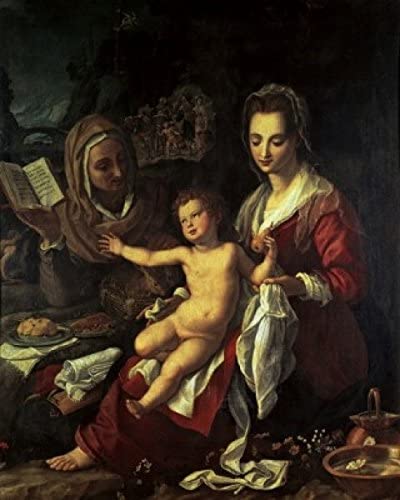
His Holy Family paintings transform sacred figures into statuesque, idealized bodies. The compositions frequently refer to Michelangelo, whose powerful anatomy had an enormous influence on sixteenth-century Florentine artists.
The large Deposition of Christ in Florence’s Accademia Gallery belongs to Bronzino’s later career. Its crowded arrangement, cold light, muscular figures and intense color demonstrate how far his religious art had moved from the natural balance of the early Renaissance.
In the late 1560s, he completed the monumental Martyrdom of Saint Lawrence in the Basilica of San Lorenzo. The fresco contains a complex assembly of nude and partially clothed bodies intended to display the artist’s mastery of anatomy. Bronzino reportedly included portraits of cultural figures and a self-portrait within the scene.
The Story of Joseph Tapestries
Bronzino also helped design the Story of Joseph tapestry cycle commissioned by Cosimo I for the Salone dei Duecento in Palazzo Vecchio.
The ambitious series was produced between 1545 and 1553 from cartoons created principally by Bronzino, Pontormo and Francesco Salviati. Its biblical account of Joseph—betrayed by his brothers but eventually raised to power—could be interpreted as an allegory of wise government, survival and dynastic legitimacy.
Woven with costly materials and displayed in one of Florence’s most important political interiors, the tapestries united painting, decorative art and Medici propaganda on a monumental scale.
Bronzino the Poet
Bronzino was an accomplished poet who participated actively in Florence’s literary culture. He wrote sonnets, serious verse and burlesque poetry, sometimes treating ordinary or deliberately comic subjects with elaborate language.
His literary interests help explain the intellectual complexity of paintings such as An Allegory with Venus and Cupid. The artist understood how images, symbols and words could conceal as much as they revealed.
Bronzino was admitted to the Accademia Fiorentina and maintained connections with prominent writers and scholars. His portrait of the engineer and intellectual Luca Martini, now in Palazzo Pitti, presents the sitter with a map connected to his engineering work—another example of the artist’s interest in learned identity.
The Accademia del Disegno and Alessandro Allori
In 1563, Bronzino became one of the founding members of Florence’s Accademia delle Arti del Disegno. Supported by Cosimo I and Giorgio Vasari, the institution elevated painting, sculpture and architecture from manual trades to disciplines grounded in design and intellectual knowledge.
Bronzino’s most important pupil was Alessandro Allori. Their relationship resembled the close artistic and personal bond Bronzino had shared with Pontormo. Allori adopted his teacher’s smooth technique, refined figures and courtly elegance, helping continue the tradition into the next generation.
Bronzino died in Florence on November 23, 1572. He was buried in the Church of San Cristoforo degli Adimari, which was later demolished. A sonnet reportedly composed by Allori remembered Bronzino not only as a master but as someone who had been like a father to him.
Bronzino’s Style and Legacy
Bronzino’s art is immediately recognizable for its smooth finish, clear contours, controlled poses and cool luminosity. Brushstrokes are often difficult to detect, giving faces and garments an enamel-like or polished-stone surface.
This perfection should not be mistaken for an inability to represent emotion. Bronzino deliberately communicated emotion through restraint. A distant gaze, a carefully placed hand or the contrast between a child’s vulnerability and formal court dress can create considerable psychological tension.
His reputation declined during periods when Mannerism was regarded as artificial or decadent. Modern scholars have reconsidered that judgment. Bronzino’s calculated elegance is now understood as an intelligent response to the political, social and literary culture of Medici Florence.
His portraits influenced later traditions of European court painting, while their immaculate surfaces and inaccessible personalities continue to fascinate contemporary audiences. The tension between outward perfection and hidden identity makes his work feel unexpectedly modern.
Where to See Bronzino’s Art
Florence contains the greatest concentration of Bronzino’s work.
The Uffizi Gallery displays several essential paintings, including Portrait of Eleonora di Toledo with Her Son Giovanni, Portrait of Bia de’ Medici and portraits associated with Cosimo I and the Panciatichi family.
Palazzo Vecchio contains the Chapel of Eleonora and the Story of Joseph tapestries. Palazzo Pitti’s Palatine Gallery holds additional portraits, including the portrait of Luca Martini and works connected with the Medici and della Rovere courts.
The Accademia Gallery houses Bronzino’s imposing late Deposition of Christ, while the Basilica of San Lorenzo preserves the Martyrdom of Saint Lawrence. Santa Felicita provides valuable context for his early collaboration with Pontormo.
Outside Italy, important works can be seen at:
- The National Gallery in London, home of An Allegory with Venus and Cupid
- The Metropolitan Museum of Art in New York, which holds Portrait of a Young Man and important drawings
- The Louvre in Paris, which owns portraits and religious works connected with Bronzino
- The Getty Center in Los Angeles, where visitors can see Saint John the Baptist
- The Musée des Beaux-Arts et d’Archéologie in Besançon, home of the original Deposition painted for Eleonora’s chapel
For a broader itinerary, see Italia Mia’s guide to Italy’s greatest art cities and where to see Italy’s best artworks.
External Sources
Uffizi Galleries: Portrait of Eleonora di Toledo with Her Son Giovanni
Uffizi Galleries: Portrait of Bia de’ Medici
Uffizi Galleries: Portrait of Lucrezia Panciatichi
National Gallery, London: Bronzino
National Gallery: An Allegory with Venus and Cupid
Metropolitan Museum of Art: Portrait of a Young Man
Museo Nacional Thyssen-Bornemisza: Bronzino
Palazzo Vecchio Museum: Official Visitor Information