
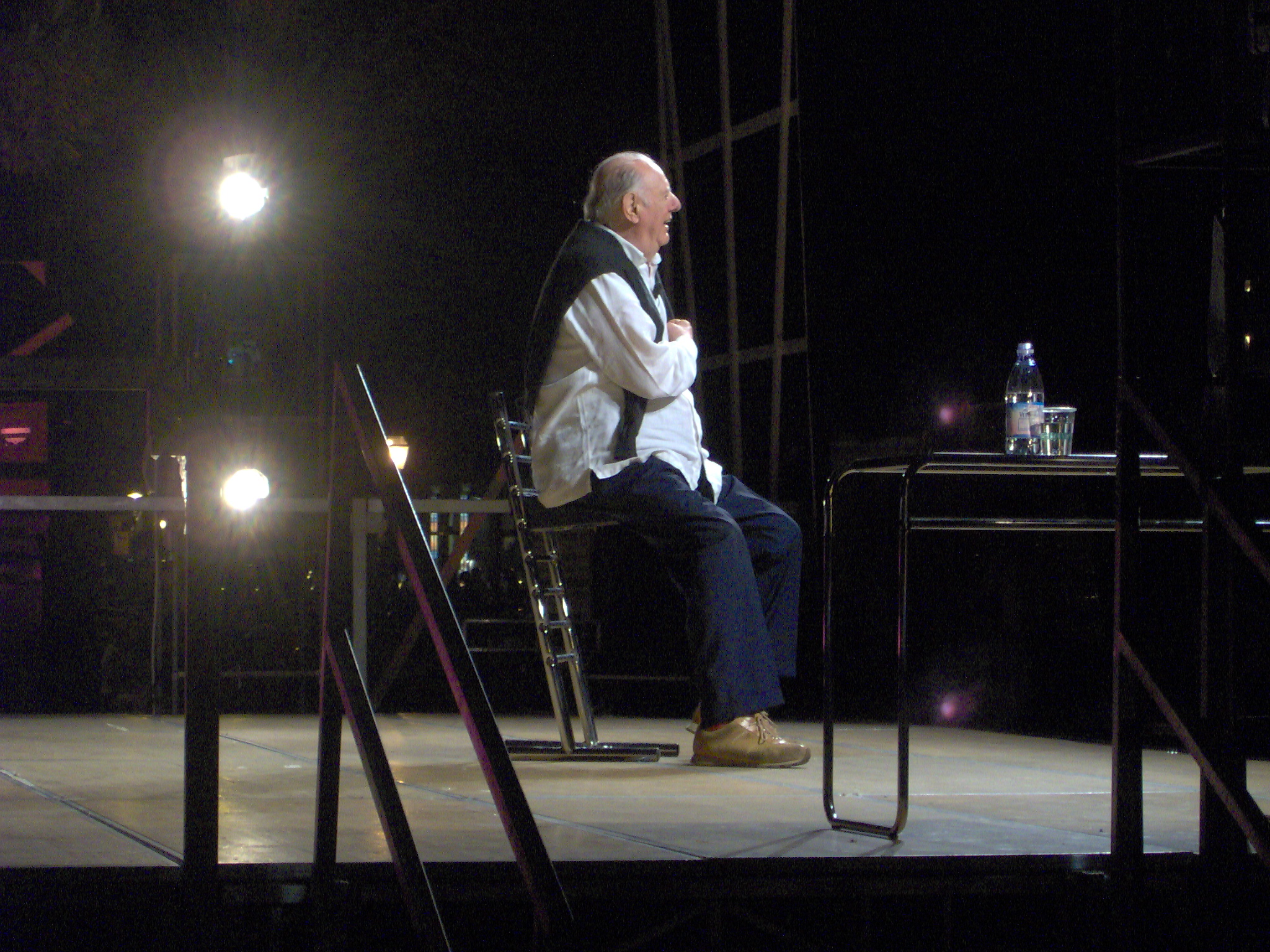
 Dario Fo could turn an empty stage into a crowded town square. With a change of voice, a crooked posture or a burst of invented language, he summoned priests, workers, officials and fools into view. Audiences laughed, but the laughter rarely left authority undisturbed.
Born on March 24, 1926, Fo would have turned 100 in 2026. He died in 2016, leaving a body of work that reaches well beyond the plays printed under his name. He was an actor, playwright, director, painter and storyteller whose theatre drew strength from people speaking back to those in power. His work also belongs to the history of a remarkable partnership. For nearly six decades, Franca Rame was his fellow performer, creative collaborator and the person who helped build and sustain their theatrical companies. To understand Fo’s achievement, it is necessary to see her standing beside him—and, often, commanding the stage herself.
A childhood filled with stories
Fo was born in Sangiano, near Lake Maggiore, and grew up among the stories of the people around him. He later spoke of local storytellers whose accounts could be extravagant, comic and sharply observant at once. A tale might begin with a recognizable neighbor and end somewhere fantastic. What mattered was the teller’s ability to hold an audience, change direction and make the listener see the world differently.
Fo studied art in Milan and kept painting throughout his life. That visual training remained visible in his theatre. He understood how a body could define a space, how a gesture could replace scenery and how an actor’s face could change the meaning of a line. His scripts mattered, but they were never the entire event. Fo wrote for a living performer in front of living spectators.
His place in 20th-century Italian literature can therefore seem unusual. He received its highest international literary honor, yet much of his writing is most fully understood when heard, watched and answered by an audience.
Milan, radio and the meeting with Franca Rame
After the Second World War, Milan offered Fo an energetic world of radio, revue, cabaret and theatre. He developed comic monologues and began making a name for himself as an actor and writer. This was also where his life became inseparable from Franca Rame’s.
Rame had been born into a family of travelling performers. Theatre was the family’s livelihood and daily practice. She brought to their partnership a deep knowledge of timing, touring, audiences and the practical work required to keep a company going. Fo and Rame married in 1954; their son, Jacopo, was born the following year. In 1958 they formed the Compagnia Dario Fo–Franca Rame.
The familiar description of Rame as Fo’s leading actress is true but incomplete. She contributed to their writing, performed and shaped roles, organized productions and carried substantial responsibility for the companies they created. Fo’s public image often centered on the tall, elastic figure delivering a monologue. Their theatre, however, was the result of shared work.
Comedy with a dangerous question underneath
Fo and Rame first reached broad audiences through comedies, farces and television. They knew how to make a scene move: a lie requires another lie, a confident official loses control, and a seemingly minor character notices what everyone else has been trained to overlook.
During Canzonissima in 1962, their satire brought them into conflict with television authorities. The experience was an early demonstration of a problem that would follow them throughout their careers: a joke could be welcomed as entertainment until it became too specific about power.
Fo’s comic technique drew from several traditions. The physical invention of commedia dell’arte, the irreverence of popular storytelling and the pace of modern farce all fed his work. He did not simply revive old theatrical forms. He used them to speak about contemporary Italy, where the language of institutions could conceal as much as it explained. Readers interested in the older tradition can find its historical context in ItaliaMia’s account of Italian literature and commedia dell’arte.
Taking theatre to a different audience
In 1968, Fo and Rame helped establish Nuova Scena. Instead of relying only on conventional theatres, the group performed in places such as workers’ clubs and other community spaces. The decision changed more than the address on a poster. A performance for people gathered in a familiar social setting could lead directly into argument, recognition and discussion.
Fo and Rame later left Nuova Scena and formed La Comune. These were politically committed years, and their work engaged with the conflicts of contemporary Italy. Rame was a central figure in this activity, onstage and in the organization of the work.
Their theatre did not ask audiences to admire political commitment from a distance. It made an official explanation sound absurd, let an apparently powerless character expose its flaws and gave spectators room to question what they had been told. The plays could be unruly and openly partisan. Their energy came from treating an audience as people capable of judgment.
Mistero buffo: Fo’s theatre in one performance
First staged in 1969, Mistero buffo became Fo’s defining work. It is a changing collection of stories and episodes rather than a conventional play with a single plot. Fo brought figures from religious and popular history onto the stage and retold their stories from unexpected positions. Sacred and powerful figures could lose their authority; those usually pushed to the margins could find a voice.
The work’s famous grammelot shows how fully Fo trusted performance. Sounds, fragments of dialect, rhythm, expression and gesture carry meaning even when a spectator cannot identify every word. He could make an audience follow an argument through the body and voice of a storyteller. Mistero buffo was also a living work: Fo returned to it, revised it and performed it across decades.
Its irreverence drew criticism, particularly where it challenged established religious interpretations. Yet the work’s lasting force is broader than provocation. Fo made old stories immediate by asking whose account had survived, whose had been ignored and who gained the right to tell it.
For a starting point, RaiPlay’s Il Mistero secondo Fo offers material about the work and its creation. Dario Fo, l’ultimo Mistero Buffo follows him preparing to perform it in 2016, at the age of 90.
Accidental Death of an Anarchist: farce confronts the state
With Morte accidentale di un anarchico (Accidental Death of an Anarchist), first staged in 1970, Fo made one of his most internationally known plays. Its starting point was the death of anarchist Giuseppe Pinelli, who fell from a window of Milan police headquarters in December 1969 after being detained during the investigation into the Piazza Fontana bombing.
Fo did not stage the subject as a solemn reconstruction. He introduced the Maniac, a role built for an actor able to change identities and unsettle everyone in the room. As the character moves through conflicting accounts, official certainty begins to collapse under its own contradictions.
The play asks a disturbing question through comedy: what happens when the people entrusted with explaining an event control the terms of the explanation? Its speed, impersonations and reversals make spectators laugh while keeping the underlying death in view. Productions in many countries have returned to the play because its questions about accountability remain recognizable.
Franca Rame’s voice and the violence she endured
The political history of Fo and Rame cannot be told without the violence committed against Rame. On March 9, 1973, she was abducted, raped and tortured in Milan by men from the far right. The attack was directed at a woman who was highly visible as an artist and activist.
Rame continued to perform. In 1975 she created Lo stupro (The Rape), a monologue drawn from the assault. She publicly identified it as autobiographical in 1987. The work places the account in the survivor’s voice, refusing to let the violence be reduced to a footnote in someone else’s biography.
Rame’s artistic work also examined women’s lives with wit, anger and close attention to everyday constraints. Tutta casa, letto e chiesa (1977), known in English as All Home, Bed and Church, brought together monologues about domestic expectations, sexuality, isolation and power. A piece could begin with a recognizable comic situation and expose how little freedom its central character actually possessed.
Remembering Rame principally as “Fo’s wife” would erase this work. Their partnership mattered because each brought something essential to it. Rame’s theatre and activism also demand attention in their own right. The Fo–Rame archive preserves a route into their productions and her individual work.
A stage large enough for songs, painting and history
Fo’s interests did not stop at spoken plays. Songs and music appeared throughout his theatrical world, sometimes lightening a scene and sometimes sharpening its political edge. Milan’s wider culture of cabaret and socially engaged performance connected his work with the environment described in ItaliaMia’s guide to Italian cantautori and song theatre. Fo and Rame followed their own theatrical path, but they belonged to a period when a song, a monologue or a joke could become a form of public argument.
Fo also remained a painter. His drawings and images were part of the way he imagined characters, movement and stories. Across his career he returned to history and religion, including in Lu Santo Jullare Francesco, bringing his interest in popular speech and unconventional saints into another theatrical setting.
This range helps explain why his work resists a simple label. He could research a historical subject, draw it, write it and then stand in front of an audience and remake it through performance. The finished script was one stage in a continuing process.
The Nobel Prize and the question of authorship
In 1997, Fo received the Nobel Prize in Literature. The award recognized an artist whose principal medium was theatre and whose reputation had been built as much in performance as on the printed page.
The honor also drew renewed attention to Franca Rame. Fo’s Nobel biography acknowledges her contributions to the writing of many of their plays and her administrative and organizational role in their company. A reader who encounters the works as books may see a single name on a cover; the history of the productions tells a fuller story.
Fo accepted the prize as the performer he had always been. The Nobel recognition did not turn him into a distant literary figure. It gave an international audience another way to encounter a theatre already shaped by years of touring, collaboration and direct contact with spectators.
Later years and the loss of Franca
Fo and Rame continued to work together for decades. Rame also pursued public office, serving in the Italian Senate from 2006 to 2008. She died in 2013.
Fo continued creating and performing after her death. One of the most moving documents from his final year is the recording of him preparing to return to Mistero buffo in 2016. The performer was older, but the appetite for the encounter with an audience remained. Fo died in Milan on October 13, 2016, aged 90.
Their son Jacopo and the Fo–Rame Foundation have helped preserve and circulate the couple’s work. The archive matters because their theatre was more than a list of finished titles: it encompassed scripts, changing productions, visual art, research and the record of a partnership.
Why the centenary matters in 2026
Fo’s hundredth birthday fell on March 24, 2026. The centenary has brought performances, exhibitions, screenings and discussions of his work, including events that place Rame’s contributions firmly within the story. Italy issued a commemorative stamp on Fo’s birthday. The Fo–Rame Foundation’s centenary program continues to gather events and information as the year unfolds.
A centenary can make an artist look settled and safely historic. Fo is harder to contain. His plays ask audiences to listen closely when an institution declares a matter closed, to notice who has been denied a voice and to recognize the force of a joke told from below. Rame’s work asks equally urgent questions about whose experience is believed and who gets to speak it aloud.
Their theatre still has the capacity to start an argument after the performance ends. That is a more fitting way to remember Fo than to leave him on a pedestal: laughing, changing voices and making room for someone else to answer.
Where to watch and read more
For performances and archival material, start with RaiPlay’s Dario Fo collection, including Dario Fo, l’ultimo Mistero Buffo. The Fo–Rame archive is useful for exploring the works by year and for following Franca Rame’s own theatrical career.
External Sources
Nobel Prize: Dario Fo biography
Fo–Rame Foundation: Dario Fo centenary
Italian Ministry of Culture archival profile of Franca Rame
Fo–Rame archive: chronological index
RaiPlay: Dario Fo collection