

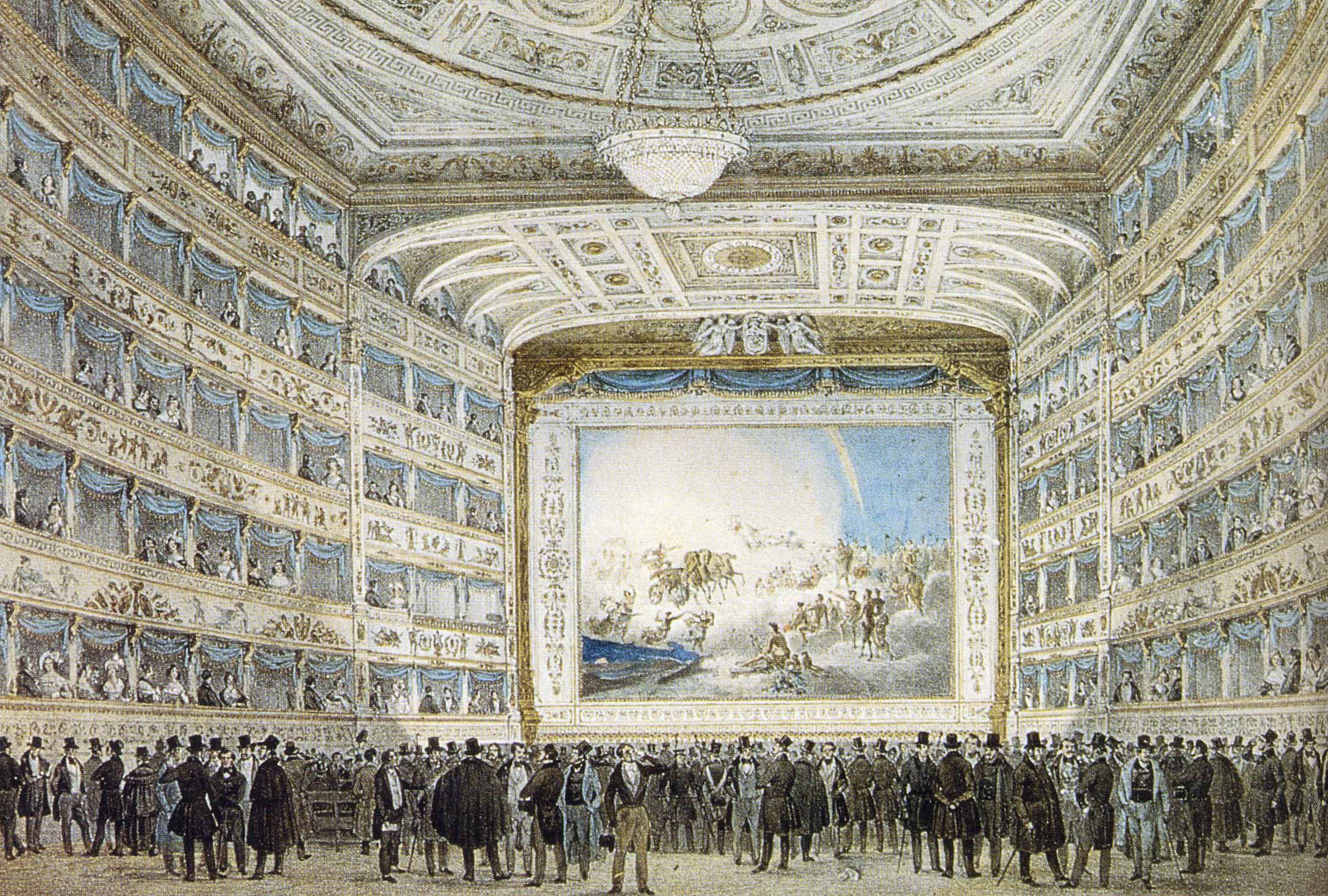
Italy did not simply contribute to the history of opera: it created the conditions in which opera could exist. The combination of music, poetry, acting, scenery and spectacle that emerged in Florence around 1600 developed into one of Italy’s most influential cultural exports.
Over the following centuries, Italian composers continually reinvented the form. Claudio Monteverdi transformed early musical experiments into convincing human drama. Rossini, Bellini and Donizetti brought bel canto singing to extraordinary heights. Giuseppe Verdi gave opera greater psychological and political force, while Giacomo Puccini created intensely theatrical works that remain among the most frequently performed in the world.
The Italian influence is also preserved in the language of music. Words such as aria, libretto, soprano, tenor, allegro, crescendo and opera itself are Italian. For a broader introduction, see our guide to Italian music and our overview of Italian classical music.
The following composers are presented chronologically so that readers can follow the evolution of Italian opera from its experimental beginnings to bel canto, Romantic drama and verismo.
1. Jacopo Peri: Opera’s Early Pioneer
Born: 1561, Rome
Died: 1633, Florence
Essential works: Dafne, Euridice
Jacopo Peri belonged to the group of Florentine poets, musicians and intellectuals who tried to recreate what they believed had been the musical drama of ancient Greece. Their experiments produced a new style in which a solo voice delivered text over relatively simple instrumental accompaniment.
Peri’s Dafne, performed during the 1590s, is generally described as the first opera, although most of its music has been lost. His Euridice, staged in Florence in 1600 for the marriage of Maria de’ Medici and Henry IV of France, is the earliest surviving opera whose music has come down to us substantially complete.
These works can sound restrained beside later opera, but their historical importance is enormous. Peri helped establish the idea that an entire drama could be sung rather than spoken.
2. Claudio Monteverdi: The First Great Opera Composer
Born: 1567, Cremona
Died: 1643, Venice
Essential works: L’Orfeo, Il ritorno d’Ulisse in patria, L’incoronazione di Poppea
Claudio Monteverdi did not invent opera, but he was the first composer to demonstrate its full emotional and dramatic potential.
Written for the Gonzaga court in Mantua, L’Orfeo premiered in 1607. Monteverdi used contrasting instruments, choruses, dances, recitative and expressive solo writing to transform the legend of Orpheus and Eurydice into a compelling theatrical experience.
After moving to Venice, Monteverdi composed for the city’s growing public opera scene. Il ritorno d’Ulisse in patria presents an aging Ulysses attempting to reclaim his home, while L’incoronazione di Poppea portrays the ruthless ascent of Poppea and Emperor Nero. The latter remains striking because its characters are neither simple heroes nor villains. Desire, political ambition and manipulation drive the story.
Monteverdi stands at the turning point between Renaissance and Baroque music. His operas proved that music could reveal the inner lives of theatrical characters, not merely decorate their words.
3. Francesco Cavalli: Opera Reaches the Public
Born: 1602, Crema
Died: 1676, Venice
Essential works: Giasone, La Calisto, Ercole amante
Opera began as entertainment for aristocratic courts, but Francesco Cavalli helped turn it into a public art form. He became the leading opera composer in seventeenth-century Venice, where paying audiences could attend performances during Carnival.
Cavalli adapted opera to the practical needs of commercial theaters. His orchestras were generally smaller than Monteverdi’s, and his scores placed greater emphasis on expressive vocal writing, memorable arias and rapidly unfolding plots.
Giasone became one of the century’s most popular operas. La Calisto, inspired by stories from Ovid, mixes gods, mortals, comedy and sensual intrigue. Although Cavalli’s works disappeared from the regular repertory for generations, modern revivals have restored his place as a central figure in Baroque opera.
4. Alessandro Scarlatti: The Rise of Opera Seria
Born: 1660, Palermo
Died: 1725, Naples
Essential works: La Griselda, Mitridate Eupatore, Il trionfo dell’onore
Alessandro Scarlatti composed dozens of operas and became one of the leading figures associated with the Neapolitan school. His career took him between Rome, Naples and other Italian musical centers.
Scarlatti helped develop the style later known as opera seria: serious opera based principally on historical, mythological or heroic subjects. His works gave increasing importance to the aria, especially forms in which an opening musical section returned after a contrasting middle passage.
This structure allowed singers to display technical skill and add ornamentation, helping create the culture of vocal virtuosity that dominated eighteenth-century opera. Scarlatti’s name may be less familiar to general audiences than Rossini’s or Verdi’s, but his influence on the development of operatic form was fundamental.
5. Giovanni Battista Pergolesi: A Master of Comic Opera
Born: 1710, Jesi
Died: 1736, Pozzuoli
Essential works: La serva padrona, Lo frate ’nnamorato, L’Olimpiade
Giovanni Battista Pergolesi died from tuberculosis at only 26, yet his brief career had a lasting impact on European music.
His best-known theatrical work, La serva padrona, began as a short comic intermezzo performed between the acts of a serious opera. Its story follows the clever servant Serpina, who manipulates her employer Uberto into marrying her.
The work’s natural humor, clear melodies and recognizable characters offered a refreshing contrast to the grandeur of opera seria. Performances in Paris later contributed to the famous Querelle des Bouffons, a public debate over the relative merits of Italian comic opera and French musical tradition.
Pergolesi demonstrated that an opera could succeed through economy, wit and sharply observed human behavior rather than elaborate heroic spectacle.
6. Gioachino Rossini: Energy, Comedy and Vocal Brilliance
Born: 1792, Pesaro
Died: 1868, Passy, France
Essential works: The Barber of Seville, La Cenerentola, Semiramide, Guillaume Tell
Few composers understood theatrical momentum as well as Gioachino Rossini. His music is immediately recognizable for its rhythmic vitality, agile vocal writing and carefully constructed crescendos in which repeated phrases accumulate irresistible energy.
The Barber of Seville initially had a difficult premiere in Rome in 1816, but it became one of the most beloved comic operas ever written. Figaro’s entrance aria, “Largo al factotum,” captures Rossini’s gift for combining characterization with dazzling musical movement.
La Cenerentola reimagines the Cinderella story without supernatural intervention, while Semiramide represents Rossini’s more serious and vocally demanding style. His final opera, Guillaume Tell, was written in French on a monumental scale and helped point toward nineteenth-century grand opera.
Rossini stopped composing for the stage while still in his thirties, but his influence continued. Today, the Rossini Opera Festival in Pesaro performs both his celebrated works and operas that were neglected for many years.
7. Gaetano Donizetti: Comedy, Madness and Tragedy
Born: 1797, Bergamo
Died: 1848, Bergamo
Essential works: Lucia di Lammermoor, L’elisir d’amore, Don Pasquale, La fille du régiment
Gaetano Donizetti was astonishingly prolific, composing more than 60 operas while working in Italy, Paris and Vienna. His best works combine lyrical immediacy with a precise understanding of theatrical character.
Lucia di Lammermoor, based on Walter Scott’s novel The Bride of Lammermoor, contains one of opera’s most famous “mad scenes.” Lucia’s increasingly fragmented music expresses a psychological collapse that words alone could not communicate.
Donizetti was equally gifted in comedy. L’elisir d’amore balances humor with genuine tenderness, particularly in the tenor aria “Una furtiva lagrima.” Don Pasquale turns the conventions of opera buffa into an affectionate but sharp study of age, vanity and romantic independence.
Visitors to Bergamo can explore Donizetti’s life and music through the Fondazione Teatro Donizetti and the annual Donizetti Opera festival.
8. Vincenzo Bellini: The Poet of Bel Canto
Born: 1801, Catania
Died: 1835, Puteaux, France
Essential works: Norma, La sonnambula, I puritani, I Capuleti e i Montecchi
Vincenzo Bellini created long, graceful melodies that appear to unfold in a single breath. His vocal lines require control, flexibility and exceptional expressive sensitivity, making his leading roles some of the most demanding in the repertory.
Norma is his acknowledged masterpiece. Set in Roman-occupied Gaul, it places a Druid priestess at the center of a conflict involving religious duty, political resistance, motherhood and betrayed love. “Casta diva,” Norma’s entrance aria, is one of the supreme tests for a soprano.
La sonnambula explores innocence and misunderstanding in a rural setting, while I puritani combines political conflict with emotional and vocal intensity.
Bellini died near Paris at only 33. His limited output nevertheless influenced later composers, including Chopin and Verdi, and established him as one of the three defining masters of bel canto alongside Rossini and Donizetti.
9. Giuseppe Verdi: Drama, Humanity and the Risorgimento
Born: 1813, Le Roncole
Died: 1901, Milan
Essential works: Nabucco, Rigoletto, Il trovatore, La traviata, Don Carlo, Aida, Otello, Falstaff
Giuseppe Verdi brought Italian opera to a new level of dramatic concentration. His works span more than half a century, from the patriotic associations surrounding Nabucco to the extraordinary psychological sophistication of Otello and Falstaff.
The chorus “Va, pensiero” from Nabucco became associated with Italians longing for freedom from foreign rule. Verdi’s relationship with the Risorgimento was more complex than the popular legend sometimes suggests, but his music undeniably acquired national significance. The slogan “Viva VERDI” could also be read as an abbreviation of “Vittorio Emanuele Re d’Italia.”
The three operas often called his “popular trilogy”—Rigoletto, Il trovatore and La traviata—were composed between 1851 and 1853. Each places outsiders, social conflict and painful moral choices at the center of the drama.
In his later works, Verdi moved beyond conventional divisions between recitative and aria. Otello, based on Shakespeare, unfolds with remarkable continuity, while Falstaff, written when Verdi was approaching 80, ends his career with comedy rather than tragedy.
Read our complete biography, Giuseppe Verdi: The Master of Italian Opera, for his life, major works, Risorgimento connections and the Italian places associated with him.
10. Amilcare Ponchielli: The Bridge to a New Generation
Born: 1834, Paderno Fasolaro
Died: 1886, Milan
Essential works: La Gioconda, I Lituani
Amilcare Ponchielli is remembered principally for La Gioconda, a large-scale drama set in seventeenth-century Venice. Its combination of spectacle, powerful vocal roles and colorful orchestration places it between Verdi’s mature operas and the theatrical style developed by the following generation.
The opera’s “Dance of the Hours” became famous far beyond the opera house, particularly after appearing in Walt Disney’s Fantasia. The complete work, however, is a dark story of political surveillance, jealousy, sacrifice and revenge.
Ponchielli also taught at the Milan Conservatory. His students included Puccini and Mascagni, giving him an important place in the transition from Romantic opera to the musical theater of the late nineteenth century.
11. Arrigo Boito: Composer, Poet and Verdi’s Librettist
Born: 1842, Padua
Died: 1918, Milan
Essential work: Mefistofele
Arrigo Boito occupies a distinctive place in Italian opera because he was both a composer and one of its greatest librettists.
His opera Mefistofele, based on Goethe’s Faust, received a disastrous premiere at La Scala in 1868. Boito substantially revised it, creating the shorter and more theatrically effective version that eventually entered the international repertory.
His greatest contribution may have come through his collaboration with Verdi. Boito wrote the librettos for Otello and Falstaff and helped revise Simon Boccanegra. His intelligence, literary skill and understanding of Shakespeare encouraged the elderly Verdi to return to the stage and produce two final masterpieces.
12. Ruggero Leoncavallo: Theater Inside the Theater
Born: 1857, Naples
Died: 1919, Montecatini Terme
Essential work: Pagliacci
Ruggero Leoncavallo wrote several operas, but his reputation rests overwhelmingly on Pagliacci, first performed in Milan in 1892.
The opera follows a traveling theatrical company whose offstage jealousy and betrayal erupt during a public performance. Its play-within-a-play structure blurs the boundary between acting and reality, culminating in a murder witnessed by an audience that initially believes it is part of the entertainment.
The tenor aria “Vesti la giubba” became one of opera’s most recognizable expressions of private suffering hidden behind a performer’s costume. Pagliacci is frequently paired with Mascagni’s Cavalleria rusticana, producing the celebrated double bill known informally as “Cav and Pag.”
13. Giacomo Puccini: The Supreme Theatrical Storyteller
Born: 1858, Lucca
Died: 1924, Brussels
Essential works: Manon Lescaut, La bohème, Tosca, Madama Butterfly, La fanciulla del West, Turandot
Giacomo Puccini had an exceptional instinct for the stage. He used recurring musical ideas, orchestral color and carefully timed emotional climaxes to create dramas that communicate directly with audiences.
La bohème finds poetry in the lives of impoverished young artists in Paris. Tosca compresses political violence, sexual coercion, love and betrayal into a tense sequence of events unfolding over little more than a day. Madama Butterfly examines devotion and abandonment, although modern productions must also confront the work’s Western stereotypes about Japan.
Puccini was influenced by verismo, particularly its focus on recognizable emotions and ordinary people, but his musical language was broader and more cosmopolitan. La fanciulla del West contains sophisticated orchestral writing, while Turandot combines monumental spectacle with unusual harmonies and melodies inspired by Chinese sources.
Puccini died before completing Turandot. Franco Alfano constructed an ending from his sketches, and the opera premiered at La Scala in 1926 under Arturo Toscanini.
Our complete Giacomo Puccini biography examines his life, operas and connections with Lucca and Torre del Lago.
14. Pietro Mascagni: The Shock of Verismo
Born: 1863, Livorno
Died: 1945, Rome
Essential works: Cavalleria rusticana, L’amico Fritz, Iris
Cavalleria rusticana made Pietro Mascagni internationally famous almost overnight. The one-act opera won a competition organized by the publisher Sonzogno and premiered in Rome in 1890.
Set in a Sicilian village on Easter morning, the story deals with adultery, jealousy, wounded pride and revenge. Mascagni’s direct dramatic style and surging orchestral intermezzo helped establish the operatic movement known as verismo.
Verismo did not mean documentary realism. Its composers still used heightened emotion, lyrical arias and theatrical coincidence. What changed was the social world presented onstage: villagers, workers and traveling performers increasingly replaced kings, gods and legendary heroes.
Mascagni composed many other works, including the tender L’amico Fritz and the more exotic Iris, but none equaled the lasting popularity of Cavalleria rusticana.
15. Umberto Giordano: Revolution and Romantic Passion
Born: 1867, Foggia
Died: 1948, Milan
Essential works: Andrea Chénier, Fedora
Umberto Giordano belongs to the generation sometimes called the giovane scuola, the “young school” of composers who followed Verdi and developed new forms of Italian musical drama.
His masterpiece, Andrea Chénier, is loosely based on the life of a French poet executed during the Reign of Terror. The opera combines political upheaval with an intense love story and offers major dramatic opportunities for tenor, soprano and baritone.
Fedora, adapted from Victorien Sardou’s play, moves through aristocratic salons, political intrigue and personal revenge. Its brief tenor aria “Amor ti vieta” remains a favorite in concerts and recordings.
Giordano’s operas show that Italian opera did not suddenly stop developing after Verdi. His music belongs to a wider late-nineteenth-century culture in which theatrical immediacy, orchestral color and passionate vocal writing became increasingly important.
What Are Bel Canto and Verismo?
Two expressions appear repeatedly in discussions of Italian opera.
Bel canto, literally “beautiful singing,” describes a tradition centered on smooth tone, breath control, flexibility, ornamentation and expressive phrasing. Rossini, Bellini and Donizetti are its principal nineteenth-century masters. Bel canto is not simply decorative vocal display: at its best, virtuosity communicates a character’s changing emotional state.
Verismo means “realism,” although the operas are rarely realistic in an everyday sense. Works such as Cavalleria rusticana and Pagliacci focus on recognizable people, concentrated action and extreme emotions. The stories frequently involve jealousy, betrayal and violence in contemporary or near-contemporary settings.
Puccini is often grouped with the verismo composers, but his musical and dramatic world is more varied. His operas draw on French, German and Italian influences and range from intimate realism to comedy, symbolism and grand spectacle.
Five Italian Operas for Beginners
Someone approaching opera for the first time does not need to begin with the longest or most historically important work. These five operas offer particularly accessible introductions:
- The Barber of Seville by Rossini – Fast, funny and filled with memorable melodies.
- La traviata by Verdi – A moving human drama with an immediately recognizable score.
- La bohème by Puccini – Intimate, emotional and relatively concise.
- Tosca by Puccini – Ideal for viewers who enjoy political thrillers and tightly constructed plots.
- Cavalleria rusticana and Pagliacci – Two short, intensely dramatic operas commonly performed together.
For the full experience, attend a performance in one of the most famous opera houses and theaters in Italy.
Italian Cities Associated With Opera
Opera is closely connected with the cities in which composers lived, studied and premiered their works.
- Florence is associated with opera’s earliest experiments.
- Mantua hosted the first performance of Monteverdi’s L’Orfeo.
- Venice developed the first successful public opera houses.
- Naples became one of Europe’s great centers of operatic training and performance.
- Pesaro celebrates Rossini through its annual festival.
- Bergamo preserves Donizetti’s legacy.
- Catania honors Bellini, whose tomb is inside the city’s cathedral.
- Busseto and Parma are closely associated with Verdi.
- Lucca and Torre del Lago preserve Puccini’s homes and musical heritage.
- Milan became inseparable from Italian opera through its publishers, conservatory and Teatro alla Scala.
La Scala opened in 1778 and hosted important premieres including Bellini’s Norma, Verdi’s Otello and Falstaff, and Puccini’s Madama Butterfly and Turandot. Its history illustrates how composers, singers, publishers, conductors and audiences collectively shaped the Italian operatic tradition.
Why Italian Opera Still Matters
Italian opera has survived because it speaks simultaneously through music, language and theater. Its greatest composers understood that an aria must do more than sound beautiful: it must reveal desire, fear, ambition, love or loss.
Monteverdi showed that music could expose the contradictions within a character. Rossini turned comic timing into sound. Bellini stretched melody across seemingly endless phrases. Donizetti moved effortlessly between comedy and tragedy. Verdi placed human conflict at the center of large historical dramas, while Puccini created moments of theatrical tension that remain powerful even for audiences hearing opera for the first time.
Their works are not museum pieces. They continue to be reinterpreted by new singers, conductors and directors in Italy and throughout the world. More than four centuries after opera’s beginnings, Italian composers still provide the foundation of the international repertory.
Internal Links
- Italian Music
- Italian Classical Music
- Giuseppe Verdi: The Master of Italian Opera
- Giacomo Puccini: The Genius Behind Italian Opera
- The Most Famous and Beautiful Theaters in Italy