

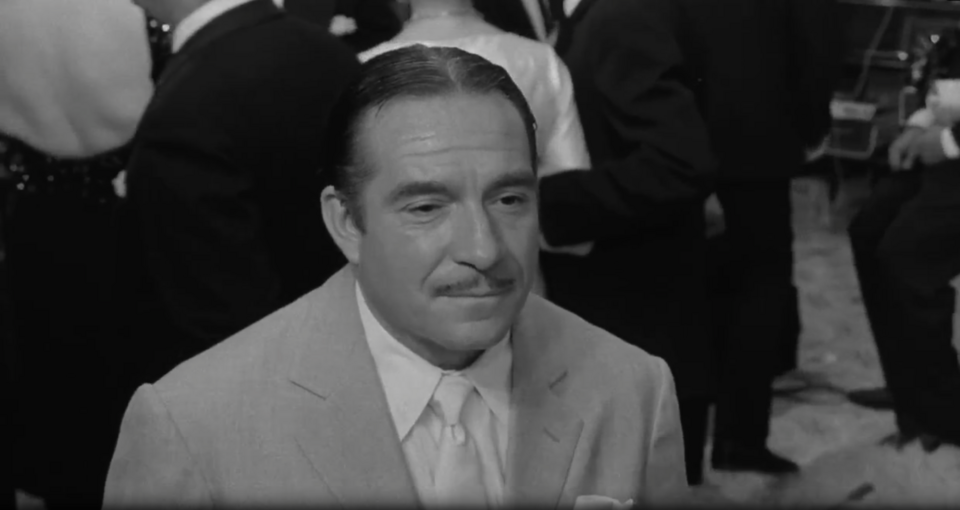
Ugo Tognazzi was one of the most versatile and perceptive actors in Italian cinema. Equally convincing as a comic performer, troubled husband, provincial opportunist, affectionate friend or morally compromised bourgeois, he helped transform popular comedy into a sharp examination of postwar Italian society.
Together with Alberto Sordi, Vittorio Gassman, Nino Manfredi and Marcello Mastroianni, Tognazzi became one of the defining faces of the commedia all’italiana. Yet calling him simply a comedian does not capture the range of his work. Across more than four decades, he moved between variety theatre, television, popular farce, political satire, unsettling social commentary and serious drama.
He was also a director, screenwriter, theatre actor and passionate food writer. His love of cooking was not a celebrity sideline but an essential part of his private and creative life.
From Cremona to the Stage
Ottavio “Ugo” Tognazzi was born in Cremona, Lombardy, on March 23, 1922. His father worked as an insurance inspector, and the family moved frequently during Tognazzi’s childhood before returning to Cremona.
As a teenager, he found employment at the Negroni cured-meat factory while performing with amateur dramatic groups in his spare time. During the Second World War, he organized theatrical entertainment for fellow soldiers, gaining practical experience in front of demanding audiences.
After the war, Tognazzi left secure employment and moved to Milan to pursue a professional career. He entered the world of rivista, the Italian variety-theatre tradition combining sketches, music, dance and topical satire. He worked in productions associated with major performers such as Wanda Osiris and gradually developed his distinctive comic style.
Unlike actors trained in formal academies, Tognazzi learned through constant performance. His expressive face, unusual voice, physical timing and ability to shift suddenly from warmth to irritation made him particularly effective in fast-moving sketches. Those qualities would later allow him to reveal the contradictions hidden inside apparently ordinary characters.
Television Success with Raimondo Vianello
Tognazzi became a national celebrity through his partnership with Raimondo Vianello. Their contrasting personalities created one of early Italian television’s most memorable comic pairings: Tognazzi was energetic, physical and instinctive, while Vianello projected dry, controlled irony.
The pair appeared together in numerous films and, most importantly, in the Rai variety program Un, due, tre, broadcast during the 1950s. Its sketches parodied current affairs, social conventions and the increasingly influential language of television itself.
At a time when television was still a relatively new presence in Italian homes, Tognazzi and Vianello helped establish the possibilities of televised comedy. Their work could be playful and accessible, but it also contained an irreverent attitude toward public figures and respectable institutions.
Tognazzi later returned to television in projects including FBI – Francesco Bertolazzi investigatore, a six-part series he also directed in 1970. Surviving sketches and appearances preserved by Rai Teche offer a valuable record of his television career.
Becoming a Master of Italian Comedy
Tognazzi made his cinema debut in Mario Mattoli’s I cadetti di Guascogna in 1950. During the decade that followed, he appeared in numerous commercially successful comedies, many of them built around familiar characters and routines inherited from variety theatre.
His decisive breakthrough came with Luciano Salce’s Il federale in 1961. Tognazzi played Primo Arcovazzi, a fanatical but inept Fascist militia officer charged with transporting an antifascist professor to Rome during the collapse of Mussolini’s regime.
The performance was comic without making the character harmless. Arcovazzi is ridiculous, ambitious and ideologically blinded, yet recognizably human. Tognazzi’s ability to create this mixture of absurdity, vulnerability and moral failure became central to his mature work.
Films such as La voglia matta, La marcia su Roma and I mostri established him as one of the principal actors of the commedia all’italiana. The genre used laughter to examine subjects such as Fascism, consumerism, masculinity, marriage, social ambition and political hypocrisy.
Tognazzi rarely played an uncomplicated hero. His characters often wanted to appear respectable, modern or powerful, but their vanity and insecurity gradually exposed them. He could invite the audience to laugh at these men while also revealing the loneliness or fear behind their behavior.
The Provocative Films of Marco Ferreri
Some of Tognazzi’s most daring performances came through his collaboration with director Marco Ferreri.
In Una storia moderna: l’ape regina (1963), released internationally as The Conjugal Bed, he played a middle-aged man whose conventional ideas about marriage lead him into an increasingly oppressive domestic situation. The film’s treatment of sexuality, religion and family life made it controversial.
In La donna scimmia (1964), Tognazzi portrayed a man who exploits a woman with excessive body hair by exhibiting her as a public curiosity. His performance is disturbing precisely because the character’s cruelty is presented through everyday charm, calculation and self-justification.
The collaboration reached its most notorious point with La grande abbuffata (La Grande Bouffe, 1973). Tognazzi appeared alongside Marcello Mastroianni, Michel Piccoli and Philippe Noiret as four affluent men who retreat to a villa with the intention of eating themselves to death. The film’s excessive food, sex and grotesque humor form a bleak satire of consumption and bourgeois emptiness.
These performances demonstrated Tognazzi’s willingness to make himself unlikable on screen. Rather than protecting his image as a popular star, he repeatedly accepted roles that challenged audiences and questioned conventional morality.
Amici miei and the Comic Mask of Count Mascetti
For many viewers, Tognazzi’s most beloved character is Count Raffaello “Lello” Mascetti in Mario Monicelli’s Amici miei (1975).
Mascetti is an impoverished aristocrat who hides his financial difficulties behind grand manners, elaborate nonsense and the famous supercazzola: a stream of impressive-sounding but meaningless words used to confuse unsuspecting victims.
The film follows a group of middle-aged Florentine friends who escape disappointment, aging and responsibility through elaborate practical jokes. Although frequently hilarious, Amici miei carries a strong current of melancholy. The friends’ laughter becomes a defense against loss and mortality.
Tognazzi returned as Mascetti in Amici miei – Atto II in 1982 and Amici miei – Atto III in 1985. His performance balances comic invention with sadness, gradually revealing the insecurity behind the character’s theatrical confidence.
Readers interested in the wider history surrounding these films can explore Italia Mia’s guide to Italian cinema.
International Recognition and Il vizietto
Tognazzi achieved international popularity through Édouard Molinaro’s French-Italian comedy La Cage aux folles, released in Italy as Il vizietto in 1978.
He played Renato Baldi, the manager of a Saint-Tropez nightclub who lives with its star performer, Albin, played by Michel Serrault. When Renato’s son announces his engagement to the daughter of a conservative politician, the couple attempt to conceal their life together from the future in-laws.
Some elements of the film reflect the stereotypes and social attitudes of its period. Nevertheless, Tognazzi gave Renato dignity, affection and emotional complexity at a time when gay relationships were rarely placed at the center of mainstream international comedies. The film became a major commercial success and produced two sequels.
A Dramatic Triumph at Cannes
Tognazzi’s dramatic abilities received one of cinema’s highest recognitions in 1981, when he won the Best Actor award at the Cannes Film Festival for Bernardo Bertolucci’s La tragedia di un uomo ridicolo.
He played Primo Spaggiari, the owner of a cheese factory whose son is apparently kidnapped. As the story becomes increasingly uncertain, Primo struggles to understand his family, his business and a changing political world.
Tognazzi avoids easy displays of emotion. His restrained performance captures a man whose authority is collapsing even as he attempts to maintain control. The Festival de Cannes archive records the award as the crowning international achievement of his acting career.
Tognazzi as a Director
Tognazzi also directed several films, often exploring themes that interested him as an actor: conformity, social control, sexual jealousy and the absurdities of respectable life.
His directorial works include Il mantenuto (1961), Il fischio al naso (1967), Sissignore (1968), Cattivi pensieri (1976) and I viaggiatori della sera (1979).
Il fischio al naso, adapted from Dino Buzzati’s story Sette piani, is generally considered his strongest film as a director. Tognazzi plays a successful businessman admitted to a clinic for a seemingly harmless condition. He is gradually transferred from one floor to another as the medical institution assumes control over his identity and fate.
The film combines comedy with an unsettling vision of bureaucracy and institutional power—subjects well suited to Tognazzi’s ability to make anxiety appear both ridiculous and painfully real.
Ugo Tognazzi’s Passion for Food
Away from the set, Tognazzi was an enthusiastic and inventive cook. At his country home near Velletri, outside Rome, he grew ingredients, experimented with recipes and prepared elaborate meals for relatives, actors, directors, writers and other friends.
For Tognazzi, hospitality was a form of performance and affection. Cooking allowed him to create an informal gathering place in which collaborators such as Vittorio Gassman, Mario Monicelli, Marco Ferreri and Paolo Villaggio could meet away from the pressures of the film industry.
He also wrote about food with humor and imagination. His culinary books included L’abbuffone, Afrodite in cucina and Il rigettario. The last title is a play on the Italian words ricettario, meaning recipe book, and rigettare, meaning to reject or throw back.
These were not conventional celebrity cookbooks. They combined recipes, personal stories, drawings, jokes, extravagant menus and reflections on conviviality. The modern edition of Il rigettario preserves menus and recipes written and illustrated by Tognazzi himself.
His interest in food also adds another dimension to La grande abbuffata. Although the film transforms eating into a disturbing metaphor for excess, Tognazzi’s personal culinary philosophy was centered on creativity, friendship and the pleasure of feeding other people.
Later Years and Legacy
During the 1980s, Tognazzi continued making films but devoted increasing attention to the theatre. His stage work included productions of Pirandello’s Six Characters in Search of an Author and Molière’s The Miser, confirming that his talents extended far beyond screen comedy.
He also experienced depression during his later years. This part of his life should be described with care, as a health condition rather than through stigmatizing expressions or assumptions about his personality.
Ugo Tognazzi died in Rome on October 27, 1990, at the age of 68, following a cerebral hemorrhage. He was buried in Velletri, the town closely associated with his family life, cooking and legendary hospitality.
His legacy survives through an exceptionally varied body of work. He could be exuberantly funny, coldly manipulative, emotionally defeated or quietly tragic—sometimes within the same performance. His characters exposed the contradictions of modern Italy, but they also spoke to universal fears about aging, status, desire, family and failure.
Among the great actors of postwar Italian cinema, Tognazzi remains distinctive because he never allowed comedy to become merely reassuring. Behind the joke, there was almost always an uncomfortable truth.
Ten Essential Ugo Tognazzi Films
Il federale (1961)
Luciano Salce’s political satire gave Tognazzi his first major mature role. His performance as a pompous Fascist officer is both comic and revealing.
La voglia matta (1962)
A middle-aged man attempts to impress a group of younger people, exposing his vanity and fear of aging.
La marcia su Roma (1962)
Tognazzi and Vittorio Gassman play two opportunists whose experiences undermine their initial support for Fascism.
I mostri (1963)
Dino Risi’s episodic satire features Tognazzi and Gassman in multiple roles, presenting a gallery of selfish, hypocritical and grotesque Italians.
Una storia moderna: l’ape regina (1963)
The first major collaboration between Tognazzi and Marco Ferreri uses marriage and sexuality to attack conventional social expectations.
La donna scimmia (1964)
One of Tognazzi’s darkest performances, centered on exploitation disguised as love and opportunity.
La grande abbuffata (1973)
Ferreri’s controversial satire of consumer society remains provocative, grotesque and impossible to forget.
Amici miei (1975)
As Count Mascetti, Tognazzi created one of his funniest and most moving characters—a man who turns language and friendship into protection against failure.
Il vizietto (1978)
Tognazzi’s performance as Renato brought him widespread international recognition and helped make the film a landmark popular comedy.
La tragedia di un uomo ridicolo (1981)
Bernardo Bertolucci’s ambiguous family and political drama earned Tognazzi the Best Actor award at Cannes.
External Links
- Ugo Tognazzi in the Treccani Encyclopedia
- Ugo Tognazzi collection at Rai Teche
- Ugo Tognazzi tribute from Rai Cultura
- 1981 awards at the Festival de Cannes
- Ugo Tognazzi’s culinary books and recipes