

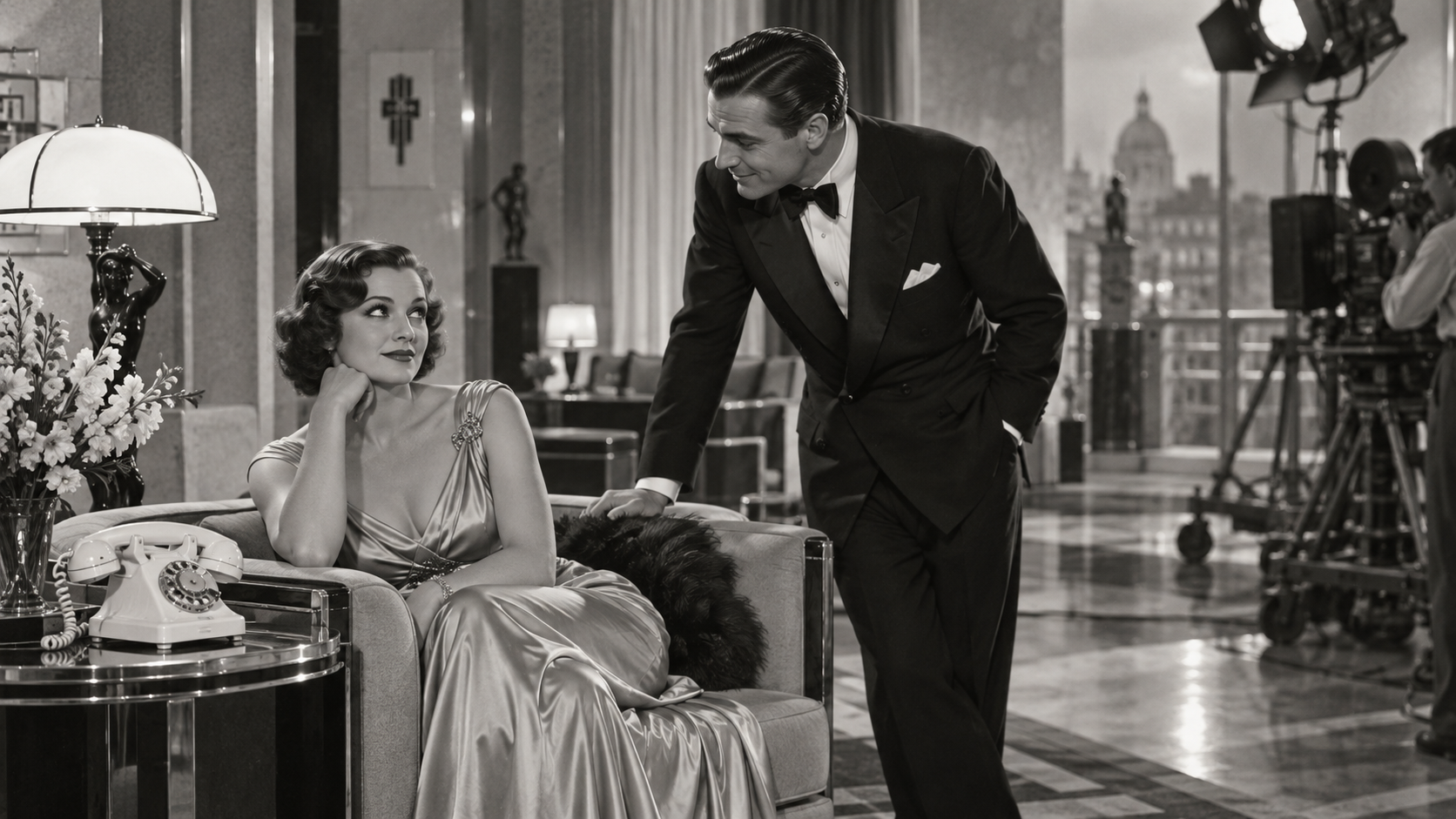
 The polished apartments, fashionable clothes and sophisticated romantic misunderstandings of Italy’s Telefoni Bianchi films can appear far removed from the dictatorship in which they were produced. Yet these elegant comedies belonged to a film industry transformed by Fascist institutions, censorship, state investment and political control.
Popular mainly from the mid-1930s until the collapse of Fascism in 1943, White Telephone films offered audiences an escape into an affluent and orderly world. They were not usually direct propaganda films, but neither were they independent of the regime surrounding them.
Understanding the period therefore requires an important distinction: escapist entertainment, state censorship and explicit Fascist propaganda were related, but they were not the same thing.
What Were the Telefoni Bianchi?
Telefoni bianchi means “white telephones.” The expression refers to the pale-colored telephones sometimes displayed in the luxurious interiors of Italian films made during the 1930s and early 1940s.
Most Italian homes did not possess any telephone, while the standard black telephone was associated with offices and ordinary professional life. On screen, a white telephone became a compact visual symbol of wealth, elegance and modernity.
The name was not an official genre designation used by the Fascist government. It became a convenient critical label for a group of sophisticated comedies and romantic films featuring affluent characters, elaborate studio sets, fashionable costumes and carefully controlled social conflicts.
These films were also sometimes described as cinema déco because their interiors drew upon Art Deco and modernist design. Curved staircases, mirrored rooms, cocktail bars, fashionable hotels and immaculate apartments created a fantasy environment that seemed international rather than specifically Italian.
Escapist Entertainment, Not One Uniform Genre
It is tempting to treat every stylish comedy made under Mussolini as a White Telephone film. The reality was more complicated.
The term covers a broad tendency rather than a rigid genre. Some films centered on wealthy families, aristocrats or business executives. Others followed clerks, shop assistants, drivers and newspaper vendors who briefly entered upper-class society through mistaken identity, romance or deception.
Plots frequently involved engagements, marriages, inheritance disputes, concealed identities and social misunderstandings. Problems that might have become serious social conflicts were usually resolved through reconciliation, good fortune or romantic union.
Many stories were adapted from Hungarian, Austrian and French plays. Foreign or imaginary settings gave filmmakers room to address adultery, divorce and unconventional relationships without representing them directly as problems within Fascist Italy.
The films promised pleasure rather than political instruction. Audiences could admire beautiful interiors, fashionable stars and lifestyles unavailable to most Italians during years marked by low wages, economic inequality, colonial warfare and eventually world war.
Why the Films Flourished under Fascism
Benito Mussolini understood cinema’s ability to reach mass audiences, but the regime did not simply order every director to make political films. Its approach combined institutional control with an effort to build a commercially successful national industry.
The government reorganized the film sector during the 1930s, created professional institutions, supported production and attempted to reduce Hollywood’s dominance of Italian screens. The state founded the Directorate General for Cinematography in 1934 and placed Luigi Freddi, an experienced Fascist official, at its head.
The Centro Sperimentale di Cinematografia opened in Rome in 1935 to train directors, actors and technicians. Two years later, the enormous Cinecittà studios opened, giving Italian filmmakers modern production facilities and the regime a prestigious symbol of national cultural power.
Government policies, subsidies and protection from foreign competition encouraged film production. This system did not require every feature to praise Mussolini openly. A technically accomplished entertainment industry could itself demonstrate the modernity and apparent stability that Fascism wanted to project.
The Difference between Entertainment and Propaganda
White Telephone comedies should not be confused with direct propaganda films.
Explicit propaganda presented Fascist ideology, militarism, colonial conquest or national sacrifice as the central subject. Films such as Alessandro Blasetti’s Vecchia guardia (1934), Carmine Gallone’s Scipione l’Africano (1937), Goffredo Alessandrini’s Luciano Serra pilota (1938) and Alessandrini’s Giarabub (1942) had a more obvious political purpose.
Scipione l’Africano, for example, used the Roman victory over Carthage to associate Fascist Italy with imperial Rome. Released after the invasion of Ethiopia, its spectacle of military conquest served a very different function from a romantic comedy about mistaken identity.
The regime also exercised influence through the Istituto Luce, which produced and distributed newsreels, documentaries and educational films. Mandatory newsreels allowed carefully selected images of Mussolini, military ceremonies, public works and national achievements to reach cinema audiences before the feature presentation.
A viewer might therefore watch a strongly political Luce newsreel followed by an apparently apolitical romantic comedy. Both appeared within the same controlled media environment, but they communicated in different ways.
Censorship and the Limits of What Could Be Shown
Censorship shaped Italian cinema not only by removing unacceptable scenes but also by encouraging filmmakers to avoid certain subjects from the beginning.
Scripts and completed films could be examined by state authorities. Filmmakers risked objections if they portrayed the monarchy, the armed forces, the Catholic Church or Fascist institutions negatively. Representations of poverty, crime, regional conflict and social disorder could be restricted when they contradicted the official picture of a united and disciplined nation.
Divorce was legally unavailable in Italy, while adultery and unconventional sexuality could create censorship problems. Producers therefore often placed romantic complications in foreign countries, softened them through comedy or restored conventional marriage by the ending.
This pressure helps explain why White Telephone films so often occupied socially vague settings. Their characters might have Italian names and speak Italian, yet live in an imaginary Central European world disconnected from recognizable political conditions.
Censorship did not make every film identical, nor did it eliminate creative ambiguity. Directors and screenwriters could still introduce irony, class satire and subtle criticism. Nevertheless, the subjects absent from these films are as historically revealing as those placed on screen.
Indirect Propaganda—or Simply Commercial Cinema?
Film historians have debated whether White Telephone cinema should be considered a form of indirect propaganda.
The argument for that interpretation is understandable. These films generally avoided unemployment, political violence, colonial repression and the hardships experienced by ordinary Italians. Their orderly fictional world rarely challenged family authority or the established social hierarchy. Conflict remained private and manageable.
By presenting modern apartments, efficient businesses and prosperous consumers, the films could contribute to an idealized vision of Fascist Italy without mentioning Fascism. Their optimism and social conservatism were compatible with the regime’s preference for reassuring popular entertainment.
However, calling the entire movement propaganda oversimplifies it.
White Telephone films were commercial products created to attract large audiences. Their sources included international theatrical comedies, and their fascination with consumption, urban romance and independent young women did not always correspond neatly with Fascist ideology.
The regime officially praised rural life, large families, motherhood and traditional gender roles. White Telephone films, by contrast, frequently celebrated fashionable cities, personal desire, consumer goods and women pursuing work or romance. Their cosmopolitan atmosphere could sit uneasily beside the regime’s nationalist rhetoric.
The most accurate interpretation lies between the extremes. These films were neither politically innocent nor simply propaganda disguised as comedy. They were entertainments produced within a dictatorship, shaped by censorship and industrial policy but still capable of irony, contradiction and creative individuality.
Class Fantasy and Social Mobility
One of the most persistent White Telephone themes was the movement between social classes.
In Mario Camerini’s Il signor Max (1937), a modest newspaper vendor played by Vittorio De Sica assumes the identity of a wealthy gentleman. The deception allows him to enter an aristocratic world, but the story eventually redirects him toward a relationship grounded in his real social position.
Camerini’s Darò un milione (1935) reverses the fantasy: a millionaire disguises himself as a poor man while searching for genuine human kindness. Once again, wealth creates the plot, but moral value is located outside social privilege.
These comedies allowed viewers to enter luxurious surroundings while gently mocking their inhabitants. The rich could appear vain, idle or foolish, but the films rarely demanded a transformation of the economic system. Individual honesty, love and personal decency resolved tensions that might otherwise have exposed deeper class divisions.
Women, Work and Marriage
Women occupied a central place in White Telephone cinema. Actresses such as Assia Noris, Isa Miranda, Alida Valli, Clara Calamai and Vivi Gioi became recognizable stars whose clothes, hairstyles and screen personalities helped define modern Italian glamour.
Female characters were often typists, shop assistants, performers, students or daughters seeking greater control over their futures. Romantic comedy allowed them to display initiative, intelligence and sexual appeal while temporarily escaping domestic expectations.
Yet the endings commonly restored marriage, family respectability or an acceptable romantic partnership. Independence could be explored, but it was rarely allowed to overturn the prevailing social order completely.
This tension makes the films especially valuable today. Their heroines reveal both the attraction of modern female autonomy and the boundaries imposed upon it by commercial conventions, censorship and Fascist ideas about gender.
Directors and Stars of the Period
Mario Camerini was one of the most accomplished directors associated with sophisticated Italian comedy. His films combined popular storytelling with observations about work, class and urban life. Gli uomini, che mascalzoni! (1932), Darò un milione, Il signor Max and I grandi magazzini (1939) helped establish Vittorio De Sica as a major screen personality.
De Sica later became one of the defining directors of Italian Neorealism, but his experience as a charismatic actor in 1930s comedy formed an essential part of his career. He also directed light comedies such as Teresa Venerdì (1941) before making the films for which he became internationally celebrated.
Other important filmmakers working within or close to this cinematic culture included Alessandro Blasetti, Mario Mattoli, Carlo Ludovico Bragaglia, Gennaro Righelli and Raffaello Matarazzo. Their work demonstrates that cinema under Fascism contained more stylistic and ideological variety than the White Telephone label sometimes suggests.
Essential Telefoni Bianchi Films
Gli uomini, che mascalzoni! (1932)
Directed by Mario Camerini and starring Vittorio De Sica and Lia Franca, this urban romantic comedy follows a chauffeur and a sales assistant through modern Milan. Its working characters and location photography make it less opulent than later White Telephone productions, but it helped establish the style of sophisticated romantic comedy that followed.
Darò un milione (1935)
A millionaire disguises himself as a beggar and promises to reward the first person who treats him kindly. Camerini turns a fantasy premise into a comedy about money, generosity and social appearances.
Il signor Max (1937)
A newspaper vendor impersonates an aristocrat and discovers that the glamorous upper-class world is less satisfying than it appears. De Sica’s performance gives the class comedy warmth as well as satirical energy.
I grandi magazzini (1939)
Set in a modern department store, Camerini’s comedy combines romance, workplace conflict, crime and consumer culture. The store itself becomes a spectacle of merchandise, fashion and modern urban life.
Mille lire al mese (1939)
Directed by Max Neufeld, this comedy takes its title from the dream of earning a secure monthly salary. Its modern technology, romance and imagined Central European setting typify the aspirations associated with White Telephone cinema.
Ore 9: lezione di chimica (1941)
Mario Mattoli’s school comedy stars Alida Valli and Irasema Dilián. Its youthful characters and romantic misunderstandings show how the style extended beyond stories about aristocratic apartments.
Teresa Venerdì (1941)
Directed by and starring Vittorio De Sica, the film follows a doctor whose professional, financial and romantic difficulties draw him into a series of comic complications. It offers an intriguing bridge between De Sica’s commercial comedy career and his later work as a director.
The End of the White Telephone World
The fantasy became increasingly difficult to sustain as Italy entered the Second World War. Military defeats, bombing, shortages and political instability made polished studio affluence appear more remote from daily experience.
The fall of Mussolini in July 1943, the German occupation and the division of Italy disrupted the national film industry. Cinecittà suffered damage and was later used as a camp for displaced people.
Filmmakers began turning toward ruined cities, unemployment, resistance, moral uncertainty and the lives of ordinary Italians. Roberto Rossellini’s Rome, Open City (1945), De Sica’s Shoeshine (1946) and Bicycle Thieves (1948), and Luchino Visconti’s La terra trema (1948) became landmarks of a cinema apparently opposed to White Telephone artificiality.
The transition was not absolute. Neorealism did not appear from nowhere, and many actors, screenwriters and technicians had developed their skills inside the Fascist-era industry. De Sica’s journey from White Telephone star to neorealist director is the clearest example of this continuity.
How Telefoni Bianchi Films Should Be Remembered
White Telephone cinema should not be dismissed as a collection of meaningless fantasies, but it should not be separated from the dictatorship that governed its production.
Its films document the aspirations, anxieties and limitations of 1930s Italian society. Their interiors reveal dreams of modern consumption; their plots expose uncertainty about class and gender; and their silences show what filmmakers could not safely represent.
Above all, the period demonstrates that cinema under Fascism was not divided neatly between propaganda and resistance. Between those poles existed a large commercial industry in which entertainment, censorship, ambition and political accommodation continually overlapped.
Explore the preceding chapter, The Great Crisis in Italian Cinema, 1919–1929, or return to the chronological History of Italian Cinema hub.
Further Reading
Peter Bondanella’s A History of Italian Cinema provides a broad introduction to the movements, filmmakers and historical conditions that shaped Italian film.
Steven Ricci’s Cinema and Fascism: Italian Film and Society, 1922–1943 offers a more specialized study of the institutions, politics and culture of filmmaking under the dictatorship.
External Sources
Treccani – Il cinema, l’arma più forte
University of California Press – Cinema and Fascism
Berghahn Books – Mussolini’s Dream Factory
Europeana – The Dawn of Propaganda in Cinema