

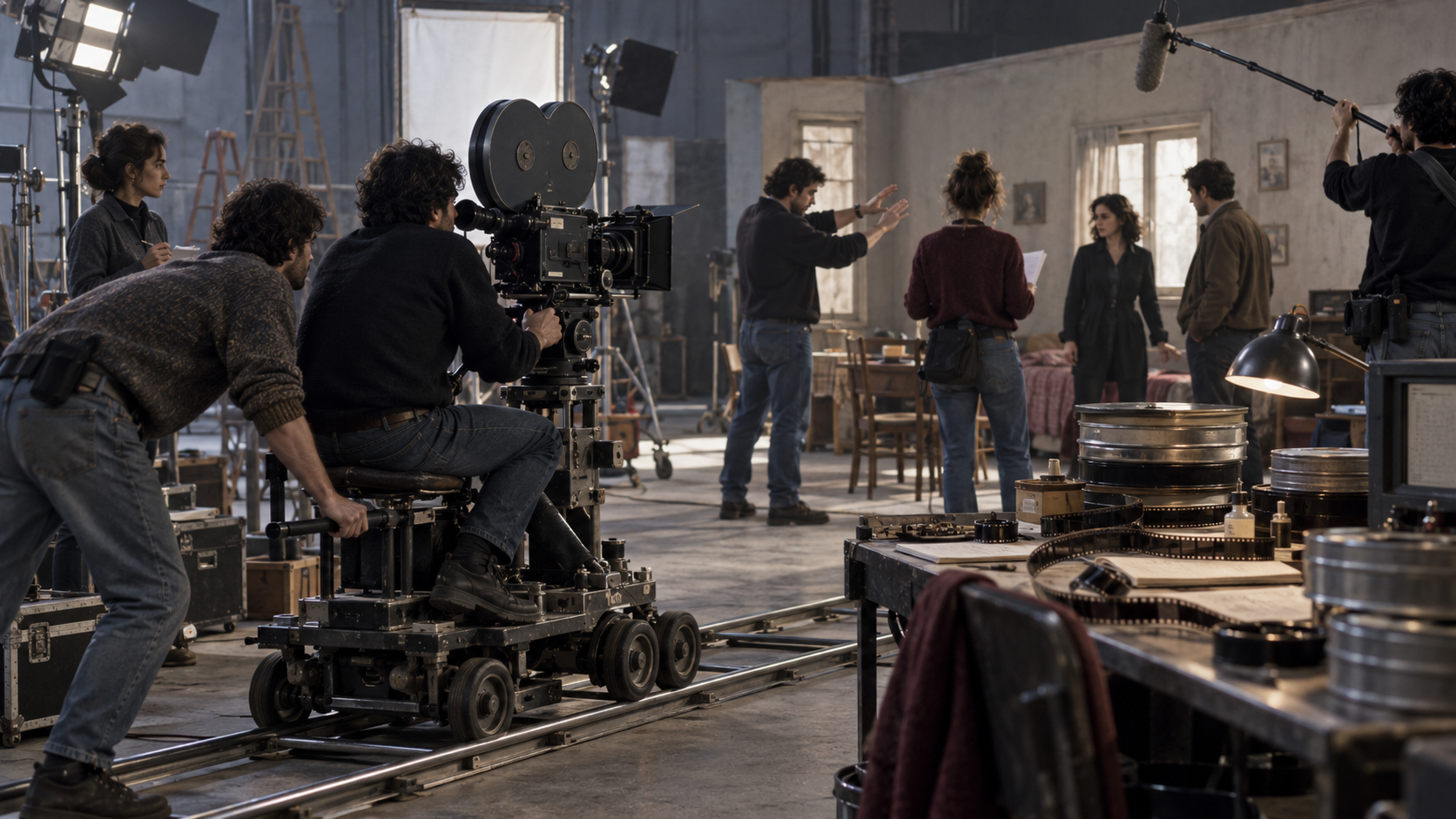
 Italian cinema entered the 1990s carrying many of the problems that had weakened the industry during the previous decade. Theater attendance had declined, commercial television had transformed viewing habits, Hollywood productions dominated the box office, and the once-prolific Italian genre-film industry was disappearing.
Yet describing the entire decade as a period of failure would be misleading. Italian filmmakers responded to reduced resources by developing more personal, regional and internationally oriented forms of cinema. Giuseppe Tornatore, Gabriele Salvatores, Gianni Amelio, Nanni Moretti and Roberto Benigni earned major awards abroad, while new directors began examining immigration, political disillusionment, family life and the changing character of Italian society.
The 1990s were therefore not another golden age on the scale of the 1950s and 1960s. They were a decade of industrial contraction followed by creative renewal—an important bridge between the crisis of the 1980s and the internationally visible Italian cinema of the twenty-first century.
A Film Industry under Pressure
The difficulties of the 1990s cannot be understood without the changes that began during the previous decade. Private television networks offered films, variety programs and imported entertainment directly in Italian homes. Audiences no longer depended on neighborhood cinemas, and many smaller theaters closed or were converted into multiscreen venues.
American films also became increasingly dominant. Italian producers generally lacked the budgets required to compete with Hollywood action movies, special-effects spectacles and worldwide advertising campaigns. The popular cycles that had sustained the national industry—spaghetti westerns, police thrillers, horror films, erotic comedies and low-budget adventures—could no longer survive in their earlier form.
The 1992–93 and 1993–94 seasons represented a particularly difficult moment. Annual cinema attendance fell below 90 million admissions, while Italian films accounted for approximately 15 percent of the domestic market. By 1995, only 93 Italian films were produced, including co-productions.
These figures reveal a genuine industrial crisis, but they do not tell the complete artistic story. Italian cinema became smaller and less commercially self-sufficient, yet directors continued to make ambitious films through public support, European co-productions, independent companies and partnerships with television broadcasters.
The decade also produced several remarkable international successes—evidence that Italian filmmaking had lost industrial power but not creative relevance.
Cinema Paradiso and the Return of International Attention
Giuseppe Tornatore’s Cinema Paradiso was released in Italy in 1988, but its international triumph belongs to the beginning of the following decade. The film won the Academy Award for Best Foreign Language Film in 1990 and introduced a worldwide audience to Tornatore’s cinema of memory, emotion and spectacle.
The story of a Sicilian boy whose life is transformed by his friendship with a projectionist was more than a nostalgic celebration of movies. It also reflected the disappearance of local theaters and the communal culture that had surrounded them. Cinema Paradiso turned the decline of traditional filmgoing into an emotional story about memory, loss and artistic vocation.
Tornatore continued exploring memory, family and spectacle during the 1990s. Everybody’s Fine, released in 1990 and starring Marcello Mastroianni, followed an aging Sicilian father searching for the truth about the lives of his adult children. The Star Maker, released in 1995, returned to postwar Sicily through the story of a fraudulent talent scout who promises ordinary people careers in cinema. It received an Academy Award nomination for Best Foreign Language Film.
Tornatore ended the decade with The Legend of 1900, an ambitious English-language production starring Tim Roth and accompanied by a score from Ennio Morricone. His career demonstrated how an Italian director could preserve a recognizable personal style while working with international financing, casts and distribution.
Gabriele Salvatores: Friendship, Escape and Experimentation
Gabriele Salvatores became one of the defining filmmakers of this transitional period. His early success grew from stories about friendship, travel and a generation uncertain about its place in contemporary Italy.
Turné, released in 1990, followed two actors traveling through Italy while confronting professional and emotional dissatisfaction. Mediterraneo, released the following year, placed a group of Italian soldiers on an isolated Greek island during the Second World War. Instead of presenting a conventional war narrative, Salvatores created a bittersweet comedy about escape, friendship and the desire to withdraw from history.
Mediterraneo won the Academy Award for Best Foreign Language Film in 1992. Its success helped restore international attention to Italian cinema, although its nostalgic and deliberately apolitical qualities also prompted debate among critics.
Salvatores did not simply repeat the same formula. Puerto Escondido explored escape and cultural dislocation, while Sud confronted unemployment, corruption, racism and political frustration in southern Italy. Nirvana, released in 1997, was an unusually ambitious Italian science-fiction production that combined cyberpunk imagery with philosophical questions about identity and artificial life.
These very different films contradict the idea that 1990s Italian cinema was incapable of experimentation. Salvatores moved between comedy, political drama, travel narrative and science fiction, even when limited budgets made such experimentation commercially risky.
Gianni Amelio and the Social Conscience of the Decade
If Salvatores often portrayed characters attempting to escape society, Gianni Amelio examined those left vulnerable by its institutions.
Open Doors, released in 1990, was adapted from a novel by Leonardo Sciascia. Set in Fascist-era Sicily, it followed a judge who opposed the death penalty despite public pressure. The film received an Academy Award nomination and established Amelio as a major international director.
The Stolen Children, released in 1992, followed a young police officer escorting two neglected children from Milan to Sicily. Its journey through Italy exposed poverty, institutional indifference and the unequal realities hidden behind the image of a prosperous modern country. The film received the Grand Prix at the Cannes Film Festival.
With Lamerica in 1994, Amelio turned to the collapse of communist Albania and the movement of migrants toward Italy. The film reversed Italy’s familiar position as a country of emigrants, asking viewers to recognize uncomfortable similarities between contemporary Albanian migrants and the impoverished Italians who had once left their own country in search of opportunity.
The Way We Laughed, which won the Golden Lion at the 1998 Venice Film Festival, returned to internal migration. Through two Sicilian brothers living in Turin between the late 1950s and 1960s, Amelio examined education, sacrifice, class and the often-painful process of integration into industrial northern Italy.
Together, these films made Amelio one of the decade’s most important chroniclers of displacement and social inequality.
Nanni Moretti’s Personal and Political Cinema
Nanni Moretti offered a different kind of renewal. His films combined autobiography, comedy, political criticism and essay-like observation, creating an unmistakably personal form of cinema.
Caro diario, released in 1993, was divided into three chapters. Moretti traveled through Rome on a Vespa, visited the Aeolian Islands and reconstructed his frustrating experience of being misdiagnosed while suffering from Hodgkin lymphoma. The film shifted freely between documentary and fiction, private experience and public criticism. Moretti received the Best Director award at Cannes in 1994.
Aprile, released in 1998, again blurred the boundaries between Moretti’s life and his screen persona. The director attempted to make a documentary about Italian politics while preparing for the birth of his son and becoming distracted by the idea of directing a musical.
These films captured the uncertainties of Italy during and after the political scandals known as Tangentopoli, the collapse of the established postwar parties and the rise of Silvio Berlusconi. Moretti did not offer conventional political dramas. Instead, he showed how national events entered everyday routines, private anxieties and personal contradictions.
His work forms an important link between the postwar masters and the contemporary filmmakers examined in Italia Mia’s guide to modern Italian film directors.
Roberto Benigni and a Worldwide Phenomenon
Roberto Benigni was already a well-known comedian before the 1990s, but the decade transformed him into an international star.
Johnny Stecchino, released in 1991, used mistaken identity and Mafia satire to create one of Italy’s most popular comedies. The Monster followed in 1994, with Benigni playing an eccentric man mistakenly suspected of being a serial killer.
His greatest success came with Life Is Beautiful. Released in Italy in 1997, the film told the story of a Jewish Italian father who uses humor and imagination to protect his young son from the psychological horror of a Nazi concentration camp.
The film provoked debate over whether comedy could appropriately approach the Holocaust, but it achieved extraordinary international success. It received the Grand Prix at Cannes and seven Academy Award nominations. At the 1999 ceremony, it won Best Foreign Language Film, Best Original Dramatic Score for Nicola Piovani and Best Actor for Benigni.
Life Is Beautiful demonstrated that an Italian-language production could still become a worldwide commercial and cultural event. Its success was not evidence that the industry’s structural problems had disappeared, but it decisively challenged the belief that Italian cinema had become internationally irrelevant.
Popular Comedy Still Mattered
Festival awards and auteur cinema represented only part of the decade. Italian audiences continued to support domestic comedy, even when many commercially successful films received little distribution abroad.
Carlo Verdone remained one of the country’s most recognizable comic filmmakers and performers. Leonardo Pieraccioni achieved an enormous popular success with The Cyclone in 1996, while the comedy trio Aldo, Giovanni and Giacomo moved from television and theater to cinema with Three Men and a Leg in 1997.
Massimo Troisi provided one of the decade’s most moving performances in Il Postino. Directed by Michael Radford and released shortly after Troisi’s death in 1994, the Italian-led international production received five Academy Award nominations and won for Luis Bacalov’s original dramatic score.
These films show why the decade should not be judged exclusively through production statistics or critical ideas about artistic innovation. Popular comedy continued to connect national cinema with Italian audiences, while performers moved increasingly between film, television and live entertainment.
Women Directors and New Perspectives
The renewal of the 1990s also included filmmakers who received less international publicity than their male contemporaries.
Francesca Archibugi explored families, childhood and emotional vulnerability in films including Towards Evening and The Great Pumpkin. Cristina Comencini developed a body of work centered on personal relationships and women’s experiences, while Wilma Labate’s My Generation examined political memory through the journey of a former left-wing militant.
Roberta Torre’s Tano da morire, released in 1997, transformed a Mafia murder into a stylized musical combining satire, popular culture and social observation. Its bold mixture of forms offered another example of innovation emerging outside Italy’s most established production traditions.
Actresses including Margherita Buy, Valeria Golino, Asia Argento, Anna Bonaiuto and Francesca Neri became important presences in films that challenged conventional representations of Italian women.
Immigration, Regional Identity and a Changing Italy
Some of the decade’s most significant films addressed the social changes taking place across Italy. Immigration was becoming increasingly visible, older political identities were breaking apart, and the divide between the prosperous north and the economically weaker south remained unresolved.
Alongside Amelio’s Lamerica, Carlo Mazzacurati’s Vesna Goes Fast examined the vulnerability of a woman arriving in Italy from Eastern Europe. Michele Placido’s Pummarò followed a Ghanaian immigrant searching for his brother, while Matteo Garrone’s early films Terra di mezzo and Guests focused on migrants living at the margins of Rome.
Regional filmmaking also became an important source of renewal. Mario Martone emerged from Naples with Death of a Neapolitan Mathematician and Nasty Love. Paolo Virzì brought a sharp Tuscan voice to working-class stories such as La bella vita and Ovosodo. Ferzan Özpetek made his feature debut with Hamam in 1997, beginning a career that would explore identity, sexuality and relationships across cultural borders.
These directors did not form a single movement. Their importance came from the diversity of their perspectives and their willingness to portray an Italy undergoing profound social change.
The End of the Old System and the Beginning of a New Cinema
The 1990s marked the end of several traditions that had defined Italian cinema. Federico Fellini made his final feature, The Voice of the Moon, in 1990 and died in 1993. Marcello Mastroianni died in 1996. The large-scale popular genres that had once supplied hundreds of films were largely gone, and television had become central to financing, employment and audience habits.
At the same time, the decade introduced or consolidated filmmakers who would shape Italian cinema for years to come. Paolo Virzì, Mario Martone, Ferzan Özpetek and Matteo Garrone emerged alongside established directors such as Moretti, Amelio, Tornatore and Salvatores.
Their films did not restore the industrial conditions of Italy’s postwar golden age. Instead, they established a different model: smaller productions, European co-financing, strong regional identities, festival exposure and stories capable of moving between specifically Italian experiences and universal themes.
For a broader selection spanning the complete history of the medium, see The Most Important Films in Italian Cinema.
How the 1990s Should Be Remembered
Italian cinema in the 1990s was neither a simple renaissance nor a decade of failed innovation. Production levels, attendance and domestic market share reached alarming lows, and many forms of popular genre filmmaking disappeared. Those losses were real.
But the decade also gave the world Mediterraneo, The Stolen Children, Caro diario, Lamerica, Il Postino and Life Is Beautiful. It strengthened the careers of several major directors, introduced important new voices and confronted a changing Italy through stories of migration, political uncertainty, family, memory and cultural identity.
The industry that emerged at the end of the decade was smaller than the one that had produced Fellini, Visconti, De Sica and Leone. It was also more decentralized, personal and dependent on international cooperation. Those characteristics would shape Italian filmmaking throughout the early twenty-first century.
Recommended Reading
A History of Italian Cinema by Peter Bondanella and Federico Pacchioni offers a detailed history of Italian film, combining discussion of major directors with the industrial, political and cultural forces behind their work.
External Sources
Academy Awards – The 71st Academy Awards, honoring Life Is Beautiful
Academy Awards – Gabriele Salvatores accepts the Foreign Language Film award for Mediterraneo
British Film Institute – Italian Cinema: Maestros and Mobsters
Italy for Movies – Caro diario
Bloomsbury Academic – A History of Italian Cinema