

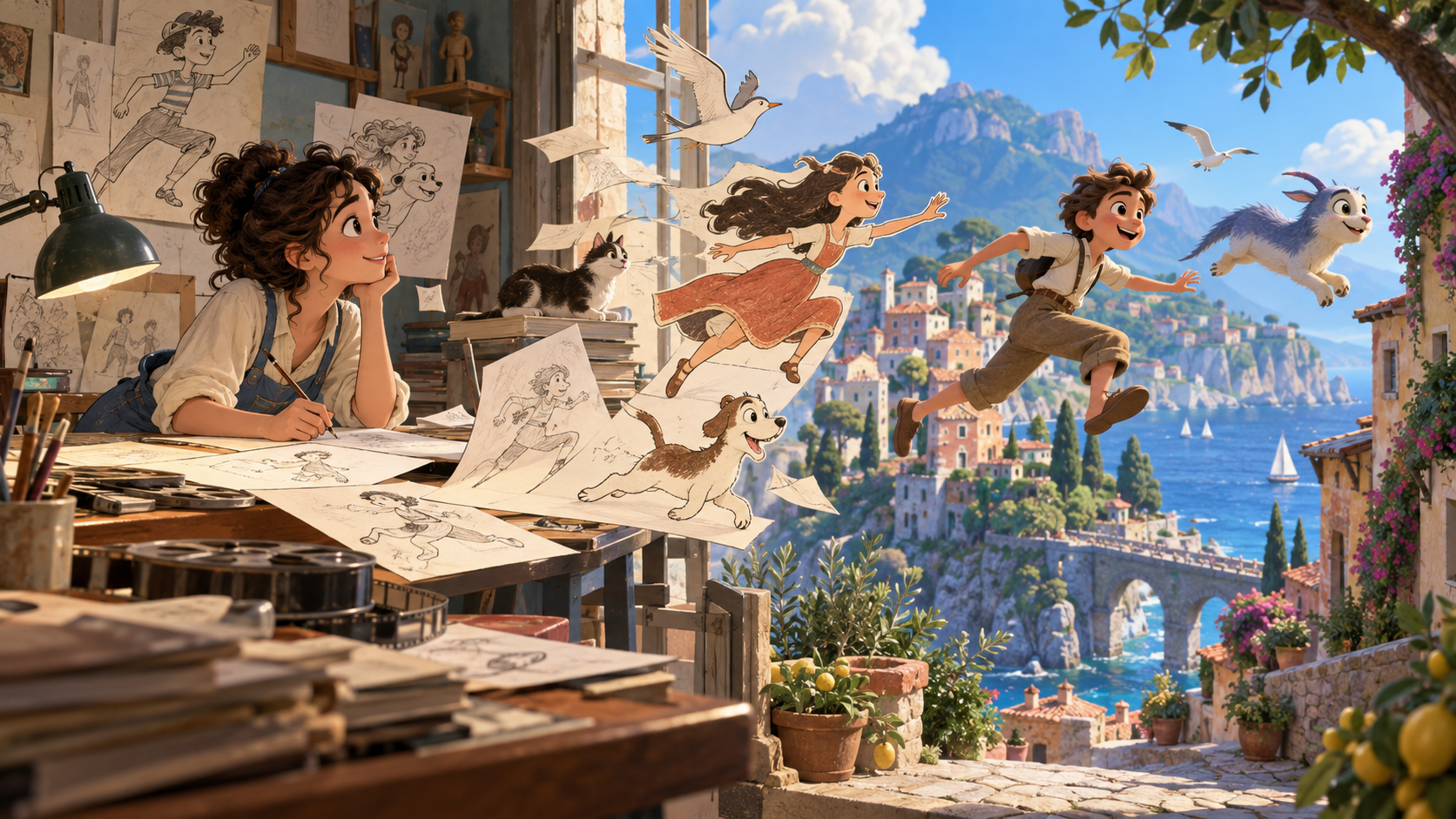
 Italian animation has never developed on the same industrial scale as its American or Japanese counterparts, but its influence cannot be measured by output alone. From handcrafted postwar shorts and elegant cut-paper films to television franchises, computer-generated productions and adult streaming series, Italian animators have created a remarkably varied body of work.
Artists such as Gibba, Emanuele Luzzati, Giulio Gianini, Bruno Bozzetto and Osvaldo Cavandoli established distinctive visual languages rather than imitating Disney. Enzo D’Alò later helped restore confidence in Italian animated features, while studios including Rainbow, MAD Entertainment, Movimenti Production and Studio Bozzetto expanded the industry into television, digital production and international co-productions.
Animation therefore deserves its own place within the broader history of Italian cinema. Its story is one of individual artistry, recurring financial challenges and an enduring ability to reinvent itself.
The Early Experiments of Italian Animation
Animation appeared in Italian cinema long before the country developed a stable animation industry. Silent filmmakers experimented with stop-motion, trick photography, puppets and drawn sequences during the early decades of the twentieth century.
One important example is Luigi Pensuti, a caricaturist and animator who produced political and advertising films during the 1910s and 1920s. Italian silent films also incorporated special-effects techniques associated with the Spanish-born filmmaker Segundo de Chomón, who worked extensively in Turin.
These experiments were inventive, but they rarely led to permanent studios capable of producing animated films continuously. Italian animation developed through isolated artists, small workshops and commissioned advertising rather than through a vertically integrated studio system.
The first major Italian animated features appeared immediately after the Second World War. Anton Gino Domeneghini’s La rosa di Bagdad and Nino Pagot’s I fratelli Dinamite were both released in 1949. They demonstrated that Italian studios could complete ambitious color features, although neither created the commercial foundation for regular feature production.
Gibba and Animation after the Second World War
Francesco Maurizio Guido, better known as Gibba, was one of the pioneers of postwar Italian animation. His work was unusually eclectic, ranging from children’s productions and advertising to satire and animation intended for adults.
His short L’ultimo sciuscià, made shortly after the war, applied a stark social sensibility to animation. Its subject—the life of a poor shoeshine boy—reflected the concerns of Italian Neorealism, a movement normally associated with live-action directors such as Roberto Rossellini, Vittorio De Sica and Luchino Visconti.
Gibba later worked on Il racconto della giungla, an Italian-Romanian production released in the 1970s, and contributed animated sequences to live-action films. His career illustrates both the originality and the instability of Italian animation: artists frequently moved among cinema, television, advertising and commissioned work because feature production alone could not provide continuous employment.
Emanuele Luzzati and Giulio Gianini
Emanuele Luzzati brought the sensibility of an illustrator, stage designer and storyteller to animation. Working with director and cinematographer Giulio Gianini, he created films that resembled moving theatrical sets or illustrated storybooks.
Their visual world was built from painted paper, cut-out figures, bold colors and deliberately visible textures. Rather than pursuing smooth realism, Luzzati and Gianini celebrated the handmade qualities of animation.
La gazza ladra, inspired by Rossini’s opera, earned an Academy Award nomination for Best Animated Short Film. Pulcinella, based on the traditional character from the commedia dell’arte, received another nomination. Other collaborations drew on operas, fairy tales and figures from Italian popular culture.
Their films demonstrated that animation could unite cinema with illustration, music, theater and folklore. They also provided an important alternative to the character-driven commercial animation associated with large international studios.
Bruno Bozzetto and the Rise of Italian Satirical Animation
Bruno Bozzetto is the most internationally recognized figure in Italian animation. He began making films in the late 1950s and developed a concise graphic style ideally suited to comedy and social satire.
His best-known character, Signor Rossi, is an ordinary middle-class Italian who repeatedly collides with bureaucracy, consumerism, technology and modern life. Through Signor Rossi, Bozzetto transformed everyday frustration into visual comedy.
Bozzetto also directed several important animated features. West and Soda, released in 1965, parodied the conventions of the Western. Vip, mio fratello superuomo satirized superheroes, advertising and consumer culture. His most celebrated feature, Allegro non troppo, combined live action and animation in a witty response to Disney’s Fantasia. Set to classical music, its animated episodes move between humor, melancholy, evolution and ecological destruction.
The short film Cavallette condensed the history of human conflict into a few devastating minutes and received an Academy Award nomination. Bozzetto’s work proved that Italian animation could be entertaining, philosophical and politically perceptive without losing its visual simplicity.
Osvaldo Cavandoli and La Linea
Another internationally successful example of Italian graphic economy was Osvaldo Cavandoli’s La Linea. Its protagonist is formed from a single continuous line and communicates through gestures, expressions and an invented stream of speech voiced by Carlo Bonomi.
Originally connected with television advertising, La Linea became an independent animated series recognized around the world. Cavandoli turned an extremely limited visual idea into a flexible comic language. The character argues with his creator, encounters obstacles drawn into his path and frequently protests against the world in which he has been placed.
The series remains one of the clearest examples of an Italian animator achieving universal appeal through simplicity rather than technical spectacle.
Italian Animation and Television
Television became essential to the survival and growth of Italian animation. The development of RAI programming, advertising and children’s television created new opportunities for artists who could not depend on theatrical releases.
Carosello, broadcast from 1957 to 1977, was especially important. Its short advertising sketches encouraged experimentation with memorable characters, graphic design, stop-motion and limited animation. Although produced for commercial purposes, many Carosello segments became part of Italy’s shared popular culture.
Television subsequently supported longer series and recurring characters. Italian companies increasingly worked with foreign broadcasters, distributors and production partners, helping programs circulate beyond the domestic market.
Mondo TV became a major producer and distributor of animated television content. Gruppo Alcuni developed series such as Cuccioli, known internationally as Pet Pals. Atlantyca Entertainment helped bring the world of Geronimo Stilton from publishing to television, demonstrating the increasingly close relationship among books, licensing and animation.
Enzo D’Alò and the Revival of Animated Features
The 1990s brought a major renewal through the films of Enzo D’Alò and the Turin-based studio Lanterna Magica.
La freccia azzurra, released in 1996 and adapted from a story by Gianni Rodari, combined traditional animation with a distinctly Italian setting centered on the Befana. Its music was composed by Paolo Conte.
D’Alò achieved even greater popular recognition with La gabbianella e il gatto in 1998. Adapted from Luis Sepúlveda’s novel, the film tells the story of a cat who promises a dying seagull that he will protect her egg and teach the young bird to fly. Its emotional clarity, literary origin and broad family appeal made it a landmark of modern Italian animation.
D’Alò continued with Momo alla conquista del tempo, Opopomoz and Pinocchio. His Pinocchio drew on the illustrations of Lorenzo Mattotti and featured music by Lucio Dalla. Rather than adopting the familiar Disney version, it returned to the visual and cultural atmosphere of Carlo Collodi’s original Italian story.
His later feature A Greyhound of a Girl, also known as Mary and the Midnight Spirit, was adapted from the novel by Roddy Doyle. Produced through European collaboration, it follows four generations of women in an Irish family and demonstrates how contemporary Italian animation frequently operates within an international creative network.
Rainbow and Italy’s Global Television Franchises
The commercial reach of Italian animation changed significantly with the growth of Rainbow, founded by Iginio Straffi. Its defining production, Winx Club, premiered in 2004 and developed into an international franchise encompassing television, films, publishing, toys, live entertainment and licensed merchandise.
Rainbow expanded into computer-generated animation through Rainbow CGI and produced animated features connected with the Winx universe. The company also developed other series and worked with international media partners.
The success of Winx Club showed that an Italian property could be conceived for a worldwide audience from the beginning. It also represented a business model very different from the auteur-driven films of Luzzati or Bozzetto: character ownership, international distribution and licensing became as important as the television program itself.
MAD Entertainment and a New Neapolitan School
Founded in Naples in 2010, MAD Entertainment helped establish one of the most distinctive centers of contemporary Italian animation.
The studio’s first major feature, L’arte della felicità, directed by Alessandro Rak, combined an adult story with a dark and atmospheric portrait of Naples. Its protagonist, a taxi driver and former musician, travels through a rain-soaked city while confronting grief, memory and spiritual uncertainty.
Rak later co-directed Gatta Cenerentola with Ivan Cappiello, Marino Guarnieri and Dario Sansone. Inspired by Giambattista Basile’s version of the Cinderella story, the film relocated the tale to a decaying ship in the Bay of Naples. Its mixture of crime, music, fantasy and computer animation offered a dramatic alternative to conventional family features.
Yaya e Lennie – The Walking Liberty continued MAD’s interest in visually ambitious animation for older audiences. Set in a future dominated by overgrown nature and authoritarian institutions, it combines ecological themes with the friendship between its two protagonists.
These productions demonstrate that Italian animation is not limited to children’s entertainment. It can also explore urban identity, politics, environmental collapse, grief and social inequality.
Lorenzo Mattotti and The Bears’ Famous Invasion of Sicily
Illustrator and comics artist Lorenzo Mattotti made his feature-directing debut with La famosa invasione degli orsi in Sicilia, adapted from Dino Buzzati’s children’s novel.
Presented in the Un Certain Regard section at the Cannes Film Festival in 2019, the film follows a community of bears that descends from the mountains into the human world. Its rich colors and painterly landscapes draw heavily on Mattotti’s work as an illustrator.
The production was a French-Italian collaboration, illustrating the importance of co-production to ambitious European animation. It also showed how Italian literature and illustration can supply material for films able to travel internationally without surrendering their cultural identity.
Streaming and Animation for Adults
Streaming platforms have given Italian animation access to audiences that traditional television schedules often struggled to reach.
A decisive example is Strappare lungo i bordi, released internationally by Netflix as Tear Along the Dotted Line. Created by the Roman cartoonist Zerocalcare and produced by Movimenti Production with BAO Publishing, the series combines autobiographical comedy, social anxiety, friendship and grief.
Zerocalcare voices most of the characters, while the Armadillo—his sharply critical conscience—is voiced by Valerio Mastandrea. The series preserves the rhythms, Roman expressions and political sensibility of the original comics while remaining accessible to viewers outside Italy.
The follow-up series Questo mondo non mi renderà cattivo, or This World Can’t Tear Me Down, broadened this approach to questions of migration, neighborhood conflict and political polarization.
Their success challenged two persistent assumptions: that Italian animation must primarily target children and that regional language must be neutralized for international distribution. In this case, cultural specificity became one of the production’s greatest strengths.
Contemporary Italian Animation Studios
Modern Italian animation is produced by a network of companies rather than by one dominant national studio.
Rainbow is the most visible international brand, while Mondo TV maintains a long history in television production and distribution. Movimenti Production develops animated series and cross-media projects for Italian and international audiences. Studio Bozzetto continues the legacy associated with Bruno Bozzetto while working in entertainment, advertising and digital communication.
MAD Entertainment has made Naples an important center for independent features, television and visual effects. Other active companies include Maga Animation Studio, Ibrido Studio, Atlantyca, Animatò, Enanimation, Red Monk Studio and Panebarco.
These businesses work in different styles and markets. Some create original intellectual property; others specialize in production services, animation, visual development or international partnerships. Together, they reveal an industry far broader than a history focused exclusively on a few famous directors would suggest.
Why International Co-Productions Matter
Animated films require long production schedules, specialized personnel and substantial financing. Italy’s domestic theatrical market is rarely large enough to support ambitious features on its own, making international co-production especially important.
Italian producers frequently collaborate with companies in France, Belgium, Luxembourg, Ireland, Spain and other European countries. These partnerships can combine financing, public support, technical expertise and distribution agreements while dividing production work among several studios.
Co-production does not necessarily make a film less Italian. Pinocchio, The Bears’ Famous Invasion of Sicily and other internationally financed projects remain closely connected to Italian writers, artists, landscapes and storytelling traditions.
The model also allows Italian animators to participate in projects initiated elsewhere. As a result, nationality in contemporary animation is often best understood as a network of creative and industrial contributions rather than a single country financing every stage of production.
Essential Italian Animated Films and Series
Several works provide an accessible introduction to the history and variety of Italian animation:
- La rosa di Bagdad (1949), directed by Anton Gino Domeneghini
- I fratelli Dinamite (1949), directed by Nino Pagot
- La gazza ladra (1964), by Giulio Gianini and Emanuele Luzzati
- West and Soda (1965), directed by Bruno Bozzetto
- Vip, mio fratello superuomo (1968), directed by Bruno Bozzetto
- La Linea (from 1971), created by Osvaldo Cavandoli
- Pulcinella (1973), by Giulio Gianini and Emanuele Luzzati
- Allegro non troppo (1976), directed by Bruno Bozzetto
- La freccia azzurra (1996), directed by Enzo D’Alò
- La gabbianella e il gatto (1998), directed by Enzo D’Alò
- Winx Club (from 2004), created by Iginio Straffi
- L’arte della felicità (2013), directed by Alessandro Rak
- Gatta Cenerentola (2017), directed by Alessandro Rak, Ivan Cappiello, Marino Guarnieri and Dario Sansone
- La famosa invasione degli orsi in Sicilia (2019), directed by Lorenzo Mattotti
- Strappare lungo i bordi (2021), created by Zerocalcare
- Yaya e Lennie – The Walking Liberty (2021), directed by Alessandro Rak
- A Greyhound of a Girl (2023), directed by Enzo D’Alò
- Questo mondo non mi renderà cattivo (2023), created by Zerocalcare
An Art Form with Several Identities
Italian animation does not follow a single recognizable formula. Its history includes postwar social observation, opera-inspired cut-outs, graphic satire, advertising characters, literary adaptations, global children’s franchises, independent adult features and autobiographical streaming series.
Its greatest continuity lies in the importance of individual drawing styles and strong authorial voices. Luzzati’s handmade theatricality, Bozzetto’s economical satire, D’Alò’s literary storytelling, Mattotti’s painterly images, Alessandro Rak’s urban worlds and Zerocalcare’s conversational immediacy could hardly be more different.
That diversity is precisely what makes Italian animation worth exploring. What once appeared to be a brief renaissance in the late 1990s can now be understood as one chapter in a much longer history—one that continues through regional studios, European partnerships, digital platforms and new generations of filmmakers.
External Sources
Cartoon Italia – National Association of Italian Animation Producers
Animation in Europe – European Animation Industry Overview
Festival de Cannes – The Bears’ Famous Invasion of Sicily
Bruno Bozzetto – Official Website
MAD Entertainment – Official Website