

 After the Second World War, Italian cinema underwent one of the most remarkable transformations in film history. The artificial elegance associated with many prewar productions gave way to ruined streets, working-class characters, moral uncertainty and new ways of representing everyday life.
Italian neorealism provided the decisive break, but the country’s cinema did not remain tied to a single movement. During the 1950s, 1960s and 1970s, Italian directors expanded beyond neorealism into psychological modernism, historical drama, social criticism, fantasy and intensely personal filmmaking.
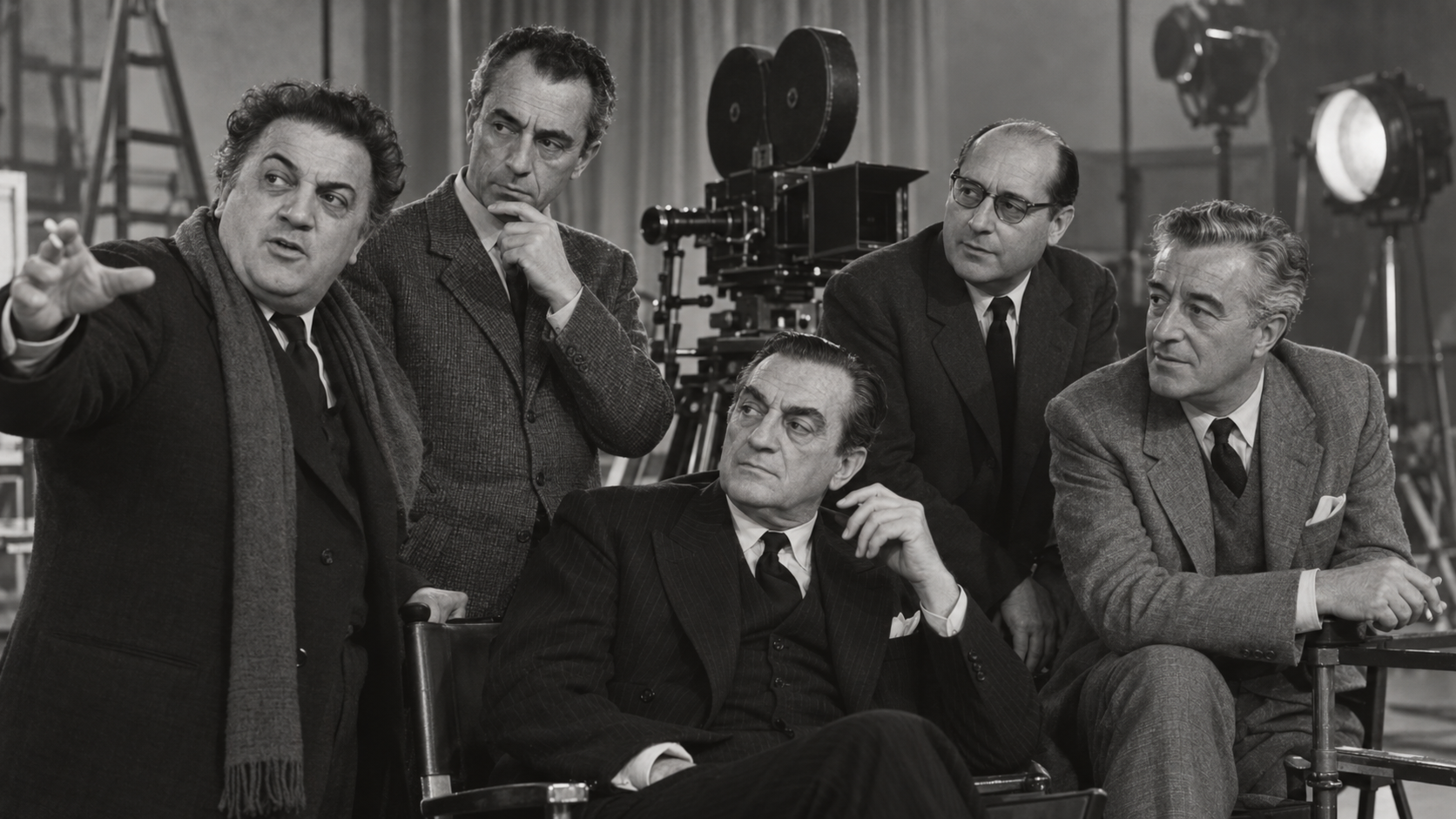
Five directors stand at the center of this development: Roberto Rossellini, Vittorio De Sica, Luchino Visconti, Federico Fellini and Michelangelo Antonioni. Their styles were profoundly different, yet together they helped establish the idea of the film director as an author with a recognizable artistic vision.
From Neorealism to the Age of the Auteur
Italian neorealism emerged during the final years of Fascism and the immediate aftermath of the war. Its filmmakers frequently worked on real locations, focused on ordinary people and rejected the polished appearance of conventional studio productions.
However, neorealism was never governed by a single manifesto. Rossellini’s urgent treatment of war and resistance differed from De Sica’s emotional humanism, while Visconti combined social observation with the visual control of an experienced theatre and opera director.
By the 1950s, Italy itself was changing. Reconstruction, industrialization, urban migration and growing consumer prosperity created new subjects for filmmakers. The struggle for material survival remained important, but directors increasingly examined memory, alienation, sexuality, faith, social ambition and the instability of personal identity.
This transition helps explain why postwar Italian cinema produced such varied works as Umberto D., Journey to Italy, La dolce vita, L’avventura and The Leopard. These films belong to different genres and aesthetic traditions, but all use cinema to investigate a rapidly changing society.
Roberto Rossellini: Cinema as Moral Investigation
Roberto Rossellini was one of the essential architects of Italian neorealism. His wartime trilogy—Rome, Open City (1945), Paisan (1946) and Germany Year Zero (1948)—examined occupation, resistance and the moral devastation left by the conflict.
Rossellini’s films did not attempt to turn historical trauma into polished spectacle. Their apparent simplicity, unpredictable performances and mixture of professional and nonprofessional actors created an immediacy that influenced filmmakers far beyond Italy.
During the 1950s, Rossellini moved toward more intimate stories. His films with Ingrid Bergman—including Stromboli (1950), Europe ’51 (1952) and Journey to Italy (1954)—explored spiritual crisis, isolation and marriages under pressure.
Journey to Italy, starring Bergman and George Sanders as an English couple whose marriage begins to disintegrate during a trip to Naples, initially received a mixed response. Its fragmented storytelling and unresolved emotions later made it a foundational work for modern European cinema.
Rossellini eventually became dissatisfied with commercial filmmaking. From the 1960s onward, he concentrated increasingly on educational television films about historical figures and periods. Productions such as The Rise to Power of Louis XIV (1966), Socrates (1971) and Blaise Pascal (1972) reflected his belief that cinema and television could help viewers understand history.
Rossellini’s importance therefore extends beyond neorealism. He treated filmmaking as a way of observing people confronting war, faith, knowledge and moral responsibility.
Vittorio De Sica: Compassion and Everyday Life
Vittorio De Sica was both a celebrated actor and one of the great directors of postwar cinema. His most important filmmaking partnership was with screenwriter Cesare Zavattini, whose ideas about ordinary people and everyday events helped shape Italian neorealism.
Their early achievements included The Children Are Watching Us (1943), Shoeshine (1946), Bicycle Thieves (1948), Miracle in Milan (1951) and Umberto D. (1952).
Bicycle Thieves follows an unemployed father whose new job depends on a bicycle that is stolen on his first day of work. The search through postwar Rome becomes both a social portrait and an intimate story about the relationship between a father and his son. Its emotional force comes not from melodramatic villains but from a society in which poverty pushes people into desperate choices.
In Umberto D., De Sica focused on an elderly pensioner facing eviction and loneliness. The film’s close attention to apparently insignificant gestures demonstrates how neorealism could reveal an entire social order through one person’s daily life.
De Sica continued directing after the central neorealist period. Two Women (1960), starring Sophia Loren, examined the suffering of civilians during the Second World War. He also directed Loren and Marcello Mastroianni in the internationally successful Yesterday, Today and Tomorrow (1963) and Marriage Italian Style (1964).
His later historical drama The Garden of the Finzi-Continis (1970) portrayed an aristocratic Jewish family in Fascist Italy as racial persecution closes around them. The film showed that De Sica’s humanism could operate within a carefully constructed period production as powerfully as it had on the streets of postwar Rome.
Readers interested in his full life, acting career and films can continue with the Italia Mia biography of Vittorio De Sica.
Luchino Visconti: History, Class and Decay
Luchino Visconti occupied a unique position in Italian culture. Born into an aristocratic Milanese family and politically associated with the left, he created films that combined Marxist attention to class with a deep understanding of privilege, ritual and historical decline.
His Ossessione (1943) is often identified as an important precursor of neorealism. La terra trema (1948), filmed in the Sicilian fishing village of Aci Trezza with local people speaking Sicilian, examined exploitation and the difficulty of resisting established economic power.
During the 1950s and 1960s, Visconti expanded from neorealist observation into visually elaborate historical drama. Senso (1954), set during the Risorgimento, transformed a doomed love affair into a study of political betrayal and social collapse.
Rocco and His Brothers (1960) followed a southern family that moves to industrial Milan. Through the family’s disintegration, Visconti addressed internal migration, urbanization, masculinity and the destructive pressures of modern life.
His best-known historical epic, The Leopard (1963), was adapted from Giuseppe Tomasi di Lampedusa’s novel. Set during the unification of Italy, it presents political transformation through the perspective of a Sicilian prince who recognizes that his class is losing its dominant position. The film’s sumptuous interiors and celebrated ballroom sequence are not decorative distractions: they make the passage of time and the decline of an entire social order visible.
Visconti continued exploring beauty, power and decay in The Damned (1969), Death in Venice (1971), Ludwig (1972) and The Innocent (1976). His cinema demonstrates how spectacle can become a method of historical analysis.
Federico Fellini: Memory, Fantasy and Performance
Federico Fellini began his film career as a screenwriter and contributed to Rossellini’s Rome, Open City and Paisan. His early work as a director retained connections to neorealism, but he gradually developed a more personal world shaped by memory, dreams, popular entertainment and fantasy.
Films such as I vitelloni (1953), La strada (1954) and Nights of Cabiria (1957) focus on outsiders, performers and people searching for affection. Giulietta Masina, Fellini’s wife and one of his most important collaborators, gave unforgettable performances as Gelsomina in La strada and Cabiria in Nights of Cabiria.
With La dolce vita (1960), Fellini created a panoramic portrait of celebrity, journalism, nightlife and spiritual emptiness in modern Rome. The film’s episodic structure follows journalist Marcello Rubini through a world that appears glamorous but offers no lasting sense of purpose.
8½ (1963) moved even further into subjective cinema. Its central character is a director unable to complete his next film while memories, fantasies, relationships and professional demands compete for his attention. Rather than resolving this creative crisis conventionally, Fellini turned it into the substance of the film itself.
Later works—including Juliet of the Spirits (1965), Fellini Satyricon (1969), Roma (1972) and Amarcord (1973)—became increasingly elaborate and dreamlike. Fellini’s sets, faces, costumes and processions created an immediately recognizable visual language.
Yet the term “Felliniesque” can obscure the discipline beneath the spectacle. His fantasies were grounded in precise observations of vanity, loneliness, sexuality, religion and the human need to perform.
For a complete account of the director’s life and career, read the Italia Mia biography of Federico Fellini.
Michelangelo Antonioni: Alienation in the Modern World
Michelangelo Antonioni became one of the defining figures of modernist cinema. While Rossellini and De Sica frequently concentrated on material hardship, Antonioni examined the emotional disconnection experienced within Italy’s increasingly prosperous urban and industrial society.
His early features—including Story of a Love Affair (1950), Le amiche (1955) and Il grido (1957)—already revealed his interest in unstable relationships, landscapes and characters unable to express what they want.
His international breakthrough came with L’avventura (1960). The disappearance of a young woman during a Mediterranean excursion appears to establish a mystery, but the conventional search gradually recedes. Antonioni instead concentrates on the uncertain relationship between the missing woman’s lover and her friend, played by Monica Vitti.
Together with La notte (1961) and L’eclisse (1962), L’avventura is often grouped into a loose trilogy concerned with emotional alienation. These films use architecture, empty spaces, interrupted conversations and unresolved endings to communicate states that dialogue cannot adequately explain.
Red Desert (1964), Antonioni’s first color feature, transformed the industrial landscape around Ravenna into an expression of psychological unease. Color itself became a dramatic and emotional element.
Antonioni then worked internationally. Blowup (1966), set in London, explored photography, perception and the uncertainty of evidence. Zabriskie Point (1970) examined American counterculture, while The Passenger (1975), starring Jack Nicholson, followed a reporter who assumes another man’s identity.
Antonioni’s deliberate rhythms are sometimes described simply as slow. More accurately, he changed the relationship between story, character and visual space. In his films, what is missing or left unresolved can be as important as what the audience sees.
Five Directors, Five Different Visions
These five directors should not be treated as members of a unified school. Their artistic differences are precisely what made postwar Italian cinema so influential.
Rossellini pursued moral and intellectual inquiry. De Sica found tragedy and dignity in ordinary lives. Visconti analyzed class and history through controlled visual grandeur. Fellini transformed autobiography and memory into theatrical fantasy. Antonioni used space, silence and uncertainty to express modern alienation.
They also shared creative collaborators who were essential to their achievements. Cesare Zavattini shaped De Sica’s neorealist projects. Giulietta Masina and composer Nino Rota became inseparable from Fellini’s cinema. Monica Vitti gave human presence to Antonioni’s most formally daring films. Visconti drew on major actors, designers, cinematographers and composers to construct his historical worlds.
The growth of international co-productions, film festivals and art-house distribution helped their work reach audiences around the world. Their films demonstrated that a national cinema could remain rooted in Italian history and society while also addressing universal questions about memory, desire, responsibility and identity.
Essential Films to Watch
A concise introduction to these directors could begin with the following films:
- Roberto Rossellini: Rome, Open City, Paisan and Journey to Italy
- Vittorio De Sica: Bicycle Thieves, Umberto D. and The Garden of the Finzi-Continis
- Luchino Visconti: Rocco and His Brothers, The Leopard and Death in Venice
- Federico Fellini: La strada, La dolce vita, 8½ and Amarcord
- Michelangelo Antonioni: L’avventura, L’eclisse, Red Desert and The Passenger
Several of these titles also appear in Italia Mia’s guide to the top Italian movies of all time.
Other Movements of the Same Period
The five filmmakers examined here do not represent the whole of Italian cinema between the 1950s and 1970s. The period also produced Pier Paolo Pasolini, Sergio Leone, Bernardo Bertolucci, Lina Wertmüller, Francesco Rosi and the masters of commedia all’italiana.
Those subjects deserve their own focused chapters. Italia Mia readers can continue with the histories of Italian comedy movies and the spaghetti western without duplicating them here.
The Enduring Legacy of Postwar Italian Cinema
Rossellini, De Sica, Visconti, Fellini and Antonioni changed the possibilities of filmmaking. They showed that cinema could combine social observation with poetry, historical spectacle with political analysis, and personal memory with radical formal experimentation.
Their films also record Italy’s passage from war and poverty to reconstruction, consumer society and cultural upheaval. Instead of offering one simple history of the nation, they created competing visions of what postwar Italy had become.
The result was an extraordinary period in which Italian cinema did more than achieve international prestige. It provided filmmakers throughout the world with new ways to look at reality, structure a story and express the interior lives of their characters.
Further Viewing and Reading
Italia Mia may earn a commission from qualifying purchases at no additional cost to you.
Browse Federico Fellini films and books on Amazon for collections, biographies and studies of his visual style.
Browse Italian neorealism films and books on Amazon for editions of works by Rossellini and De Sica and introductions to the movement.
Browse Michelangelo Antonioni and Luchino Visconti films on Amazon for restored films and director collections.
External Sources
- BFI: The Roots of Italian Neorealism
- BFI: Where to Begin with Roberto Rossellini
- BFI: Where to Begin with Vittorio De Sica
- BFI: Where to Begin with Luchino Visconti
- BFI: Where to Begin with Federico Fellini
- BFI: Where to Begin with Michelangelo Antonioni