

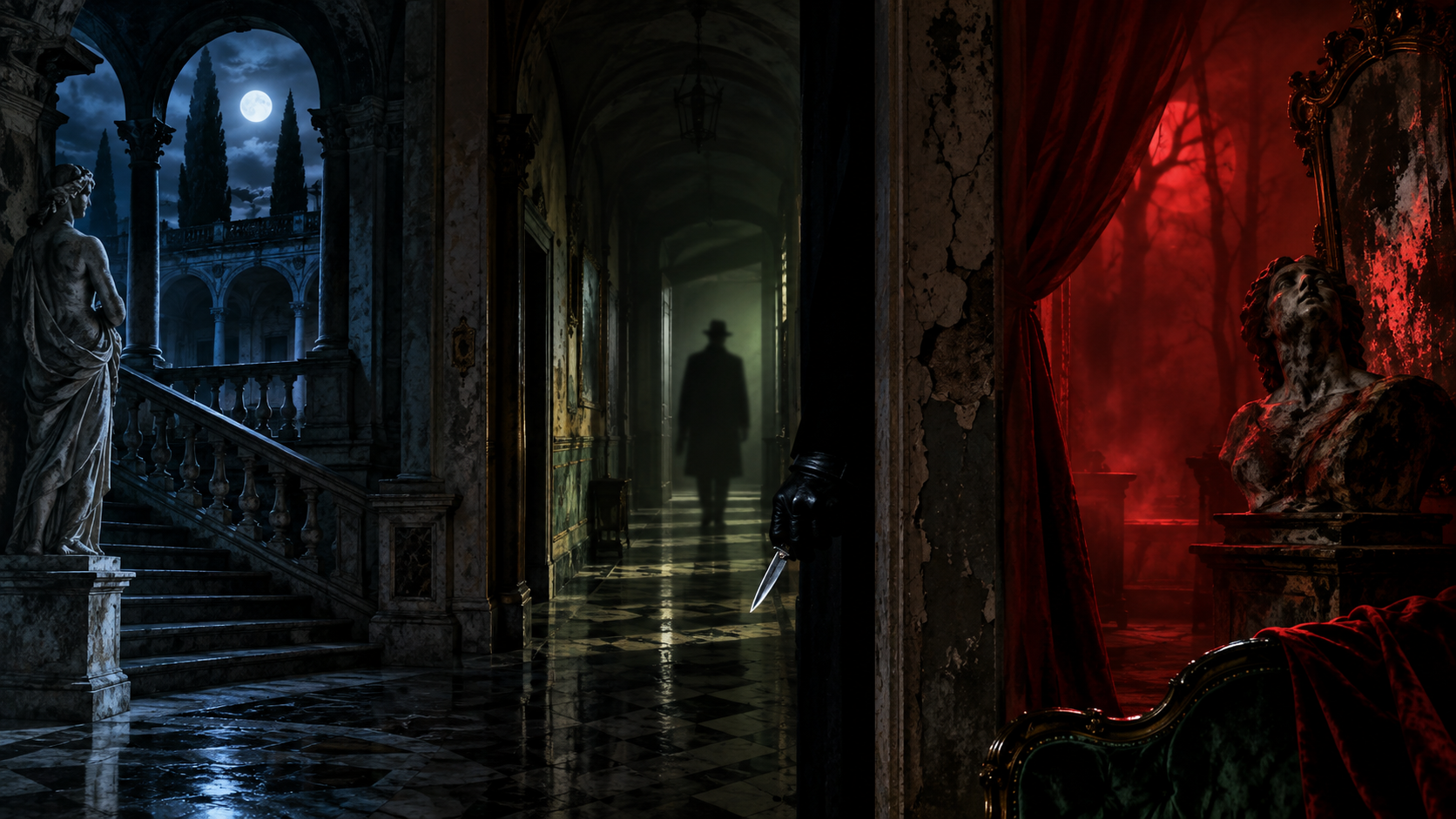
 Italian horror cinema is not a single genre. It is a family of related traditions that developed across several decades: the shadowy Gothic films of the late 1950s and 1960s, the murder mysteries known as gialli, supernatural nightmares, zombie films and the graphic splatter movies that flourished around the end of the 1970s.
These traditions frequently overlap, but the terms are not interchangeable. A Gothic horror film normally builds fear through haunted buildings, family curses, ghosts, witches or other supernatural forces. A giallo is primarily a mystery or thriller, usually centered on a series of murders and an investigation. Splatter cinema makes graphic injury, bodily destruction and elaborate special effects central to the experience.
Directors such as Mario Bava, Dario Argento and Lucio Fulci moved between these forms, helping Italian filmmakers transform limited budgets, international casts and familiar stories into some of the most visually distinctive genre films ever made.
The Birth of Italian Gothic Horror
Italy had produced fantasy, crime and supernatural stories before the late 1950s, but Riccardo Freda’s I vampiri (1957) is generally regarded as a crucial starting point for the country’s modern Gothic horror cycle. Mario Bava, then best known as a cinematographer and special-effects specialist, completed parts of the production when Freda left the film.
I vampiri combined a contemporary investigation with castles, laboratories, aristocratic decadence and the search for eternal youth. Its imagery pointed toward a style of horror that would become internationally successful during the following decade.
Freda continued exploring the Gothic with films including L’orribile segreto del Dr. Hichcock (The Horrible Dr. Hichcock, 1962) and Lo spettro (The Ghost, 1963). Antonio Margheriti contributed Danza macabra (Castle of Blood, 1964), while directors such as Renato Polselli and Camillo Mastrocinque created their own variations on haunted houses, vampires and tormented aristocratic families.
These films drew upon nineteenth-century Gothic literature and the international popularity of British Hammer horror. However, the Italian productions developed their own identity through expressive lighting, elaborate interiors, sensuality and stories in which beauty and decay seemed inseparable.
Mario Bava and the Reinvention of Horror
Mario Bava became the central figure connecting Italian Gothic horror to the later development of giallo. His background in cinematography allowed him to make modest sets appear mysterious and expansive through lighting, colored filters, smoke, camera movement and carefully constructed compositions.
La maschera del demonio (Black Sunday, 1960), Bava’s official solo directorial debut, established him internationally. Loosely inspired by Nikolai Gogol, the film stars Barbara Steele in a dual role involving a condemned witch and her innocent descendant. Its ruined castles, fog-covered landscapes, secret passages and supernatural revenge place it firmly within Gothic horror.
Bava continued developing the form in La frusta e il corpo (The Whip and the Body, 1963), I tre volti della paura (Black Sabbath, 1963) and Operazione paura (Kill, Baby… Kill!, 1966). These are stories of ghosts, curses, forbidden desire and uncanny places rather than detective narratives.
His work was not limited to the Gothic. With La ragazza che sapeva troppo (The Girl Who Knew Too Much, 1963), Bava created a playful murder mystery involving an amateur witness who believes she has seen a killing in Rome. The film is frequently described as an early cinematic giallo.
Sei donne per l’assassino (Blood and Black Lace, 1964) supplied much of the form’s recognizable visual language: a masked, black-gloved killer; a succession of spectacular murders; vivid color; fashion and luxury settings; and an investigation filled with misleading clues. Bava’s films therefore provide a bridge between two related but separate traditions.
Readers can explore more of his career in Mario Bava: The Master of Italian Horror and Giallo Cinema.
What Is a Giallo Film?
The word giallo means “yellow” in Italian. Its association with mystery fiction comes from the yellow covers used by Mondadori for a popular series of detective novels launched in 1929. In everyday Italian, un giallo can still mean a mystery or crime story.
In cinema, the term describes a flexible form combining murder mystery, psychological thriller, crime fiction and, in many cases, horror. A typical giallo may feature an unidentified killer, black gloves, an amateur investigator, subjective camerawork, an unreliable memory, concealed trauma and a final revelation.
The investigator is often not a police officer. A writer, musician, tourist, photographer or ordinary witness becomes obsessed with a detail that was seen or heard incorrectly. Solving the crime depends on recovering that overlooked fragment.
Not every giallo is supernatural, and not every giallo is especially bloody. Conversely, an Italian film does not become a giallo simply because it contains murder or graphic violence. The mystery structure and the tension between perception and truth are usually more important defining characteristics.
Dario Argento and the Giallo at Its Peak
Dario Argento brought the giallo to a wider international audience with L’uccello dalle piume di cristallo (The Bird with the Crystal Plumage, 1970). Its protagonist witnesses an apparent attack in an art gallery but cannot correctly interpret what he has seen. The film turns this uncertain memory into the foundation of its mystery.
Argento continued the form with Il gatto a nove code (The Cat o’ Nine Tails, 1971), Quattro mosche di velluto grigio (Four Flies on Grey Velvet, 1971), Profondo rosso (Deep Red, 1975), Tenebre (1982) and Opera (1987).
Profondo rosso is one of the clearest examples of Argento’s approach. It combines an intricate murder investigation with fluid camerawork, striking architecture, sudden violence and a forceful score by Giorgio Gaslini and Goblin. As in several gialli, the solution has effectively been placed before the viewer, but its meaning remains hidden until the protagonist reconstructs what he originally saw.
Suspiria (1977), however, should not be classified simply as another giallo. It abandons the conventional murder investigation for a supernatural story about witchcraft inside a German dance academy. Its intense colors, artificial spaces and celebrated Goblin score connect it stylistically to Argento’s thrillers, but its narrative belongs to supernatural horror.
Inferno (1980) and The Mother of Tears (2007) continued the mythology begun in Suspiria, forming Argento’s “Three Mothers” trilogy. The difference between Deep Red and Suspiria demonstrates why giallo and supernatural horror should not be treated as synonyms.
Other Masters of the Italian Giallo
Although Bava and Argento are its most internationally famous directors, the giallo was shaped by many filmmakers.
Sergio Martino directed Lo strano vizio della Signora Wardh (The Strange Vice of Mrs Wardh, 1971), La coda dello scorpione (The Case of the Scorpion’s Tail, 1971) and Tutti i colori del buio (All the Colors of the Dark, 1972). His films combine criminal plots, psychological instability, eroticism and uncertainty about what is real.
Massimo Dallamano’s Cosa avete fatto a Solange? (What Have You Done to Solange?, 1972) uses the conventions of a murder mystery while gradually revealing a deeply tragic story. Aldo Lado’s Chi l’ha vista morire? (Who Saw Her Die?, 1972) places a disturbing investigation within an unusually bleak Venice.
Pupi Avati’s La casa dalle finestre che ridono (The House with Laughing Windows, 1976) follows an art restorer investigating a mysterious fresco and the death of its creator. Its rural setting, religious unease and gradually accumulating dread distinguish it from the fashionable urban world associated with many gialli.
These films show how varied the form could be. Some resemble police procedurals, others psychological thrillers, and others approach Gothic or folk horror.
Lucio Fulci: From Giallo to Splatter
Lucio Fulci worked in comedy, westerns, adventure films and musicals before becoming internationally identified with horror. His career also demonstrates the difference between giallo and splatter.
Una lucertola con la pelle di donna (A Lizard in a Woman’s Skin, 1971), Non si sevizia un paperino (Don’t Torture a Duckling, 1972) and Sette note in nero (The Psychic, 1977) are mysteries. They include murder, psychological tension and, in the case of The Psychic, apparent supernatural perception, but their plots still depend on investigation and revelation.
Don’t Torture a Duckling is particularly important because it moves the giallo away from fashionable cities and places it in a traditional southern community. Suspicion falls on outsiders, women and supposed practitioners of magic while the film examines repression, prejudice and concealed violence.
Zombi 2 (Zombie, 1979), Paura nella città dei morti viventi (City of the Living Dead, 1980), …E tu vivrai nel terrore! L’aldilà (The Beyond, 1981) and Quella villa accanto al cimitero (The House by the Cemetery, 1981) belong to a different phase. These films emphasize zombies, decaying bodies, supernatural forces and increasingly graphic effects.
The term splatter refers to this explicit visual concentration on physical destruction. It describes an aesthetic or level of graphic violence, not a mystery structure. A giallo can contain splatter effects, but splatter films are not automatically gialli.
Fulci’s best horror films also contain more than gore. The Beyond, for example, uses disjointed logic, nightmarish locations and an atmosphere of inevitable doom. Its power comes from the sense that ordinary reality is collapsing, not simply from its violent effects.
Zombies, Cannibals and Extreme Horror
Italian producers responded rapidly to international successes. George A. Romero’s Dawn of the Dead, released in Italy as Zombi with a soundtrack by Goblin, helped encourage a cycle of Italian zombie films. Zombi 2 was marketed as though it were a continuation, despite having no narrative connection to Romero’s film.
The late 1970s and early 1980s also produced cannibal films, including Ruggero Deodato’s Cannibal Holocaust (1980). This controversial cycle combined exploitation, adventure and graphic violence. Although it is part of the history of Italian genre cinema, it should not be confused with giallo or Gothic horror.
Films from this period sometimes used overlapping personnel, visual techniques and international marketing strategies. That industrial connection helps explain why the categories are frequently grouped together, but it does not erase their differences.
The Decline of the Traditional Genre Industry
Italian horror’s international prominence depended partly on an industry capable of producing and exporting large numbers of comparatively inexpensive genre films. By the late 1980s and 1990s, that system was weakening.
Changing audience habits, the growth of commercial television, reduced theatrical opportunities and competition from American productions made it increasingly difficult to sustain the old production model. Argento and Fulci continued working, but fewer Italian horror films received the international distribution once enjoyed by the genre.
Michele Soavi emerged as one of the most interesting directors of the transition. Deliria (StageFright, 1987), La chiesa (The Church, 1989), La setta (The Sect, 1991) and Dellamorte Dellamore (Cemetery Man, 1994) combined the visual inheritance of Italian horror with contemporary slasher films, black comedy and surrealism.
Dellamorte Dellamore, starring Rupert Everett as a cemetery caretaker whose dead refuse to remain buried, has become an important cult film. Its mixture of zombies, romance, absurdity and existential despair makes it difficult to place within any single category.
Later Revivals and Continuing Influence
Italian horror never disappeared completely, although its later history has been more fragmented than the concentrated cycles of the 1960s through the 1980s.
Directors have periodically returned to Gothic imagery, supernatural horror and the giallo tradition. Federico Zampaglione’s Shadow (2009) and Tulpa (2012), Roberto De Feo’s Il nido (The Nest, 2019), Domenico de Feudis’s Il legame (The Binding, 2020) and Roberto De Feo and Paolo Strippoli’s A Classic Horror Story (2021) illustrate different attempts to reconnect Italian filmmaking with horror.
Argento himself returned to the giallo with Occhiali neri (Dark Glasses, 2022), built around a killer, a vulnerable witness and an investigation in Rome.
International filmmakers have also continued revisiting Italian horror. Luca Guadagnino’s 2018 reinterpretation of Suspiria transformed Argento’s premise into a very different historical and political film. Rather than replacing the original, it demonstrated how strongly the imagery and ideas of Italian horror continue to invite reinvention.
Essential Italian Horror and Thriller Films
For an introduction to the major traditions, begin with:
• I vampiri (1957) — an early foundation for Italian Gothic horror
• La maschera del demonio (1960) — Bava’s Gothic breakthrough
• Sei donne per l’assassino (1964) — a decisive step in the development of giallo
• Operazione paura (1966) — supernatural Gothic horror
• L’uccello dalle piume di cristallo (1970) — Argento’s landmark giallo
• Reazione a catena (A Bay of Blood, 1971) — a violent mystery that anticipated later slashers
• Non si sevizia un paperino (1972) — Fulci’s rural giallo and social critique
• Profondo rosso (1975) — one of the defining gialli
• La casa dalle finestre che ridono (1976) — rural mystery and Gothic dread
• Suspiria (1977) — supernatural horror rather than conventional giallo
• Zombi 2 (1979) — graphic zombie horror
• L’aldilà (1981) — Fulci’s surreal supernatural splatter film
• Tenebre (1982) — Argento’s self-conscious return to giallo
• Dellamorte Dellamore (1994) — zombies, romance and existential black comedy
For the broader historical setting, see Italia Mia’s guide to Italian movies and the cinema of Italy. Individual film essays can also be found in the Italia Mia Italian Movies archive.
Books for Further Reading
Mario Bava: All the Colors of the Dark by Tim Lucas is an extensively researched study of Bava’s life, career and films.
Fear: The Autobiography of Dario Argento presents Argento’s account of his films, influences and creative methods.
Italian Gothic Horror Films by Roberto Curti provides a detailed history of the Gothic cycle and many of its lesser-known productions.
Why Italian Horror Still Matters
The importance of Italian horror lies not in a single formula but in its remarkable range. Gothic filmmakers turned inexpensive studios into haunted worlds. Giallo directors transformed murder investigations into elaborate studies of vision, memory and obsession. Splatter filmmakers pushed physical effects toward shocking extremes, while supernatural horror abandoned ordinary narrative logic for the structure of nightmares.
Understanding the differences among these traditions makes the history richer. Gothic horror, giallo and splatter may share directors, actors, composers and visual ideas, but each produces fear in a different way. Together, they form one of the boldest and most influential chapters in the history of Italian cinema.
External Sources
British Film Institute — 10 Great Italian Gothic Horror Films
The Criterion Collection — The Italian Art of Violence
Treccani — Definition and History of “Giallo”