

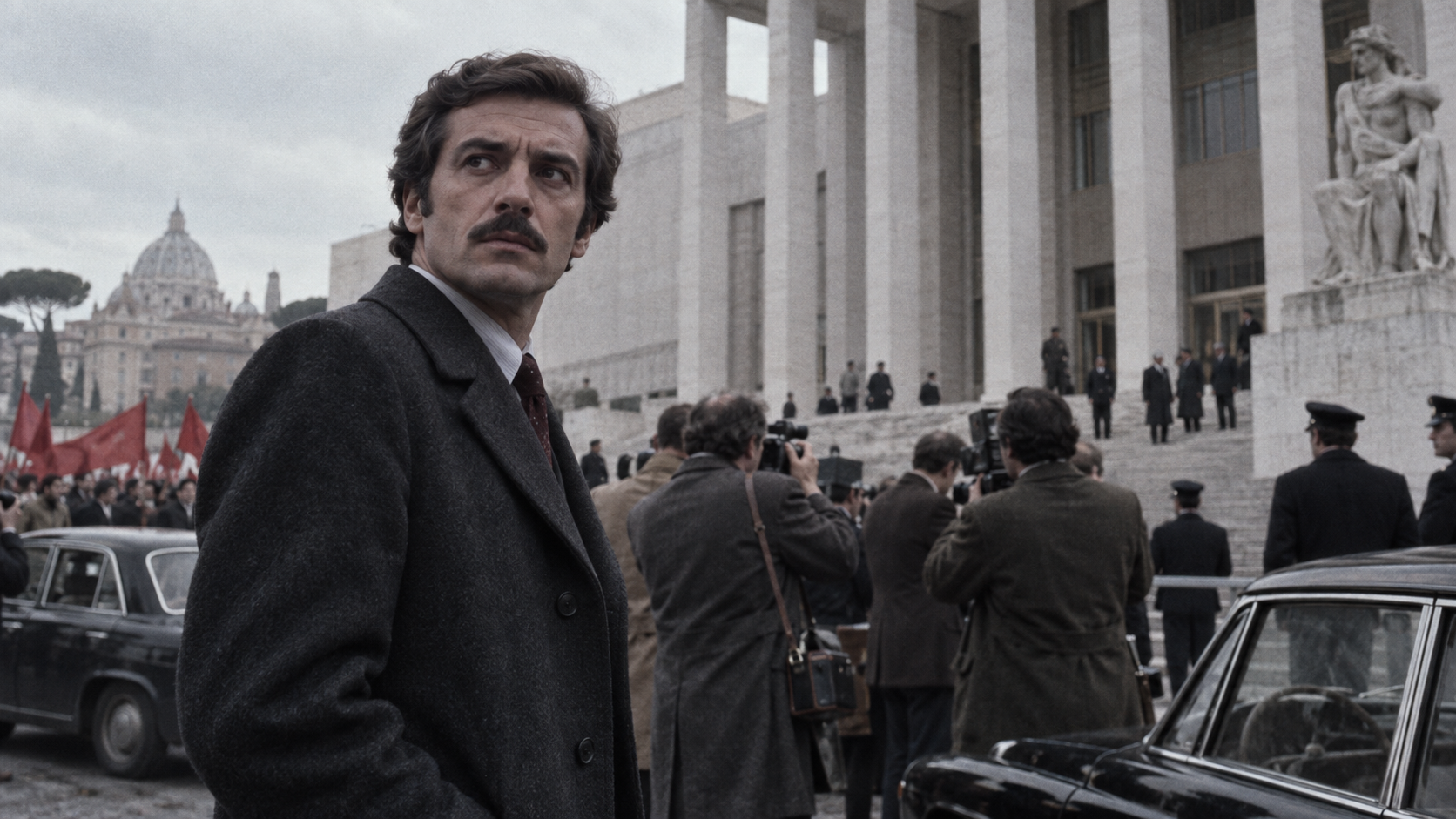
 Italian political cinema reached its most influential period during the 1960s and 1970s, when filmmakers confronted corruption, organized crime, industrial conflict, colonialism, Fascism and the abuse of institutional power.
Known in Italy as cinema politico or cinema d’impegno civile, this was not a single genre with fixed rules. Political arguments appeared in investigative dramas, historical films, satires, courtroom stories and thrillers. What united them was the belief that cinema could examine the systems operating behind public events.
Directors such as Francesco Rosi, Elio Petri, Gillo Pontecorvo and Damiano Damiani transformed political questions into compelling narratives. Screenwriters including Franco Solinas and Ugo Pirro helped give the movement its intellectual force, while Gian Maria Volonté became its most recognizable actor.
This period belongs within the broader history of Italian cinema, but it should not be confused with Italian Neorealism. Neorealism emerged during and immediately after the Second World War; Italian political cinema developed later, responding to the conflicts and contradictions of a rapidly modernizing country.
Italy’s Political Climate in the 1960s
Italy experienced an extraordinary economic transformation after the war. The so-called economic miracle expanded manufacturing, consumer spending and internal migration, particularly from the rural South to the industrial cities of the North.
Prosperity did not eliminate inequality. Housing speculation reshaped cities, working conditions remained difficult, and the relationship among political parties, state institutions, business interests and organized crime attracted increasing scrutiny.
By the end of the 1960s, student protests, factory occupations and the “Hot Autumn” of 1969 had intensified political debate. The bombing in Milan’s Piazza Fontana in December 1969 marked the beginning of a prolonged period of terrorism, political violence and public distrust commonly associated with the Years of Lead.
Filmmakers responded by asking difficult questions. Who controlled public institutions? How did criminal interests enter politics? Could official investigations be trusted? Why did the powerful so often escape accountability?
Francesco Rosi and the Cinema of Investigation
Francesco Rosi became one of the defining figures of Italian political cinema. Instead of simplifying political events into stories about individual heroes and villains, he examined networks of power.
Salvatore Giuliano (1962) investigates the life and mysterious death of the Sicilian bandit without turning him into a conventional protagonist. Giuliano is frequently absent from the screen, while the film reconstructs the forces surrounding him: separatism, the Mafia, landowners, police, peasants and political authorities.
The fragmented chronology makes viewers assemble the evidence themselves. Rosi’s approach became known as cine-inchiesta, or cinema of investigation—a form combining dramatic reconstruction, documentary observation and political analysis.
Le mani sulla città (Hands Over the City, 1963) turns its attention to urban development in Naples. Rod Steiger plays a property developer who also serves as a city councillor, using political influence to profit from construction projects.
The film demonstrates how corruption can operate legally through planning decisions, alliances and procedural manipulation. Its opening building collapse is dramatic, but the real subject is the political system that allows private interests to shape an entire city.
Rosi continued investigating institutional power in Il caso Mattei (The Mattei Affair, 1972), starring Gian Maria Volonté as Enrico Mattei, the influential president of the state-controlled energy company ENI. Mattei died in a plane crash in 1962 under circumstances that generated decades of speculation.
The film does not pretend to solve the mystery. Instead, Rosi exposes the difficulty of discovering the truth when political influence, international energy interests, journalism and state secrecy intersect.
Lucky Luciano (1973) examines organized crime as an international economic and political structure, while Cadaveri eccellenti (Illustrious Corpses, 1976) uses the form of a conspiracy thriller to portray a state consumed by secrecy and institutional paranoia.
Gillo Pontecorvo and The Battle of Algiers
Gillo Pontecorvo expanded political cinema beyond Italy’s borders. His most celebrated work, La battaglia di Algeri (The Battle of Algiers, 1966), reconstructs the struggle between the Algerian National Liberation Front and French colonial forces during the Algerian War.
Shot in black and white with non-professional performers alongside a small number of professional actors, the film resembles news footage. Its documentary appearance is carefully constructed, however, through precise staging, editing and Ennio Morricone’s music.
The film depicts bombings, assassinations, torture and military repression without reducing the conflict to a simple adventure story. Pontecorvo shows both the effectiveness and the human consequences of political violence.
Although the film supports Algerian independence, it does not conceal attacks on civilians. Its representation of urban insurgency, counterterrorism and colonial power has kept it politically relevant long after its release.
Pontecorvo returned to colonialism with Queimada (Burn!, 1969), starring Marlon Brando as a British agent who encourages a slave revolt on a fictional Caribbean island and later returns to suppress the revolutionary leader he once helped create. The film presents colonialism as a system capable of changing its methods while preserving economic control.
Elio Petri: Power, Labor and Political Satire
Elio Petri approached politics through satire, psychological instability and grotesque exaggeration. His films often show institutions becoming absurd without becoming harmless.
A ciascuno il suo (We Still Kill the Old Way, 1967), adapted from a novel by Leonardo Sciascia, follows a professor who investigates a double murder in Sicily. What initially appears to be a crime of passion gradually reveals connections among local power, politics and organized crime.
Petri’s international breakthrough came with Indagine su un cittadino al di sopra di ogni sospetto (Investigation of a Citizen Above Suspicion, 1970).
Gian Maria Volonté plays a senior police official who murders his mistress and deliberately leaves evidence pointing toward himself. He wants to prove that his position places him beyond suspicion. His subordinates repeatedly resist the obvious conclusion because acknowledging his guilt would threaten the authority of the institution itself.
The film combines a police thriller with black comedy and political allegory. It won the Academy Award for Best Foreign Language Film and remains one of the most powerful cinematic studies of authoritarian psychology.
In La classe operaia va in paradiso (The Working Class Goes to Heaven, 1971), Volonté plays Lulu Massa, a factory worker whose speed and productivity initially make him valuable to management. After an industrial accident, he becomes increasingly conscious of exploitation, alienation and conflict within the labor movement.
Petri does not idealize the factory, management, unions, students or workers. The noise and repetition of industrial production dominate the film, making political conflict a physical experience.
Todo modo (1976), loosely adapted from another Sciascia novel, presents political and religious leaders gathered for a spiritual retreat while an epidemic spreads outside. Its fictional politician, again played by Volonté, was widely interpreted as resembling Christian Democratic leader Aldo Moro.
Released two years before Moro’s kidnapping and murder, the film’s mixture of political satire, ritual and death acquired an even darker significance after 1978.
The Mafia, the State and Damiano Damiani
Damiano Damiani brought political themes into accessible crime dramas. Il giorno della civetta (The Day of the Owl, 1968), adapted from Leonardo Sciascia’s novel, stars Franco Nero as a police captain investigating a murder in Sicily.
The investigation encounters silence, intimidation and political protection. The film rejects the romantic image of the Mafia and presents it as a modern system connected to business and public authority.
Confessione di un commissario di polizia al procuratore della repubblica (Confessions of a Police Captain, 1971) explores the failure of legal institutions to confront organized crime. The film places a police commissioner and a public prosecutor on opposite sides of a moral argument about justice, evidence and the limits of lawful action.
Damiani’s work sometimes overlapped with the popular poliziottesco, or Italian police thriller. However, his best films focus less on action than on the political structures that make crime possible.
Historical Films as Political Arguments
Several filmmakers revisited historical events to address contemporary Italy.
Giuliano Montaldo’s Sacco e Vanzetti (1971) dramatizes the prosecution and execution of Italian immigrants Nicola Sacco and Bartolomeo Vanzetti in the United States. The film connects prejudice, class conflict and judicial power, strengthened by Volonté’s performance and Ennio Morricone’s score.
Florestano Vancini’s Bronte: cronaca di un massacro che i libri di storia non hanno raccontato (1972) examines the violent suppression of a Sicilian uprising during the Risorgimento. Its long title announces its purpose: to challenge a heroic national history by recovering events neglected in conventional accounts.
Vancini’s Il delitto Matteotti (The Assassination of Matteotti, 1973) reconstructs the murder of Socialist politician Giacomo Matteotti after he denounced Fascist electoral violence in 1924. Released while contemporary Italy was confronting terrorism and authoritarian fears, the film treated Fascism as a historical process rather than a sudden accident.
Bernardo Bertolucci’s Il conformista (The Conformist, 1970) approaches Fascism through psychology, visual design and personal compromise. Its protagonist joins the Fascist secret police not from deep ideological conviction but from a desire to appear normal and belong to respectable society.
Bertolucci later expanded his political canvas with Novecento (1900, 1976), an epic about landowners, peasants, Socialism and Fascism across several decades of Italian history.
Marco Bellocchio, Pasolini and Political Rebellion
Marco Bellocchio’s I pugni in tasca (Fists in the Pocket, 1965) is not a conventional film about parties or government. Its attack on the bourgeois family, Catholic morality and social respectability nevertheless made it one of the decade’s most provocative works.
In La Cina è vicina (China Is Near, 1967), Bellocchio used satire to expose opportunism within electoral politics, class relationships and revolutionary rhetoric.
Pier Paolo Pasolini pursued a more poetic and ideological cinema. Uccellacci e uccellini (The Hawks and the Sparrows, 1966) combines comedy, religious imagery and Marxist reflection. Teorema (1968) dismantles a wealthy Milanese family through the arrival of a mysterious visitor, turning bourgeois security into spiritual and social crisis.
Pasolini’s political cinema cannot be reduced to a party position. He criticized consumer capitalism, the disappearance of traditional cultures and what he regarded as the conformism of modern mass society.
Lina Wertmüller and Politics through Grotesque Comedy
Lina Wertmüller combined politics with energetic performances, sexual conflict and grotesque comedy.
Film d’amore e d’anarchia (Love and Anarchy, 1973) follows an anarchist preparing to assassinate Benito Mussolini while hiding in a Roman brothel. The historical setting becomes a study of courage, fear and the personal cost of political commitment.
Travolti da un insolito destino nell’azzurro mare d’agosto (Swept Away, 1974) reverses the social positions of a wealthy woman and a working-class sailor after they become stranded together. Its treatment of class, sex and power remains deliberately confrontational and controversial.
Pasqualino Settebellezze (Seven Beauties, 1975) follows an opportunistic Neapolitan who repeatedly compromises himself to survive Fascism, war and a concentration camp. Wertmüller became the first woman nominated for the Academy Award for Best Director for the film.
Gian Maria Volonté: The Face of Political Cinema
No performer became more closely associated with Italian political cinema than Gian Maria Volonté.
After gaining international fame in Sergio Leone’s westerns, Volonté used his intensity and physical control in films by Rosi, Petri, Damiani and Montaldo. His characters included politicians, industrialists, police officials, workers, criminals and revolutionaries.
Volonté did not play these figures in the same way. His factory worker in The Working Class Goes to Heaven is emotionally and physically overwhelmed, while his police chief in Investigation of a Citizen Above Suspicion turns authority into theatrical arrogance. In The Mattei Affair, he makes economic and political ambition charismatic but difficult to interpret.
His career demonstrates how politically committed cinema could remain dramatically compelling and reach a broad audience.
Essential Italian Political Films
The following films provide a strong introduction to the movement:
- Salvatore Giuliano — Francesco Rosi, 1962
- Hands Over the City — Francesco Rosi, 1963
- The Battle of Algiers — Gillo Pontecorvo, 1966
- We Still Kill the Old Way — Elio Petri, 1967
- The Day of the Owl — Damiano Damiani, 1968
- Investigation of a Citizen Above Suspicion — Elio Petri, 1970
- The Conformist — Bernardo Bertolucci, 1970
- The Working Class Goes to Heaven — Elio Petri, 1971
- Sacco and Vanzetti — Giuliano Montaldo, 1971
- The Mattei Affair — Francesco Rosi, 1972
- Love and Anarchy — Lina Wertmüller, 1973
- The Assassination of Matteotti — Florestano Vancini, 1973
- Seven Beauties — Lina Wertmüller, 1975
- Todo modo — Elio Petri, 1976
- Illustrious Corpses — Francesco Rosi, 1976
Readers interested in further study can browse books about Italian political cinema on Amazon.com.
Why the Movement Declined
By the late 1970s, the conditions that had supported political cinema were changing. The Italian film industry was entering a wider crisis, television was taking audiences away from theaters, and political violence had made earlier forms of militant optimism increasingly difficult to sustain.
The kidnapping and murder of Aldo Moro by the Red Brigades in 1978 became a symbol of the country’s political trauma. Filmmakers continued to address terrorism, corruption, organized crime and state power, but the concentrated movement associated with the 1960s and 1970s gradually fragmented.
Its influence never disappeared. Later films such as Il Divo, Gomorrah, Romanzo criminale and The Traitor returned to many of the same questions about political authority, criminal networks and the uncertain boundary between official history and hidden power.
The finest Italian political films remain important because they do more than reproduce political opinions. They investigate how power works—and why uncovering the truth can be far more difficult than identifying an individual culprit.
External Sources
Italian Political Cinema, 1962–1976 — Cinescuola
Salvatore Giuliano — The Criterion Collection
Investigation of a Citizen Above Suspicion — The Criterion Collection
Italian Political Cinema: Figures of the Long ’68 — University of Minnesota Press
Pier Paolo Pasolini and Italian Cinema in the 1960s — Austrian Film Museum