
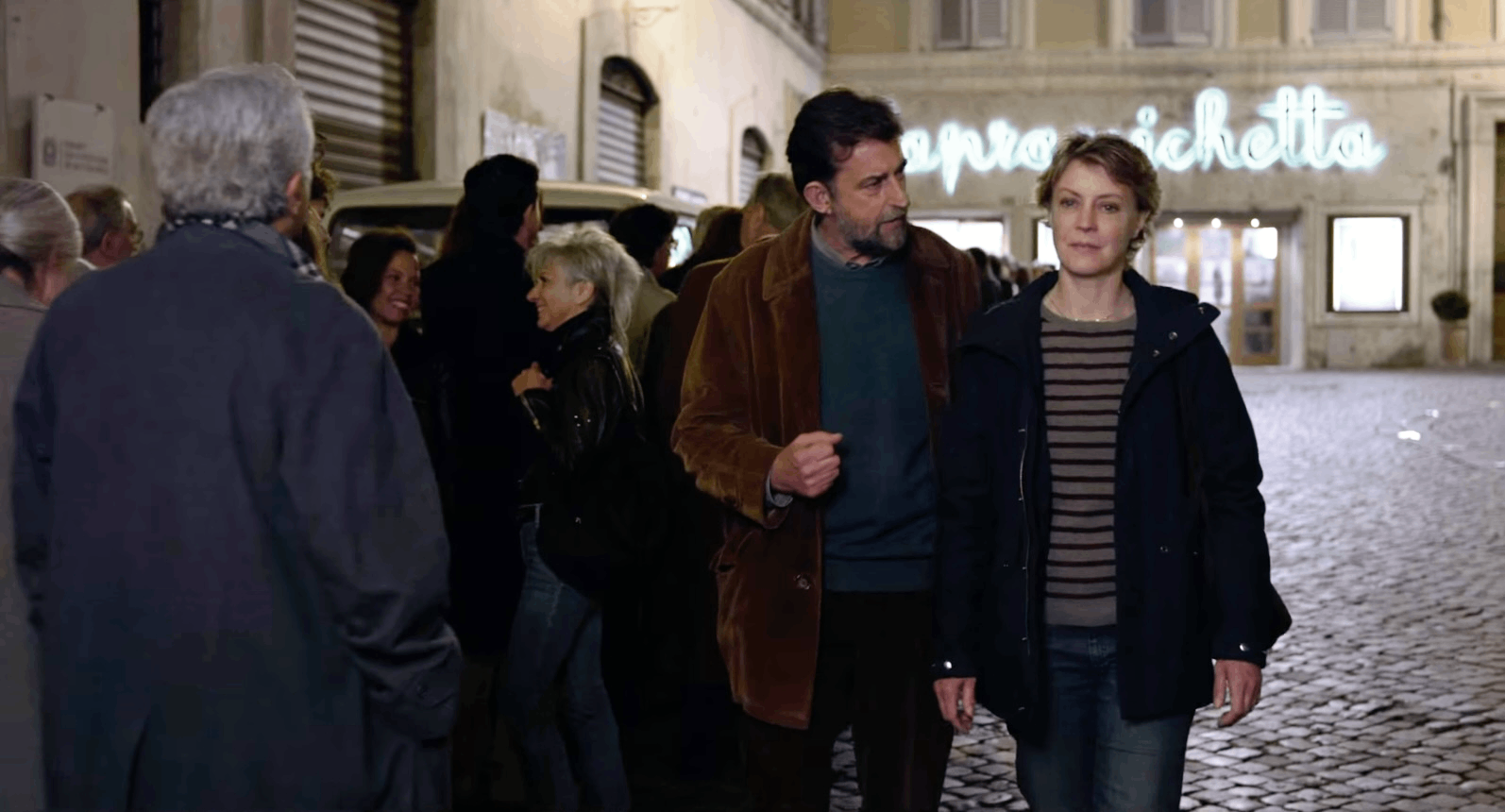
 Mia Madre, also known in English as My Mother, is Nanni Moretti’s 2015 film about a director trying to keep working while her mother’s health deteriorates. Starring Margherita Buy, Giulia Lazzarini, John Turturro and Moretti himself, it brings together family drama, filmmaking comedy and the uncertainty of approaching loss.
Its emotional power comes from ordinary situations: hospital visits, difficult conversations, interruptions at work and the feeling that we should be doing more for someone we love. Within Italia Mia’s collection of Italian movies, it offers an intimate portrait of contemporary life, with room for both sadness and absurdity.
The Story
The following overview discusses the premise and themes without revealing the ending.
Margherita is directing a film about workers facing layoffs at a factory. The production is already demanding when American actor Barry Huggins arrives, bringing an impressive reputation and a frustrating inability to deliver what she needs.
Away from the set, her mother Ada is seriously ill in hospital. Margherita shares the responsibility of caring for her with her brother Giovanni, whose apparent calm makes her own confusion feel even greater. She is also raising her teenage daughter, Livia, while struggling with changes in her personal life.
The story moves between professional obligations and family concerns, allowing memories and dreams to interrupt the present. These shifts reflect Margherita’s difficulty accepting what is happening. She can ask for another take on set; at the hospital, she has no comparable control.
Much of the film’s poignancy lies in that gap. Work continues to demand attention even when something more important is unfolding elsewhere. Moretti gives space to distraction, impatience and disbelief—the uncomfortable feelings that can accompany love.
Cast and Characters
Margherita Buy plays Margherita, the filmmaker at the center of the story. Her performance conveys a woman accustomed to making decisions who increasingly doubts her judgment. Irritation and vulnerability sit close together, making the character recognizably human.
Giulia Lazzarini plays Ada, Margherita and Giovanni’s mother. Her presence gives the family scenes their emotional weight, allowing Ada to remain a person with her own identity rather than simply the cause of her children’s distress.
Nanni Moretti plays Giovanni, Margherita’s brother. His restrained performance provides a counterpoint to her agitation, while leaving room to question whether composure necessarily means someone is suffering less.
John Turturro plays Barry Huggins, the American actor whose behavior disrupts the production. His comic energy changes the rhythm of the film, bringing moments of release into an otherwise painful situation.
Beatrice Mancini plays Livia, Margherita’s daughter, completing the story’s connection between three generations.
Awards and Recognition
Mia Madre competed for the Palme d’Or at the 2015 Cannes Film Festival. It received the Prize of the Ecumenical Jury, whose recognition highlighted the film’s sensitive treatment of loss and its use of humor. This was a separate award from the festival’s main competition prizes.
At Italy’s 2015 David di Donatello Awards, the film won two acting prizes:
Margherita Buy — Best Actress.
Giulia Lazzarini — Best Supporting Actress.
It received ten David nominations in total, including Best Film, Best Director and Best Screenplay.
Those acting awards are particularly fitting for a film whose impact depends on small changes in expression, unfinished conversations and the relationships between its characters.
How the Film Was Made
Moretti wrote the screenplay with Francesco Piccolo and Valia Santella. Arnaldo Catinari was the cinematographer, and Clelio Benevento edited the film.
The story draws on Moretti’s experience of losing his mother. In the Cannes presentation, he discussed the strength of those feelings and their influence on the film. Its autobiographical foundation gives the family scenes a particular intimacy, while the fictional framework allows him to examine those emotions through different characters.
One of the most effective choices is placing Margherita Buy in the role of the director while Moretti plays her brother. The filmmaker’s anxieties emerge through her struggle to work, care for her family and understand herself.
The film within the film adds another dimension. Margherita is trying to represent a public conflict involving workers and management while confronting a private crisis she cannot resolve. The contrast invites us to consider the distance between artistic conviction and everyday emotional competence.
The changes between comedy, present-day events, dreams and recollections also shape the viewing experience. Margherita’s mind keeps moving beyond the task immediately in front of her, and the film follows that movement.
Why It Still Matters
Mia Madre speaks to anyone who has tried to maintain an ordinary routine while someone close to them is seriously ill. There are calls to answer, decisions to make and people expecting attention. Even during a family crisis, daily life rarely becomes simple.
Moretti understands the guilt that can accompany divided attention. Margherita is not always patient or generous, but the film allows those shortcomings to coexist with her love for her mother.
It also captures the unsettling reversal that can occur between parents and adult children. Someone who once seemed a source of certainty becomes vulnerable, leaving the family to navigate unfamiliar responsibilities.
The comedy matters because it preserves the unpredictable texture of life. Barry’s problems do not disappear because Margherita is grieving. Absurdity continues alongside fear and sadness.
For readers interested in the broader history of Italian cinema, Mia Madre shows how a deeply personal story can reach beyond its immediate setting. Its subject is one family, but its questions about care, work and loss are widely shared.
Where to Watch or Buy
Availability checked on September 30, 2026. Streaming catalogs, prices and subtitle options can change.
United States: subscription and free streaming
JustWatch currently lists Mia Madre on fuboTV and OVID, with advertising-supported viewing on Tubi and Plex. Consult the U.S. viewing listings for current offers and access conditions.
United States: digital rental or purchase
Rental and digital purchase are currently listed through Amazon Video, Apple TV Store and Fandango at Home. The distributor links to this Amazon.com digital edition of Mia Madre. Check the language, English subtitles and current transaction options before paying.
Italy: subscription and free streaming
Italian listings currently include MUBI, MUBI Amazon Channel and Anni Duemila Amazon Channel. RaiPlay is also listed as a free option with advertising; visit the official Mia Madre page on RaiPlay to check playback availability.
Italy: digital rental or purchase
Apple TV Store, Rakuten TV and Amazon Video currently list rental and purchase options. See the Italian viewing listings and check whether your chosen version includes the subtitles you need. A paid Amazon channel subscription is separate from a standard Prime subscription.
DVD and Blu-ray
A U.S. Blu-ray edition is currently listed, and Music Box Films documents a home-video release with supplementary material. For physical copies, browse Mia Madre DVD and Blu-ray results on Amazon.com or Amazon.it. These are search links, so check each edition’s stock, subtitles and region compatibility.
Watching Italian services while traveling
If you use a VPN while traveling, NordVPN is an option to consider. Access to any particular Italian streaming service depends on its territorial restrictions and terms; a VPN does not guarantee that Mia Madre will be available.
Affiliate disclosure: Italia Mia may earn a commission from qualifying purchases through the Amazon and NordVPN links, at no additional cost to you.
External Sources
Festival de Cannes: Mia Madre and official credits
Festival de Cannes: Moretti discusses the film’s personal background
David di Donatello: awards and nominations
Ecumenical Jury: Mia Madre award
Music Box Films: cast, trailer and home-video information
JustWatch: United States availability
JustWatch: Italian availability