
Italy’s cinematic reputation was built by unforgettable performers such as Anna Magnani, Sophia Loren, Claudia Cardinale, Monica Vitti and Giulietta Masina. Their successors have not simply inherited that tradition: they have expanded it through independent films, international productions, television series and, increasingly, work behind the camera.
Choosing only ten contemporary Italian actresses is inevitably subjective. This selection considers the quality and range of their performances, major awards, influence on Italian cinema and ability to reach audiences beyond Italy. It is not a ranking based on beauty, celebrity or box-office success alone.
For a broader introduction to the country’s screen history, read Italia Mia’s guide to Italian movies and the cinema of Italy.
1. Monica Bellucci
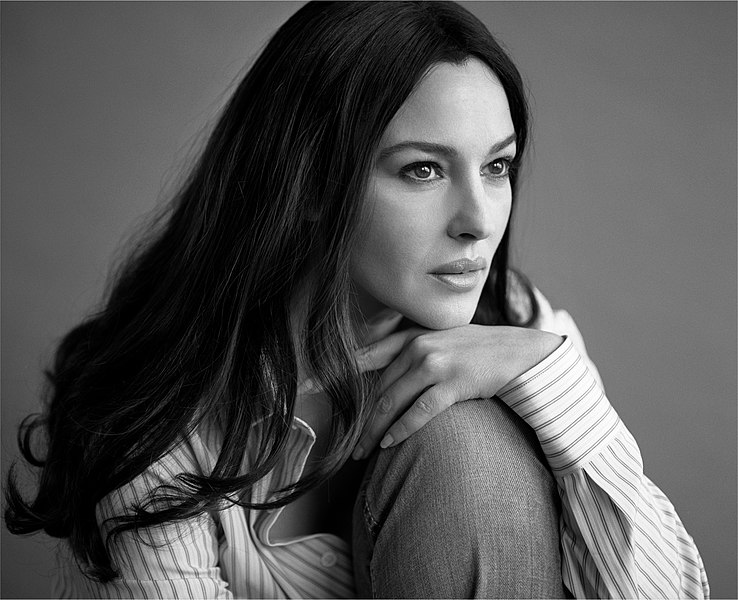
Few contemporary Italian actresses possess the international recognition of Monica Bellucci. Born in Città di Castello, Umbria, she moved from modeling into acting and gradually built a career encompassing Italian, French, American and international cinema.
Her defining Italian-language performance came in Giuseppe Tornatore’s Malèna (2000). Bellucci plays a woman in wartime Sicily who becomes the target of desire, envy and vicious provincial gossip. Although her character speaks relatively little, the actress communicates loneliness, humiliation and resilience through gesture and expression.
Bellucci subsequently appeared in major international productions including The Matrix Reloaded, The Matrix Revolutions, The Passion of the Christ, The Brothers Grimm and Spectre. Her appearance in the James Bond film attracted particular attention because she challenged the franchise’s conventional portrayal of women as much younger companions to its hero.
Her career has sometimes been associated more closely with glamour than with the Italian film industry, but her longevity and ability to work across languages make her an essential figure in any discussion of 21st-century Italian actresses.
Readers can explore her best-known Italian film in Italia Mia’s feature on Malèna and its portrayal of desire, jealousy and social judgment.
2. Paola Cortellesi
Paola Cortellesi has evolved from a gifted comic performer and television personality into one of the most important creative figures in modern Italian cinema.
Her acting combines warmth, intelligence and impeccable comic timing. Films such as Nessuno mi può giudicare, Scusate se esisto!, Gli ultimi saranno ultimi, Come un gatto in tangenziale and Ma cosa ci dice il cervello demonstrated her ability to move naturally between popular comedy and socially conscious drama.
The decisive turning point came with C’è ancora domani (2023), her feature-film directing debut. Cortellesi co-wrote the screenplay, directed the film and played Delia, a working-class wife and mother living in postwar Rome under an abusive husband.
Shot largely in black and white, the film combines comedy, domestic drama and a reflection on women’s political emancipation. It became an extraordinary Italian box-office success and received 19 David di Donatello nominations. Cortellesi won for Best Actress and Best Directorial Debut, among other awards associated with the film.
Her achievement was significant because it transformed her from one of Italy’s most popular actresses into an influential director and screenwriter capable of connecting with audiences across generations.
3. Margherita Buy
Margherita Buy is one of the most consistently acclaimed performers in contemporary Italian cinema. Rather than building her career around a fixed star image, she has specialized in psychologically detailed characters whose anxiety, intelligence and emotional contradictions feel completely believable.
She has worked with many leading Italian directors, including Nanni Moretti, Ferzan Özpetek, Giuseppe Piccioni, Cristina Comencini, Carlo Verdone and Maria Sole Tognazzi.
Among her strongest 21st-century performances are Le fate ignoranti, Giorni e nuvole, Habemus Papam, Mia madre and Tre piani. In Mia madre, directed by Moretti, Buy plays a filmmaker attempting to complete a production while confronting her mother’s declining health. Her restrained performance captures grief before the character is fully able to acknowledge it.
Buy is particularly effective at revealing discomfort through small pauses, changes of expression and nervous humor. Her characters are rarely idealized, which is precisely what makes them so recognizable.
With numerous David di Donatello awards and nominations across several decades, she remains one of the defining actresses of modern Italian cinema.
4. Valeria Golino
Born in Naples and raised partly in Greece, Valeria Golino has enjoyed one of the most varied international careers of any Italian actress of her generation.
English-speaking audiences may remember her from Rain Man, Hot Shots! and Hot Shots! Part Deux, but her most substantial work has often appeared in European cinema. Her credits include Respiro, La guerra di Mario, Il capitale umano, Per amor vostro, La vita possibile and Il colore nascosto delle cose.
Golino brings an unusual combination of intensity and spontaneity to the screen. She can appear emotionally exposed without making a performance seem calculated, and she has repeatedly taken roles involving complicated women rather than conventional heroines.
She has also become an accomplished director. Her films Miele and Euforia examine illness, mortality, intimacy and personal responsibility with sensitivity and restraint. Her directing career strengthens her importance within Italian cinema: she is not merely an international actress but a filmmaker with a distinct artistic perspective.
5. Alba Rohrwacher
Alba Rohrwacher has become one of the most respected faces of European art-house cinema. Her performances are often quiet and understated, yet they carry considerable emotional force.
After early success in films such as Giorni e nuvole and Il papà di Giovanna, she established herself through collaborations with directors including Alice Rohrwacher, Saverio Costanzo, Marco Bellocchio, Laura Bispuri and Luca Guadagnino.
Her major films include La solitudine dei numeri primi, Hungry Hearts, Vergine giurata, Le meraviglie, Lazzaro felice, La chimera and Maria Montessori: La Nouvelle Femme. International viewers also know her as the narrator of the television adaptation of Elena Ferrante’s My Brilliant Friend.
Rohrwacher excels at portraying isolation, moral uncertainty and emotions that remain partly unspoken. She avoids theatrical displays and allows a character’s inner life to emerge gradually. This subtlety has made her a natural choice for filmmakers working beyond conventional commercial formulas.
She also represents the increasingly international nature of Italian cinema, appearing regularly in Italian, French, German and multilingual productions.
6. Jasmine Trinca
Jasmine Trinca made an extraordinary entrance into cinema when Nanni Moretti cast her in The Son’s Room while she was still a teenager. Rather than becoming defined by that early success, she developed into an actress of remarkable emotional and stylistic range.
Her filmography includes The Best of Youth, Romanzo criminale, The Caiman, Miele, Fortunata, The Goddess of Fortune and Superheroes. She has worked with directors such as Marco Tullio Giordana, Michele Placido, Nanni Moretti, Valeria Golino, Sergio Castellitto and Ferzan Özpetek.
Trinca can convey vulnerability without reducing her characters to victims. Even when playing women facing grief, unstable relationships or personal crisis, she preserves their intelligence and autonomy.
She has also moved into directing. Her feature Marcel! followed the short film Being My Mom, showing an interest in family relationships, memory and unconventional forms of storytelling.
Her transition from teenage discovery to actor-director makes her one of the clearest examples of an Italian performer growing into a complete cinematic artist.
7. Valeria Bruni Tedeschi
Valeria Bruni Tedeschi occupies a distinctive position between Italian and French cinema. Born in Turin and raised partly in France, she works fluently in both cultural traditions as an actress, writer and director.
Her acting often combines emotional volatility, vulnerability, privilege and self-deprecating humor. She has appeared in films such as Human Capital, Like Crazy, Summer of 85 and The Line, while working with directors including Paolo Virzì, François Ozon and Patrice Chéreau.
In Human Capital, she gives a finely controlled performance as a wealthy woman whose comfortable life conceals dissatisfaction and moral compromise. In Like Crazy, opposite Micaela Ramazzotti, she creates a larger, more flamboyant character whose comic behavior gradually reveals profound instability and pain.
As a director, Bruni Tedeschi frequently draws upon family memory, class and autobiography. Films such as It’s Easier for a Camel…, A Castle in Italy and Forever Young blur the boundary between personal experience and fiction.
Her career demonstrates how contemporary Italian identity can extend beyond national borders while remaining deeply connected to Italian family life and social structures.
8. Giovanna Mezzogiorno
Giovanna Mezzogiorno is known for emotionally demanding roles that require intensity without sentimentality. The daughter of actors Vittorio Mezzogiorno and Cecilia Sacchi, she built her reputation through theater and cinema rather than relying on her family background.
Her central 21st-century films include The Last Kiss, Facing Windows, The Beast in the Heart, Vincere and Naples in Veils. In Ferzan Özpetek’s Facing Windows, she plays a woman whose encounter with an elderly Holocaust survivor prompts her to reconsider her marriage and abandoned ambitions.
Her performance as Ida Dalser in Marco Bellocchio’s Vincere is even more forceful. Mezzogiorno portrays a woman who claims to have married Benito Mussolini and spends years fighting against her institutional erasure. The role demands passion, defiance and an almost unbearable sense of isolation.
Mezzogiorno chooses her projects carefully and has sometimes remained outside Italy’s celebrity culture. That selectiveness has strengthened her reputation as a serious dramatic actress.
9. Micaela Ramazzotti
Micaela Ramazzotti possesses a rare ability to combine exuberant comedy with emotional fragility. Her characters can appear impulsive, chaotic or socially awkward, but she gives them a dignity that prevents them from becoming caricatures.
She gained widespread attention with The First Beautiful Thing, directed by Paolo Virzì, and continued with notable performances in A Flat for Three, Anni felici, Like Crazy, Tenderness and The Best Years.
Her work opposite Valeria Bruni Tedeschi in Like Crazy is among her finest achievements. The two actresses play women who escape from a psychiatric treatment facility and form an unpredictable friendship. Ramazzotti’s performance is quieter than Bruni Tedeschi’s, gradually revealing the grief and guilt beneath her character’s defensive behavior.
Ramazzotti later moved into directing with Felicità, in which she also starred. The film’s focus on a dysfunctional family and a woman attempting to protect her brother reflected many of the emotional themes that have shaped her acting career.
10. Matilda De Angelis
Matilda De Angelis represents a younger generation of Italian actresses who move easily between national cinema and international streaming productions.
Her breakthrough came with Italian Race, in which she played a young woman unexpectedly forced to manage her family and its troubled racing legacy. The role earned her a David di Donatello nomination for Best Actress.
She subsequently appeared in Rose Island, winning the David di Donatello for Best Supporting Actress, before reaching a much larger international audience in HBO’s The Undoing. She later took the title role in the Netflix series The Law According to Lidia Poët, inspired by the woman widely recognized as Italy’s first female lawyer.
De Angelis combines directness and contemporary energy with an ability to handle period drama, comedy and psychologically complex material. Her growing international profile suggests that her most important work may still lie ahead.
For more performers shaping the future of Italian film and television, see Italia Mia’s guide to promising young Italian actors and actresses and its overview of famous Italian actresses under 50.
The Changing Role of Italian Actresses
What connects these ten women is not a single acting style. Their importance comes from the different paths they have created.
Bellucci and Golino established durable international careers. Buy, Mezzogiorno and Ramazzotti brought emotional complexity to modern Italian drama. Rohrwacher and Trinca became essential figures in European auteur cinema. Bruni Tedeschi developed a body of work spanning acting, writing and directing. De Angelis represents a multilingual, streaming-era generation, while Cortellesi demonstrated that an actress associated with popular comedy could become one of Italy’s most successful filmmakers.
Their careers also reflect a broader transformation. Italian actresses are increasingly working as screenwriters, producers and directors, gaining more influence over the stories in which women appear. The result is a richer screen culture in which female characters are not confined to romantic or decorative roles.
These ten actresses do not represent every important woman working in Italian cinema. Performers such as Barbara Ronchi, Sonia Bergamasco, Anna Foglietta, Isabella Ragonese, Cristiana Capotondi and Elena Sofia Ricci could also make strong claims for inclusion. The difficulty of limiting the selection is itself evidence of the depth of acting talent in contemporary Italy.
External Links
David di Donatello – Italian Academy of Cinema
La Biennale di Venezia – Venice International Film Festival