
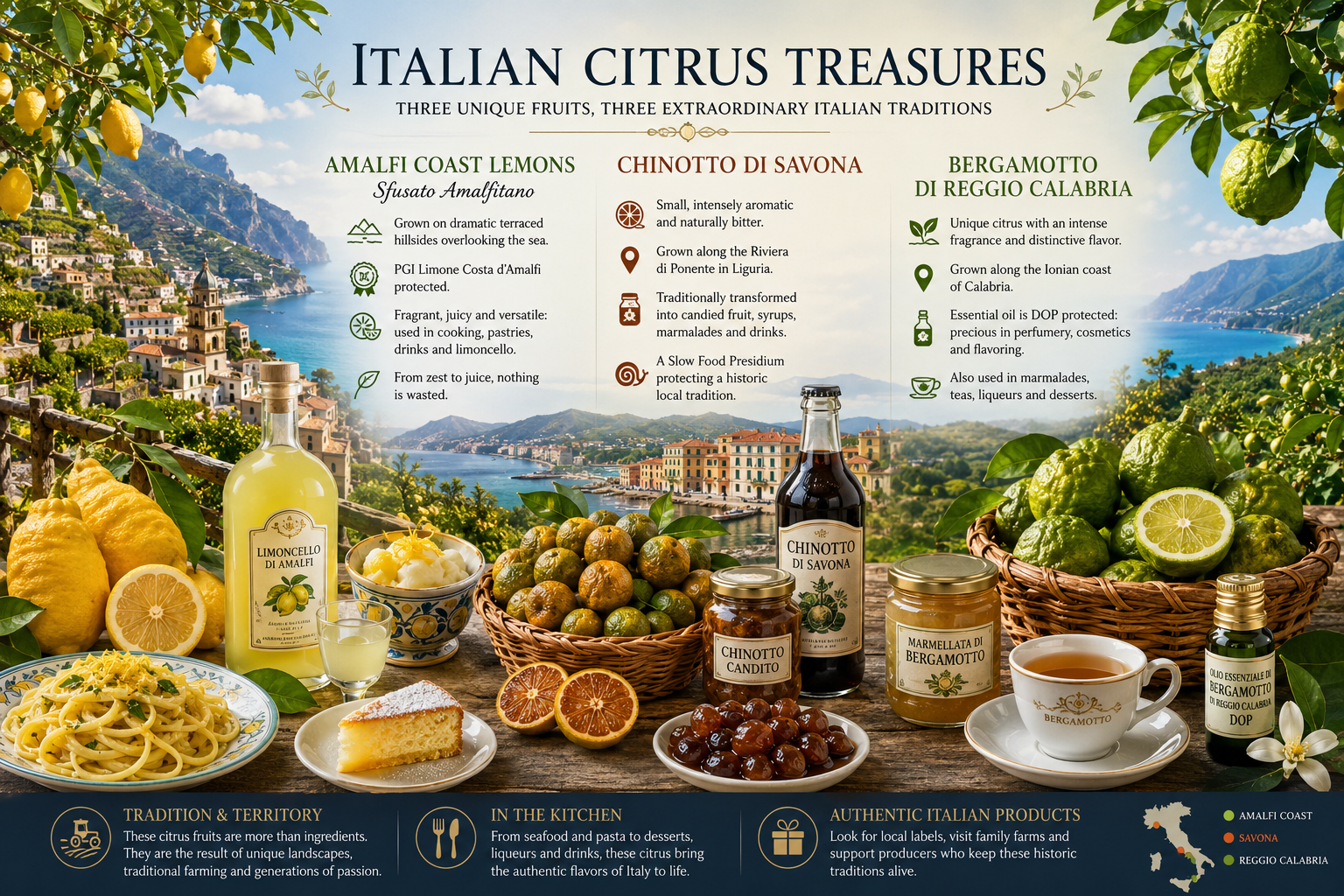
Italy is home to some of the world’s most distinctive citrus fruits, but three stand out for the extraordinary relationship they have developed with their territories: the Sfusato Amalfitano lemon of the Amalfi Coast, Chinotto di Savona, and bergamot of Calabria.
They are very different fruits. The Amalfi lemon is fragrant, juicy and versatile; chinotto is tiny, intensely aromatic and famously bitter; bergamot combines an unusual citrus fragrance with an essential oil that has become an international ingredient in perfumery and food.
Together, they tell a fascinating story about Italian agriculture, regional traditions, food, drinks, cosmetics and even the perfume industry.
The Amalfi Coast Lemon: Sfusato Amalfitano
When people picture the Amalfi Coast, they often imagine colorful villages, dramatic cliffs and the Mediterranean Sea. But there is another unmistakable symbol of the landscape: the enormous lemon terraces climbing the mountainsides.
The characteristic lemon of the area is the Sfusato Amalfitano, part of the protected Limone Costa d’Amalfi PGI production. Its name, sfusato, refers to its elongated, tapered shape.
Unlike the small, highly acidic lemons commonly found in supermarkets, the Amalfi lemon is relatively large, aromatic and exceptionally rich in fragrant essential oils. Its peel and pith are important culinary ingredients, not simply waste surrounding the juice.
The fruit is grown in a spectacular agricultural environment. The mountains descend almost vertically toward the sea, leaving farmers with little naturally level land. Over centuries, local families constructed terraces supported by dry-stone walls and developed pergola systems that allow lemon trees to thrive on steep slopes.
The result is one of Europe’s most remarkable examples of traditional mountain agriculture.
FAO has recognized the Amalfi agricultural system as a Globally Important Agricultural Heritage System. Lemon cultivation remains largely manual, with family farmers maintaining terraces, pergolas and trees according to knowledge passed down through generations.
Where Amalfi Lemons Are Grown
The production area extends along much of the Amalfi Coast and includes:
- Amalfi
- Atrani
- Conca dei Marini
- Furore
- Maiori
- Minori
- Positano
- Praiano
- Ravello
- Scala
- Tramonti
- Vietri sul Mare
The landscape changes considerably from town to town, but the combination of Mediterranean climate, sunlight, sea exposure and steep terraces creates the conditions associated with the Sfusato Amalfitano.
The lemon is harvested at different stages throughout the year rather than being restricted to a single short season. This is one reason visitors can encounter fresh Amalfi lemons during much of the tourist season.
The Aceto Family: One of Amalfi’s Historic Lemon Producers
One of the most important names in Amalfi lemon cultivation is the Aceto family.
The family’s agricultural history dates to 1825, when Salvatore Aceto purchased land in Ravello and began producing and trading lemons. The family subsequently became one of the major lemon producers on the coast and played an important role in promoting the identity of the Sfusato Amalfitano.
Today, the family is associated with the Azienda Agricola Salvatore Aceto and the Amalfi Lemon Experience, which combines agricultural production with visitor experiences.
This is particularly interesting for travelers because the lemon is not simply presented as a food product. Visitors can see the terraces, traditional cultivation techniques and the extraordinary amount of manual work required to produce lemons in this environment.
Other small agricultural producers operate throughout the Coast, particularly around Ravello, Amalfi, Minori and Maiori. Much of the production remains family-based rather than industrial.
How Amalfi Lemons Are Used
One of the most important characteristics of the Amalfi lemon is that almost the entire fruit can be used.
The juice is used in:
- seafood dishes
- salads
- sauces
- pasta
- marinades
- desserts
- drinks
- sorbets
- granita
The aromatic peel is perhaps even more important.
Finely grated zest can transform pasta, risotto, cakes, cookies, seafood and pastries. Because the peel contains concentrated aromatic oils, a relatively small amount can provide an intense citrus fragrance.
The fruit is also traditionally sliced or served in ways that take advantage of its comparatively mild bitterness.
Lemon and seafood
The relationship between lemon and seafood is particularly strong on the Amalfi Coast.
Local cuisine uses lemon with anchovies, prawns, squid, shellfish and other seafood. The acidity brightens delicate flavors without requiring heavy sauces.
One of the most recognizable combinations is simply fresh seafood accompanied by Amalfi lemon.
Lemon pasta
Lemon has also become a defining ingredient in contemporary Campanian cuisine.
Chefs use juice and zest with spaghetti, linguine, tagliolini and other fresh or dried pastas. Creamier preparations often combine lemon with butter, cheese or seafood.
The key is restraint: the best dishes use the lemon as an aromatic component rather than allowing acidity to dominate.
Limoncello: Amalfi’s Most Famous Lemon Drink
Perhaps no product has done more to spread the reputation of southern Italian lemons internationally than limoncello.
Traditionally, limoncello is made by extracting the aromatic compounds from lemon peel in alcohol and subsequently combining the infusion with sugar syrup.
The Amalfi Coast, Sorrento and Capri all have longstanding associations with limoncello, and the question of its exact birthplace has generated competing local traditions. What is certain is that lemon liqueur became deeply integrated into the culture of Campania.
Today it is normally served very cold, particularly after a meal.
The quality of the lemon is crucial because the principal ingredient is not the juice but the aromatic peel.
This is one reason untreated, highly fragrant local lemons are prized for artisanal limoncello.
Beyond Limoncello
The Amalfi lemon has become an ingredient in an extraordinary range of products:
- lemon marmalade
- lemon cream
- lemon cakes
- lemon sorbet
- granita
- lemon candies
- biscuits
- infused olive oils
- cosmetics
- soaps
- perfumes
- syrups
- flavored spirits
The lemon has therefore become an entire local economy rather than simply an agricultural commodity.
Chinotto di Savona: Italy’s Little Bitter Citrus
Travel north from Campania to Liguria and the citrus story changes completely.
Near Savona, a tiny citrus fruit has developed an almost cult-like following: Chinotto di Savona.
The chinotto is much smaller than a conventional orange or lemon. Its fruit is intensely aromatic but extremely bitter and acidic, making it unsuitable for eating like a normal orange.
The plant itself is believed to have originated in China and was introduced to the Ligurian coast centuries ago. According to the Slow Food Foundation, a Savonese navigator brought the plant to the Ligurian coast around the 1500s, where it adapted particularly well to the local environment.
The traditional production area runs along the Riviera between Varazze and Pietra Ligure, in the province of Savona.
A Fruit That Almost Disappeared
Chinotto was once considerably more important commercially than it is today.
During the late nineteenth and early twentieth centuries, candied chinotto and chinotto preserved in syrup were popular in Italian cafés. The fruit was also preserved in Maraschino and served as a small after-dinner delicacy.
But production declined dramatically.
The reasons included difficult and labor-intensive processing, reduced cultivation, winter frosts, urbanization and the poor economic return for farmers.
The traditional fruit eventually became sufficiently rare that its survival became a conservation issue.
In 2004, Chinotto di Savona became a Slow Food Presidium, with the objective of recovering authentic local cultivation and traditional processing.
How Chinotto Is Traditionally Used
The bitterness of the fresh fruit explains its unusual culinary history.
Instead of eating it fresh, producers traditionally transform chinotto into products such as:
- candied chinotto
- chinotto in syrup
- chinotto preserved in Maraschino
- marmalade
- syrups
- liqueurs
- soft drinks
- confectionery
The candying process is particularly important.
It is long and labor-intensive, requiring preparation of the fruit and progressive treatment with increasingly concentrated syrups. The process transforms the intensely bitter fruit into something sweet, aromatic and complex.
Historically, small jars of preserved chinotto could be found on café counters in Italy and France.
The Chinotto Soft Drink
The word chinotto is now perhaps more familiar internationally as the name of an Italian dark-colored carbonated soft drink.
The drink has a complex sweet-bitter flavor and is one of Italy’s classic non-alcoholic beverages.
It should not, however, be confused with the fresh fruit itself.
Commercial chinotto beverages can use extracts, infusions or other citrus components depending on the formulation. The original Savona fruit represents a specific agricultural tradition, while “chinotto” as a beverage has become a much broader Italian product category.
This distinction is particularly important for travelers interested in authentic local products.
Important Chinotto Producers
One of the best-known traditional producers is Parodi Chinotto, based in Finale Ligure.
The Parodi family has been involved in agriculture since 1930 and specifically cultivates Chinotto di Savona, along with other citrus fruits. Its production includes traditional processed chinotto products.
The Slow Food Presidium also identifies a number of growers and processors in the Savona area, particularly around Finale Ligure, Pietra Ligure, Borgio Verezzi and Savona. Among the listed processors are Alessandro Parodi, Pier Paolo Morelli and Dalpian Il Sottobosco.
For anyone interested in the authentic fruit rather than simply the industrial soft drink, this Ligurian Riviera area is the place to explore.
Bergamot: Calabria’s Green Gold
Further south, along the Ionian coast of Calabria, another citrus fruit has developed a completely different identity.
The bergamot, Citrus bergamia, is one of Italy’s most internationally important specialty citrus fruits.
Its heartland is the province of Reggio Calabria, particularly the narrow coastal zone stretching along the Ionian side of the province.
Here, the warm Mediterranean climate and particular environmental conditions have created an agricultural territory strongly associated with bergamot.
Bergamot is sometimes called the green gold of Calabria, a reference to the economic and cultural importance of its essential oil.
The fruit itself resembles a small orange or lemon, with a yellow-green skin when mature and a distinctive perfume.
Its greatest commercial value, however, lies in its peel.
The Bergamot Essential Oil
Bergamot essential oil is extracted from the peel and is one of the world’s most recognizable citrus fragrance ingredients.
It has a fresh, elegant aroma with sweet, bitter and floral characteristics.
Its importance in perfumery dates back centuries and it became particularly associated with fragrances such as Eau de Cologne.
Modern perfumery continues to use bergamot extensively because it provides an exceptionally effective opening note and blends well with floral, woody, spicy and aromatic ingredients.
The essential oil is also used in:
- perfumes
- cosmetics
- soaps
- shampoos
- aromatherapy products
- food flavorings
- beverages
- confectionery
Bergamot in Food
Bergamot is considerably more challenging than a conventional sweet orange.
The juice has a distinctive acidic and bitter character, while the peel is extremely aromatic.
It can be used in:
- marmalade
- pastries
- cakes
- biscuits
- ice cream
- sorbets
- teas
- liqueurs
- cocktails
- sauces
- flavored confectionery
Bergamot has also become increasingly popular among chefs interested in highly aromatic Mediterranean ingredients.
Its flavor is particularly effective when used sparingly.
A small amount of zest can provide an extraordinary perfume without overwhelming a dish.
Bergamot and Earl Grey Tea
One of the world’s most famous uses of bergamot is Earl Grey tea.
The characteristic citrus aroma of Earl Grey comes from bergamot flavoring.
This means that a fruit strongly associated with a relatively small section of southern Calabria has become part of a global tea tradition.
It is an excellent example of how Italian citrus products can have an influence far beyond Italian cuisine.
The Bergamot Production Area
The traditional production territory is concentrated in the province of Reggio Calabria.
The current Italian geographical-protection framework is particularly interesting.
The Bergamotto di Reggio Calabria – Olio Essenziale has DOP status for its essential oil, with the designation applying to oil extracted from qualifying bergamot fruit grown in the defined production area.
The protected essential oil is obtained from Citrus bergamia and includes the recognized cultivars Femminello, Castagnaro and Fantastico.
In 2026, Italy also submitted an application for IGP protection for the Bergamotto di Reggio Calabria fruit itself, an important development for the agricultural product beyond its traditional essential-oil designation.
This distinction is worth emphasizing: the established DOP concerns the essential oil, while the fruit itself is the subject of the newer IGP application.
The Bergamot Consortium
The Consorzio di Tutela del Bergamotto di Reggio Calabria is based in Condofuri, in the province of Reggio Calabria, and represents an important part of the protected-product system. The Italian Ministry of Agriculture’s current list identifies the consortium as the recognized protection consortium for the DOP essential oil.
Historically, the bergamot industry developed a sophisticated processing system because the essential oil became an internationally traded commodity.
The fruit is harvested and processed specifically to recover its valuable aromatic compounds.
Capua 1880: A Major Name in Bergamot
One of the most important companies associated with Italian citrus processing is Capua 1880, headquartered in Reggio Calabria.
The company dates back to 1880 and began producing essential oils for the perfume industry. Over five generations, it developed into a major international citrus-processing business.
Today, Capua 1880 works with bergamot, lemon, orange and mandarin and supplies essential oils and citrus ingredients to the international fragrance and flavor industries.
The company describes itself as a leading global processor of bergamot and states that it processes a substantial share of Italy’s bergamot production.
For bergamot, this illustrates an important difference from the Amalfi lemon and Savona chinotto.
While the Amalfi and Savona products remain strongly connected with small-scale agricultural and culinary traditions, Calabrian bergamot also has a major industrial and international B2B market, particularly in perfumery.
Three Citrus Fruits, Three Italian Identities
Although all three belong to the enormous citrus family, they have developed very different identities.
| Citrus | Principal territory | Character | Traditional importance |
|---|---|---|---|
| Sfusato Amalfitano | Amalfi Coast, Campania | Aromatic, juicy, relatively mild | Cooking, desserts, limoncello |
| Chinotto di Savona | Savona Riviera, Liguria | Small, intensely bitter and aromatic | Candied fruit, preserves, drinks |
| Bergamot | Reggio Calabria, Calabria | Highly fragrant, acidic and bitter | Essential oil, perfume, tea, food |
The differences are striking.
The Amalfi lemon is fundamentally a culinary fruit.
Chinotto is primarily a preserved, confectionery and beverage fruit.
Bergamot is perhaps the most industrial and aromatic of the three, with an extraordinary role in perfume and flavor production.
Italian Citrus and Traditional Agriculture
There is another important connection between these fruits: all three demonstrate how Italian agriculture has adapted to difficult environments.
On the Amalfi Coast, farmers constructed terraces on steep mountainsides.
In Liguria, chinotto found a home in the mild coastal climate between the mountains and the sea.
In Calabria, bergamot developed within the unique microclimate of the Reggio Calabria coastal belt.
In each case, geography became part of the identity of the product.
This is why authentic Italian specialty citrus cannot simply be understood as a variety of fruit.
It is a combination of:
fruit + climate + soil + cultivation techniques + local knowledge + processing + history.
Traditional Italian Citrus Products to Look For
Visitors traveling through these regions should look beyond the fresh fruit.
On the Amalfi Coast
Look for:
- Limone Costa d’Amalfi PGI
- Sfusato Amalfitano
- artisanal limoncello
- lemon marmalade
- lemon granita
- lemon sorbet
- lemon pastries
- candied lemon peel
- lemon-infused products
The best place to experience the fruit is often directly from a local agricultural producer rather than a generic souvenir shop.
Around Savona
Look for:
- authentic Chinotto di Savona
- candied chinotto
- chinotto in syrup
- chinotto marmalade
- chinotto preserved in Maraschino
- traditional chinotto beverages
Because genuine local production is relatively small, the Slow Food Presidium is a useful reference when trying to distinguish local Chinotto di Savona from generic chinotto-flavored products.
Around Reggio Calabria
Look for:
- fresh bergamot
- bergamot marmalade
- bergamot candies
- bergamot liqueur
- bergamot-flavored desserts
- bergamot tea
- authentic bergamot essential oil
- cosmetics and perfumes containing Calabrian bergamot
For the essential oil, the DOP designation is particularly important because it identifies the protected product and its production requirements.
Citrus as a Symbol of Italian Craftsmanship
Perhaps the most fascinating aspect of these fruits is how much they reveal about the Italian concept of craftsmanship.
A bottle of Amalfi limoncello, a jar of candied Savona chinotto or a vial of Calabrian bergamot oil may look like simple products.
Behind each one, however, lies a complicated chain of human knowledge.
The Amalfi farmer must maintain terraces and pergolas on extraordinarily steep terrain.
The Savona producer must preserve a fruit that nearly disappeared because traditional processing became economically difficult.
The Calabrian bergamot processor must extract and preserve one of the world’s most valuable natural citrus aromas.
These are very different challenges, but the principle is the same: Italian specialty foods often emerge from the relationship between a very particular landscape and generations of accumulated knowledge.
From Lemon Grove to Luxury Perfume
Few products illustrate the versatility of Italian agriculture better than these three citrus fruits.
An Amalfi lemon can begin its life on a mountain terrace overlooking the Mediterranean and end up in a plate of pasta, a pastry or a glass of limoncello.
A tiny chinotto grown near Savona can be transformed through weeks of traditional processing into an elegant candied delicacy—or contribute its distinctive bitter character to an Italian soft drink.
A bergamot harvested in Calabria can become marmalade, flavoring for tea or a sophisticated perfume ingredient used by an international fragrance house.
That extraordinary range is what makes Italian citrus culture so compelling.
These are not simply fruits.
They are regional identities, agricultural traditions, culinary ingredients and commercial products, each shaped by the landscape in which it evolved.
For travelers, the best way to understand them is to visit their growing regions: walk among the lemon terraces of the Amalfi Coast, discover the small chinotto plantations around Savona and Finale Ligure, and explore the bergamot country along the Calabrian coast around Reggio Calabria.
Only then does it become clear why three relatively obscure citrus fruits can tell such a large story about Italy.
Limoncello: The Spirit of Southern Italy in a Glass
Region of Calabria: Italy’s Untamed Beauty of Cliffs, Mountains, and Crystal Seas
Top 10 Italian Fragrances for Women and Men: The Ultimate Guide to Luxury Perfumes