
 Italy exports enormous quantities of Parmigiano Reggiano, prosciutto, pasta, olive oil and other familiar foods to the United States. Yet some of the country’s most memorable specialties remain almost unknown outside their place of origin.
These foods are difficult to find in America for several reasons. Traditional salumi must comply with strict U.S. import rules. Fresh cheeses may have an extremely short shelf life. Other products are made by only a handful of producers, while many regional dishes depend on wild herbs, wood-fired ovens, terracotta cooking vessels or knowledge passed down within local families.
Some can occasionally be ordered from specialist importers or tasted in ambitious Italian restaurants. Others are best treated as reasons to travel.
For a broader introduction to the country’s culinary geography, see Italia Mia’s guide to what to eat in every region of Italy.
Why So Many Authentic Italian Foods Are Hard to Find in America
Italy’s regional food culture is far more localized than many international diners realize. A cheese may be made in three mountain villages. A salume may depend on the humidity of one river valley. A savory pie can change from one side of a provincial border to the other.
The European Union’s PDO and PGI systems help protect these connections. A PDO, or Protected Designation of Origin, has the strongest relationship with its territory: production, processing and preparation must take place within the designated area. A PGI, or Protected Geographical Indication, requires at least one important stage to occur there.
Protected status does not necessarily mean that a food is widely exported. In fact, the smallest and most distinctive specialties are often the least likely to reach American supermarkets.
Rare Italian Salumi and Preserved Meats
Lardo di Colonnata IGP
Lardo di Colonnata is one of the clearest examples of a food that cannot be separated from its birthplace.
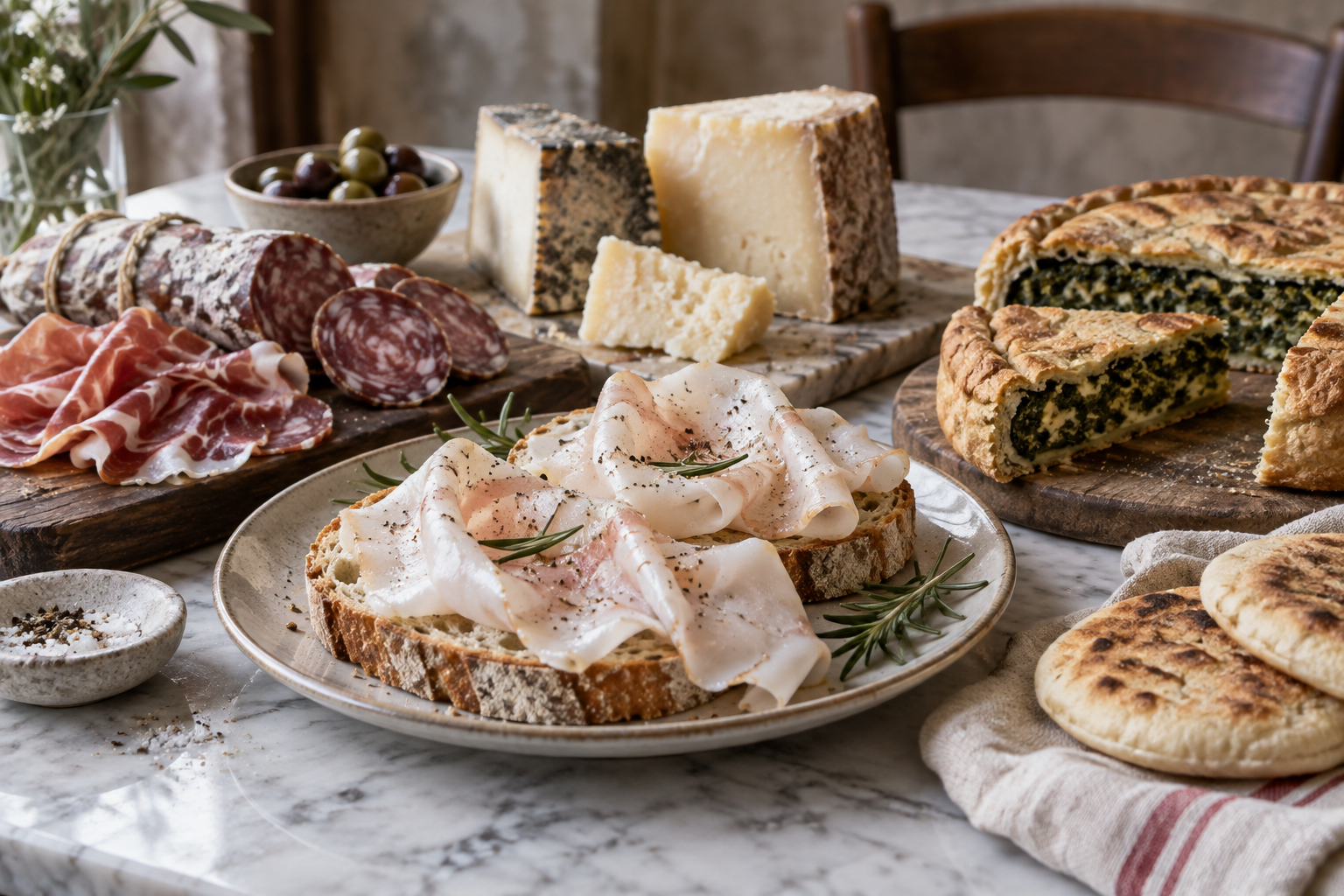
Colonnata is a small village above Carrara in northern Tuscany, surrounded by the marble quarries of the Apuan Alps. Here, thick pieces of pork fatback are layered with salt, garlic, rosemary and spices inside basins made from local marble. The lardo matures slowly, developing a silky texture and a delicate flavor quite different from uncured pork fat.
It is generally served in paper-thin slices over warm bread, allowing the heat to soften it. It may also appear with tomatoes, beans, honey or seafood, but complicated preparations are unnecessary.
Authentic Lardo di Colonnata IGP can occasionally be found through specialized American importers, but availability is irregular. Travelers should not assume that they can place it in their luggage: USDA rules state that cured ham and salami from Italy cannot be brought into the United States by individual travelers and must enter as properly certified commercial shipments.
Colonnata is only a short distance from Carrara, making it an excellent culinary excursion for travelers exploring the northern Tuscan coast and the Apuan Alps.
Culatello di Zibello DOP
Culatello di Zibello is produced in the humid lowlands near the Po River northwest of Parma. It is made from the most prized muscular portion of a pig’s hind leg, rather than from the entire leg used for prosciutto.
The meat is salted, placed inside a natural casing and tied into its recognizable pear shape. It then ages through the changing seasons in cellars where the fog and humidity of the Bassa Parmense contribute to its character.
Properly sliced culatello is tender, fragrant and more delicate than many heavily seasoned salumi. It is usually served by itself with bread and perhaps a little butter rather than buried under cheese or condiments.
Authentic Culatello di Zibello DOP has entered the American market through approved commercial importers, but production is limited and prices are high. American-made products labeled simply “culatello” are not necessarily the protected Italian specialty.
Pitina IGP
Pitina comes from the mountain valleys north of Pordenone in Friuli-Venezia Giulia. It began as a practical method of preserving meat when a sheep, goat or wild animal had to be slaughtered.
The meat was traditionally minced, seasoned with salt, garlic and pepper, shaped into a flattened ball, coated with cornmeal and smoked near the fireplace. Modern protected versions follow controlled production rules, but the food retains its rustic appearance.
Pitina can be eaten thinly sliced, warmed in vinegar, cooked in broth or added to polenta. Its small production area and unusual combination of smoking, seasoning and meat types make it exceedingly rare in the United States.
Salama da Sugo IGP
This imposing specialty from Ferrara is not an ordinary slicing salami. Salama da sugo is made from seasoned pork enriched with wine and spices, enclosed in a casing and aged. It must then be cooked slowly for several hours before serving.
When opened, the interior is dark, soft and intensely flavored. It is traditionally spooned over mashed potatoes or purée, which balances its richness.
Because it requires lengthy preparation and has a flavor that may surprise diners expecting familiar salami, it has remained a local specialty rather than an international Italian-American staple.
Violino di Capra della Valchiavenna
The “goat violin” of Valchiavenna in Lombardy takes its name from its shape and the traditional way it is held while being sliced. The cured goat leg rests against the shoulder while the knife moves across it, almost as if the producer were playing a violin.
Its flavor is lean, savory and more pronounced than pork prosciutto. Small-scale production, limited supply and import restrictions make genuine Valchiavenna violino di capra exceptionally difficult to encounter in America.
Ciauscolo IGP
Ciauscolo, associated particularly with the Marche, looks like salami but has a soft, spreadable interior. Pork meat and fat are finely ground, seasoned and cured to produce a texture that can be spread across bread.
Some American shops now carry imported ciauscolo, but it remains far less common than prosciutto, mortadella or harder Italian salami. When buying it, look for the complete protected name, Ciauscolo IGP, rather than assuming every soft salami is equivalent.
Italian Cheeses That Rarely Travel Well
Castelmagno DOP
Castelmagno is a crumbly, complex cheese from a small mountain area in the province of Cuneo, Piedmont. Depending on its age, it can be pale and mildly tangy or more assertive, granular and veined.
In Piedmont it is used in gnocchi sauces, risotto and polenta, although mature Castelmagno deserves to be tasted on its own. Limited production and cost make it uncommon in America, where it is often replaced in recipes with Gorgonzola. The substitution may produce a good dish, but not the same flavor.
Formadi Frant
Formadi Frant reflects the old mountain principle that valuable food should never be wasted. Broken or imperfect cheeses were crushed and mixed with cream, milk, salt and pepper, creating a powerful new cheese instead of being discarded.
The result can be spicy, creamy and remarkably complex. It is associated with Carnia in Friuli-Venezia Giulia and is protected by a Slow Food Presidium. Production remains small, so tasting it usually means visiting Friuli or finding a particularly well-connected specialist cheesemonger.
Puzzone di Moena DOP
The name means “the stinky cheese of Moena,” although its flavor is usually more balanced than the playful translation suggests.
This Trentino cheese develops its penetrating aroma through repeated washing of the rind during maturation. Inside, it is supple, savory and well suited to polenta, canederli and other Alpine dishes.
Puzzone di Moena occasionally appears in major American cheese shops, but it is rarely seen in ordinary supermarkets. The washed rind also requires careful handling and temperature-controlled transportation.
Casizolu
Casizolu is a traditional pear-shaped cow’s-milk cheese from Sardinia. This surprises some visitors because Sardinia is more internationally associated with pecorino made from sheep’s milk.
Producing Casizolu requires considerable skill. The warm curd is stretched and shaped by hand, giving the cheese its distinctive form. Mature examples develop aromas of grass, wood and buttermilk. It remains much less widely exported than Pecorino Sardo.
Squacquerone di Romagna DOP
Squacquerone is so soft that it appears to collapse when removed from its container. Its fresh, gently tangy flavor is traditionally paired with warm piadina and peppery arugula.
This is precisely the kind of cheese that has difficulty traveling. It contains substantial moisture, requires refrigeration and is meant to be eaten fresh. American producers make comparable soft cheeses, but authentic Squacquerone di Romagna DOP remains a specialty-shop find.
Regional Italian Dishes Almost Unknown in the United States
Torta d’Erbi of Lunigiana
Torta d’erbi—or torta d’erbe—is a savory herb pie strongly associated with Pontremoli and the Lunigiana, the historical territory between northern Tuscany and eastern Liguria.
There is no single household recipe. The filling may contain Swiss chard, leeks, onions, borage, spinach and seasonal wild greens. Some families add grated cheese, rice or potatoes; others insist on a simpler mixture of greens, salt and olive oil. The filling is enclosed between very thin sheets of dough and was traditionally cooked using heated testi.
Its identity depends partly on the herbs available locally, which is why even a carefully made American version will not taste exactly like one prepared in a Lunigiana home.
A Practical Torta d’Erbi for an American Kitchen
To make an approachable version, prepare a simple dough with flour, water, olive oil and a little salt. Let it rest while preparing the filling.
Finely slice Swiss chard, leeks, scallions and a small quantity of spinach or borage. Salt the greens lightly and leave them for approximately 30 minutes. Squeeze out as much liquid as possible, then dress them with olive oil. A modest amount of grated Pecorino or Parmigiano can be added, but it should not overwhelm the herbs.
Roll half the dough very thinly, place it in an oiled pan and distribute the uncooked filling evenly. Cover with another thin sheet, seal the edges, brush with olive oil and bake until the crust is crisp and lightly browned.
The exact mixture should change with the season. That flexibility is not a compromise; it is part of the dish’s character.
Testaroli
Testaroli are one of Lunigiana’s most distinctive foods. A batter of flour, water and salt is cooked into a large, thin round using a traditional testo. The cooked sheet is cut into diamond-shaped pieces, briefly softened in hot water and commonly dressed with pesto, olive oil and grated cheese.
Although packaged testaroli are now sold beyond Lunigiana, freshly cooked versions have a texture and aroma that are difficult to reproduce industrially. They are sometimes described as an ancient form of pasta, but diners should not expect the firmness of dried spaghetti. Testaroli are softer, more porous and particularly good at absorbing sauce.
Panigacci
Panigacci use a similarly simple batter but produce a different result. They are cooked between red-hot terracotta plates, traditionally stacked near a wood fire. The finished rounds are thin, fragrant and lightly crisp.
They are served hot with salumi and soft cheeses, or occasionally softened and dressed like pasta. The official La Spezia tourism site identifies them with the Lunigiana–La Spezia area and especially with Podenzana.
The ingredients are easy to obtain in America; the difficult part is recreating the intense heat and the flavor imparted by the traditional terracotta testi.
Focaccia di Recco col Formaggio IGP
Focaccia di Recco bears little resemblance to thick focaccia covered with herbs. It consists of two extremely thin layers of unleavened dough enclosing a generous amount of fresh, creamy cheese.
The dough is stretched almost transparently, filled, covered and torn in places before being baked quickly at high heat. The cheese melts into bubbling pockets while the exterior becomes crisp.
American restaurants frequently use the name for filled flatbreads, but the protected Ligurian version depends on specified techniques and suitable fresh cheese. It is best eaten within minutes of leaving the oven, making it a naturally local experience.
Frico
Frico is a specialty of Friuli made by cooking cheese until it develops a crisp, browned exterior. The best-known version combines cheese with potatoes and sometimes onions, producing something between a pancake, a rustic pie and a cheese crisp.
It was historically a resourceful way to use cheese remnants. Frico can be prepared successfully in the United States, especially with Montasio, but it remains surprisingly uncommon on Italian-American menus.
Seadas
Seadas, also called sebadas, are among Sardinia’s most distinctive desserts. Thin pastry encloses fresh cheese, traditionally flavored with citrus zest. The parcel is fried and finished with Sardinian honey.
The contrast is the point: crisp pastry, warm salty cheese, fragrant citrus and sweet honey. Seadas need to be assembled and cooked shortly before serving, while the appropriate fresh Sardinian cheese is difficult to export. This helps explain why they are much rarer in America than cannoli, tiramisù or panna cotta.
Pani câ Meusa
Palermo’s pani câ meusa is a bread roll filled with chopped veal spleen and lung that have been boiled and then fried in lard. It can be ordered schettu, or plain with lemon, or maritatu—“married”—with grated cheese.
This is working-class street food rather than a formal restaurant dish. Organ meats have a smaller audience in the contemporary United States, and the preparation requires both a knowledgeable butcher and a cook familiar with the proper texture.
For adventurous diners, it is one of the essential tastes of Palermo.
Tortelli Amari di Castel Goffredo
These filled pasta parcels from Castel Goffredo in Lombardy are flavored with a local aromatic herb called erba amara, generally identified with costmary. The filling may also contain herbs, cheese, breadcrumbs and other household ingredients.
Costmary is uncommon in American markets, and the dish belongs to a very limited geographical area. Even many Italians from other regions have never tasted it.
Tiella di Gaeta
Tiella di Gaeta is a round, enclosed pie traditionally filled with ingredients such as octopus, anchovies, onions, escarole or zucchini. Its dough is softer than a conventional pie crust and sturdy enough to hold the moist filling.
The dish developed as portable food for workers and fishermen. Although it can be recreated in America, it remains overshadowed by more internationally familiar pizza and focaccia.
Why Italian-American Food Developed Differently
The absence of these specialties from American menus does not make Italian-American food less authentic. It reflects a different history.
Many Italian immigrants came from southern regions and adapted their cooking to ingredients, wages and customer expectations in the United States. Meat became more affordable, portions grew, and recipes from different provinces began to mix. At the same time, intensely local foods dependent on a particular climate, herb, breed of animal or production method were difficult to reproduce.
Italian-American cuisine consequently developed its own traditions, while hundreds of village dishes remained in Italy.
Can You Bring Italian Salumi and Cheese Home?
Never assume that a vacuum-sealed package is automatically permitted.
The USDA states that travelers may not bring cured hams and salami from Italy into the United States in their personal baggage. These products require commercial certification and documentation.
Rules for dairy products are different. USDA guidance generally permits solid hard or soft cheeses that do not contain meat and are not liquid or pourable. Nevertheless, every agricultural product must be declared, and border inspectors make the final decision.
Keep foods in their original labeled packaging, retain receipts and declare everything. Regulations can change, so check the current USDA guidance before traveling rather than relying on advice from a shopkeeper or an older travel article.
How to Taste These Foods Authentically
The most reliable method is to search by territory rather than by famous city.
Visit Colonnata for lardo, the Bassa Parmense for culatello, Pontremoli and Podenzana for Lunigiana cooking, Carnia for Formadi Frant, Moena for its washed-rind cheese, Recco for cheese focaccia and Palermo for pani câ meusa.
Look for village sagre, food festivals, weekly markets, agriturismi, small alimentari and restaurants that explicitly identify their local suppliers. Ask what is made nearby and what is in season instead of searching only for dishes already familiar from American Italian restaurants.
For readers who want to reproduce the spirit of these foods at home, regional cookbooks are often more useful than collections promising a single universal Italian cuisine.
Some links in this article are affiliate links. Italia Mia may earn a commission if you make a purchase, at no additional cost to you.
Giulia Scarpaleggia’s Cucina Povera cookbook is a useful introduction to the seasonal, economical cooking traditions that produced many of Italy’s most enduring local dishes.
The Foods Worth Planning a Journey Around
Rare Italian specialties reveal something that internationally famous dishes sometimes conceal: Italian cuisine is built from thousands of local environments rather than from one national recipe book.
Lardo di Colonnata belongs to marble-quarry country. Culatello belongs to the fog of the Po Valley. Torta d’erbi, testaroli and panigacci belong to the roads, hearths and herb-covered hills of Lunigiana. Squacquerone makes sense beside a hot Romagnola piadina, while pani câ meusa belongs to the streets of Palermo.
Finding these foods in America is sometimes possible. Tasting them where they were created, however, explains why they exist.
Frequently Asked Questions
Is Lardo di Colonnata simply pork fat?
It is cured pork fatback, but its protected production method, seasoning, long maturation and use of marble basins give it a distinctive texture and flavor. It is normally sliced very thinly and eaten in small quantities.
Can authentic Italian salumi be imported into the United States?
Yes, certain products can enter through approved commercial importers that meet American certification requirements. This does not mean travelers may carry those same products in their luggage.
Which rare Italian dishes are easiest to make at home?
Torta d’erbi, frico and tiella are among the most practical. Panigacci and testaroli use very simple ingredients but are harder to reproduce because traditional testi and high-temperature cooking contribute to their character.
What is the difference between testaroli and panigacci?
Both are associated with Lunigiana and begin with a flour-and-water batter. Testaroli are cooked as large sheets, cut into pieces, softened in hot water and dressed like pasta. Panigacci are smaller, usually crisper and commonly served hot with salumi and cheese.
Are all these foods legally protected?
No. Some carry PDO or PGI protection, while others are recognized as traditional regional foods or supported by Slow Food Presidia. A dish can be culturally important without having an EU geographical indication.
External Sources
- European Commission explanation of PDO, PGI and other geographical indications
- European Union eAmbrosia register of protected geographical indications
- USDA rules for travelers carrying meat and cured meat products
- USDA rules for travelers carrying milk and dairy products
- Visit Tuscany guide to Pontremoli and torta d’erbi
- Visit La Spezia guide to traditional panigacci
- Slow Food Foundation profile of Pitina