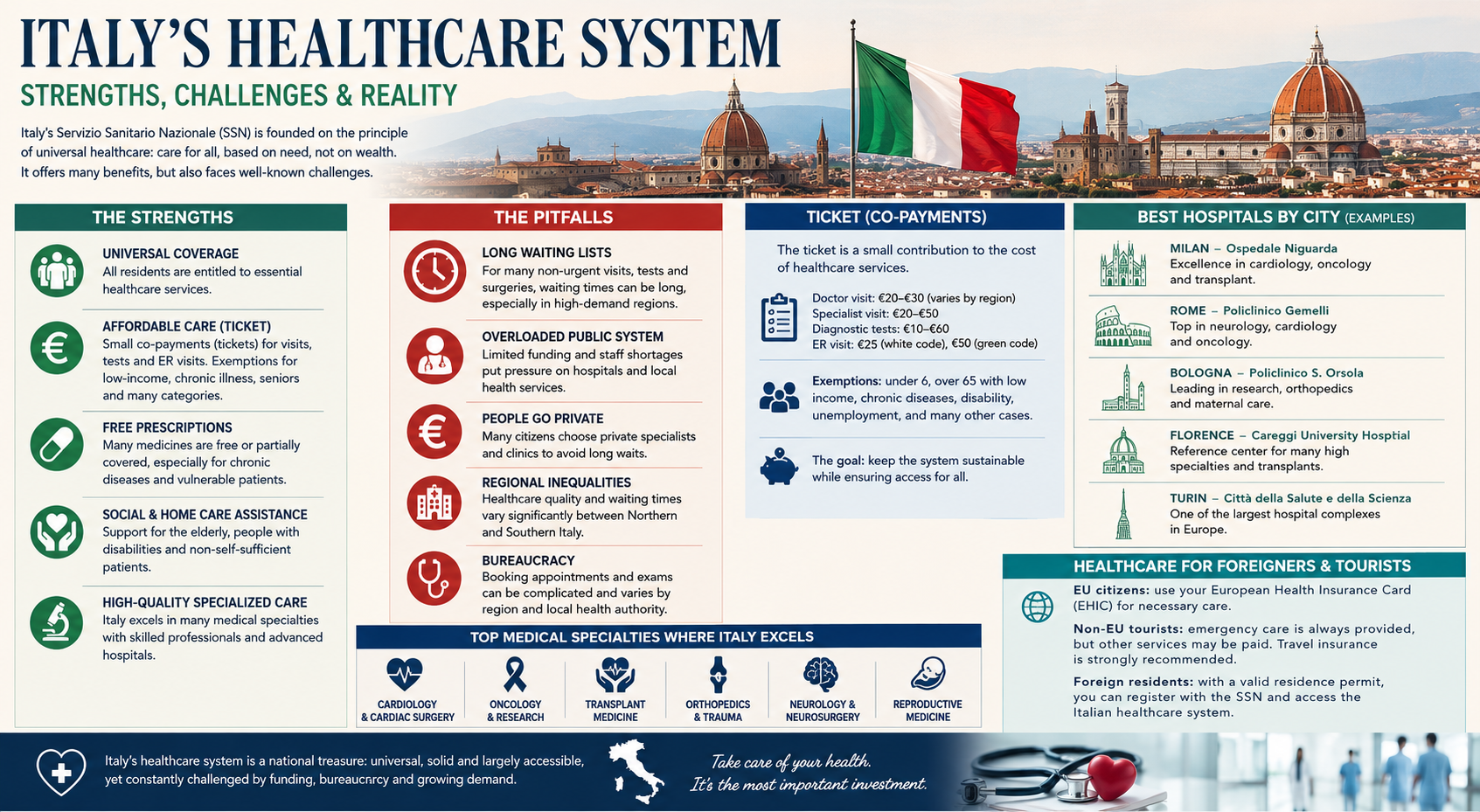
 Italy’s healthcare system is one of the country’s most important public institutions. The Servizio Sanitario Nazionale (SSN) was created in 1978 with a fundamental principle: healthcare should be available to everyone, not only to people who can afford private insurance or expensive medical treatment.
More than four decades later, the Italian system remains a complicated mixture of excellent medicine, highly trained doctors, advanced hospitals and relatively low costs for patients, alongside serious problems involving waiting lists, bureaucracy, regional inequalities and shortages of medical personnel.
For many Italians, the experience of the SSN can therefore be contradictory. A patient can receive extraordinarily sophisticated surgery in a public hospital at little or no direct cost, while waiting months for a specialist appointment. Someone may be entitled to a diagnostic examination through the public system but discover that the first available appointment is so far away that paying a private doctor becomes the only practical option.
This contradiction is at the heart of the debate over Italian healthcare.
How the Italian healthcare system works
The SSN is a predominantly tax-funded system. Healthcare is administered through the national government but is largely organized and delivered at the regional level.
This means that healthcare in Italy is not completely uniform. Lombardia, Emilia-Romagna, Toscana, Veneto, Lazio, Campania, Sicilia and the other regions operate their own regional health systems within the national framework.
The national government establishes the Livelli Essenziali di Assistenza (LEA), or Essential Levels of Care. These represent the healthcare services that the SSN is required to guarantee throughout Italy.
In theory, therefore, an Italian citizen should have access to essential healthcare regardless of where he or she lives.
In practice, however, the quality and accessibility of services can vary considerably between regions.
This regional organization has produced some of Italy’s greatest healthcare successes, but it has also contributed to a significant North-South divide.
Northern and central regions generally have a greater concentration of highly specialized hospitals, university medical centers and advanced services. This contributes to sanità di mobilità, or healthcare migration, in which patients travel from one region to another to receive treatment.
The great advantage: healthcare does not normally depend on your wealth
One of the most important strengths of the Italian system is that a person does not normally have to purchase private health insurance to have access to essential medical treatment.
An Italian resident can have a family doctor, receive hospital treatment, undergo surgery and access many diagnostic and specialist services through the SSN.
For serious medical conditions, this can be enormously valuable.
A major operation performed in a public or accredited hospital can cost the patient little compared with the enormous bills that can arise in countries where healthcare is predominantly insurance-based.
Hospital treatment covered by the SSN generally does not involve the same type of direct patient charges associated with private healthcare. The Ministry of Health also notes that hospital treatments are generally excluded from the specialist-care ticket system.
This is particularly important for older people and patients with chronic diseases.
What is the “ticket”?
The word ticket can be confusing to foreigners.
It does not mean that Italians pay for their entire healthcare. It is a co-payment for certain services provided through the SSN.
The ticket can apply to:
- Specialist consultations
- Diagnostic imaging
- Laboratory examinations
- Certain outpatient treatments
- Some non-urgent emergency-room visits
- Certain pharmaceutical expenses, depending on regional rules
For outpatient specialist services, the national framework provides a maximum ticket of €36.15 per prescription, subject to exemptions and regional rules.
A patient who needs a specialist examination may therefore pay a relatively modest amount through the SSN rather than the full private-market price.
But there is an important catch.
The cheap appointment may not be available soon enough.
That is where one of the biggest problems in Italian healthcare begins.
Waiting lists: perhaps the biggest weakness
Long waiting lists have become one of the most controversial issues in Italian healthcare.
The problem is not necessarily that Italy lacks doctors capable of providing excellent treatment. The problem is often access to those doctors and services at the moment they are needed.
A patient may receive a prescription for an orthopedic examination, cardiology consultation, ophthalmology appointment, MRI or ultrasound and then discover that the first available SSN appointment is several months away.
The problem has become sufficiently serious that the government approved a new National Waiting List Management Plan for 2026–2028, intended to improve monitoring, unify booking systems, strengthen patient-protection procedures and improve the management of demand.
The statistics demonstrate why the issue matters.
According to ISTAT, the percentage of Italians reporting unmet medical needs increased from 7.6% in 2023 to 9.9% in 2024. ISTAT also reported that hospital beds in high-care wards declined from 3.2 per 10,000 inhabitants in 2022 to 2.9 in 2023, while the proportion of hospitalizations taking place outside a patient’s home region increased.
In an earlier ISTAT analysis, 4.5% of the population reported unmet medical needs because of long waiting lists in 2023, compared with 2.8% in 2019.
The problem is also highly visible to the public. An Ipsos survey conducted in 2025 found that 66% of respondents identified access to treatment and/or long waiting times as one of the biggest problems facing Italian healthcare.
The private specialist solution
This has created an unofficial two-speed system.
There is the SSN route, which is less expensive but can involve long waits.
Then there is the private route, in which the patient pays the doctor directly and can frequently obtain an appointment much faster.
This is particularly common for specialists such as:
- Orthopedists
- Dermatologists
- Ophthalmologists
- Cardiologists
- Neurologists
- Gastroenterologists
- Urologists
- Gynecologists
- Endocrinologists
The result is frustrating for patients.
A person may have a legitimate prescription for a specialist consultation through the public system, but after discovering that the appointment is six months away, decide to pay €100–€200 or more for a private consultation.
This is one of the system’s greatest contradictions: healthcare may be theoretically universal, but timely access is not always universal.
For people with limited incomes, this can be particularly difficult.
The result can be delayed diagnosis, delayed follow-up or patients simply deciding to live with symptoms until they become more serious.
Private healthcare is not completely separate from the public system
Italy also has a large network of private facilities accredited by the SSN.
This is an important distinction.
A private hospital or clinic may operate within the national healthcare system and provide services covered by the SSN. The Ministry of Health explicitly recognizes specialist services delivered through both public facilities and private facilities accredited by the SSN.
Therefore, “private hospital” does not necessarily mean “completely private treatment.”
Italy’s healthcare structure is better understood as a mixture of:
Public hospitals + university hospitals + IRCCS research hospitals + private accredited hospitals + completely private providers.
The last category is the one that normally requires the patient to pay the full cost.
The intramoenia system
Another particularly Italian concept is intramoenia.
In simple terms, some doctors who work within the public hospital system can also provide private consultations within the hospital or affiliated structures outside their ordinary SSN activity.
This can give patients access to the same specialist more quickly, but at a private fee.
For the patient, this can be an attractive compromise: rather than waiting months for a public appointment, he or she pays for a private consultation with a doctor who may also work within the public hospital.
Critics argue that this illustrates the structural weakness of the system: people who can afford to pay can sometimes move ahead of those who cannot.
Free or heavily subsidized medicines
One of the major advantages of the Italian system is pharmaceutical assistance.
The situation is more complicated than simply saying that “medicines are free.”
Italy abolished a nationwide pharmaceutical co-payment in 2000, but many regions subsequently introduced their own forms of participation for certain Class A medicines.
Medicines in Class A are generally those considered essential and are normally reimbursed by the SSN, although regional co-payments and specific rules may apply.
Class C medicines, by contrast, are generally paid entirely by the patient.
There is another important issue involving brand-name medicines.
When an equivalent generic medicine is available, a patient who specifically chooses the branded product may have to pay the difference between the reimbursed reference price and the price of the medicine chosen.
For people who take several medications every day, however, the SSN can provide enormous financial assistance.
Exemptions from the ticket
The Italian system contains a substantial network of exemptions.
Patients may qualify for exemption because of:
- Age and income
- Certain chronic diseases
- Rare diseases
- Disability
- Pregnancy
- Certain cancer-screening programs
- Other specific medical or social circumstances
The Ministry of Health states that exemptions based on income can provide total or partial exemption from healthcare co-payments.
People with recognized disabilities can also receive exemptions for some or all appropriate specialist outpatient services, depending on their disability category.
Patients with qualifying chronic illnesses can receive exemption from the ticket for specific services required to monitor the disease and prevent complications.
This is an important benefit that foreigners unfamiliar with the Italian system can easily overlook.
Prevention is another major advantage
The SSN also supports a number of preventive programs.
Some screening examinations are provided without a ticket when they form part of organized regional prevention programs.
Examples can include:
- Mammography screening
- Cervical cancer screening
- Colorectal cancer screening
- Vaccination programs
The Ministry of Health specifically identifies organized early-diagnosis and prevention programs among services for which no ticket is charged.
This demonstrates an important characteristic of the Italian system: it is not simply designed to treat people after they become seriously ill. It also has a strong public-health component.
Italy’s biggest healthcare problem: inequality of access
Italy’s healthcare system is often described as universal, but the word universal needs qualification.
The right to healthcare is broadly universal.
The ability to obtain a specialist at the desired time is not.
The ability to choose a particular doctor is not.
The ability to travel to another region for treatment depends partly on money and mobility.
And the quality and availability of services vary considerably geographically.
This creates a paradox.
A patient living in Milan, Bologna, Florence or Rome may have access to several major specialist centers within relatively easy reach.
A patient living in a smaller town or in some parts of southern Italy may have fewer choices and may need to travel considerably farther.
The shortage of doctors and nurses
Another problem is personnel.
Italy has a large number of physicians, but this does not mean that every medical specialty has enough doctors available to meet demand.
The shortage of nurses is particularly important.
ISTAT reported that the number of nurses and midwives increased from 5.6 to 6.8 per 1,000 inhabitants between 2014 and 2022, but nevertheless described the number of nurses as insufficient, particularly because demand is increasing as the population ages.
General practitioners are also under pressure.
ISTAT reported that the percentage of family doctors responsible for more than the regulatory threshold of 1,500 patients rose to 51.7% in 2023, compared with 28% in 2014.
This means that even the traditional Italian family doctor model is under increasing pressure.
Bureaucracy: prescriptions, referrals and CUP
For someone accustomed to a private healthcare system, the Italian system can seem bureaucratic.
A typical specialist visit may require:
- Consultation with the family doctor
- A prescription or electronic referral
- Checking whether the service requires a ticket
- Booking through the regional CUP — Centro Unico di Prenotazione
- Paying the ticket if applicable
- Attending the appointment
- Returning to the doctor with the results
The official system requires specialist services to be prescribed and booked through the appropriate channels, with the CUP serving as the principal booking mechanism.
This system provides structure and helps control inappropriate demand, but it can also be frustrating.
Emergency rooms: excellent for emergencies, problematic for everything else
Italy’s emergency departments provide another example of the system’s strengths and weaknesses.
For a genuine emergency — heart attack, stroke, major trauma, severe respiratory problems, serious bleeding and similar conditions — the hospital system can provide sophisticated emergency medicine.
The problem arises when people use the emergency department because they cannot obtain timely access to a family doctor or specialist.
This contributes to overcrowding.
Italy also has a ticket for certain emergency-room cases classified as non-urgent and discharged without hospitalization. The exact rules and amounts can vary regionally.
The basic lesson is simple:
The emergency room should be used for emergencies, not as a substitute for a specialist appointment.
Italian hospitals can be exceptionally good
It would be unfair to discuss Italian healthcare only in terms of its problems.
Italy has hospitals capable of providing world-class treatment.
The country’s strengths are particularly evident in complex medicine, university hospitals, cancer treatment, cardiovascular medicine, transplantation, neurosurgery, orthopedics and other highly specialized fields.
AGENAS operates the Programma Nazionale Esiti (PNE), which compares healthcare outcomes and processes across public and accredited hospitals. Importantly, AGENAS itself warns that PNE is not intended to create a simple league table of “best hospitals”; it is designed to evaluate effectiveness, safety, efficiency and quality and to identify opportunities for improvement.
Consequently, any list of “best hospitals” should be treated as a guide rather than an absolute ranking.
Some of Italy’s leading hospitals by city
For readers looking for major centers of excellence, the following hospitals are among the most prominent names in Italy.
Milan
Grande Ospedale Metropolitano Niguarda
Niguarda is one of Italy’s leading public hospitals and a major referral center for complex medicine.
The 2026 edition of Newsweek’s World’s Best Hospitals again recognized Niguarda as Italy’s leading public hospital. It was ranked 43rd globally.
Its major strengths include emergency medicine, cardiovascular medicine, neurology, neurosurgery, oncology, gastroenterology, obstetrics and gynecology.
Ospedale San Raffaele
San Raffaele is a major private hospital within the Gruppo San Donato system and is particularly associated with complex medicine, research, neuroscience, cardiovascular medicine, oncology and transplantation.
Humanitas — Rozzano
Just outside Milan, Humanitas is one of Italy’s major private research hospitals, particularly strong in oncology, gastroenterology, cardiovascular medicine, surgery and research.
The 2025 Newsweek ranking placed Niguarda first among Italian hospitals, followed by Gemelli, San Raffaele and Humanitas.
Rome
Policlinico Universitario Agostino Gemelli
Gemelli is one of Italy’s most internationally recognized hospitals and a major university medical center.
It has extensive expertise in oncology, cardiovascular medicine, surgery, neuroscience, women’s health, transplantation and complex medical care.
In the 2025 Newsweek ranking, Gemelli was Italy’s second-highest hospital and 44th worldwide.
Policlinico Tor Vergata
Another important university hospital in Rome, with numerous specialist departments and a significant role in teaching and research.
Azienda Ospedaliera Sant’Andrea
Sant’Andrea is another major university hospital and was among the Italian hospitals included in Newsweek’s 2025 global ranking.
Bologna
Policlinico Sant’Orsola-Malpighi
Sant’Orsola is one of Italy’s great university hospitals and a major referral center for complex medicine.
It is particularly important for transplantation, cardiovascular medicine, oncology, surgery, rare diseases and women’s health.
Newsweek ranked Sant’Orsola fifth among Italian hospitals in 2025 and 73rd worldwide.
Florence
Azienda Ospedaliero-Universitaria Careggi
Careggi is Tuscany’s principal university hospital and one of the country’s most important centers for complex medical treatment.
It has extensive capabilities in oncology, surgery, cardiovascular medicine, transplantation, neurology and other specialties.
It was ranked among Italy’s top hospitals in the 2025 Newsweek list.
Pisa
Azienda Ospedaliero-Universitaria Pisana
Pisa is an important center for university medicine and specialist treatment in Tuscany.
The Pisa university hospital network is particularly relevant for transplantation, oncology, cardiovascular medicine, neurosurgery and complex surgery.
Pisa is also one of Tuscany’s major destinations for patients referred from other parts of the region.
Padua
Azienda Ospedale-Università di Padova
Padua has a long medical and university tradition and is one of Italy’s leading centers for complex care and medical research.
It is particularly significant in transplantation, pediatric medicine, oncology, cardiovascular medicine and rare diseases.
Newsweek placed Padua among Italy’s top ten hospitals in 2025.
Verona
Ospedale Borgo Trento — Azienda Ospedaliera Universitaria Integrata Verona
Borgo Trento is one of northern Italy’s major university hospitals.
It has strong capabilities across surgery, oncology, cardiovascular medicine, transplantation and other highly specialized fields.
It ranked among the top Italian hospitals in the 2025 Newsweek list.
Bergamo
Ospedale Papa Giovanni XXIII
Papa Giovanni XXIII is a major high-complexity hospital and one of Lombardy’s most important referral centers.
It is particularly relevant for transplantation, oncology, cardiovascular medicine and complex surgery.
It was ranked sixth among Italian hospitals in Newsweek’s 2025 ranking.
Turin
Molinette — Città della Salute e della Scienza
Molinette is one of Piedmont’s major university medical centers and an important referral hospital for complex medicine.
It is particularly important in transplantation, oncology, cardiovascular medicine and specialized surgery.
Naples
Azienda Ospedaliera dei Colli
The Azienda Ospedaliera dei Colli represents one of the important centers of high-complexity care in Naples.
Southern Italy has fewer hospitals that attract large numbers of patients from outside their home regions, which is one reason for the persistent phenomenon of migration toward northern and central Italy.
San Giovanni Rotondo
Casa Sollievo della Sofferenza
Located in Puglia, Casa Sollievo della Sofferenza is one of the major specialist hospitals in southern Italy and an important exception to the concentration of high-complexity healthcare in the North and Center.
The best medical specialties in Italy
Italy has particularly strong traditions in several medical fields.
Oncology
Italy has an extensive network of oncology centers, university hospitals and cancer institutes.
Large centers in Milan, Rome, Bologna, Turin, Florence and other cities provide chemotherapy, radiotherapy, surgery, immunotherapy, molecular diagnostics and clinical trials.
Cardiology and cardiac surgery
Cardiology is another major strength.
Niguarda, San Raffaele, Gemelli, Sant’Orsola, Padua, Verona and other university hospitals have substantial expertise in interventional cardiology, cardiac surgery and complex cardiovascular disease.
Neurosurgery and neurology
Italy has internationally respected centers for brain and nervous-system disorders.
Niguarda, for example, received particularly strong recognition for neurosurgery and neurology in Newsweek’s specialized-hospital analysis.
Transplantation
Italian transplant centers perform kidney, liver, heart, lung and other transplants.
The system benefits from a national organ-donation and transplantation network, highly specialized surgical teams and major university hospitals.
Orthopedics
Italy has numerous strong orthopedic centers.
The specialty is particularly important in an aging population, where hip replacement, knee replacement, spinal surgery and fracture treatment are increasingly common.
Gastroenterology
Gastroenterology is another area where Italian hospitals perform strongly, particularly in advanced endoscopy, inflammatory bowel disease, liver disease and gastrointestinal oncology.
Niguarda was among the Italian hospitals receiving international recognition in this specialty.
Women’s health
Obstetrics and gynecology are also major areas of expertise.
Niguarda, for example, ranked particularly highly internationally in obstetrics and gynecology in Newsweek’s specialized-hospital analysis.
Where Italy struggles most
The biggest weaknesses can be summarized relatively simply.
Waiting lists are probably the most visible problem.
Staff shortages create pressure on hospitals and primary care.
Regional inequality means that the quality and availability of services can vary substantially.
Bureaucracy can make accessing care frustrating.
Private healthcare has become increasingly important for people who cannot wait.
Healthcare migration forces many patients to travel hundreds of kilometers for specialized treatment.
And there is an increasingly important problem of people giving up on healthcare altogether.
When a patient cannot afford a private consultation and cannot obtain a public appointment within a reasonable period, the theoretical right to healthcare becomes much less meaningful.
Why people still defend the Italian system
Despite all these problems, many Italians remain strongly attached to the SSN.
The reason is straightforward.
When something serious happens, the system can provide treatment regardless of whether the patient has a large bank account.
A patient suffering a heart attack does not need to first determine whether he has enough money for a cardiac procedure.
A person diagnosed with cancer can enter a complex treatment pathway without facing the kind of enormous hospital bills associated with completely private healthcare systems.
People with chronic diseases may qualify for ticket exemptions and ongoing monitoring.
Certain essential medicines are reimbursed.
Preventive screening programs are available.
Public and accredited hospitals contain some of the best doctors and medical teams in Europe.
And Italy continues to produce excellent medical researchers, surgeons, specialists and healthcare professionals.
The fundamental problem is therefore not that Italian healthcare is universally bad.
It is that excellent healthcare is not always equally accessible, quickly accessible or geographically accessible.
How to navigate the Italian healthcare system more effectively
For residents and foreigners living in Italy, understanding the system can make a substantial difference.
First, establish a relationship with a medico di medicina generale, the family doctor.
Second, ask whether a specialist service can be obtained through the SSN and whether an exemption applies.
Third, learn how your regional CUP works.
Fourth, when receiving a prescription, check the urgency classification. Some prescriptions are assigned different priority levels depending on clinical need.
Fifth, if the waiting time appears unreasonable, ask the CUP or health authority about alternative facilities, including accredited providers.
Sixth, consider checking hospitals outside your immediate city when the condition is serious or highly specialized.
Finally, remember that hospital quality should be judged by the specific specialty and procedure, not simply by the reputation of the hospital as a whole.
A hospital may be exceptional in cardiac surgery but less prominent in another field.
The future of Italian healthcare
Italy faces a difficult demographic challenge.
The country has an aging population, and older people naturally require more healthcare, more medications, more specialist consultations and more chronic-disease management.
At the same time, Italy needs to recruit and retain doctors, nurses and other healthcare professionals.
The government has responded with measures targeting waiting lists, including the 2026–2028 national plan, but solving the problem will require more than simply creating additional appointments. The government itself has emphasized appropriate prescribing, unified booking systems, monitoring and transparency as part of the strategy.
Digital healthcare and telemedicine may also help, particularly for follow-up appointments and patients living far from major medical centers.
But technology alone will not solve the underlying problem.
Italy ultimately needs enough doctors, nurses, hospital beds, diagnostic equipment and operating-room capacity to meet demand.
The verdict: an excellent system with a serious access problem
The Italian healthcare system is neither the disaster sometimes portrayed by frustrated patients nor the flawless universal system sometimes described in political debates.
It is a high-quality public healthcare system under significant pressure.
Its greatest strength is its fundamental principle: essential healthcare should not depend entirely on personal wealth.
Its greatest weakness is that access to that healthcare can be slow.
A patient may receive excellent surgery almost entirely covered by the SSN but wait months for a specialist consultation beforehand. A prescription may entitle someone to an examination at a relatively low cost, but the patient may ultimately pay privately because the public appointment is too far in the future.
This is the central contradiction of Italian healthcare.
The quality of the medicine can be excellent. The price can be remarkably low. The problem is getting through the door quickly enough.
Italy therefore does not necessarily need to choose between public and private healthcare. The challenge is to make the public system sufficiently efficient that private care becomes a choice rather than a necessity.
If Italy can reduce waiting lists, address shortages of nurses and doctors, improve regional equality and simplify access, the SSN could remain one of the country’s greatest social achievements for decades to come.
Healthcare for Foreigners and Tourists in Italy
Foreign visitors can also access healthcare in Italy, but the rules depend heavily on their country of residence, nationality, length of stay and type of healthcare coverage. Tourists from EU countries, Iceland, Liechtenstein, Norway and Switzerland should bring their European Health Insurance Card (EHIC/TEAM). During a temporary stay, the card provides access to medically necessary healthcare through public hospitals and healthcare providers accredited by the Italian SSN under broadly the same conditions as Italian patients. A ticket or other applicable co-payment may still be charged. The EHIC is intended for necessary care during a temporary stay; it does not cover planned medical treatment or treatment received from completely private, non-contracted providers.
For tourists from countries outside the EU/EEA and Switzerland, the situation is different. A short-term visitor, such as a tourist staying for up to 90 days, generally does not automatically become entitled to free treatment through the Italian SSN. Foreign visitors may have to pay the applicable regional charges for healthcare received in Italy, including urgent and other medical services. For this reason, comprehensive travel health insurance is strongly recommended for non-EU visitors, particularly because private medical consultations, diagnostic examinations and hospitalization can become expensive.
Emergency treatment remains available to people who need it, regardless of whether they are tourists or residents. Italy’s public hospitals and emergency departments provide emergency care, but the financial arrangements can differ depending on the visitor’s insurance and country of origin. Visitors should therefore carry their passport or identification, insurance information and, where applicable, their EHIC. It is also wise to keep all medical reports, prescriptions, invoices and receipts because these may be required when seeking reimbursement from an insurance company or foreign healthcare system.
Tourists should also understand the difference between a public or SSN-accredited facility and a completely private clinic. An EU visitor with an EHIC can generally receive medically necessary treatment directly through the public system or an SSN-accredited provider, while a private doctor or clinic outside the SSN network can charge the full private fee.
Italy also has tourist medical services, or guardia medica turistica, in some heavily visited areas, particularly during the summer. These services are specifically designed to provide medical assistance to tourists but can charge fees even to patients who hold an EHIC. The exact charges are established regionally.
Foreigners who actually live in Italy rather than simply visit have different rights. EU citizens who stay for less than 90 days can generally use their EHIC, while EU citizens who establish themselves in Italy may qualify for registration with the Italian SSN depending on their circumstances. Non-EU citizens with a valid residence permit may also be able to register with the SSN, either obligatorily or voluntarily depending on the reason for their stay. Registration can provide access to the Italian healthcare system, including the possibility of choosing a family doctor.
Foreigners who deliberately travel to Italy for planned medical treatment are subject to different rules. EU patients may, under certain circumstances, obtain planned treatment in Italy through the cross-border healthcare system, but prior authorization may be required, particularly for hospital treatment and highly specialized care. The EHIC should not be confused with authorization for medical tourism or planned treatment.
For tourists, therefore, the basic advice is straightforward: EU visitors should carry their EHIC; non-EU visitors should have comprehensive travel medical insurance; everyone should know whether the facility they are using is public, SSN-accredited or completely private. Italy offers excellent emergency and specialist medicine, but visitors should not assume that every medical service will automatically be free.