
 In late October, flower stalls across Italy fill with chrysanthemums. Families make plans to visit cemeteries, churches announce special services, and travelers discover that November 1 and November 2 have different effects on their itinerary. These two days are closely connected, but they are not the same holiday.
All Saints’ Day, called Ognissanti or Tutti i Santi, falls on November 1 and is a national public holiday. All Souls’ Day, the Commemorazione dei Defunti, follows on November 2. It is a day of remembrance, but it is generally a normal working day. Understanding that distinction will help you plan around closures while appreciating why the first days of November matter to many Italian families.
What Is the Difference Between the Two Days?
In the Catholic calendar, All Saints’ Day honors the saints, including those who have no individual feast day. Churches celebrate Mass on November 1, and many Italians have the day off work.
All Souls’ Day is dedicated to remembering and praying for people who have died. Families may attend Mass, visit graves, bring flowers, and spend time recalling relatives and friends. Although November 2 has no nationwide public-holiday status, its observance is visible well beyond church services. In many communities, cemetery visits begin before November 1 and continue through the following days.
You do not need to take part in the religious observances to notice the change in atmosphere. A neighborhood florist may be busy, traffic may build near a cemetery, and families who live elsewhere may return to their hometown. The mood is usually quiet and personal.
Cemetery Visits, Flowers and Candles
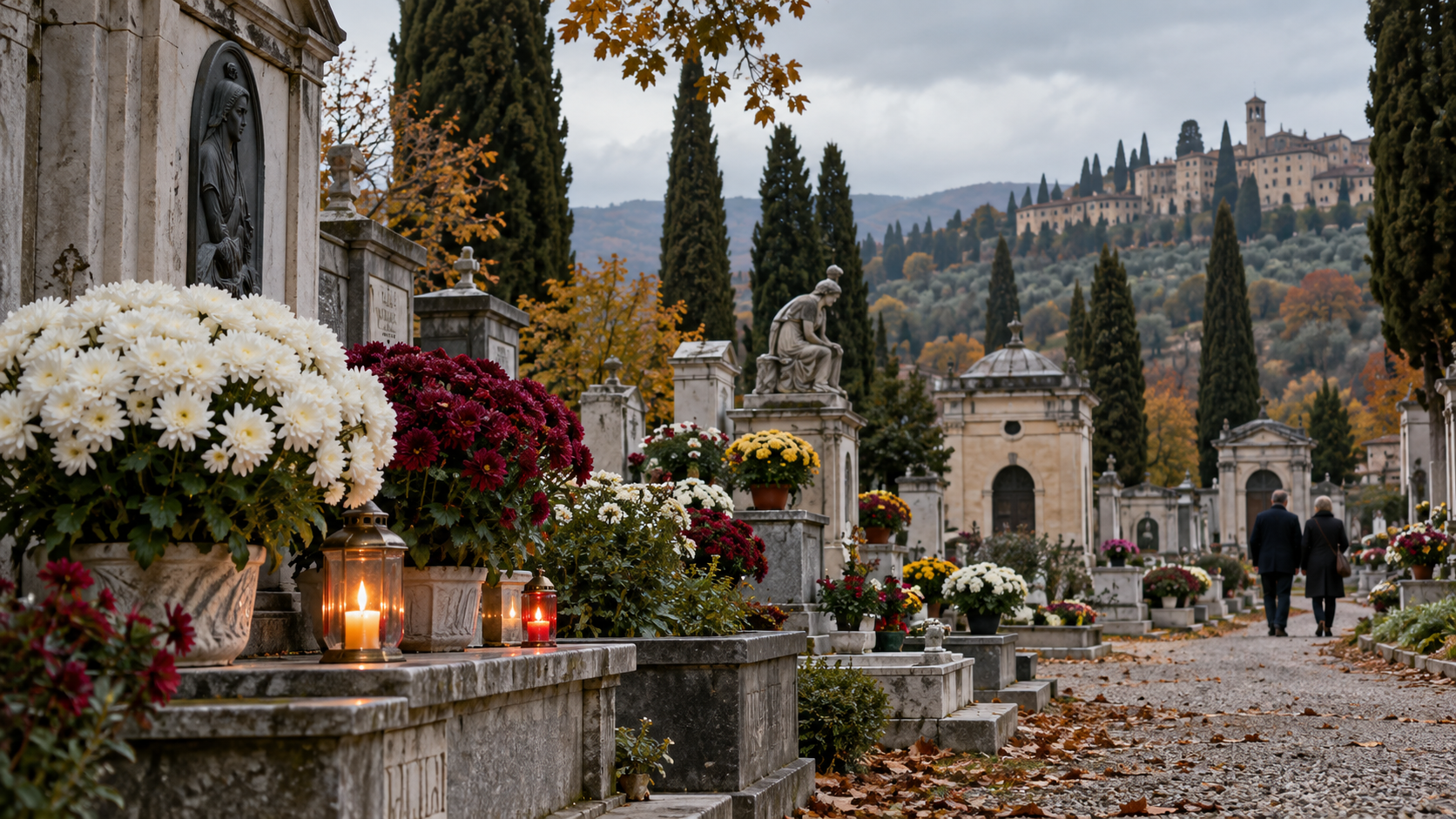
For many families, the central custom is a visit to the cemetery. They clean family graves, replace flowers, light votive candles where permitted, and pause to remember the people buried there. Some go together across generations; others prefer a private visit.
Chrysanthemums are the flowers most strongly associated with remembrance in Italy. Their abundance at flower shops around this time does not mean the shops are preparing for a cheerful autumn festival. If you are buying flowers as a gift for an Italian host, choose another variety unless you know the recipient’s preference.
Cemeteries can become much busier than usual. Municipalities sometimes extend opening hours or change access arrangements, and local authorities may add buses or restrict vehicle entry. These measures differ by city and year. If you plan to visit a cemetery, check its municipal notice shortly before going, especially if you need step-free access or intend to arrive by car.
Visitors are generally welcome in public cemeteries, including those with significant art and architecture, but November 1–2 is first and foremost a time for families. Speak quietly, keep clear of private gatherings, and avoid photographing mourners or individual graves without permission.
Masses and Church Visits
Parishes commonly celebrate Mass for All Saints’ Day and hold services connected with the commemoration of the dead. Times vary, and larger churches may have several services. A church that is normally open for sightseeing may limit tourist access during Mass or alter its visiting hours.
If you wish to attend, consult the parish or cathedral’s current schedule and arrive a little early. If your purpose is sightseeing, check the visitor timetable before making the church the fixed point of your day. A closed tourist entrance does not necessarily mean a religious service has been canceled; the two schedules serve different purposes.
The pairing of the dates is meaningful: November 1 celebrates the saints, while November 2 turns attention to the departed. In everyday family practice, the visits and memories can extend across both days rather than fitting neatly into one calendar square.
What Closes on November 1?
Because All Saints’ Day is a national holiday, expect government offices, many banks, and schools to be closed. Some independent shops and services also close or shorten their hours. November 2 does not automatically bring the same nationwide closures.
Tourist businesses require a separate check. Restaurants in busy destinations may open, but a family-run place might close for the holiday. Museums, archaeological sites, and attractions each set their own calendars; some open on November 1, while others change their hours. A museum’s regular Monday closing can also affect November 2, independently of All Souls’ Day.
Do not assume that an entire city will shut down. Equally, do not plan an appointment at a public office, a specific museum visit, or a meal at one particular restaurant without confirming its hours. Book any attraction that matters to your itinerary through its official site and recheck the notice near your visit.
Trains, Buses and Driving
Long-distance trains continue to connect Italian cities over the holiday, but you should search the operator’s timetable for your exact date and route. Regional trains, local buses, metro services, and ferries can follow different holiday or Sunday patterns. In 2026, November 1 falls on a Sunday and November 2 on a Monday, making a careful check of both days especially useful.
Cemetery routes deserve particular attention. A city may run extra buses to its main cemeteries even while other local services follow a holiday timetable. Rome, for example, has previously announced additional cemetery connections for this period. That is an example of how local plans can work, not a timetable to rely on for a future trip.
If you are driving, allow extra time near cemetery entrances and watch for temporary parking or traffic restrictions. The busiest approach roads may be far from the tourist center. Travelers transferring between a station, hotel, and smaller town should also confirm the last local bus of the day rather than assuming that a train arrival guarantees an onward connection.
For the broader mechanics of rail travel, including regional services and ticket rules, see Italia Mia’s guide to traveling by train in Italy.
Regional Customs: One Calendar, Many Ways to Remember
The cemetery visit is familiar across Italy, but local food and family customs give the period different textures.
In Sicily, November 2 is widely known as the Festa dei Morti. Traditions associated with the day include sweets given to children, particularly colorful pupi di zucchero—figures made from sugar—and frutta martorana, almond-paste sweets shaped like fruit. The Regione Siciliana describes the occasion as a way of passing family memory between generations. You may see these sweets in pastry shops and markets before the date itself, though customs vary from household to household.
In a city such as Milan, the commemoration is especially visible in the arrangements around its cemeteries. The municipality publishes seasonal opening and access information as the dates approach. This practical attention reflects how many residents make time for a visit, even when November 2 falls on an ordinary workday.
Smaller towns may have their own parish services and familiar family routines without staging an event for visitors. Ask locally if you want to understand what is happening, and resist the temptation to treat every observance as a festival. For a wider view of how customs vary by place and family, read Italia Mia’s introduction to Italian cultural traditions and its guide to everyday Italian habits.
A Sensible Two-Day Itinerary
Keep November 1 flexible. Reserve a timed attraction only after checking that it will open, choose a restaurant whose holiday hours are confirmed, and leave room for a walk through the city. If you are traveling between towns, check both the rail service and the final local connection.
On November 2, many workplaces resume their normal routine, but individual closures still matter. Look at the museum’s weekly schedule, the church’s service times, and any municipal transport announcement. A Monday closure at a museum is a Monday closure, even though All Souls’ Day itself is not a national holiday.
Pack for changeable autumn weather and shorter daylight hours. If these dates are part of a longer trip, Italia Mia’s November and December travel guide will help you plan the rest of the season.
All Saints’ and All Souls’ Days ask for a little more attention to opening hours and transport. They also offer a glimpse of an Italian tradition that remains rooted in family, faith, and remembrance. Give the people observing it their space, and you can travel thoughtfully through both days.
External Sources
- Italia.it: Public holidays in Italy — the official tourism portal lists November 1 as a national holiday. Italia.it
- The Holy See: All Saints and All Souls — explains the relationship between the two observances. vatican.va
- Regione Siciliana: The Festa dei Morti — documents Sicilian remembrance and sugar-figure traditions. Regione Siciliana
- Comune di Milano: Commemoration of the Departed — an example of the local cemetery notices travelers should check each year. comune.milano.it
- Roma Capitale: November 1–2 transport notice — a past example of holiday schedules and additional cemetery buses, not a 2026 schedule.