

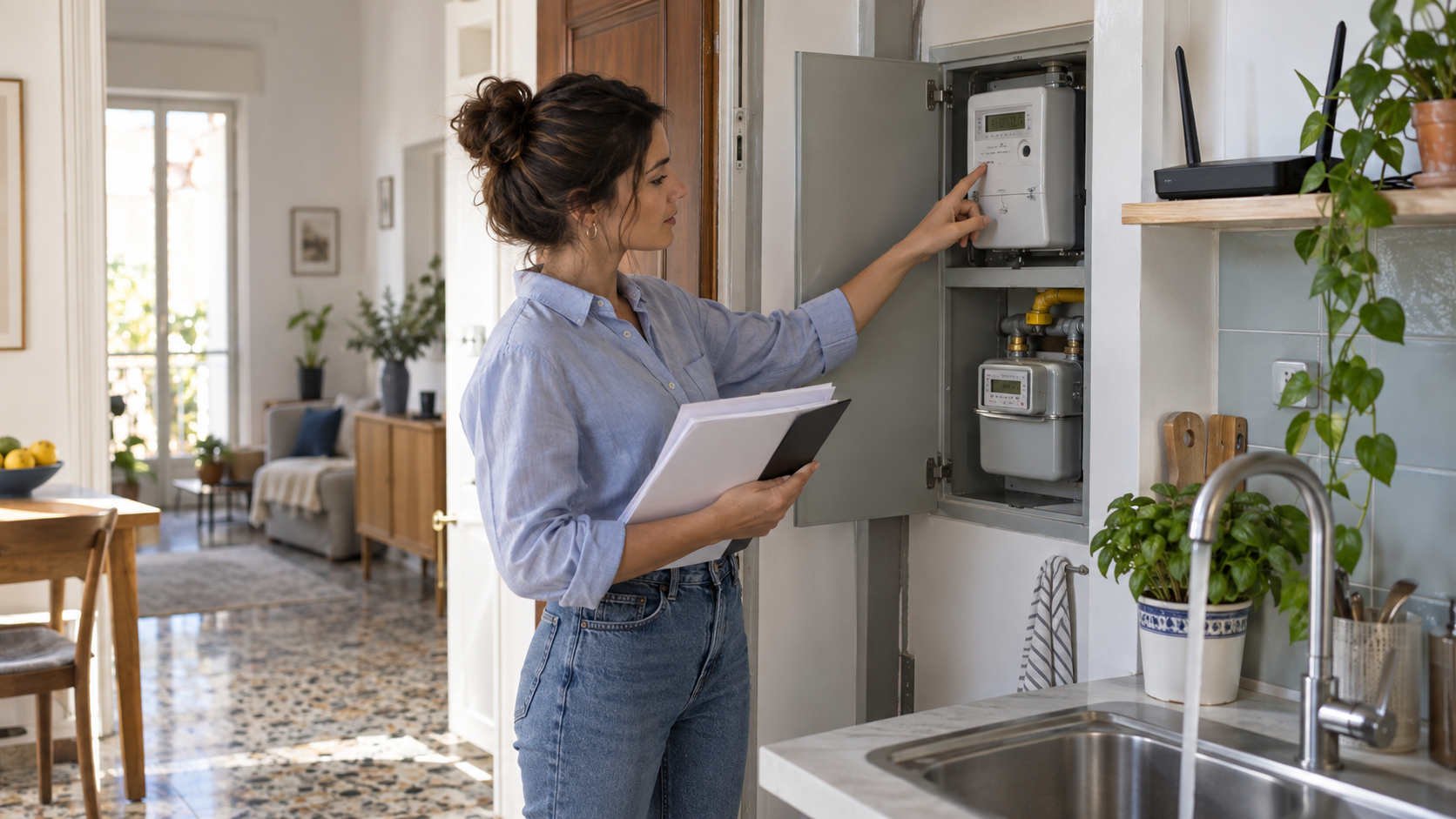
 Moving into an Italian home involves more than collecting the keys. Electricity, gas, water and internet may already be working, may have been disconnected or may never have been connected at all. Each situation requires a different procedure, and using the wrong Italian term can cause unnecessary delays.
The process is usually manageable once you identify the meters, obtain the previous bills and collect the required documents. Renters should clarify responsibilities with the landlord before moving in, while buyers should examine every utility during the property handover.
The Four Main Utility Procedures
Before contacting a supplier, determine which of the following procedures applies.
Voltura — change of account holder
A voltura transfers an active utility contract from the previous account holder to the new occupant. Electricity, gas or water continues without interruption. This is normally the simplest solution when moving into an occupied or recently vacated property whose utilities remain active.
Subentro — reactivation of a disconnected supply
A subentro is required when the meter exists but the previous contract has been closed and the supply has been disconnected. The new resident signs a new contract and asks for the existing meter to be reactivated.
Prima attivazione — first activation
This applies when a meter has already been installed but has never been activated. It is common in newly constructed or extensively renovated properties.
Allacciamento — new physical connection
An allacciamento is needed when the property is not yet connected to the electricity, gas or water network. The local distributor or water operator must inspect the site, prepare an estimate and complete the physical connection. This can take considerably longer than a voltura or subentro.
If you are still looking for a home, our guides to renting an apartment in Italy and buying property in Italy as a foreigner explain other checks that should be completed before signing.
Documents You Will Usually Need
Requirements vary slightly between companies, but electricity, gas, water and internet providers commonly request:
- A valid passport or identity card
- An Italian codice fiscale
- The full address of the property, including apartment number
- A telephone number and email address
- Proof that you have the right to occupy the property
- A registered rental contract, deed of ownership or other occupancy declaration
- The previous customer’s name, if available
- Meter identification numbers
- A recent meter reading
- Italian or SEPA bank details if paying by direct debit
Electricity suppliers use a POD code, normally beginning with “IT,” to identify the supply point. Gas suppliers use a PDR code, generally consisting of 14 digits. These codes identify the connection, not the customer, and normally remain the same when the property changes hands.
The easiest place to find the POD or PDR is on a previous bill. If no bill is available, photograph the meter and record its serial number before contacting the supplier.
Foreign residents who have not yet obtained their tax number should begin with our guide to getting a codice fiscale in Italy. Although some companies may accept a foreign bank account within the SEPA area, an Italian bank account can make direct debits and refunds easier to manage.
Setting Up Electricity
Electricity is supplied through two different types of company. The seller, or venditore, manages your contract and bills. The distributor, or distributore, owns the local network and meter and handles technical work.
For a normal voltura, subentro or supplier change, you generally contact the seller. For a new connection, major increase in available power or technical meter problem, the distributor will become involved, although the initial request can often be submitted through a seller.
Before applying, check whether the electricity is active:
- If the lights work and the meter is active, request a voltura.
- If the meter is present but the electricity has been disconnected, request a subentro.
- If the meter has never been used, request a prima attivazione.
- If there is no meter or network connection, request an allacciamento.
A typical Italian household connection has 3 kW of contractual power, but this may not be sufficient for a large home, induction cooking, electric heating, air conditioning or electric-vehicle charging. The bill or meter display shows the available contractual power. Increasing it involves an administrative and technical charge and may raise fixed costs.
Take a photograph of the electricity meter when you receive the keys. With an electronic meter, record the total consumption and, where displayed, the A1, A2 and A3 time-band readings.
Setting Up Gas
The gas procedure resembles the electricity process, but safety requirements can make activation slower. You will need the PDR code, meter serial number and current reading.
For a gas meter with a working supply, request a voltura. If the previous account has been closed, request a subentro. A technician may need access to the meter, so make sure the company has the correct address, doorbell name and telephone number.
A new or substantially modified gas installation may require documentation confirming that the system complies with Italian safety standards. This normally comes from the qualified installer. If the property has been empty for a long period, ask the owner whether the boiler and gas system have been inspected.
When taking the opening reading, record the whole cubic metres shown before the decimal point. Photograph the complete meter, including its serial number.
In some apartments, gas is used only for cooking. Heating and hot water may instead be provided by a central condominium system. Confirm this before opening a contract that you do not need.
If you smell gas, do not operate electrical switches or use a flame. Open windows if it is safe to do so, close the gas valve, leave the property and call the emergency number printed on the meter or displayed by the local gas distributor. This emergency service is separate from the company that sends the bill.
Regulated and Free-Market Energy Contracts
Italy’s energy market can be confusing because network charges remain regulated while most households choose electricity and gas from commercial suppliers.
In the free market, companies determine the energy price and commercial conditions. Offers may have fixed or variable prices, introductory discounts, online-only billing, bundled services or cancellation conditions. The physical electricity or gas reaching the home does not change when you switch sellers.
ARERA’s public Portale Offerte allows consumers to compare electricity and gas offers without relying solely on commercial comparison sites. Compare the estimated annual cost, not only the advertised price per kilowatt-hour or cubic metre. Check the duration of any fixed price, monthly sales charge, payment method, renewal terms and cost after promotional discounts expire.
The old protected-market system is no longer available to every household. For electricity, non-vulnerable customers who had not selected a free-market contract were moved to the Servizio a Tutele Graduali, which currently runs until 31 March 2027. The Servizio di Maggior Tutela remains available to qualifying vulnerable electricity customers.
For gas, regulated vulnerability conditions have replaced the former general protected service. Other domestic customers use the free market.
A customer may be considered vulnerable because of circumstances including age, economic hardship, qualifying disability or emergency housing. The exact eligibility criteria differ slightly between electricity and gas. ARERA publishes current details in its guides to the end of electricity protection and end of gas protection.
Never sign a contract solely because a caller claims that your current supplier is closing or that a market change is compulsory. Ask for the written offer and identification of the company. A genuine change of electricity or gas seller does not require replacement of the meter or interruption of the supply.
Deposits and Payment Methods
A supplier may request a security deposit, especially when the customer does not use direct debit. The amount and conditions depend on the utility, type of contract and applicable regulatory limits.
Free-market energy contracts must explain the deposit in their contractual documentation. Water companies follow local service rules within the national regulatory framework. Internet companies may charge equipment, activation or advance-payment costs instead of describing the amount as a deposit.
Before accepting any contract, check:
- The amount of the deposit
- Whether direct debit removes or reduces it
- When it will be returned
- Activation and administrative charges
- Charges for meters, modems or installation
- Early termination or equipment-return conditions
Keep proof of every payment. A refundable deposit should normally be credited when the contract closes, after the final bill and any outstanding balance have been calculated.
Understanding Electricity and Gas Bills
A utility bill contains both consumption-related and fixed charges. The total is not simply the advertised energy price.
Electricity and gas bills can include:
- Energy or gas supply costs
- Network transport and meter-management charges
- System charges
- Taxes and VAT
- Fixed commercial charges
- Adjustments for previous estimated readings
- The television licence fee, when legally applicable, on the electricity bill
Check whether the consumption is marked as actual, self-reported or estimated. Estimated bills are later adjusted when the distributor receives a valid reading, sometimes producing a large credit or additional charge.
Customers can use ARERA’s free Portale Consumi to review electricity and gas supply information, historical readings and available consumption data. Access to the private area requires a recognized Italian digital identity.
Setting Up Water Service
Water is different from electricity and gas because residents cannot select among competing suppliers. Each municipality or service area has a designated water operator, known as the gestore del servizio idrico.
Ask the landlord, seller, condominium administrator or municipality which company serves the property. Its name may also appear on a previous bill or near the water meter.
If the water remains active, request a voltura. If the contract was closed and the service disconnected, request a subentro or riattivazione. A property without an existing connection requires an allacciamento.
The operator will usually ask for identification, codice fiscale, proof of occupancy, meter details and an opening reading. Local forms may also request cadastral information about the property.
In apartment buildings, water may be billed directly to each unit or collectively through the condominium. If it is communal, the building administrator divides the cost according to individual submeters, occupancy or the condominium’s rules. Confirm the arrangement before opening a separate account.
Photograph the meter at move-in and record the whole cubic metres. Water leaks can be expensive, so compare the reading after several hours when no taps, toilets or appliances are being used. Movement during that period may indicate a hidden leak.
Setting Up Home Internet
Internet service is supplied by private operators rather than a local utility monopoly. Availability depends on the exact address and sometimes the individual building.
Before choosing a plan, verify which technology actually reaches the property:
- FTTH: fibre runs directly into the home.
- FTTC: fibre reaches a street cabinet, with the final connection using copper.
- FWA: fixed wireless access connects the property through a radio antenna.
- ADSL: an older copper-based connection, increasingly limited.
- Mobile broadband: a 4G or 5G router, often useful as a temporary solution.
AGCOM’s Broadband Map can help identify available network coverage, but the chosen operator should still verify the specific street number and apartment.
Providers commonly request identification, codice fiscale, address, contact details and a payment method. Some may ask for an Italian telephone number or proof of residence.
If an active internet contract is moving with you from another Italian address, ask for a trasloco della linea. If changing operator while keeping an existing fixed-line number or service, the current bill may contain a codice di migrazione needed for the transfer.
Ask whether the quoted price includes:
- Installation
- Modem rental or purchase
- Technician visits
- Telephone service
- Promotional discounts
- Minimum contractual duration
- Cancellation charges
- Modem-return requirements
Activation may take several days or weeks, particularly if a technician must install fibre inside the building. People who work from home should arrange a temporary mobile connection instead of assuming the fixed service will be ready on moving day.
Special Advice for Renters
Read the tenancy agreement before transferring any utility. Some rentals include water, central heating or internet in the rent or condominium charges, while others require the tenant to hold every contract individually.
Ask the landlord for:
- The latest electricity, gas and water bills
- POD and PDR codes
- Meter locations and serial numbers
- Confirmation of which services remain active
- Information about central heating and hot water
- Details of the internet infrastructure
- Contact information for the condominium administrator
Do not leave utilities indefinitely in the landlord’s or previous tenant’s name without a clear written agreement. It can create disputes over bills, deposits, tax status and responsibility for unpaid consumption.
The electricity contract should also state accurately whether the property is your registered residence or a second home. Tell the supplier if your residence status later changes.
Special Advice for Homeowners
Property buyers should inspect all meters during the final handover and include their readings in the handover record. Ask for recent bills even when the seller says every account has been paid.
For a vacant or renovated house, determine whether the installations are merely disconnected or physically incomplete. A subentro is relatively straightforward; a new allacciamento may involve excavation, permits, quotations and significant waiting time.
Owners should also collect:
- Electrical-system compliance documentation
- Gas-system and boiler records
- Heating-system maintenance records
- Water and sewer connection information
- Fibre or telephone cabling information
- Condominium statements showing any shared utility expenses
Major changes to gas, electricity or plumbing systems should be completed by qualified professionals who can issue the required conformity declarations.
Common Problems and How to Handle Them
The previous occupant left unpaid bills
A new tenant or buyer who has no relationship with the former customer should not automatically assume that person’s debt. Provide the supplier with proof of the date you acquired or began occupying the property. Do not sign a document accepting old debt merely to accelerate activation.
The supplier cannot identify the meter
Send clear photographs of the meter, serial number and property address. A previous bill with the POD or PDR code is especially useful. In buildings with several meters, ask the administrator to confirm which one belongs to the apartment.
The landlord has not registered the lease
Utility companies may require proof of lawful occupancy. Ask the landlord to register the contract promptly and provide the registration details. Avoid making inaccurate declarations about ownership or residence.
Bills are based on estimates
Submit an autolettura through the supplier’s website, app or telephone service during the published reading window. Retain a dated photograph in case the reading is disputed.
The advertised internet speed is unavailable
Ask the operator to confirm the technology and estimated speed in writing before accepting the contract. “Fibre” may refer to FTTC rather than fibre entering the apartment.
A supplier requests an unexpected payment
Ask for a written breakdown identifying whether the amount is a deposit, activation charge, previous balance or network cost. Never provide bank or identity details to an unsolicited caller without independently confirming the company.
The problem remains unresolved
Send a formal written complaint and retain the reference number. For electricity, gas and water disputes, ARERA’s Servizio Conciliazione provides a free online procedure after the required complaint stage.
A Move-In Utility Checklist
On the day you receive the property:
- Photograph every meter and its serial number.
- Record electricity, gas and water readings.
- Obtain the POD, PDR and customer codes.
- Determine which utilities are active.
- Confirm whether heating and water are individual or communal.
- Request voltura or subentro without delay.
- Compare energy offers using the official public portal.
- Verify internet technology at the exact address.
- Save contracts, photographs, bills and request numbers.
- Register separately for TARI, the municipal waste charge, when required.
Setting up utilities in Italy is easier when the paperwork begins before the move. Obtain the previous bills, use the correct procedure and never rely on verbal assurances about account status or outstanding balances. A few photographs and written confirmations at the start can prevent months of billing disputes later.
External Sources
ARERA – Electricity voltura and subentro
ARERA – Gas voltura and subentro
ARERA – Water voltura and subentro
ARERA – End of electricity-market protection
ARERA – End of gas-market protection
ARERA – Portale Offerte information
ARERA – Portale Consumi information