

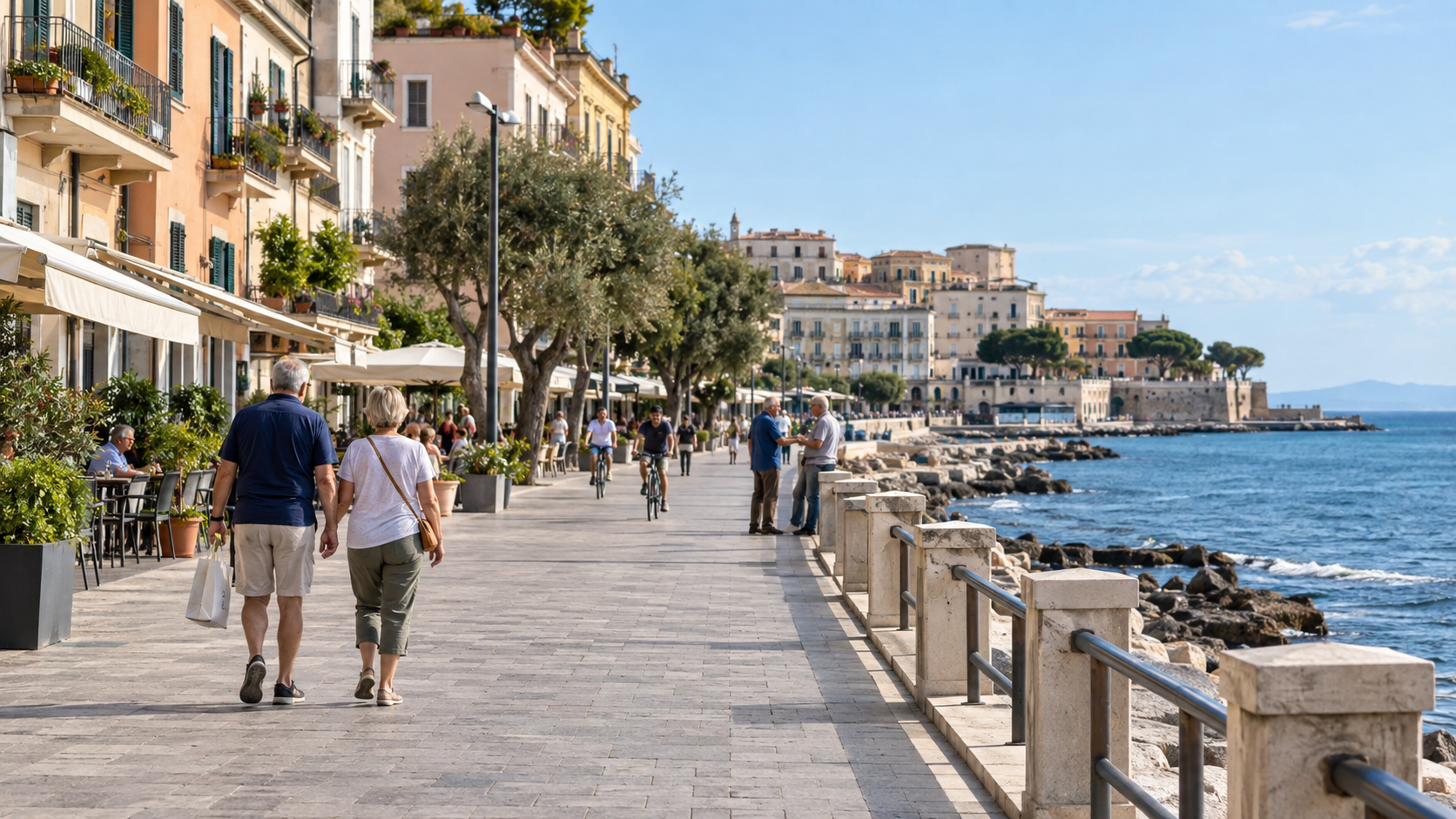
Living beside the sea is one of the great attractions of moving to Italy. Yet choosing a coastal home requires more than finding a beautiful beach or a photogenic historic center.
A place that feels idyllic during a two-week summer holiday may become inconvenient in January when restaurants close, public transport is reduced and the nearest major hospital is an hour away. Housing availability, summer heat, flood exposure, airport connections and access to everyday services should all influence the decision.
For most foreign residents, a medium-sized coastal city is more practical than an isolated seaside village. Cities provide hospitals, railway stations, year-round shops, administrative offices and a broader rental market while still offering easy access to the water.
The five destinations below are not simply Italy’s prettiest coastal locations. They represent different combinations of affordability, healthcare, transportation, climate and daily quality of life.
Housing figures in this guide are average asking prices recorded in August 2026. They are useful for comparison but should not be treated as final transaction prices. Rents vary considerably by neighborhood, property condition and contract type.
Italy’s Best Coastal Cities for Expats at a Glance
| Destination | Average asking rent | Average sale price | Best for | Main drawback |
|---|---|---|---|---|
| Genoa | €11.10 per m²/month | €1,862 per m² | Services, hospitals and northern connections | Hills, traffic and heavy rainfall |
| Trieste | €12.47 per m²/month | €2,693 per m² | Central European atmosphere and international access | Strong bora winds and cooler winters |
| Pescara | €9.98 per m²/month | €2,163 per m² | Affordability, beaches and easy daily living | Less international than larger cities |
| Bari | €12.88 per m²/month | €2,325 per m² | Southern city life, transport and healthcare | Hot summers and rising housing demand |
| Cagliari | €14.11 per m²/month | €2,716 per m² | Island lifestyle with capital-city services | Dependence on flights and ferries |
1. Genoa: Best for Healthcare and Big-City Services
Genoa is often overlooked by foreigners who head directly for Portofino, Santa Margherita Ligure or the Cinque Terre. For someone planning to live in Italy permanently, however, the regional capital is usually far more practical than its smaller and more expensive neighbors.
The city stretches along the Ligurian coast, with neighborhoods climbing steeply into the surrounding hills. Its historic center is one of Europe’s largest, while districts such as Nervi, Quarto, Quinto and Pegli provide a more residential atmosphere close to the sea.
Genoa offers something that many Italian coastal resorts cannot: a genuine year-round economy. The port, shipping, engineering, tourism, education and healthcare sectors support employment beyond the summer season.
Housing costs in Genoa
According to Immobiliare.it’s Genoa property market data, the average asking price in August 2026 was approximately:
- €1,862 per square meter to buy
- €11.10 per square meter per month to rent
Prices vary dramatically between neighborhoods. Albaro and the eastern seafront are among the most expensive areas, while districts farther west or inland can be much more affordable.
An 80-square-meter apartment at the citywide average would therefore have an advertised rent of about €890 per month, before condominium charges and utilities.
Healthcare and transportation
Genoa has several major hospitals, including the San Martino Policlinico, as well as specialist clinics and university medical facilities. This makes it one of the strongest choices for retirees, families and anyone managing a chronic health condition.
The main railway stations, Genova Piazza Principe and Genova Brignole, provide connections along the Ligurian coast and toward Milan, Turin, Tuscany and Rome. Genoa Airport is connected to the nearby railway station by the frequent Genova Airlink service.
A car is unnecessary in many central neighborhoods, although Genoa’s steep streets and stairways can present difficulties for people with limited mobility. Before renting, check the walking route between the property, bus stops and essential shops rather than relying only on the distance shown on a map.
Climate and environmental considerations
Liguria enjoys relatively mild winters, but Genoa can experience intense rainstorms. Properties near rivers, streams, steep slopes or low-lying roads require careful investigation.
Before buying, consult ISPRA’s IdroGEO hazard maps and ask a surveyor about flood, drainage and landslide exposure. In older buildings, also examine roof condition, damp, exterior maintenance and the availability of a lift.
Choose Genoa if: you want the sea without surrendering hospitals, cultural life, rail connections or everyday urban services.
Think twice if: you need flat streets, easy parking or consistently dry weather.
For a broader look at the region, read Italia Mia’s complete Liguria travel guide.
2. Trieste: Best for International Connections and Central European Character
Trieste stands at the northeastern edge of the Adriatic, close to Slovenia and within easy reach of Croatia and Austria. Its Habsburg architecture, historic cafés and multicultural identity give it a character unlike any other Italian coastal city.
The city can appeal particularly to expats who want Italian life combined with convenient access to Central Europe. It is cultured, walkable in its central districts and generally active throughout the year.
The waterfront is urban rather than resort-like, but swimming areas and rocky beaches are easily reached along the coast toward Barcola, Miramare and Sistiana.
Housing costs in Trieste
Immobiliare.it’s Trieste market report listed average August 2026 asking prices of:
- €2,693 per square meter to buy
- €12.47 per square meter per month to rent
An average 80-square-meter rental would consequently be advertised at around €1,000 per month. Central apartments and properties with sea views generally cost more, while neighborhoods south and east of the center may offer better value.
Trieste has many handsome historic buildings, but buyers should check for lifts, insulation, window condition and potentially high heating or condominium expenses.
Healthcare and transportation
As a regional capital and university city, Trieste offers major hospitals, specialist services and a wider selection of doctors than small Adriatic resorts.
Trieste Centrale provides rail connections to Venice and other northern Italian cities. The airport has its own integrated transport hub. According to Trieste Airport, the station receives regional, interregional and high-speed services, as well as cross-border connections.
Local buses cover the city and surrounding coast effectively, although some residential areas are hilly. A car becomes more useful for exploring the Karst plateau, Slovenia and smaller coastal communities.
Climate and environmental considerations
Trieste has cooler winters than southern Italy and is famous for the bora, a powerful northeasterly wind. For some residents the wind is invigorating; for others it becomes a genuine inconvenience.
When viewing a property, examine window seals, shutters and outdoor spaces. A panoramic terrace has less value if it becomes unusable during strong winds.
Choose Trieste if: you want culture, international connections, good services and a less conventional version of coastal Italy.
Think twice if: your ideal Italian retirement depends on warm winters, sandy beaches and a southern Mediterranean atmosphere.
3. Pescara: Best Value for a Practical Beach Lifestyle
Pescara lacks the monumental beauty of Florence or Venice, but that is partly why it works as a place to live. It is a modern, relatively flat Adriatic city with a long sandy beach, a seafront cycle route, shops, schools, hospitals and an active year-round population.
Residents can walk or cycle between many neighborhoods, and the mountains of Abruzzo are close enough for day trips. This combination of beach and mountain access is one of Pescara’s strongest advantages.
Housing costs in Pescara
The Immobiliare.it market report for Pescara recorded average asking prices of:
- €2,163 per square meter to buy
- €9.98 per square meter per month to rent
At the citywide average, an 80-square-meter apartment would be advertised at approximately €800 per month. The center and Pineta districts are generally more expensive, while areas around the airport, hospital and outer neighborhoods may cost less.
Pescara’s rental market can still be affected by summer demand. Confirm whether an advertised lease is a registered long-term residential contract or only a seasonal arrangement.
Healthcare and transportation
The city has a major public hospital and is the principal service center for a large part of coastal Abruzzo. For highly specialized treatment, residents may occasionally need to travel to Chieti, L’Aquila, Rome or another larger medical center.
Pescara Centrale lies on the main Adriatic railway line, with services north toward Ancona and Bologna and south toward Bari and Lecce. Abruzzo Airport is close to the city, although its destination network is smaller than those of Rome, Bari or Milan.
Pescara is among the easiest choices on this list for cycling and level walking. A car is helpful for reaching Abruzzo’s national parks, mountain villages and inland hospitals, but it is not essential for ordinary life in central neighborhoods.
Climate and environmental considerations
Summers are hot and humid, although sea breezes often provide relief. Winters are cooler than many foreign buyers expect, and occasional cold weather can arrive from across the Adriatic.
Because Pescara occupies low coastal land near the mouth of a river, buyers should examine local flood mapping, drainage and ground-floor exposure carefully. Proximity to the beach should never substitute for environmental due diligence.
Choose Pescara if: you want a straightforward, affordable coastal lifestyle with a real city behind the beach.
Think twice if: you need a large international community, extensive intercontinental flights or the architectural drama of Italy’s most famous destinations.
Explore the surrounding mountains, towns and coastline in Italia Mia’s guide to the best places in Abruzzo.
4. Bari: Best for Southern Italian City Life and Transportation
Bari combines a historic center, a long seafront, a major university, hospitals, an international airport and one of southern Italy’s most useful railway stations. It is a working city rather than a seaside resort, making it considerably more practical for permanent residents.
Bari Vecchia provides atmosphere and history, while Murat offers central shopping and transportation. Madonnella has an appealing position near the lungomare, and neighborhoods such as Carrassi, Picone and Poggiofranco provide more residential surroundings.
Those wanting a smaller coastal community can also investigate Torre a Mare, south of central Bari, while retaining access to the city’s services.
Housing costs in Bari
Immobiliare.it’s Bari property data showed average August 2026 asking prices of:
- €2,325 per square meter to buy
- €12.88 per square meter per month to rent
This places the approximate advertised rent for an 80-square-meter property at just over €1,030 per month. Prices are lower in peripheral neighborhoods and higher in central districts or near desirable sections of the seafront.
Demand from students, professionals and tourists can make attractive long-term rentals competitive. Begin searching well before the intended move and verify the proposed contract with a qualified local professional.
Healthcare and transportation
Bari is home to the Policlinico di Bari and several other public and private healthcare facilities. Its status as Puglia’s regional capital makes it a better base for healthcare than many of the region’s smaller coastal towns.
High-speed and long-distance trains connect Bari with Rome, Bologna and Milan, while regional services reach destinations throughout Puglia. Bari Airport has domestic and international routes and is linked to the city by rail.
Public transportation is adequate for central life, but a car is useful for exploring the Valle d’Itria, Gargano and Salento. Parking and traffic, however, can become frustrating in the center.
Climate and environmental considerations
Bari has hot, bright summers and generally mild winters. Prolonged summer heat makes air conditioning, shutters, insulation and building orientation important considerations.
Water scarcity, extreme heat, intense storms and coastal flooding are increasingly relevant throughout southern Italy. Prospective buyers should inspect municipal and regional risk information for the exact address rather than making assumptions based on the city as a whole.
Choose Bari if: you want southern Italian culture with major-city healthcare, trains, flights and year-round activity.
Think twice if: you are searching for a quiet resort, cooler summers or an inexpensive home directly beside the sea.
Learn more about the wider region in Italia Mia’s guide to the best places to visit in Puglia.
5. Cagliari: Best Island Base with Full Urban Services
Cagliari offers the pleasures of Sardinian life without the extreme isolation of a small island village. It has a university, major hospitals, cultural events, shops, an international airport and Poetto, one of Italy’s most impressive urban beaches.
The historic districts of Castello, Marina, Stampace and Villanova have atmosphere but can include steep streets, limited parking and older buildings. San Benedetto is convenient for everyday shopping, while areas toward Molentargius and Poetto provide easier access to the coast.
Cagliari is particularly attractive to remote workers, retirees and people who value outdoor living. However, anyone dependent on mainland clients, specialist services or frequent family visits should calculate the cost and inconvenience of repeated flights.
Housing costs in Cagliari
According to Immobiliare.it’s Cagliari housing data, average asking prices in August 2026 were:
- €2,716 per square meter to buy
- €14.11 per square meter per month to rent
An 80-square-meter property at the citywide average would therefore be advertised for about €1,130 per month. Areas around Poetto can command considerably more, while Is Mirrionis, San Michele and some outer districts tend to offer lower prices.
The figures also show why Sardinia should no longer be treated automatically as a low-cost relocation destination. Cagliari’s rental market is now the most expensive of the five cities in this comparison.
Healthcare and transportation
Cagliari has major public hospitals and specialist services, making it a more sensible choice for permanent residence than remote parts of Sardinia. Even so, some complex medical needs may require travel to mainland Italy.
The city has local buses and a developing metropolitan transport network. Trains connect central Cagliari with Elmas Airport in only a few minutes. Elsewhere on the island, railway coverage is limited, and a car is often necessary.
Air connections are essential rather than optional. Before relocating, compare year-round schedules and fares to the mainland cities you expect to visit regularly.
Climate and environmental considerations
Cagliari has long, hot and dry summers, with mild winters and abundant sunshine. Heat, drought, water restrictions and wildfire conditions can affect Sardinia, particularly outside the city.
When evaluating homes, look for effective shading, cross-ventilation, efficient air conditioning and reasonable exposure to afternoon sun. Near lagoons and low coastal areas, check flood and drainage conditions as well as mosquitoes and seasonal humidity.
Choose Cagliari if: you want beaches, outdoor life and Sardinian culture while retaining the services of a regional capital.
Think twice if: you need frequent, inexpensive access to mainland Italy or want to live without a car while exploring the island.
Italia Mia’s Sardinia travel resources can help you compare Cagliari with other parts of the island.
What About Atrani, Lerici and Santa Margherita Ligure?
Atrani, Lerici and Santa Margherita Ligure appeared in the original version of this article. All three remain beautiful places, but beauty alone does not make them the most practical choices for a permanent international move.
Atrani is tiny, steep and heavily affected by the seasonal economy of the Amalfi Coast. Lerici offers an appealing lifestyle but does not have its own railway station. Santa Margherita Ligure is well connected and attractive, but its property market reflects its status as an affluent resort.
These towns may suit healthy, financially comfortable residents who deliberately want a smaller community. They are less convincing as general recommendations for expats who need major hospitals, employment options, broad rental availability or easy year-round travel.
For inspiration rather than relocation analysis, see Italia Mia’s guide to the best coastal cities and towns in Italy.
Healthcare Access: What Expats Should Check
Being close to a hospital does not automatically guarantee immediate access to every service. Eligibility for Italy’s National Health Service depends on citizenship, immigration status, residence and the reason for living in Italy.
Before moving, determine:
- Whether you qualify for mandatory or voluntary SSN enrollment
- Whether private health insurance is required for your visa
- Which local health authority covers your address
- How far the nearest emergency department is
- Whether your required specialists are available locally
- Whether you can manage appointments and medical conversations in Italian
- How you will reach healthcare facilities if you stop driving
Even in a city with excellent hospitals, waiting times for non-urgent public appointments can encourage residents to use private specialists occasionally. Include this possibility in your budget.
For the administrative steps involved in relocation, consult Italia Mia’s complete guide to moving to Italy.
Climate Risk Should Be Checked Before Buying
No coastal property should be purchased solely on the strength of a sea view.
Italy faces varying combinations of river flooding, flash floods, coastal erosion, landslides, heatwaves, drought and wildfire. Exposure can change from one street to another, particularly in towns built near rivers, cliffs or steep hillsides.
Before committing to a property:
- Check the address using ISPRA’s IdroGEO platform.
- Review municipal civil-protection and flood-risk plans.
- Ask whether the building or street has flooded previously.
- Speak with a geometra, architect or engineer who represents you rather than the seller.
- Inspect retaining walls, basements, drainage, roofs and signs of damp.
- Obtain insurance quotations before making the purchase irreversible.
- Visit after heavy rain as well as during good summer weather.
Climate risk does not make coastal Italy unlivable. It simply needs to be treated as part of property due diligence, just like title searches, structural condition and condominium expenses.
Rent Before You Buy
The safest way to choose a coastal home is to experience the destination in different seasons. A minimum six- or twelve-month rental can reveal problems that are invisible during a holiday.
Spend time testing:
- Summer heat and tourist congestion
- Winter activity and shop closures
- Noise during evenings and weekends
- Internet reliability
- Public transportation
- Walking routes to shops and doctors
- Airport access
- Parking
- Humidity, wind and rainfall
- The availability of long-term rentals
A short preliminary stay can help narrow the search. You can compare accommodation through Trip.com before arranging longer-term local viewings.
For realistic monthly estimates beyond housing, see Italia Mia’s cost-of-living guide.
Useful Books for Planning a Move
Books cannot replace current legal or tax advice, but they can help prospective residents understand Italian customs, bureaucracy and everyday life.
- Browse books about moving to and living in Italy on Amazon
- Browse Italian language guides and phrasebooks
- Browse travel guides to Italy’s regions
As an Amazon Associate, Italia Mia may earn from qualifying purchases.
Which Coastal City Is Best for You?
There is no single best coastal location for every expat.
Genoa provides the strongest combination of major-city services, healthcare and mainland transport. Trieste is ideal for people attracted to Central Europe and international connections. Pescara offers the best balance of affordability, flat terrain and everyday beach access. Bari combines southern Italian life with excellent transportation and medical infrastructure. Cagliari delivers the most complete island lifestyle, although living there requires accepting greater dependence on flights and ferries.
The most successful relocation usually begins with practical questions rather than romantic ones. Decide how close you need to be to a hospital, whether you can live without a car, how often you will travel abroad and what climate you can comfortably tolerate.
Then rent, experience ordinary daily life and allow the right coastal destination to prove itself before you buy.
External Sources
- Immobiliare.it – Italian property-market data
- ISPRA IdroGEO – Landslide and flood-hazard maps
- Trenitalia – Official railway information
- Italian Ministry of Health
- Genoa Airport – Ground transportation
- Trieste Airport – Rail connections


