

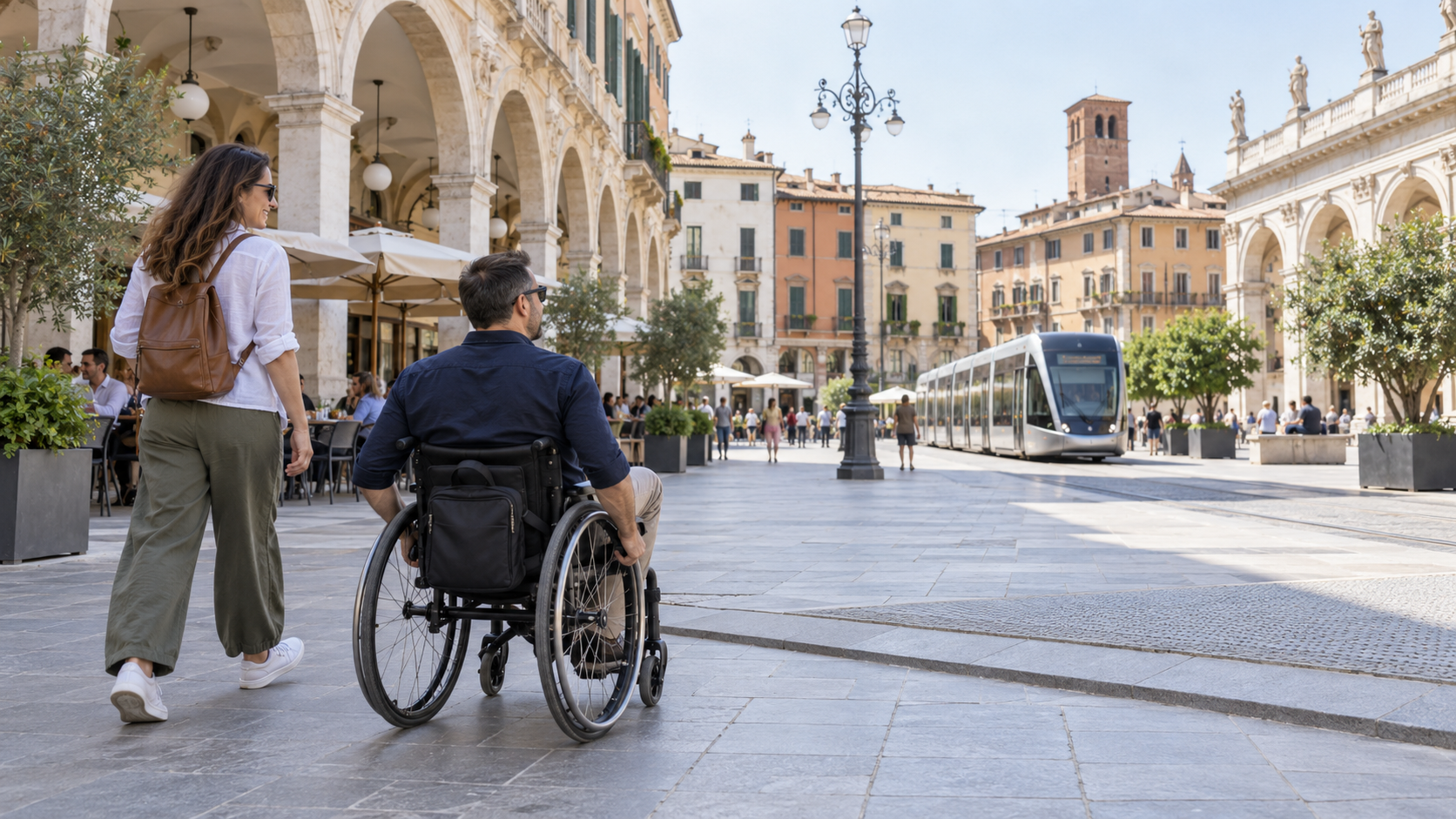
 Italy’s historic cities were built centuries before anyone considered step-free access. Cobblestones, bridges, steep lanes and protected monuments can create genuine obstacles for wheelchair users. Yet Italy is far more accessible than its ancient streets sometimes suggest.
High-speed trains connect the principal cities, major railway stations provide assistance for passengers with reduced mobility, and many famous museums and archaeological sites have installed ramps, lifts and alternative routes. The key is careful planning—and verifying specific details rather than assuming that an entire city, hotel or attraction is accessible.
This guide examines Italy’s most practical destinations for wheelchair users, how to arrange assistance on trains, which major attractions provide accessible routes and what to confirm before making a reservation.
Is Italy Wheelchair Accessible?
Italy is partly accessible, but the experience varies enormously.
Modern railway stations, airports, larger hotels and nationally administered museums generally provide the most reliable facilities. Historic centers are more complicated. A city may have accessible public transportation and excellent museums while still presenting uneven paving, steep gradients or sidewalks blocked by parked vehicles.
Accessibility also depends on the traveler. A route manageable with a powered wheelchair may be exhausting in a manual chair. A small lift may accommodate one wheelchair but not a larger mobility scooter. Someone who can transfer or manage a few steps will have more options than a traveler who requires completely step-free access.
For this reason, “wheelchair accessible” should be treated as the beginning of a conversation, not a guarantee.
Before traveling, confirm:
- Step-free access from the street
- Door and elevator dimensions
- Maximum lift or ramp weight
- Accessible bathroom facilities
- Shower type and available grab rails
- Bed height and clearance beneath the bed
- Distance from the railway station or nearest accessible transit stop
- The presence of cobblestones, hills or bridges outside the property
- Whether assistance must be reserved in advance
The Most Wheelchair-Friendly Cities in Italy
No Italian city is completely barrier-free. Nevertheless, several destinations offer a useful combination of relatively level terrain, accessible transportation and major attractions with adapted routes.
Milan: Italy’s Most Practical Major City
Milan is often the easiest large Italian city for a wheelchair traveler. Much of the center is comparatively level, sidewalks are generally better than in older southern cities, and the public transportation network includes an increasing number of accessible metro stations, buses and low-floor trams.
Accessibility is not identical throughout the Metro system, so check the status of elevators at the stations you intend to use. Older trams may also have steps, while newer vehicles are easier to board.
The central streets around Piazza del Duomo, Galleria Vittorio Emanuele II, La Scala and the fashion district are relatively manageable. The Duomo has adapted access, although the cathedral, archaeological area and rooftop terraces have different routes and restrictions. Contact the cathedral before visiting if you use a large powered chair or mobility scooter.
Other generally accessible attractions include:
- Museo del Novecento
- Pinacoteca di Brera
- Sforza Castle museums
- Fondazione Prada
- Leonardo da Vinci National Museum of Science and Technology
- Santa Maria delle Grazie, home of The Last Supper
The Last Supper requires advance booking for every visitor. Wheelchair users should mention their requirements when reserving because access procedures and capacity are controlled.
Milano Centrale is a large, busy station, but it has elevators and passenger-assistance services. Staying near an accessible Metro station is usually more convenient than staying directly beside the station.
Turin: Broad Streets, Porticoes and Excellent Museums
Turin is one of Italy’s most underrated accessible destinations. Its broad avenues, large squares and long arcaded streets are generally easier to navigate than the narrow lanes of many medieval cities.
Some historic paving remains uneven, but the city center is predominantly flat. The Metro is modern and accessible, while the accessibility of buses and trams depends on the vehicle and stop.
Major attractions with accessible facilities include:
- Egyptian Museum
- National Cinema Museum
- Royal Museums
- Palazzo Madama
- Automobile Museum
- Venaria Reale, outside the center
The National Cinema Museum occupies the Mole Antonelliana, a historic building with some unavoidable limitations. Verify which areas and panoramic facilities are available before visiting.
Torino Porta Nuova station is centrally located, making it possible to reach many hotels and attractions without a long transfer.
Bologna: Level Streets Beneath Historic Porticoes
Bologna is largely flat and has an exceptionally compact center. Its kilometers of porticoes offer protection from sun and rain, although thresholds, changes in pavement level and occasional narrow sections require attention.
Piazza Maggiore, the Basilica of San Petronio area and many central streets can be explored without steep climbs. Some medieval towers and historic buildings remain inaccessible, but the city’s food markets, squares and street life can still be enjoyed fully.
Accessible or partly accessible cultural sites include:
- Museo Civico Archeologico
- Palazzo Pepoli – Museum of the History of Bologna
- MAMbo modern art museum
- Pinacoteca Nazionale
- Basilica of San Petronio
- Sanctuary of San Luca
The portico leading to San Luca is extremely long and climbs substantially. A taxi or adapted vehicle is far more practical than attempting the ascent in a manual wheelchair.
Bologna Centrale is one of Italy’s most important railway hubs. It makes the city an excellent base for accessible day trips to Florence, Milan, Ferrara, Modena, Parma and Ravenna.
Ravenna: A Manageable Center and Extraordinary Mosaics
Ravenna combines a relatively level historic center with some of Italy’s greatest early Christian monuments. Distances between the principal mosaic sites are manageable, although paving and entrances vary.
San Vitale, the Mausoleum of Galla Placidia, Sant’Apollinare Nuovo and other monuments have their own access arrangements. Not every original architectural feature can be made step-free, so consult the official monument information before purchasing a combined ticket.
Ravenna is quieter than Rome, Florence or Venice and can be a good choice for travelers who prefer a slower itinerary. It is connected to Bologna by regional train, although not every departure or station facility should be assumed accessible without confirmation.
Florence: Accessible Masterpieces, Challenging Pavements
Florence is compact and mostly level, but its historic paving can be difficult. Narrow sidewalks, stone slabs, crowded streets and high curbs are common. The area along the Arno is generally easier, while Piazzale Michelangelo and hillside districts require transportation.
The Uffizi Gallery, Accademia Gallery and several other state museums provide adapted entrances and lifts. Accessible visitors may use a different entrance from the general public, so ask staff rather than joining the main line automatically.
Potentially accessible highlights include:
- Uffizi Gallery
- Accademia Gallery
- Palazzo Pitti
- Boboli Gardens, only in certain sections
- Museo dell’Opera del Duomo
- Basilica of Santa Croce
- Palazzo Vecchio
- Santa Maria Novella
The Florence Cathedral complex requires separate research. The cathedral, baptistery, museum, bell tower and dome are distinct attractions with very different physical conditions. Brunelleschi’s Dome and Giotto’s Bell Tower involve hundreds of steps and are not wheelchair accessible.
Firenze Santa Maria Novella station is close to the center. Travelers combining Florence with other cities can consult Italia Mia’s complete guide to train travel in Italy.
Rome: Accessible Highlights in a Difficult Urban Landscape
Rome can be immensely rewarding, but it requires patience. Distances are long, cobblestones are widespread, curb cuts are inconsistent and elevators in Metro stations may occasionally be unavailable.
A realistic itinerary should include fewer attractions per day, scheduled rest periods and occasional accessible taxis. Staying close to the sights that matter most may save more energy than choosing a cheaper hotel on the outskirts.
The Colosseum has a step-free entrance and lifts serving accessible portions of the monument. The Roman Forum and Palatine Hill are more difficult because of slopes, rough ancient surfaces and occasional lift closures. The archaeological park publishes information about accessible routes and provides a limited number of wheelchairs at principal entrances.
The Vatican Museums provide a recommended barrier-free itinerary. Most museum areas can be visited by wheelchair, but the accessible route does not always follow the standard visitor flow. This can affect access between the Sistine Chapel and St. Peter’s Basilica.
The Vatican Museums also offer:
- Priority entry for qualifying disabled visitors
- Free admission with appropriate disability documentation
- Free admission for a companion when required
- Wheelchairs on loan, subject to availability
- Accessible toilets along the museum route
Free disability tickets are issued at the museum rather than booked through the ordinary online ticket system. Visitors should carry official documentation and read the current Vatican policy before arriving.
Other comparatively manageable Roman attractions include:
- Pantheon
- Piazza Navona
- Trevi Fountain viewing area
- Capitoline Museums, using adapted routes
- Borghese Gallery
- Baths of Caracalla
- MAXXI
- National Roman Museum branches
Ancient sites should always be checked individually. Temporary restoration, archaeological work and malfunctioning lifts can alter accessible routes without much notice.
Venice: Difficult, but Not Impossible
Venice is often described as inaccessible because its islands are connected by hundreds of stepped bridges. That description is understandable but incomplete.
Several parts of Venice can be explored without crossing bridges, while accessible vaporetti allow wheelchair users to travel between districts. Some bridges also have permanent or seasonal ramps. The result is not a single continuous accessible city, but a collection of reachable zones.
Venezia Santa Lucia station has step-free access to the waterfront. From there, an accessible vaporetto is usually the most practical way to reach accommodation, provided the nearest stop and the route from the stop to the hotel have been checked.
Accessible areas may include parts of:
- Cannaregio near Santa Lucia
- The Rialto market district
- Piazza San Marco
- The waterfront from San Marco toward Castello
- Giudecca
- Murano
- Burano
- Venice Lido
Water levels, tides and crowding can change the experience. During acqua alta, temporary walkways may be too narrow or steep for some wheelchairs.
Most vaporetti can carry wheelchairs, but boarding conditions depend on the boat, landing stage, tide and wheelchair dimensions. Tell staff where you intend to disembark so they can help position the chair safely.
A wheelchair traveler should never reserve a Venetian hotel based only on the phrase “near San Marco” or “near Rialto.” Ask the property for a precise, bridge-free route from the nearest accessible vaporetto stop. One small bridge can make an otherwise suitable hotel unreachable.
Traveling Through Italy by Train
Rail is generally the best way for wheelchair users to travel between Italy’s major cities.
Trenitalia operates high-speed Frecciarossa, Intercity and regional services. Italo provides high-speed connections between many principal destinations. Accessible spaces are limited and may differ according to the train type.
Rete Ferroviaria Italiana coordinates free station assistance through its Sala Blu network. Depending on the station and journey, assistance can include:
- Guidance through the station
- Help reaching the correct platform
- Boarding and disembarking with a lift
- Assistance during train changes
- Help with one item of luggage when compatible with the service
Assistance can be requested through the Sala Blu online service, the SalaBlu+ application, by telephone or through participating stations. Reserve as early as possible, particularly for international journeys, early departures, late arrivals or smaller stations.
When making the request, provide:
- Travel date and train number
- Departure, arrival and transfer stations
- Wheelchair type and dimensions
- Combined weight of the wheelchair and passenger
- Whether the chair is manual or powered
- Battery type, when relevant
- Whether you can transfer to a train seat
- Whether you are traveling with a companion
- The assistance required at each station
Do not assume that every station is step-free simply because a train stops there. Some regional stations have underpasses without functioning elevators, low platforms or limited staffing. Confirm assistance before purchasing a nonrefundable itinerary.
Arrive at the designated meeting point at the time stated in the confirmation. If changing trains, avoid tight connections. Thirty minutes between services may look generous on a booking screen but can be insufficient when lifts, platform changes or staff assistance are involved.
For general ticketing, reservations and train categories, read How to Travel by Train in Italy. Italia Mia’s guide to traveling around Italy without a car can also help identify the most convenient bases.
Urban Transportation
Accessibility on local transportation varies by city and vehicle.
Modern metro lines generally provide elevators and level or ramp-assisted boarding. Older stations may have gaps, stairs or elevators that are temporarily out of service. A station marked accessible on a map may become unusable if its only lift fails.
Low-floor buses are common in major cities, but equipment and driver assistance are not completely consistent. Bus stops may also be difficult to reach because of curbs, traffic or parked vehicles.
When possible:
- Check the transport operator’s accessibility page
- Verify elevator status on the day of travel
- Avoid peak commuter hours
- Allow several alternative routes
- Photograph the name of your destination in Italian
- Keep the address of your hotel available offline
- Identify a local accessible-taxi service before arrival
In Venice, public transportation means boats rather than buses. In hill towns, funiculars may provide step-free access, but the route from the station to the funicular can still include steep streets.
Flying to Italy with a Wheelchair
European rules require airports and airlines to provide assistance to passengers with disabilities or reduced mobility. Request the service through the airline when booking or as soon as possible afterward.
Give the airline exact information about your wheelchair, including its dimensions, weight, battery and detachable components. Remove loose accessories and carry essential cushions, controls or removable parts in the cabin when airline rules permit.
Before handing over a powered wheelchair:
- Photograph it from several angles
- Label the chair and detachable components
- Attach clear handling instructions
- Explain how to disengage and re-engage the motors
- Carry information about the battery
- Keep medications and essential equipment in hand luggage
- Inspect the chair immediately after arrival
Airport assistance normally ends at an agreed point within the terminal. It does not automatically include an accessible taxi or hotel transfer, which must be arranged separately.
How to Find a Truly Accessible Hotel
Hotel booking filters are useful but insufficient. “Facilities for disabled guests” can mean anything from a ramp at reception to a fully adapted bedroom.
Contact the property directly and ask questions that require specific answers.
Instead of asking, “Is the room accessible?”, ask:
- Are there any steps between the street and the bedroom?
- What are the narrowest door and elevator widths?
- Is the shower completely level with the bathroom floor?
- Is there a fixed or portable shower seat?
- On which sides of the toilet are grab rails installed?
- Is there enough space beside the bed for my wheelchair?
- Can a mobile hoist fit beneath the bed?
- Does the entrance have a steep ramp?
- Is there a bridge, hill or cobbled street between the hotel and public transportation?
- Can you send current photographs of the entrance and bathroom?
In Venice, ask for the exact number of bridges from the vaporetto stop. In Florence and Rome, ask about cobblestones and curb cuts. In hill towns, confirm the gradient as well as the distance.
Italia Mia’s guide to where to stay in every Italian region can help identify practical bases, but accessibility must still be verified with the individual property.
Museums, Churches and Historic Attractions
Italy’s principal state museums and archaeological sites have made substantial improvements, but protected buildings cannot always be altered freely.
An accessible entrance may be around the side or rear of a monument. Visitors may need to call an intercom, ask a guard to unlock a door or follow an alternative route. This is common and does not necessarily mean that the site is inaccessible.
When planning a visit:
- Read the attraction’s official accessibility page
- Contact the site directly when the information is vague
- Ask whether lifts are currently operating
- Confirm the permitted size and weight of powered wheelchairs
- Carry recognized disability documentation
- Ask whether a companion receives free admission
- Reserve a suitable guided tour rather than a standard group tour
- Allow extra time for security and alternative entrances
Some attractions admit qualifying visitors with disabilities and a necessary companion free of charge. Requirements are not identical everywhere, particularly at Vatican, municipal and privately managed sites. Never assume that a foreign parking permit alone will be accepted as disability certification.
Italia Mia’s city-by-city museum ticket guide explains how advance reservations work at the country’s busiest attractions.
Destinations That Require Extra Planning
Some of Italy’s most beautiful destinations present substantial physical obstacles.
The cliffside towns of the Amalfi Coast have steep roads, stairways and crowded buses. Positano is particularly difficult, while flatter waterfront sections of Amalfi and Salerno are more manageable.
Cinque Terre villages contain hills, stairs and narrow lanes. Monterosso is generally the most practical of the five, but train-platform access must still be confirmed.
Matera’s Sassi are defined by steep stone paths and staircases. Accessible viewpoints and modern districts can provide a rewarding visit, but much of the ancient cave settlement is unsuitable for independent wheelchair navigation.
Siena, Assisi, Orvieto and many other hill towns can be reached by public transportation, yet gradients and historic paving remain challenging. Accessible taxis or private drivers may transform the experience.
Beaches also vary. Some Italian resorts install seasonal boardwalks, beach wheelchairs and adapted changing facilities, but services may operate only during the summer. Contact the individual stabilimento balneare rather than relying on general information about the town.
Useful Italian Accessibility Phrases
A few phrases can make requests clearer:
“Ho bisogno di assistenza.”
I need assistance.
“Uso una sedia a rotelle.”
I use a wheelchair.
“C’è un ingresso senza gradini?”
Is there a step-free entrance?
“C’è un ascensore?”
Is there an elevator?
“L’ascensore funziona?”
Is the elevator working?
“Il bagno è accessibile?”
Is the bathroom accessible?
“La doccia è senza gradino?”
Is the shower step-free?
“Posso salire con la sedia a rotelle?”
Can I board with the wheelchair?
“Dove devo aspettare l’assistenza?”
Where should I wait for assistance?
“Ci sono ponti o scale lungo il percorso?”
Are there bridges or stairs along the route?
A Practical Accessible Italy Itinerary
For a first trip, a route through Milan, Bologna, Florence and Rome offers the best balance of transportation and major attractions.
A possible 12-night itinerary is:
- Milan: three nights
- Bologna: two nights
- Florence: three nights
- Rome: four nights
Each transfer can be made by direct high-speed train. The cities contain enough accessible attractions to justify a slower schedule, and Bologna provides a useful intermediate stop between Milan and Florence.
Venice can replace Milan or Bologna, but accommodation and vaporetto routes must be investigated carefully. Turin and Ravenna are excellent alternatives for travelers who want fewer crowds.
Avoid changing hotels every night. Wheelchair travel involves more equipment, more coordination and less tolerance for disrupted lifts or missed connections. A longer stay in fewer cities usually produces a richer and more comfortable vacation.
Final Advice
Accessible travel in Italy is possible, but successful trips are built around details.
Choose cities connected by direct trains. Arrange station assistance in advance. Obtain written answers from hotels, reserve accessible museum routes and keep alternatives ready when lifts or transportation fail.
Most importantly, do not allow Italy’s historic architecture to suggest that the entire country is out of reach. A wheelchair user may not enter every tower, crypt or medieval lane, but can still experience Roman ruins, Renaissance art, grand piazzas, regional cuisine and everyday Italian life.
The best accessible itinerary is not the one that visits the greatest number of places. It is the one that removes avoidable barriers while leaving enough time to enjoy the places that truly work.
External Sources
Trenitalia – Assistance for Passengers with Disabilities or Reduced Mobility
Rete Ferroviaria Italiana – Sala Blu Passenger Assistance
Italo – Assistance for Passengers with Reduced Mobility
Vatican Museums – Accessibility and Services for Visitors with Disabilities
Colosseum Archaeological Park – Accessibility Services
ITA Airways – Accessible Travel
ENAC – Rights of Passengers with Disabilities and Reduced Mobility