
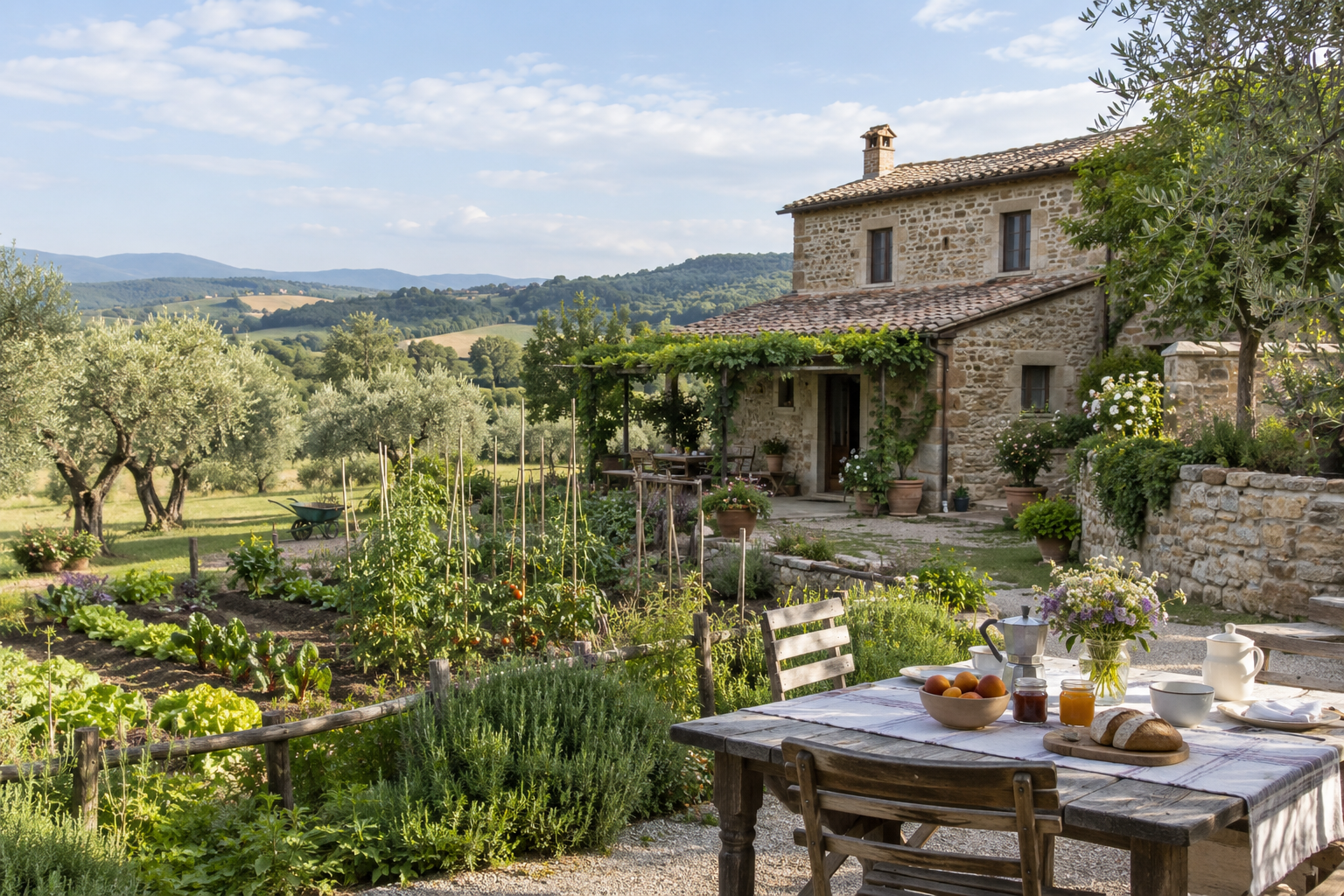
 An agriturismo is a working Italian farm that offers accommodations, meals or rural experiences to visitors. It may resemble a country hotel, bed-and-breakfast, villa or collection of self-catering apartments, but agriculture must remain an important part of the business.
That distinction matters. A beautiful hotel surrounded by vineyards is not automatically an agriturismo. A legally recognized agriturismo is connected to an active farm and operates under national principles and regional regulations.
For travelers, an agriturismo can provide peaceful surroundings, regional food and a closer connection to rural Italian life. The challenge is that properties vary enormously. Some are simple family farms; others offer swimming pools, restaurants, cooking classes and rooms approaching boutique-hotel standards.
What Does Agriturismo Mean?
The word combines agricoltura, meaning agriculture, with turismo, or tourism. The closest English translations are “farm stay,” “farmhouse accommodation” or “agritourism,” although none captures every type of Italian agriturismo.
Under Italy’s national agriturismo law, agritourism activities must be carried out by an agricultural entrepreneur in connection with the farm. Agriculture must remain the principal activity.
An authorized agriturismo may provide:
- Guest rooms or apartments
- Campsites
- Meals and drinks
- Tastings of farm products
- Cooking or food-related activities
- Hiking, cycling or horseback-riding opportunities
- Educational, cultural or recreational experiences connected with the farm and surrounding territory
Regional authorities establish many of the detailed operating requirements. This means that rules governing meals, accommodations, capacity and farm products can differ between Tuscany, Umbria, Sicily, Piedmont and other regions.
Italy has thousands of these properties. In its report for 2022, Italy’s National Institute of Statistics counted 25,849 active agritourism businesses distributed across much of the country.
What Staying at an Agriturismo Is Really Like
There is no single agriturismo experience.
At a traditional property, the owners may live on the farm and personally welcome guests. Breakfast could include homemade cakes, preserves, honey, cheese or fruit from the property. Dinner might be served at a communal table on selected evenings.
At the more refined end of the market, an agriturismo may have renovated stone suites, air conditioning, a panoramic pool, a spa and an elegant restaurant. The agricultural activity may involve wine, olive oil, saffron, hazelnuts, citrus fruit or organic vegetables.
Others concentrate almost entirely on self-catering apartments. You receive a kitchen, outdoor space and perhaps access to a pool, but little daily service and no restaurant.
The word agriturismo therefore tells you what kind of business the property is—not precisely what your stay will include.
Agriturismo, Hotel or Vacation Rental?
An agriturismo is a particularly good choice when the countryside is part of the trip rather than simply a place to sleep.
| Type of stay | Best for | Possible disadvantage |
|---|---|---|
| Agriturismo | Rural scenery, regional food, wine country, families and slower travel | A car may be necessary and hotel-style services can be limited |
| Hotel | Daily service, central locations, transportation access and short stays | Less privacy and less connection to the countryside |
| Vacation rental | Space, kitchens, longer stays and independent travelers | Limited assistance, meals or organized activities |
| Rural resort | Pools, spas, restaurants and a high level of service | Often more expensive and potentially less connected to working agriculture |
An agriturismo is not necessarily inexpensive. Simple farm rooms can offer excellent value, but highly renovated properties in the Tuscan countryside may cost as much as an upscale city hotel.
How to Choose the Right Agriturismo
Choose the Region Before the Property
Start with the places you want to visit. A lovely farm is not a practical choice if it adds two hours of driving every day.
Tuscany is the best-known agriturismo destination, particularly around Chianti, Siena, San Gimignano, Montepulciano and the Val d’Orcia. Its popularity produces a wide selection, but prices can be higher during spring and summer.
Umbria offers vineyards, olive groves, medieval towns and a quieter atmosphere around Assisi, Spello, Todi, Orvieto and Lake Trasimeno. The official Italian tourism guide to Umbria is useful for understanding the region’s geography and attractions.
Piedmont is an excellent choice for wine and food, especially around the Langhe, Roero and Monferrato. Veneto and Friuli-Venezia Giulia combine vineyards with access to historic towns. Puglia offers masserie, olive estates and rural properties within driving distance of coastal destinations.
Sicily and Sardinia provide citrus farms, vineyards, mountain properties and accommodations near the sea. In Trentino-Alto Adige, farm stays may be called agriturismi, masi or Bauernhöfe and often emphasize alpine scenery, hiking and local dairy products.
Travelers interested in quieter areas should also consider Le Marche, Abruzzo, Basilicata and inland Campania. The alternatives in Where to Go in Italy Without the Crowds can help identify less congested destinations.
Check the Exact Location
“Near Florence” can mean anything from a 20-minute drive to more than an hour on winding country roads. Never judge distance only from the property’s promotional description.
Check:
- Actual driving time to the towns you intend to visit
- Distance from the nearest paved road
- Whether the final approach is narrow, steep or unpaved
- Distance to restaurants, supermarkets and pharmacies
- Whether taxis are realistically available
- The nearest train or bus station
- Whether the farm provides transfers
A property may look close to a town on a map while being separated from it by a mountain, river or road network requiring a long detour.
Decide Whether You Need a Car
Many agriturismi are designed for travelers with cars. Public buses in rural Italy may run infrequently, particularly on Sundays and holidays. Taxis can be expensive and may need to be reserved in advance.
Before booking without a car, ask the owner these specific questions:
- Can you collect guests from the nearest train station?
- Is dinner available every night?
- Can guests walk safely to a restaurant or village?
- Are excursions or wine tastings offered with transportation?
- Can the property arrange a driver?
- How much does a transfer normally cost?
If the answers are vague, assume that a car is necessary.
Travelers combining cities and countryside can take a train to a regional center and collect a rental car there. The first-time guide to traveling in Italy by train explains reservations, regional tickets and luggage considerations.
When driving, avoid choosing a vehicle larger than necessary. Farm lanes, village streets and parking areas can be tight. Review Italy’s rules for restricted traffic zones, tolls and parking before beginning a rural road trip.
Verify the Type of Accommodation
Read the room description carefully. Agriturismo listings may include several different arrangements on the same property:
- A room with breakfast
- A studio with a kitchenette
- A one- or two-bedroom apartment
- An independent cottage
- A room in the owner’s farmhouse
- A separate building some distance from the reception area
- A villa rented exclusively to one group
If you want daily housekeeping, fresh towels or breakfast, confirm that these are included. Apartment stays may be cleaned only before arrival and after departure.
Also check whether air conditioning is available in the entire unit or only in one room. Thick stone walls can keep buildings cool, but Italian summers have become increasingly hot.
Understand the Meal Arrangements
Do not assume every agriturismo has a restaurant.
Some serve breakfast daily but offer dinner only on certain evenings. Others prepare meals exclusively for guests and require reservations by the previous day. A few operate a public restaurant that becomes busy on weekends.
Ask whether:
- Breakfast is included
- Dinner is served every night
- Meals have a fixed menu
- Vegetarian, vegan or gluten-free meals are available
- Children’s meals can be prepared
- Drinks are included
- Cooking facilities are available
- The restaurant closes on a particular weekday
A fixed farm dinner can be one of the highlights of the stay, but it may not suit travelers who expect an à la carte menu or need substantial dietary flexibility.
Look for Evidence of Genuine Farm Activity
A good listing should explain what the farm produces. Depending on the region, this might include wine, olive oil, fruit, vegetables, cheese, meat, honey or grains.
The presence of farm animals does not automatically mean children can enter enclosures, feed them or participate in farm work. If those experiences are important, look for clearly described activities rather than relying on photographs.
Harvests and agricultural work are seasonal. Grapes may be harvested in late summer or early autumn, while olive picking usually takes place later in the year. Guests should not assume that participation is always available.
Do Not Treat Sunflowers Like Hotel Stars
Italy has developed a national classification system for agriturismi, usually represented by one to five sunflowers. According to the official Agriturismo Italia information service, the five-class system operates in almost all Italian regions.
The classification is designed for rural accommodations and considers farm character, hospitality, services, surroundings and recreational opportunities. It should not be read as an exact equivalent of a hotel’s star rating.
A two- or three-sunflower farm can still provide a wonderful stay. It may simply offer fewer facilities than a large property with a pool, restaurant, organized activities and daily service.
Read Reviews for Practical Details
The overall rating matters less than recurring comments.
Look for recent reviews mentioning:
- Road access
- Cleanliness
- Mattress comfort
- Noise between rooms
- Wi-Fi reliability
- Air conditioning
- Water pressure
- Breakfast quality
- Owner availability
- Insects
- Pool maintenance
- Driving time to nearby towns
A complaint about church bells or farm animals may not concern you. Repeated reports of difficult access, cleanliness problems or misleading room descriptions deserve more attention.
Questions to Ask Before Booking
A short message to the property can prevent most disappointments. Ask only what the listing does not clearly answer.
Useful questions include:
- Is the final road paved and suitable for a small rental car?
- Is breakfast included in the quoted rate?
- On which evenings is dinner available?
- Does the room have air conditioning and heating?
- Is the swimming pool open during my travel dates?
- Are towels, linens and final cleaning included?
- Is there reliable Wi-Fi inside the accommodation?
- Are there stairs between the parking area and the room?
- Is the property suitable for a guest with limited mobility?
- What is the cancellation policy?
- Are city tax or additional fees payable at the property?
- What time are check-in and check-out?
Do not assume there will be a staffed reception desk throughout the day. Many farms are family-run, and the owner may be working elsewhere on the property. Arrange your arrival time in advance.
Families, Couples and Travelers With Limited Mobility
Agriturismi can be particularly enjoyable for families because they may offer outdoor space, pools, animals and apartments with kitchens. However, farm machinery, unfenced water, uneven terrain and animals mean that children still require supervision.
Couples should decide whether they want seclusion or a social atmosphere. A small farm with shared dinners creates a different experience from an independent apartment where guests rarely see the owners.
Travelers with limited mobility should request precise information. “Accessible” can mean different things, and historic farm buildings may contain steps, gravel paths and bathrooms that cannot accommodate a wheelchair. Ask for photographs and measurements when accessibility is essential.
When to Stay at an Agriturismo
Spring brings green landscapes, wildflowers and comfortable sightseeing temperatures, although pools may not yet be open.
Summer offers long days and outdoor dining, but central and southern Italy can be very hot. Air conditioning and a swimming pool become more important in July and August.
Early autumn is ideal for food and wine travelers. Grape and olive harvest periods bring agricultural activity, but popular properties may fill early.
Late autumn and winter can be peaceful and economical. Some farms close seasonally, however, and rural restaurants may reduce their opening days. Confirm heating, meal service and nearby dining options before booking.
Common Agriturismo Booking Mistakes
The most frequent mistake is choosing a property for its photographs without considering transportation. A panoramic farmhouse may be inconvenient for a city-centered itinerary.
Other common errors include:
- Assuming every farm serves dinner
- Confusing a private apartment with a serviced hotel room
- Booking a remote property without renting a car
- Expecting daily housekeeping
- Failing to check whether the pool is seasonal
- Underestimating rural driving times
- Arriving after check-in without notifying the owner
- Assuming that every advertised farm experience is included in the room rate
- Choosing an agriturismo for day trips that are too widely scattered
Keep some cash available for small purchases or locally collected fees, even if the accommodation accepts cards. The Italia Mia guide to money, cards, ATMs and tourist taxes explains what visitors should expect.
Is an Agriturismo Right for You?
Choose an agriturismo if you want countryside, regional food, open space and a slower rhythm. It is especially suitable for wine-country stays, family trips, romantic breaks and itineraries built around small towns.
Choose a city hotel instead if you depend on public transportation, want a staffed reception desk, need consistent daily service or plan to spend nearly all your time visiting urban attractions.
The best agriturismo is not necessarily the most luxurious. It is the one whose location, meal arrangements, service level and farm character match the way you intend to travel.
Frequently Asked Questions
Do I have to work on the farm?
No. An agriturismo is not normally a working holiday. Guests may be offered farm tours, tastings, cooking classes or seasonal activities, but participation is usually optional.
Is breakfast always included?
No. Some rates include breakfast, while apartments may be offered on a self-catering basis. Confirm what is included before booking.
Are agriturismi suitable for children?
Many are, especially properties with pools, playgrounds, animals or family apartments. Check safety features, pool rules and the availability of child-friendly meals.
Can I stay at an agriturismo without speaking Italian?
Usually. Many hosts in popular regions speak at least some English. At smaller farms, communication may be more limited, but translation apps can help with simple arrangements.
Is a car necessary?
Often, but not always. Farms near towns or those offering station transfers can work without a car. Obtain specific transportation information from the property before making a nonrefundable reservation.
Are pets normally allowed?
Policies vary. Even pet-friendly properties may impose size restrictions or prohibit animals from restaurants and pool areas. Farms with livestock may have additional rules.
External Sources
- Italian law governing agritourism activities
- Agriturismo Italia official information and classification FAQ
- ISTAT report on agritourism businesses in Italy
- Official Italian tourism guide to Umbria