
 Italy’s Ghost Towns: 10 Abandoned Villages with Extraordinary Stories
The Italy most travelers know is full of life: crowded piazzas, ringing church bells, busy cafés and families talking across balconies. But scattered among its mountains, valleys and remote countryside is another Italy—one made of silent streets, roofless houses and villages where daily life stopped suddenly.
Some Italian ghost towns were abandoned after earthquakes or landslides. Others slowly emptied as residents left in search of work. A few have been revived by artists, filmmakers and travelers, creating communities that exist somewhere between ruin and rebirth.
These places are not amusement parks built to imitate history. They are fragments of real communities. Behind every broken doorway was a kitchen, a bedroom, a family and a reason for leaving.
For American visitors accustomed to Italy’s major destinations, exploring one of these forgotten villages can offer a surprisingly intimate encounter with the country. It also provides a compelling look at the regional differences described in Italia Mia’s guide to Italy from north to south.
Here are ten of the most fascinating abandoned villages and ghost towns in Italy—and what you should know before visiting them.
Why Does Italy Have So Many Abandoned Villages?
Italy’s ghost towns do not share a single history. Their abandonment reflects several forces that reshaped the country during the nineteenth and twentieth centuries.
Earthquakes and landslides
Italy lies in a geologically active part of Europe. Earthquakes have repeatedly damaged settlements in Liguria, Calabria, Campania, Basilicata, Abruzzo and Sicily.
Mountain and hilltop towns also face landslides, unstable clay formations and erosion. When rebuilding the original settlement was considered too dangerous or expensive, residents were sometimes relocated to an entirely new town nearby.
That is why visitors frequently encounter pairs of places with names such as vecchio and nuovo: the abandoned old village and its modern replacement.
Emigration
Between the late nineteenth and early twentieth centuries, millions of Italians left the country. Many traveled to the United States, Canada, Argentina, Brazil and Australia.
The movement continued within Italy after World War II as people left rural villages for industrial cities such as Milan, Turin and Genoa. Isolated communities gradually lost shops, schools, doctors and public transportation. Once the younger generation departed, permanent decline often followed.
For Italian Americans researching their origins, a visit to an ancestral village can therefore be emotional. Italia Mia’s guide to Italian genealogy and family history explains how to begin tracing those connections before traveling.
Changing ways of life
Many abandoned communities were built for an agricultural society in which people lived close to fields, pastures, forests and water sources. Modern employment, transportation and housing needs made some of these locations increasingly impractical.
A dramatic hilltop position that once provided protection could become a disadvantage when residents needed roads, schools, hospitals and reliable utilities.
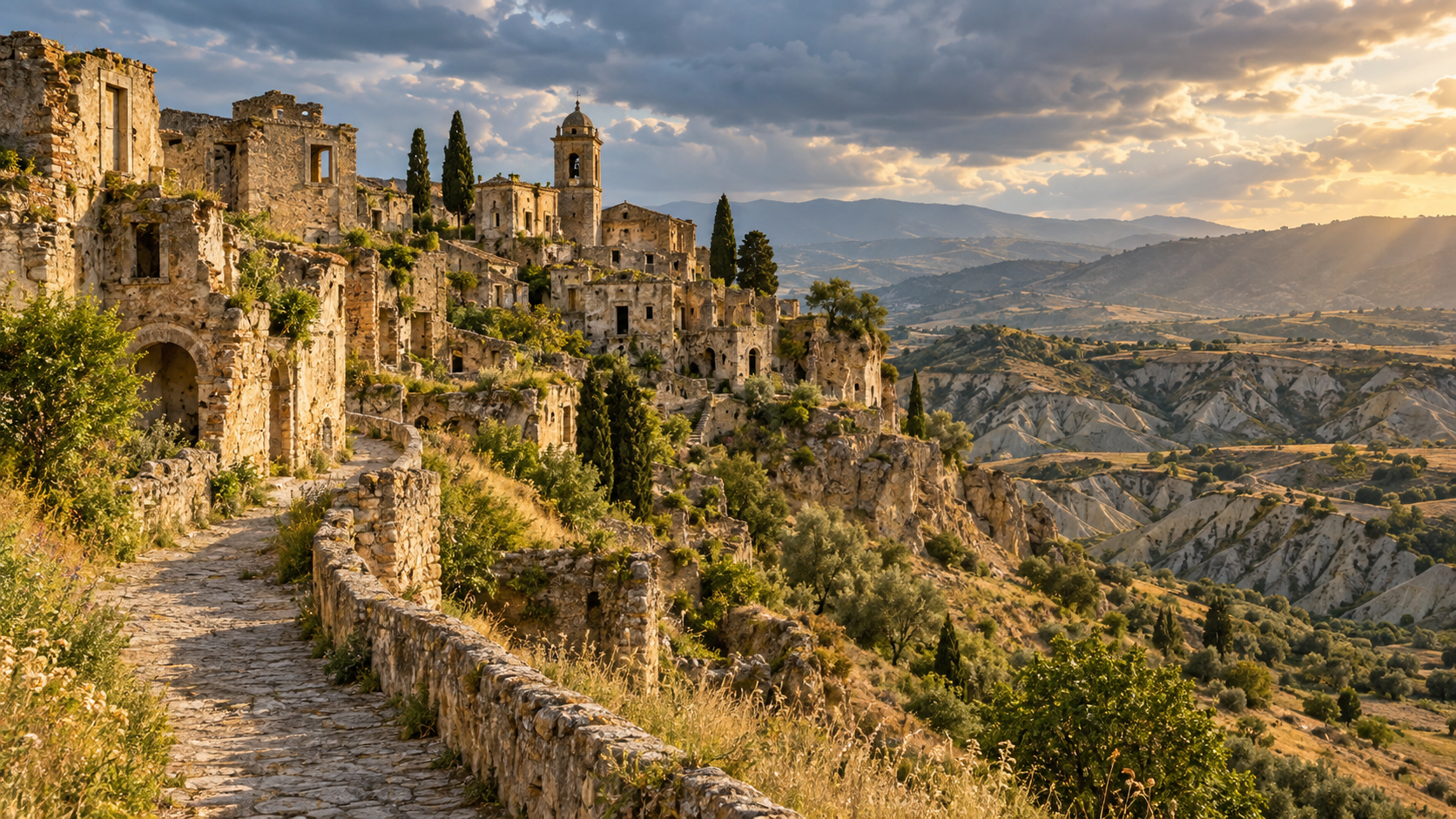
1. Craco, Basilicata: Italy’s Most Cinematic Ghost Town
Craco rises above the pale, eroded landscape of Basilicata like the remains of a medieval kingdom. From a distance, its houses appear stacked against the hillside beneath a Norman tower.
The old town was evacuated following a devastating landslide in 1963. Flooding and an earthquake later contributed to its decline, while residents rebuilt their lives in Craco Peschiera.
Today, Craco is probably Italy’s best-known ghost town. Its dramatic appearance has attracted filmmakers, photographers and television productions. Yet the landscape is more than a spectacular backdrop: it tells a sobering story about geological instability and forced relocation.
Visitors should not enter the ruins independently. Access to the historic center is regulated because buildings and surrounding terrain may be unstable. Official visits generally begin through the museum and authorized visitor program.
What makes Craco special
- Medieval buildings silhouetted above the Lucanian badlands
- Extraordinary views across an austere southern landscape
- A powerful connection between natural disaster and human displacement
- Easy inclusion in a broader Basilicata road trip
Craco is approximately 50 kilometers from Matera, making it a natural addition to an itinerary through the region. Italia Mia’s complete guide to Basilicata can help visitors plan the rest of the journey.
2. Pentedattilo, Calabria: The Village Beneath Five Stone Fingers
Pentedattilo occupies one of the most imaginative landscapes in southern Italy. The village clings to the slopes of Monte Calvario, whose five rocky pinnacles resemble the fingers of a gigantic hand. Its name comes from the Greek words for “five fingers.”
The settlement was severely damaged by the 1783 Calabrian earthquake. Depopulation continued over generations, and the historic center was eventually almost entirely abandoned.
Yet Pentedattilo is no longer silent. Restoration projects, artisans, cultural associations and the Pentedattilo Film Festival have given the village a new identity. Small workshops and seasonal activities now appear among its old stone buildings. Italy’s official tourism portal describes it as a former ghost town where tourism and craftsmanship have begun to flourish again.
What makes Pentedattilo special
- The unforgettable hand-shaped mountain
- Stone houses seemingly carved into the rock
- Greek-Calabrian cultural heritage
- Views extending toward the Ionian coast
- A convincing example of revival without overdevelopment
Pentedattilo can be combined with Bova, Reggio Calabria and the coast around Melito di Porto Salvo. Read more about this remarkable part of southern Italy in Italia Mia’s Calabria travel guide.
3. Roghudi Vecchio, Calabria: A Village at the Edge of the Aspromonte
Roghudi Vecchio occupies a rocky spur above the Amendolea riverbed in the wild landscape of the Aspromonte. Although it lies only about 40 kilometers from the coast, reaching it requires time and careful driving.
The village was evacuated following destructive floods and landslides in the early 1970s. Residents were relocated closer to the coast, creating a geographical separation between the old settlement and the new municipality.
Roghudi lies within Calabria’s historic Greek-speaking area. The presence of the Grecanico language and local traditions gives the abandoned village a cultural importance extending far beyond its ruined buildings.
Legends surround the site. One concerns strange carved stone heads placed near doorways to keep evil forces away. Another tells of enormous nails supposedly hammered into the rock to prevent the village from sliding into the valley. These stories should be understood as folklore, but they illustrate how communities explained the dangers of an unpredictable landscape.
Visiting Roghudi Vecchio
The road is narrow, isolated and potentially affected by weather or rockfalls. It is wise to seek current local advice before attempting the journey. Do not enter unstable buildings, and avoid visiting alone during poor weather.
The official Italian tourism itinerary for the area emphasizes that the journey from Melito Porto Salvo takes longer than its relatively short distance suggests.
4. Gairo Vecchio, Sardinia: A Town Abandoned to the Mountains
In Sardinia’s Ogliastra region, Gairo Vecchio stretches across the slope of Monte Trunconi above the Rio Pardu valley. Rows of roofless homes and crumbling walls follow the steep contours of the hillside.
A series of destructive floods and landslides—particularly the disastrous events of 1951—made the settlement unsafe. Its residents gradually moved to newer communities, including modern Gairo.
Unlike a prehistoric archaeological site, Gairo still looks recognizably domestic. Doorways, rooms, staircases and sections of painted wall remain visible. It is easy to imagine the farmers, shepherds, merchants and children who once filled its streets.
The site also shows why Sardinia should never be considered merely a beach destination. Its interior contains mountains, prehistoric monuments, pastoral communities and settlements shaped by harsh environmental conditions. The regional tourism authority identifies Gairo Vecchio as eastern Sardinia’s most famous ghost village.
Travelers planning a longer island journey can consult Italia Mia’s guide to the region of Sardinia.
5. Roscigno Vecchia, Campania: The Pompeii of the Twentieth Century
Roscigno Vecchia is sometimes called the “Pompeii of the twentieth century,” although its story is very different from that of the Roman city.
Concerns about landslides led authorities to begin relocating the population in the early twentieth century. Residents gradually moved to Roscigno Nuova, leaving the original village increasingly empty.
At its center is Piazza Giovanni Nicotera, surrounded by the old church, communal fountain and abandoned houses. The village feels less violently destroyed than many other ghost towns. Instead, it appears to be waiting for inhabitants who simply never returned.
The Museum of Rural Civilization preserves tools and household objects recovered from homes, cellars and stables. The collection provides valuable context: without it, visitors might see only picturesque decay rather than evidence of a complete agricultural society. The municipality reports that the collection contains hundreds of objects associated with the former community.
Why visit Roscigno Vecchia?
It is one of the best places to understand ordinary village life rather than simply photograph ruins. It can also be combined with an exploration of Cilento, an area known for mountains, archaeological sites, Mediterranean landscapes and traditional food.
6. Romagnano al Monte, Campania: Frozen in 1980
On November 23, 1980, a powerful earthquake devastated communities across Campania and Basilicata. Romagnano al Monte was among the villages abandoned after the disaster.
The modern town was constructed elsewhere, while the original settlement remained on its rocky ridge above the Platano and Bianco river valleys. Its damaged homes, church and narrow streets preserve the atmosphere of a community interrupted abruptly.
Unlike a medieval ruin abandoned over several centuries, Romagnano al Monte contains traces of relatively recent life. Modern construction materials coexist with stone walls, creating a disorienting sense that the residents might have departed only yesterday.
Italy’s official tourism website describes the village as divided between a living modern settlement and an old center “crystallised” at the moment of the 1980 earthquake.
Visitors should respect barriers and local restrictions. Earthquake-damaged structures may remain dangerous even when exterior walls appear solid.
7. Apice Vecchio, Campania: A Medieval Town Emptied by Earthquakes
Apice Vecchio stands approximately 13 kilometers from Benevento. Its tightly packed streets surround a Norman castle, giving the old town a distinctly medieval appearance.
The settlement was evacuated after the 1962 earthquake, although a small number of residents remained for a period. Further damage from the 1980 Irpinia earthquake reinforced the relocation to Apice Nuova.
The castle has become central to efforts to restore and interpret the old village. Cultural events and guided activities occasionally bring life back to streets once filled with shops and families.
Official tourism information identifies the earthquakes of 1962 and 1980 as the principal events behind the village’s abandonment.
Combine Apice with
- Benevento and its Roman monuments
- The vineyards of the Sannio countryside
- Other earthquake-affected communities of inland Campania
- Roscigno Vecchia or Romagnano al Monte on a longer road trip
8. Monterano, Lazio: Ruins, Nature and the Work of Bernini
Not every Italian ghost town was abandoned in modern times. Ancient Monterano, west of Lake Bracciano and within reach of Rome, has been uninhabited for more than two centuries.
The settlement developed across Etruscan, Roman and medieval periods before reaching renewed importance under the Altieri family. In the seventeenth century, Gian Lorenzo Bernini contributed to its architectural transformation.
Among its most recognizable remains are the dramatic convent of San Bonaventura, a fountain associated with Bernini, sections of an aqueduct, defensive walls and the ruins of noble buildings. Vegetation and grazing animals now occupy spaces once controlled by powerful families.
Malaria, conflict and economic decline contributed to the town’s abandonment around the end of the eighteenth century.
Monterano later became a popular filming location. Its ruins provided scenery for Italian productions and international films, giving the dead city a curious second life on screen.
The abandoned settlement lies within the Monterano Regional Nature Reserve. The site is normally accessible by foot without an admission charge, but there are no cafés, restaurants or lighting among the ruins.
9. Consonno, Lombardy: The Failed “Las Vegas of Brianza”
Consonno is unlike any other ghost town in Italy.
Once a traditional rural hamlet near Lecco, it was purchased during the 1960s by entrepreneur Mario Bagno. Much of the old settlement was demolished to make room for an eccentric entertainment resort intended to become the “Las Vegas of Brianza.”
The result included restaurants, dance halls, decorative towers and a collection of architectural fantasies inspired by different parts of the world. Promotional signs promised that everything in Consonno was wonderful and that the celebration never ended.
But it did end.
A landslide in 1976 blocked the main access road. The resort declined, and its brightly colored attractions were gradually left to decay. Today, rusting signs, abandoned structures and an unusual minaret-like tower create a surreal contrast with the surrounding Lombard hills. The regional tourism authority continues to describe Consonno as a ghost town and the remains of an attempted entertainment paradise.
Consonno is especially intriguing because it represents abandonment caused not by the collapse of an ancient agricultural village alone, but also by the failure of a modern commercial dream.
10. Bussana Vecchia, Liguria: The Ghost Town That Artists Revived
Bussana Vecchia overlooks the Ligurian coast near Sanremo. A devastating earthquake struck the village in 1887, after which the original population relocated to Bussana Nuova.
For decades, the damaged town stood largely empty. Then, during the 1950s and 1960s, artists began moving into its abandoned buildings. They repaired spaces, established workshops and galleries, and created an unconventional international community.
Bussana Vecchia is therefore not a true ghost town today. People live and work among the ruins, and visitors will encounter art studios, ceramics, craft shops and places to eat.
The most poignant structure is the ruined Church of Sant’Egidio, whose damaged walls and surviving bell tower remain symbols of the earthquake. Visitors can also explore the old lanes and follow a historic mule track toward the newer settlement.
Italy’s tourism portal describes Bussana Vecchia as an open-air work of art inhabited by an international community of artists.
Its story makes an appropriate conclusion to this journey: abandonment does not always have to be permanent.
Which Italian Ghost Town Is Best for You?
| If you are interested in… | Consider visiting… |
|---|---|
| Dramatic photography | Craco or Pentedattilo |
| Earthquake history | Apice Vecchio or Romagnano al Monte |
| Rural Italian life | Roscigno Vecchia |
| Wild landscapes | Roghudi Vecchio or Gairo Vecchio |
| Architecture and cinema | Monterano |
| Unusual modern history | Consonno |
| Art and creative communities | Bussana Vecchia |
| Italian-American ancestral connections | The abandoned village closest to your family’s town of origin |
How to Visit Italian Ghost Towns Safely
The word “abandoned” does not mean that a site has no owner, rules or dangers. Some ghost towns are publicly accessible, others require a guide, and certain areas may be completely closed.
Never assume an empty building is safe
Floors can collapse, roofs may be unstable, and vegetation can conceal holes or debris. Remain on recognized paths and obey every barrier.
Check conditions locally
Access can change following storms, landslides, earthquakes or restoration work. Consult the municipality, regional tourism authority, museum or local visitor center shortly before traveling.
Do not remove objects
Tiles, tools, letters, religious objects and household fragments are part of the site’s history. Taking even a small souvenir damages the integrity of the place and may be illegal.
Wear suitable footwear
Uneven stones, broken glass, mud and steep paths make sandals a poor choice. Hiking shoes or sturdy walking shoes are preferable.
Avoid entering private property
A place can look abandoned while still being privately owned. This is particularly important in partially revived villages such as Bussana Vecchia and Pentedattilo.
Plan transportation carefully
Many ghost towns are difficult or impossible to reach by train. A car is usually the most practical option, but mountain roads may be narrow and poorly lit. Italia Mia’s guide to driving in Italy and its overview of the Italian autostrade are useful starting points.
The Best Time to Visit
Spring and early autumn are generally the most comfortable seasons. Temperatures are moderate, vegetation adds color to the ruins, and the light is particularly good for photography.
Summer can be extremely hot in Basilicata, Calabria, Campania and Sardinia. Many abandoned sites provide little shade or drinking water.
Winter creates an atmospheric experience, but rain, ice, fog and shorter daylight hours can make isolated roads and paths more difficult. Consult Italia Mia’s month-by-month guide to the best time to visit Italy when planning a longer trip.
Why These Silent Villages Matter
It is tempting to see a ghost town simply as a beautiful ruin. But Italy’s abandoned villages preserve something more important: the memory of communities that were forced to adapt.
Their inhabitants did not disappear. They moved to modern towns, crossed regional borders or emigrated overseas. Their descendants may now live in New York, New Jersey, Pennsylvania, California, Toronto, Melbourne or Buenos Aires without knowing much about the village their family once called home.
For an Italian American, standing in an abandoned southern village can make the history of migration tangible. A passenger list or birth certificate records a departure, but an empty house reveals what may have been left behind.
These towns also raise questions about Italy’s future. Hundreds of small communities continue to face population loss. Tourism can support preservation, but popularity can also damage fragile places. The best visitor approaches them with curiosity, humility and respect.
Italy’s ghost towns are not truly empty. They remain filled with architecture, memory, landscape and unfinished stories. You only have to walk slowly enough to hear them.
Frequently Asked Questions
Does Italy have real ghost towns?
Yes. Italy has numerous villages and historic centers abandoned because of earthquakes, landslides, floods, malaria, economic decline and migration. Some remain deserted, while others have been partially restored or repopulated.
What is the most famous ghost town in Italy?
Craco in Basilicata is probably the most internationally recognized. Its hilltop ruins and surrounding badlands have made it a popular location for photographers and filmmakers.
Can tourists enter Craco?
The historic center should be visited only through authorized arrangements. Because of landslide damage and unstable structures, visitors should never bypass gates or attempt to explore the ruins independently.
Are Italian ghost towns free to visit?
Some, including Monterano, can generally be explored without an admission fee. Others may require tickets, guided visits or special permission. Conditions and regulations can change, so always check official information.
Do people live in Bussana Vecchia?
Yes. Bussana Vecchia was abandoned after the 1887 earthquake but was later repopulated by an international community of artists. It is better described as a revived village built among historic ruins.
Can I visit these places without a car?
A few can be reached using a combination of trains, buses, taxis and walking. However, a rental car is normally the most practical way to reach remote villages, especially in Calabria, Basilicata, Sardinia and inland Campania.
Are ghost towns suitable for children?
Some accessible villages may be appropriate for families, but many contain unstable walls, steep paths and unprotected drops. Parents should investigate the specific site beforehand and keep children close at all times.
External Links
- Italy’s official guide to abandoned villages
- Official Craco visitor information
- Craco on Italia.it
- Pentedattilo on Italia.it
- Gairo Vecchio—Sardinia’s official tourism website
- Roscigno Vecchia—Comune di Roscigno
- Romagnano al Monte on Italia.it
- Apice Vecchio on Italia.it
- Monterano Regional Nature Reserve information
- Bussana Vecchia on Italia.it