
Part of Unexpected Italy: Stories from My Recent Travels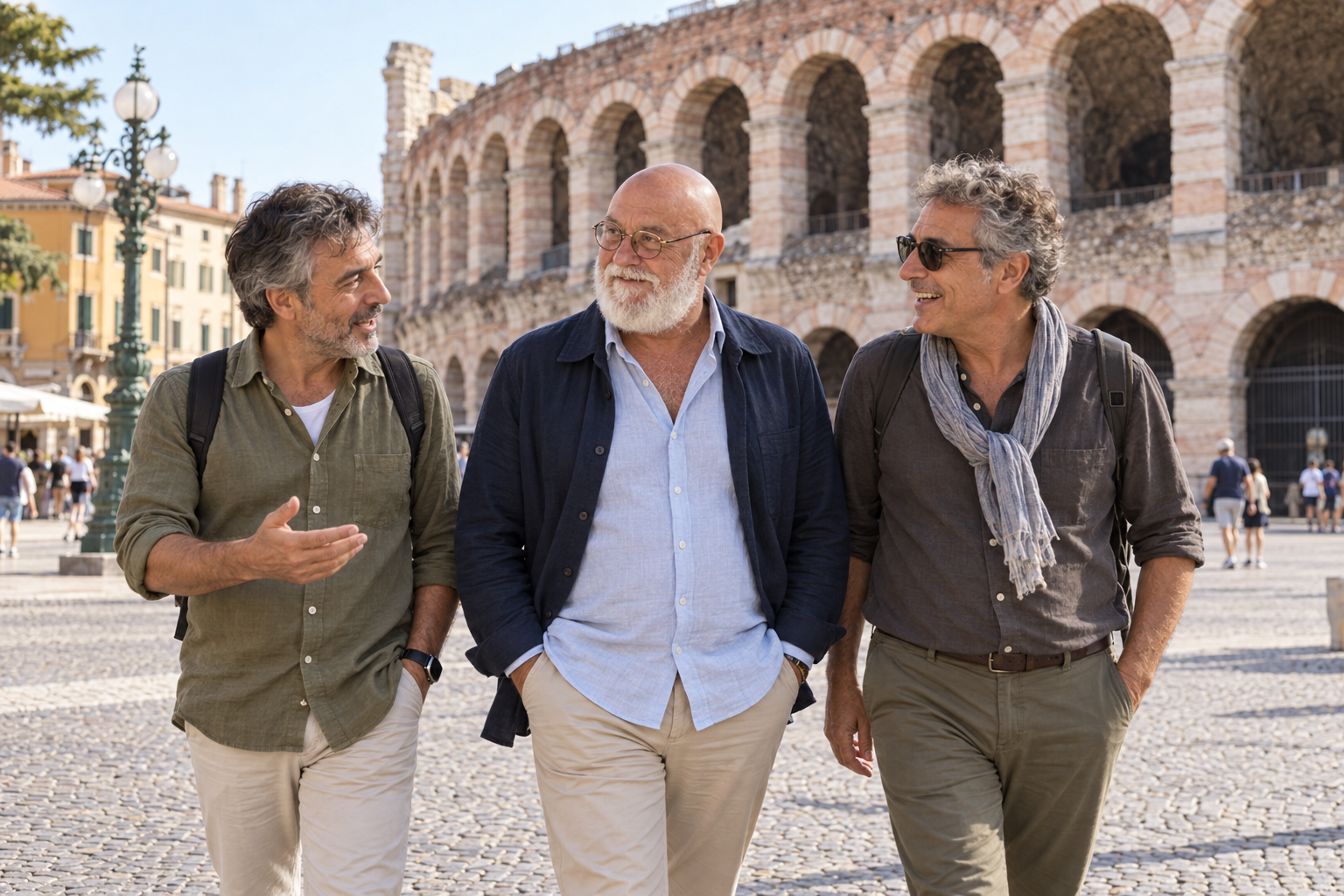 There are cities that invite careful planning, and others that are better understood by walking until the map becomes unnecessary. Verona belongs to the second group. I went there for the day with two friends, with no ambition to see everything. We wanted to visit the principal sights, eat something decent and return home without turning the day into a race.
That modest plan suited Verona. The historic center is compact enough to cross on foot, but dense enough that every direct route becomes a succession of distractions: a Roman gate, a courtyard, a church façade, a market stall or another view of the Adige. We began with the famous Verona and gradually found the real one underneath it.
Starting at Piazza Bra
Our first destination was Piazza Bra, the broad entrance to the monumental city. The Arena dominates the square, but not in the theatrical way I had expected. Photographs usually isolate it, making it seem like an object from antiquity preserved behind glass. In reality, it stands in the middle of Verona’s daily movement, surrounded by cafés, traffic, people meeting and waiters preparing tables.
We walked around the amphitheater before going farther. Built in the first century, the Arena has survived because Verona never allowed it to become merely a ruin. It has remained a working part of the city, most famously as the setting for large-scale opera performances. Even without entering, its mass is impressive. The stone is worn, irregular and more convincing up close than it appears in polished travel photographs.
The Liston, the wide paved promenade along the square, was already busy. We resisted the temptation to sit down immediately. On a day trip, the first coffee can easily become the moment when everyone begins negotiating what to skip. We had only just arrived, so we continued toward Via Mazzini.
Through Via Mazzini to Juliet’s Courtyard
Via Mazzini is Verona’s polished commercial corridor, lined with familiar fashion names and a steady current of shoppers. It connects Piazza Bra with the older civic heart of the city so efficiently that it would be easy to treat it as a passage rather than a place. With friends, however, even an ordinary shopping street becomes part of the day: comments about clothes we would never buy, disagreements about where to stop for coffee and the usual attempts to keep walking at the same speed.
From there we turned toward the Casa di Giulietta. The courtyard was crowded, as expected. People raised their phones toward the balcony, waited near the bronze statue and tried to manufacture a private romantic moment in one of the least private spaces in Verona.
I do not object to the story. Shakespeare’s tragedy has given Verona an international identity that few cities could purchase through advertising. But the courtyard is most interesting when approached honestly. It is a place created from the long relationship between literature, tourism and the human desire to attach love to a physical address. Romeo and Juliet were not historical residents waiting to be documented. The balcony is a later construction. Still, the visitors’ enthusiasm is real, and that, too, has become part of Verona.
We stayed only long enough to look, make a few dry comments and move on. The city became more persuasive as soon as we left the balcony behind.
Piazza delle Erbe, Where Verona Feels Most Alive
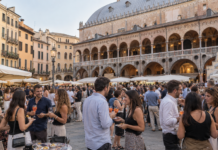
Piazza delle Erbe was the point at which the day found its rhythm. The square occupies the site of the Roman forum, but it does not feel like an archaeological display. It is layered rather than preserved: medieval buildings, Renaissance frescoes, market umbrellas, stone monuments, café tables and people crossing in every direction.
We stopped near the fountain of Madonna Verona and looked toward the Torre dei Lamberti. The façades around the square do not form a neat composition, and that is precisely their strength. Verona’s history is visible as accumulation. One century did not erase the previous one; it built beside it, above it or directly into it.
Piazza delle Erbe also exposed the limits of traveling with a list. One friend wanted to climb the tower. The other was hungry. I wanted to remain in the square long enough to see something beyond the first impression. We solved the disagreement in the traditional Italian manner: we found food first.
Lunch was simple and deliberately unceremonious. On a short visit, I prefer a place that allows the conversation to continue over one that turns the meal into a performance. We talked about the city, but also about entirely unrelated matters. That is one of the differences between traveling alone and traveling with friends. A city does not occupy every minute. It becomes the setting for conversations that might be remembered more clearly than the names of the buildings.
Piazza dei Signori and the Scaliger Verona
After lunch we passed beneath the arch into Piazza dei Signori. The change was immediate. Piazza delle Erbe is commercial and restless; Piazza dei Signori feels controlled, almost formal. Dante stands at its center, surrounded by palaces associated with the political power of medieval Verona.
Nearby, the Arche Scaligere presented a more severe version of the city. The elaborate Gothic tombs of the Scaliger lords are beautiful, but they are also declarations of authority. They remind visitors that Verona was not built as a romantic backdrop. It was a strategic and frequently contested city, governed by families that understood architecture as a public expression of power.
This part of the center deserved more time than we could give it. That is an honest limitation of a day trip. You can see the shape of Verona in a day, but not absorb every historical layer. The mistake is pretending otherwise.
Walking to Ponte Pietra
We continued toward the Adige, passing quieter streets as the concentration of shops and tour groups began to loosen. Ponte Pietra came into view at a bend in the river. It is Verona’s oldest Roman monument, although war damage and later reconstruction have also become part of its physical history.
The bridge provided the pause that the day needed. From the center, Verona can seem like a sequence of celebrated attractions placed unusually close together. At the river, its geography becomes clear. The Adige curves around the historic core, the hills rise beyond it, and the city no longer feels like a stage set built around the Arena and Juliet’s balcony.
We crossed slowly. One friend looked back toward the towers while the other tried to identify the buildings on the opposite bank. Nobody was in a hurry for several minutes. It was not a dramatic event, and nothing unexpected happened. Yet this was the part of Verona that stayed with me: three friends standing above the river, briefly silent after spending most of the day talking.
On the far side, the Roman Theatre and the climb toward Castel San Pietro offered the possibility of a higher view. A day trip requires decisions, and ours was to preserve enough energy to walk back across the center rather than treat every staircase as an obligation. Verona had already shown us enough to justify returning.
Castelvecchio Before Leaving
We followed the river back toward Castelvecchio. Its fortified walls and distinctive bridge give the western side of the center a different character—less decorative, more defensive. Even without making a full museum visit, walking through the area helped complete the historical arc of the day, from the Roman Arena to the medieval city and its later transformations.
By then our pace had slowed. We returned toward Piazza Bra with the mild fatigue that comes from a day spent almost entirely on foot. The square looked different in the later light. In the morning it had been our starting point and an item to be visited. Now it felt like a recognizable place.
We finally sat down for a drink. The discussion was no longer about what we still had time to see. It was about which part of the day had been worth the journey. The Arena was the most imposing sight, and Piazza delle Erbe the most animated. But all three of us returned to Ponte Pietra and the river.
What Verona Revealed in One Day
Verona is often reduced to two powerful images: the Arena and Juliet’s balcony. Both deserve a place in a first visit, but neither explains the city by itself. The more interesting Verona appears in the connections between its monuments—in the walk from Roman stone to medieval squares, from commercial streets to the Adige, and from a crowded literary shrine to a bridge where the city finally opens around you.
A day was enough to understand its scale, but not enough to exhaust it. That may be the best result of a short journey. We did not leave with the satisfaction of having completed Verona. We left knowing where we would begin the next time.
Practical Notes for a Day in Verona
The historic center is well suited to walking. A sensible route begins at Piazza Bra and the Arena, continues along Via Mazzini to the Casa di Giulietta, Piazza delle Erbe and Piazza dei Signori, then reaches Ponte Pietra before returning toward Castelvecchio.
Comfortable shoes matter more than an ambitious schedule. If you want to enter the Arena, climb the Torre dei Lamberti or visit the Castelvecchio Museum, check opening times in advance and choose one or two paid attractions rather than trying to fit in all of them. Verona rewards time spent in its streets and squares as much as time spent inside monuments.
External Sources
Visit Verona – Official Tourist Board
Arena di Verona – Official Website
Piazza delle Erbe – Visit Verona