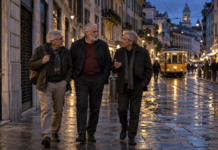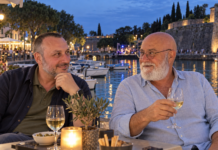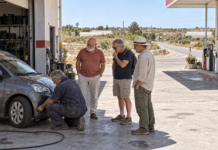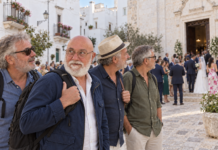

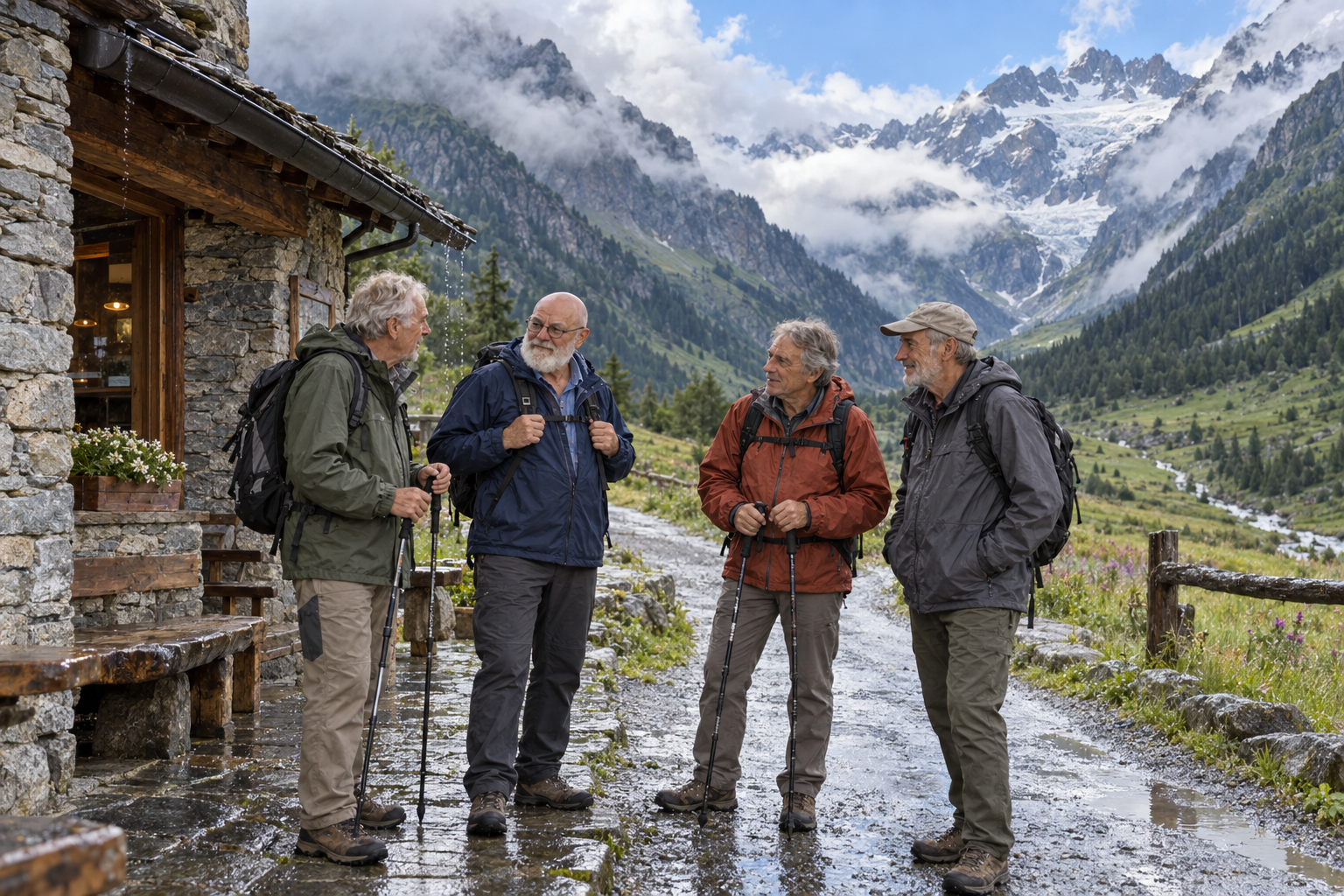
 There were four of us in the car, all men, leaving northern Tuscany before dawn with enough luggage for four nights and enough opinions for a much longer journey.
The Aosta Valley looked close on the map. It was simply north and slightly west, beyond Liguria and Piedmont, a narrow region pressed against France and Switzerland. The distance itself was manageable. What the map did not show was how quickly the landscape would change once we left the plain and entered the valley along the Dora Baltea.
Vineyards appeared on slopes that seemed too steep to cultivate. Castles occupied rock outcrops above the road. The mountains rose so abruptly that the valley felt less like an open landscape than a corridor with stone walls several thousand meters high.
We had rented a B&B in Aosta for four nights. That gave us a fixed base and, we believed, a simple method: castles in the morning, valleys in the afternoon, dinner in town, then repeat.
It was July. In Tuscany, July meant heat that could be anticipated. In the Alps, we were about to learn, a clear morning was not a contract.
Aosta as Our Headquarters
The B&B stood outside the busiest part of Aosta, close enough for us to walk into the center but far enough away that parking did not become the central problem of the holiday.
On our first evening, we crossed the city through the Arch of Augustus, continued toward the Roman Theatre and walked along streets where Roman remains, medieval towers and ordinary shops occupied the same compact space. Piazza Chanoux was full without feeling chaotic. People were having aperitivi under the porticoes while the mountains remained visible at the ends of the streets.
We discussed the next four days over dinner. One friend had made a list of castles. Another was interested mainly in the mountain roads. The third wanted long lunches and considered every itinerary an opening proposal rather than an obligation.
I wanted to see how the valley fit together. From the motorway, its castles had looked like defensive punctuation marks: Fénis low and solid behind its walls, Verrès commanding the entrance to its side valley, and others set high above villages and vineyards.
Our compromise was predictable. We would try to do everything.
Castles Along the Dora Baltea
The next morning we drove east to Fénis Castle. Its towers, double walls and interior courtyard made it look like the medieval castle people imagine before they have seen a real one. Yet its position was not especially defensive. It had been a prestigious residence of the Challant family, built to demonstrate rank as clearly as to provide protection.
From Fénis we continued to Issogne. The change was immediate. Issogne was less severe, more domestic and more revealing about the life that once took place inside. Its painted courtyard and wrought-iron pomegranate fountain remained in my mind longer than the military outlines of the earlier castle.
We added Verrès because it was nearby. By then, the stone staircases and family histories had begun to merge. The friend who had prepared the list continued to supply dates. The rest of us became less disciplined with each room.
On another day, we visited Sarre Castle, with its associations with the House of Savoy, and stopped at Saint-Pierre, whose castle rises above orchards and the main road. We did not enter every building we saw. In the Aosta Valley, that would have turned the trip into an inspection.
The castles worked best as landmarks. They explained the geography: control the valley floor, watch the tributary valleys, occupy the narrow points. Even when we were no longer touring them, they remained above us as we drove.
Into the Valleys
The side valleys were different. Each required leaving the central route and committing to a road that climbed toward a separate world.
We drove to Cogne and continued to Valnontey, at the edge of Gran Paradiso National Park. The meadows were broad and green, the glaciers visible beyond them. We walked without attempting anything ambitious. At our age, four men can turn a modest path into a competition while insisting that nobody is competing. One walked quickly, one stopped for photographs, one claimed to be conserving energy, and I tried not to become responsible for the schedule.
Another day took us into Valsavarenche. Villages became smaller, the road narrower and the traffic lighter. We saw hikers preparing packs with the seriousness of people going somewhere that required more than comfortable shoes. We were visitors moving between the car, short walks and meals, and there was no reason to pretend otherwise.
By the third day, the routine seemed reliable. The morning would begin clear. Clouds would gather around the peaks after lunch. A brief shower might pass, but the evening would settle again.
That assumption lasted until Val Ferret.
The Morning in Val Ferret
We left Aosta under a clean blue sky and drove west toward Courmayeur. Above the town, the Mont Blanc massif dominated the view without needing to be identified. Even from the road, its scale disturbed the proportions of everything around it.
From Courmayeur, we entered Val Ferret and continued toward Planpincieux and Lavachey. The road followed the valley beneath sharp ridges and glaciers. In July, the lower slopes were intensely green, and the air felt several degrees cooler than it had in Aosta.
We parked and began walking along an easy route above the valley floor. None of us had planned a serious hike. We carried water, light jackets and the misplaced confidence produced by sunshine.
At first, the clouds improved the view. They moved across the peaks, exposing and concealing sections of rock and ice. One of my friends said we should continue for another half hour before turning back. Another pointed out that the people coming toward us were putting on waterproof jackets.
We noticed this but did not immediately interpret it as information.
The temperature dropped first. Then the wind arrived, pushing through the valley with enough force to bend the grass. The peaks disappeared. The cloud that had been above us seemed to descend to the path.
The first drops were large and widely spaced. Within minutes, rain was striking the ground hard enough to bounce.
We turned back.
The Building Near Lavachey
There was no dramatic rescue. We were not lost, and the road was not far away. The problem was simpler: four men in summer clothes were becoming soaked, visibility had shortened, and thunder was moving closer.
Near Lavachey, we saw a low stone building serving as a bar and restaurant. Several people were already crowded beneath the entrance canopy. We joined them, then moved inside when another burst of rain made the doorway useless as shelter.
The room was warm and smelled of wet clothing, coffee and cooked cheese. Every table was occupied. A woman working there looked at the four of us, looked at the remaining chairs and began reorganizing the room without asking whether anyone preferred privacy.
We were seated at a long table with a couple from Turin, two hikers from Belgium and a man from the Swiss side of the mountains who had arrived on a motorcycle. His waterproof clothing had performed better than ours, but water ran from his gloves onto the floor.
Nobody had chosen the company. The weather had made the seating plan.
We ordered polenta concia, dense with butter and Fontina, because it was hot and available. Someone added a plate of local cured meats for the table. The motorcyclist ordered coffee and changed his mind when the food arrived.
Outside, rain moved across the windows in sheets. The mountains had disappeared completely.
A Conversation Without Introductions
The conversation began with the weather, as conversations between strangers often do when the weather has physically confined them to one room.
The Turin couple came to Val Ferret every summer and treated our surprise with amusement. The man told us that in the mountains, the forecast described a tendency, not a schedule. His wife corrected him: the forecast had predicted an afternoon storm, but he had chosen not to read it.
The Belgian hikers had turned around before us. They had seen the change in the clouds and understood it immediately. We admitted that we had seen people putting on waterproofs and continued anyway.
“So you had a forecast,” one of them said. “It was walking toward you.”
That ended any attempt to defend our judgment.
The Swiss rider had crossed from Martigny and intended to continue south. He unfolded a paper map on the table because his phone had lost its signal. One of my friends, who had navigated the entire trip electronically, examined the map as though it were an archaeological object.
We compared routes, argued about which castles were worth visiting and discussed the difference between staying in Courmayeur and staying in Aosta. The couple from Turin approved of our base. Aosta, they said, forced us to travel through the region rather than remain beneath its most famous mountain.
The woman serving us brought another bowl of polenta and divided it among the table. It was not free, and nobody treated it as a ceremonial act of hospitality. She was feeding wet customers during a storm and keeping the room operating. The efficiency was more convincing than any performance of mountain tradition.
For almost two hours, nobody could leave. The fact removed the usual impatience from conversation. Phones were checked, found unhelpful and put away. We learned that one of the Belgian hikers repaired elevators, that the Swiss man taught mathematics, and that the couple from Turin had been married for thirty-eight years but disagreed about every mountain road in the region.
They learned that we were four friends from northern Tuscany, staying four nights in Aosta and attempting to combine castles, valleys and generous lunches in a schedule that had not accounted for alpine weather.
No one offered a lesson about life. We talked because there was thunder outside and nowhere else to sit.
When the Mountains Returned
The rain stopped as abruptly as it had begun.
At first, the room became brighter. Then pieces of the opposite slope appeared through the windows. People went outside cautiously, carrying jackets and unfinished conversations.
The valley had changed. Cloud still filled the lower spaces, but higher ridges had emerged into sunlight. For a few minutes, it seemed that we were standing above one layer of weather and below another. Water ran from roofs and across the road. The temperature remained cool enough that none of us complained about the heavy food.
The Belgian hikers resumed their route. The motorcyclist waited for the road to dry. The Turin couple remained for coffee. We exchanged first names, but no telephone numbers. There was no reason to manufacture a future relationship from an accidental lunch.
Before leaving, the man from Turin pointed toward the upper valley and told us not to assume the storm was finished merely because we could see blue sky.
This time, we listened.
We returned to the car and drove slowly toward Courmayeur. The road shone with rain, and fragments of cloud moved between the trees. Behind us, the mountains appeared and disappeared with every bend.
Four Nights Were Not Enough
Back in Aosta that evening, our damp clothes were distributed around the B&B in ways the owner could not have intended. We went into town for dinner and reviewed the day with the mild dishonesty common among friends. Each of us remembered having recommended that we turn back before the others.
The following morning, our last, we abandoned two planned stops. We walked through Aosta again, bought Fontina and bread for the journey, and left time for coffee in Piazza Chanoux.
Four nights had been enough to see several castles and enter three mountain valleys. They had not been enough to understand the region, but that was no longer the objective.
What remained with me was not a single grand view. It was the structure of the trip: the fortified valley, the roads climbing away from it, and the speed with which conditions changed once we entered the mountains.
The storm in Val Ferret did not transform us. It delayed us, soaked us and placed us at a table with people we would otherwise have passed without speaking. For two hours, the itinerary ceased to matter because the mountains had made it irrelevant.
When the clouds lifted, we had eaten too much, learned more about the valley than we had from our guidebooks and lost most of the afternoon.
Nothing had gone according to plan.
It was the most useful part of the journey.