
 I went to Turin by train and stayed for two nights at a friend’s home. It was not a major expedition, and I had not built the visit around a strict itinerary. I wanted to see the Egyptian Museum, walk through the center, look around the shops and spend some unhurried time with someone I did not see often enough.
My expectations of Turin were respectful but not especially warm. I knew its reputation: the former Savoy capital, the industrial city of Fiat, the broad avenues, the arcades and the grand cafés. I expected order, architecture and perhaps a certain northern reserve. I did not expect the city to make an immediate effort to charm me, and in that respect I was correct.
What I had not understood was that Turin does not reveal itself through a single famous view. Its character accumulates. It appears in the distance between one square and the next, in the protection of the porticoes when the weather changes, in the seriousness with which a café serves chocolate, and in conversations that begin without any obvious purpose.
The rain helped me see that.
Arriving by Train
The train brought me directly into the center, avoiding the negotiations that usually come with arriving by car: exits, traffic, restricted zones and the search for parking. At Porta Nuova, Turin seemed immediately composed. The station opens onto Corso Vittorio Emanuele II, and from there the city presents long lines, measured façades and streets that appear to have been drawn with a ruler.
My friend met me, and we walked rather than taking a taxi. I had packed for only two nights, so there was no reason not to. The air was cooler than it had been in northern Tuscany, and the light had the pale, slightly metallic quality that Turin often seems to wear well.
After leaving my bag at his apartment, we went back out. Having a local friend changed the rhythm of the visit. There was no pressure to collect landmarks. We could enter a shop, reject three cafés before choosing one, turn into a side street for no reason and go home when we had had enough.
That first afternoon was mostly a long reconnaissance of the center. We crossed Piazza San Carlo, continued toward Piazza Castello and walked beneath arcades that made the commercial streets feel less exposed than those of many Italian cities. Turin’s elegance was obvious, but it was not decorative in the usual sense. The city did not appear arranged for visitors. Offices, bookshops, clothing stores, pastry counters and old institutions all occupied the same disciplined urban frame.
In Galleria Subalpina, the glass roof filtered the daylight and the polished interior seemed to belong to another era without becoming theatrical. We stopped for coffee, continued through Via Po and eventually reached Piazza Vittorio Veneto, its great open space descending toward the Po and the church of the Gran Madre on the opposite bank.
I admired it, but I was still observing Turin from the outside.
Shops, Cafés and a City That Does Not Hurry to Explain Itself
The next morning, we began with no urgency. One advantage of staying with a friend is that breakfast does not have to become part of the sightseeing program. We had coffee, discussed where to go and changed the plan twice before leaving.
We moved between the shops around Via Roma, Via Garibaldi and the streets leading toward Piazza Castello. I was struck by how little noise the city needed in order to feel active. Turin was busy, but it did not constantly announce its activity. Even the more elegant shops seemed less concerned with spectacle than similar places in Milan.
The cafés were another matter. Turin takes them seriously, and not only because of coffee. Their mirrors, woodwork, counters, small pastries and thick chocolate are part of the city’s public life. They are places in which people sit properly, talk without shouting and remain longer than a quick espresso would require.
We stopped more than once during the trip. I tried chocolate and later a bicerin, the layered Torinese drink of coffee, chocolate and cream. It is rich enough to make a separate dessert unnecessary. The first taste is easy; finishing the glass requires a little more commitment.
That seriousness about chocolate could easily become a tourist cliché, but in Turin it felt integrated into ordinary life. Chocolate was not presented as a souvenir invented for visitors. Gianduiotti appeared in windows beside pastries bought by local customers. A cup of hot chocolate arrived with the density of something meant to be eaten slowly rather than drunk on the way elsewhere.
My friend watched me assess it and asked whether I approved.
“It isn’t a drink,” I said. “It’s a decision.”
He laughed and ordered another coffee.
The Egyptian Museum Without Rushing
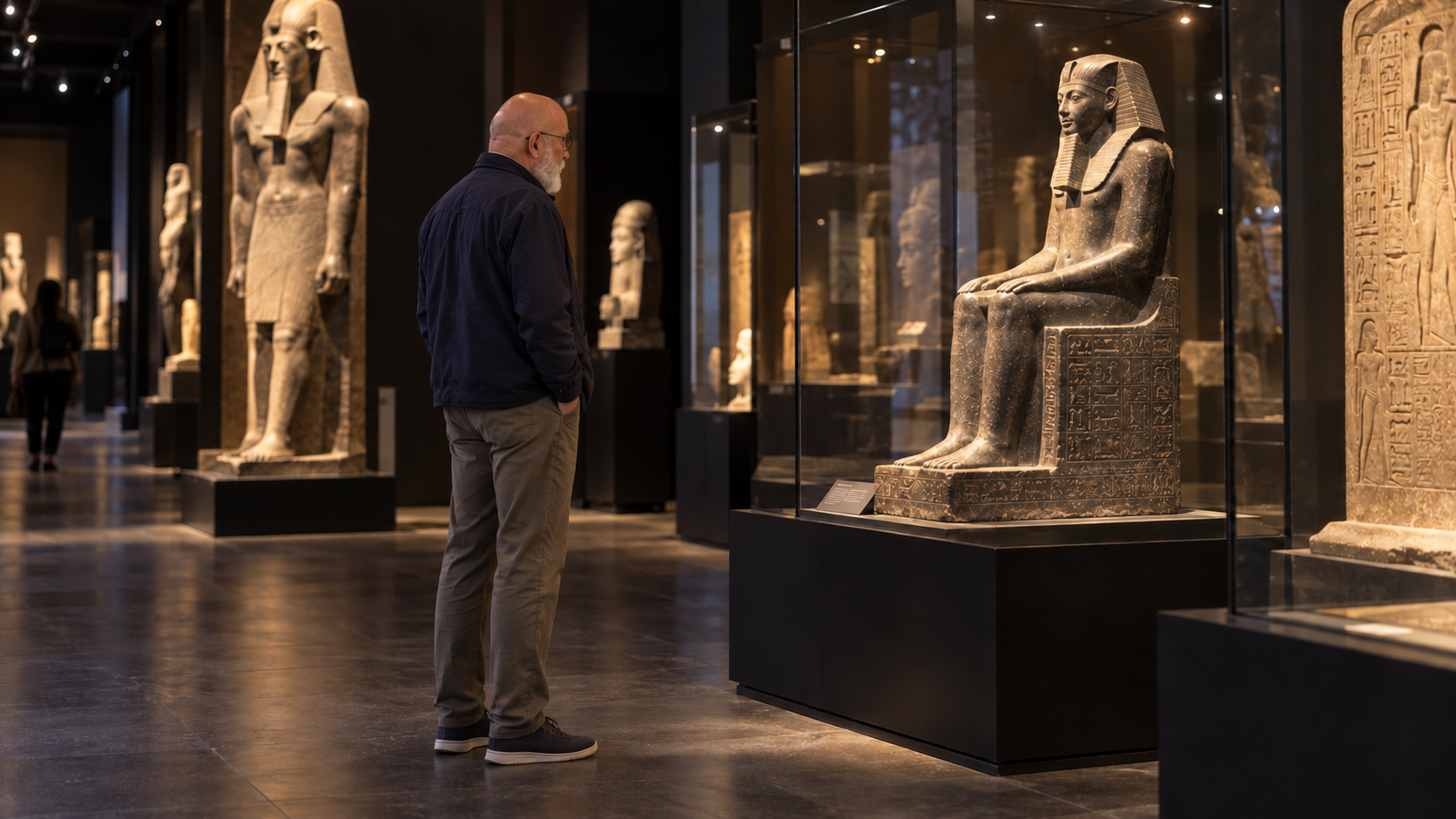
The Museo Egizio was the one visit I considered essential. Founded in 1824, it is not a secondary collection placed in Turin by chance. The scale and depth of the museum make it one of those institutions that can dominate an entire day if you allow it.
We did not try to study everything. That is one of the mistakes people make in important museums: determination replaces attention. After a while, every object becomes simply the next object.
Instead, we slowed down in front of the pieces that held us. The monumental statues had the expected authority, but the smaller objects affected me more: tools, fragments of writing, domestic items and funerary objects made for people whose names survived while almost everything around them disappeared.
The papyri were particularly absorbing. Among the museum’s documents are records connected to royal succession, work, legal accusations and even one of the earliest known labor strikes. Ancient Egypt becomes less abstract when bureaucracy enters the picture. Kings and gods may dominate the galleries, but lists, disputes and wages bring ordinary human behavior much closer.
We spent several hours inside. When we emerged, the city looked almost aggressively modern for a few minutes—traffic signals, shop windows, umbrellas, mobile phones. Then the proportions adjusted again.
The weather had deteriorated while we were in the museum. A light rain was falling, steady enough to alter our plan but not heavy enough to send everyone home.
The Mercatino in Piazza Vittorio
We made our way toward Piazza Vittorio, where a small mercatino had attracted the usual mixture of purposeful buyers and people simply passing time. There were secondhand objects, old prints, household pieces, costume jewelry and items whose original use was no longer entirely clear.
Markets like this interest me because they interrupt a city’s official presentation of itself. Museums preserve what has been judged important. A mercatino collects what individual people have decided they no longer need.
I looked through old postcards of Turin, many of them showing the same squares we had just crossed. The streets were recognizable, but the vehicles, signs and people belonged to a city that had already disappeared. At another table there were small metal boxes, watches, worn books and postcards sent decades earlier with messages more practical than sentimental: arrival times, health, weather, greetings to relatives.
The rain grew heavier. Sellers began covering their tables with plastic sheets, and visitors moved under the arcades. A few minutes earlier we had planned to walk across the bridge toward the Gran Madre. That idea was abandoned without discussion.
We entered Caffè Elena, on the corner of Piazza Vittorio. Its history goes back to the late nineteenth century, when the café became a meeting place for students, intellectuals and artists associated with the nearby university and Accademia Albertina. I did not know those details when I entered. I only knew that it was dry, occupied and had a table available.
A Conversation While the Rain Continued
We ordered coffee and chocolate. At the next table, a man sitting alone had been watching the rain with the patience of someone whose schedule was not threatened by it. He was perhaps around my age, well dressed without appearing formal, with a folded newspaper beside his cup.
The conversation began because my friend commented on one of the objects I had bought at the market, a small old print that had survived the sudden packing of the stalls. The man glanced at it and identified the street shown in the image. He corrected us on the direction from which the picture had been taken, then mentioned a building that was no longer there.
He did not introduce himself immediately, and neither did we. In Italy, a conversation can begin with the subject before anyone establishes the identities of the people having it.
He had lived in Turin most of his life and had worked for years in an office connected to the automotive industry. He spoke about the city without praising it. That was what made me listen.
Turin, he said, had spent too many years being described only through Fiat, as though a city of that size had been an extension of one company. But he did not deny what the factories had meant. They had shaped neighborhoods, working hours, migration from southern Italy, family histories and the city’s sense of discipline. When that structure weakened, Turin had to decide what else it was.
I told him that the city felt more formal than I had expected.
“At first,” he replied.
He did not elaborate, and the silence after those two words was more convincing than a speech would have been.
My friend asked whether Turin had changed for the better. The man considered the question before answering. Some things were better, he said. The center was livelier, visitors came for the museums, food and culture, and the city no longer depended on a single identity. Other things had simply become more expensive.
There was nothing extraordinary in the conversation. No secret address was revealed, no invitation followed and no friendship was promised. We spoke about work, the cost of apartments, the Egyptian Museum, the weather and the strange habit visitors have of trying to understand a city in forty-eight hours.
When the rain weakened, he finished his coffee, put the newspaper under his arm and left. Only then did I realize that almost an hour had passed.
Turin After the Rain
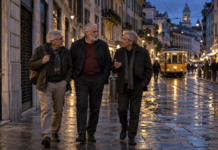
We stepped back beneath the arcades. The paving stones reflected the lights from the cafés and shops, and Piazza Vittorio seemed less severe than it had the previous day. Nothing in the architecture had changed. My way of looking at it had.
The man’s unfinished phrase—“At first”—remained with me because it accurately described the city. Turin had not been unfriendly. It had simply refused to perform intimacy on demand.
As we walked along Via Po toward Piazza Castello, I began noticing the small negotiations of daily life that had escaped me earlier: someone pulling a chair farther beneath the arcade, a shopkeeper drying the entrance, students sharing cigarettes out of the rain, a waiter carrying cups across a crowded room. The grand buildings remained in place, but they had stopped being the entire subject.
That evening, my friend and I ate without turning dinner into another event. We discussed the museum, the market and the man in the café. My friend was less surprised by the encounter than I was. Turin, he suggested, contains many people who initially appear reserved and then speak with great precision once there is a reason to speak.
The next morning, before my train, we went out for one last coffee. The weather had cleared. I could see more of the Alpine horizon, although Turin itself still held my attention. We passed shop windows that were just being arranged and cafés preparing for the day. The city had returned to work.
What Changed in Two Nights
Two nights are not enough to know Turin. They are enough, however, to correct a superficial judgment.
I had arrived expecting a dignified city that I would respect more than enjoy. I left understanding that its restraint was not coldness. Turin’s public face is controlled, but behind it is a city shaped by migration, industry, scholarship, political history, appetite and reinvention.
The Egyptian Museum provided the major cultural experience. The shops and streets gave the visit its movement. Staying with a friend gave it an ordinary domestic rhythm that no hotel could have supplied. Yet the memory that organized everything came from an afternoon we had not planned: a mercatino closing under plastic sheets, wet pavement in Piazza Vittorio, thick chocolate on a café table and a stranger who answered a simple observation with two exact words.
Turin did feel formal—at first.
That qualification made all the difference.
A Practical Note for a Short Stay in Turin
Turin works particularly well for a short train trip because Porta Nuova is within easy walking distance of the historic center. Many of the principal streets, squares, shops and cafés can be explored on foot, while trams and buses cover longer distances.
The Egyptian Museum deserves advance planning and several hours rather than a hurried visit. Its official website provides current ticket and visitor information. The city’s historic cafés are not interchangeable, so it is worth choosing according to location and atmosphere rather than trying to visit all of them. Turismo Torino maintains information about Caffè Elena, Al Bicerin, Baratti & Milano, Mulassano and other historic establishments.
Most importantly, leave part of the schedule empty. Turin is a city in which bad weather may not ruin the afternoon. It may decide what the afternoon becomes.
External Sources
The History of the Museo Egizio
Turismo Torino: Historic Cafés