
Part of Unexpected Italy: Stories from My Recent Travels
 Cremona is one of those Italian cities whose name is more famous than the place itself. People know Stradivari. They know that exceptional violins were made here. Musicians may speak of Cremona with the seriousness normally reserved for Florence or Venice, yet many travelers cross Lombardy without considering a visit.
That imbalance was exactly what made the city interesting to me.
I arrived expecting the violin to dominate everything. It certainly remains Cremona’s most recognizable achievement, but the city does not feel like a museum built around one successful tradition. The historic center is compact and active, the main square is among the most coherent medieval spaces in northern Italy, and the churches and civic collections reveal a city that had cultural ambitions long before Antonio Stradivari became its best-known citizen.
Cremona can be visited in a day, although an overnight stay gives the streets a different character after the museums close and the daytime visitors leave. It is a city best understood on foot, moving between brick architecture, Renaissance painting, working violin shops and restaurants that take the cooking of the Po Valley seriously.
A City with Roman Foundations
Cremona’s recorded history begins with Rome. The settlement was founded in 218 BC as a Roman colony, in a strategic position near the Po River. Its location connected military routes, agriculture and trade, but also exposed the city to repeated conflict. Cremona was destroyed during the turbulent Year of the Four Emperors in AD 69 and later rebuilt.
After the end of Roman rule, the city passed through Lombard and Carolingian control. By the Middle Ages it had become a prosperous commune whose political life was shaped by the same rivalries that divided much of northern Italy. Its wealth came from the fertile surrounding countryside, commerce along the Po and its position between Milan, Mantua, Parma and Brescia.
The medieval city left its clearest statement in Piazza del Comune. Later periods added their own layers. Cremona came under the influence of the Visconti and Sforza rulers of Milan, then experienced French, Spanish and Austrian government before joining the Kingdom of Italy in the nineteenth century.
This history is not difficult to follow on the ground. Roman remains survive beneath later buildings, the medieval commune controls the main square, Renaissance frescoes fill the cathedral, and elegant palaces record the fortunes of families who prospered in subsequent centuries.
Piazza del Comune: Cremona in One View
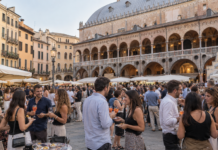
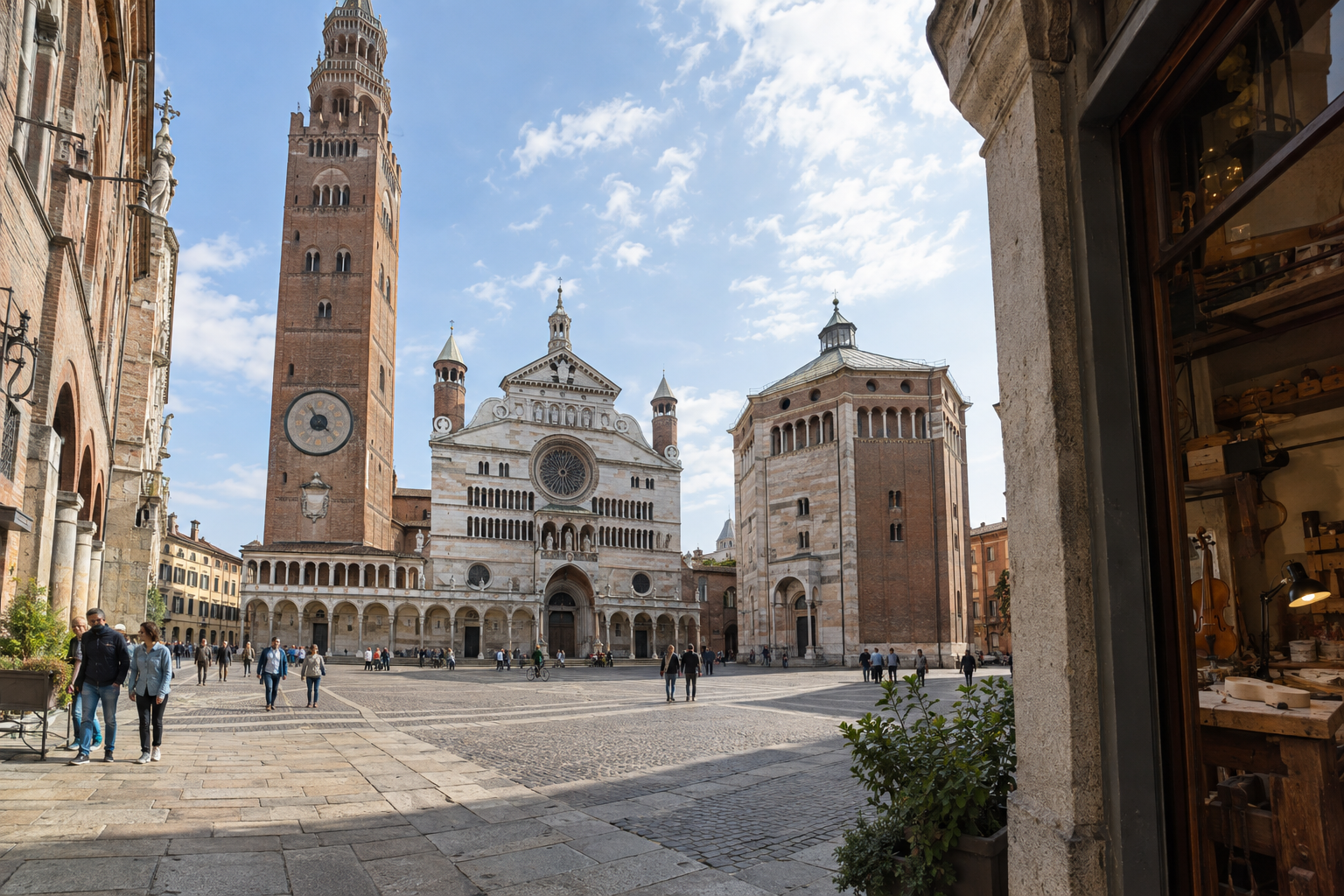
The best place to begin is Piazza del Comune. It is not a large square by Italian standards, but nearly every building has a strong and distinct function. The cathedral, baptistery, Torrazzo, Palazzo Comunale and Loggia dei Militi face one another across a space that once concentrated religious, political and commercial power.
Unlike monumental squares designed as a single architectural project, this one developed over centuries. The result should feel irregular, yet it holds together. Red brick, pale stone, arcades, towers and façades of different periods form a civic center that still belongs to everyday Cremona.
The Palazzo Comunale was begun in 1206 in the Lombard broletto tradition and expanded in later centuries. Across from it, the Loggia dei Militi dates from the thirteenth century. These were not decorative additions. They were buildings through which the medieval city represented and conducted its public life.
The square is especially effective because no single monument completely defeats the others. The Torrazzo dominates the skyline, but at street level the cathedral façade, baptistery and civic buildings continue to compete for attention.
The Cathedral and Its Painted Interior
Cremona Cathedral is dedicated to Santa Maria Assunta. Construction began in the early twelfth century, and the building was altered repeatedly, producing a mixture of Romanesque, Gothic and Renaissance elements.
The façade is elaborate, but the greater surprise is inside. Along the central nave is an important sixteenth-century fresco cycle by artists including Boccaccio Boccaccino, Romanino and Pordenone. The scale and density of the paintings have led the cathedral to be described as the “Sistine Chapel of the Po Valley.” Comparisons of that kind are often more useful for publicity than understanding, but in this case they indicate how unexpectedly ambitious the interior is.
The frescoes do not function as isolated masterpieces. They create a continuous narrative environment above the nave, turning the architecture into part of the painted program. It is worth walking slowly and looking upward from different positions rather than treating the cathedral as a quick stop before climbing the tower.
The crypt contains the relics of Saint Homobonus, or Sant’Omobono, a twelfth-century cloth merchant who became Cremona’s patron saint. His identity is significant: the city honors not a warrior or ruler, but a layman remembered for work, charity and religious devotion.
Beside the cathedral stands the octagonal Baptistery, begun in 1167. Its combination of brick and marble mirrors the wider architectural language of the square. The interior is broad and relatively restrained, which makes the geometry of the structure easy to appreciate.
Climbing the Torrazzo
The Torrazzo is Cremona’s unmistakable landmark. Rising approximately 112 meters beside the cathedral, it developed in stages between the thirteenth and early fourteenth centuries. Its enormous astronomical clock was added later and remains one of the most recognizable details in the city.
The climb is long, and there is no reason to pretend otherwise. Visitors with mobility, heart or respiratory concerns should assess whether the stairs are appropriate before beginning. For those able to make the ascent, the reward is not simply a photograph of the square below.
From the upper levels, Cremona’s geography becomes clear. The dense historic center gives way to the level landscape of the Po Valley, where distance is measured horizontally rather than by mountains. On a clear day, the view explains why the city’s tower carries such authority: there is little in the surrounding plain to challenge it.
The tower also houses the Vertical Museum, which uses the ascent to examine the measurement of time and the workings of the astronomical clock. This gives the climb a purpose beyond reaching the top.
The Museo del Violino
The Museo del Violino is essential even for visitors who do not play an instrument. It explains why Cremonese violin making became a cultural tradition rather than merely a successful craft.
The story begins before Stradivari. Andrea Amati helped establish the form and reputation of the modern violin in sixteenth-century Cremona. The Amati family was followed by other extraordinary workshops, including those of the Guarneri family and Antonio Stradivari. Their instruments combined acoustical judgment, woodworking, varnishing and a highly refined understanding of proportion.
The museum presents historic instruments alongside molds, drawings, tools and workshop materials. This is important because it moves attention away from auction prices and famous owners. A violin begins as a set of decisions made by hand: the selection and seasoning of wood, the arching of the plates, the thickness of each area, the shape of the sound holes and the composition of the varnish.
Cremona’s traditional violin craftsmanship was inscribed on UNESCO’s Representative List of the Intangible Cultural Heritage of Humanity in 2012. The designation concerns a living body of knowledge, not just old instruments preserved behind glass.
The museum’s Giovanni Arvedi Auditorium was designed for exceptional acoustics and hosts recitals and instrument auditions. If a performance is scheduled during a visit, it changes the experience completely. Seeing an old instrument is one thing; hearing it played removes it from the category of precious object and returns it to its actual purpose.
Looking for the Living Craft
After the museum, the next step is to walk through the nearby streets and notice the violin makers’ workshops. Cremona still supports an international community of liutai, as violin makers are called. Some were born locally; others came from abroad to study at the city’s violin-making school and remained.
These are working studios, not open exhibitions. A respectful visitor does not assume that every door can be opened or every craftsman interrupted. Some workshops welcome appointments, display instruments in their windows or participate in organized visits. Even from the street, however, their presence matters.
The contemporary workshops prevent the Stradivari story from becoming an exercise in nostalgia. Cremona is not famous only because incomparable instruments were built here three centuries ago. It remains a place where people train for years to build new ones.
Piazza Roma, a short walk from the center, contains Stradivari’s tombstone within the public gardens. The church where he was buried no longer stands, and the exact location of his remains is uncertain. The modest memorial is therefore more honest than a grand tomb would have been.
Art Beyond the Instruments
The Museo Civico Ala Ponzone is the place to understand that Cremona’s artistic importance extends beyond music. Housed in Palazzo Affaitati, its collection follows local art from the Middle Ages into the modern era.
Two works attract particular attention. Caravaggio’s Saint Francis in Meditation is severe and concentrated, reducing the scene to physical presence, shadow and spiritual exhaustion. Giuseppe Arcimboldo’s reversible The Gardener operates very differently: what first appears to be a bowl of vegetables becomes a face when the painting is turned upside down.
The museum also provides a deeper account of Cremonese Renaissance painting, including the Campi family and other artists whose work helps place the cathedral frescoes in context. It is a substantial collection, but it rarely feels crowded. That makes it possible to look without the pressure found in Italy’s most visited museums.
Travelers with additional time could also visit the Archaeological Museum of San Lorenzo, built around remains of a Roman domus, or the Diocesan Museum near the cathedral complex.
Streets, Churches and the Ponchielli Theatre
Cremona’s major sights are close together, but the smaller streets between them prevent the visit from becoming a sequence of museum entrances. Corso Campi and Corso Garibaldi provide shops and cafés, while side streets lead past palaces, courtyards and less celebrated churches.
The Teatro Ponchielli, named for the Cremonese composer Amilcare Ponchielli, represents another part of the city’s musical identity. The present neoclassical building took shape after earlier theaters on the site were damaged by fire. Its program includes opera, concerts, dance and theater, and a performance here makes a natural evening conclusion to a music-focused visit.
The Church of San Sigismondo, outside the tight central circuit, is worthwhile for visitors with more time. Its richly painted Renaissance interior has a unity that contrasts with the layered development of the cathedral. Reaching it is easier by bicycle, taxi or car than as part of a rushed walking itinerary.
What to Eat in Cremona
Cremona’s food is direct, substantial and tied to the agricultural wealth of the Po Valley. The best-known local dish is marubini, small filled pasta traditionally served in broth. The filling and exact preparation vary, but the dish belongs to the city’s domestic cooking rather than to modern restaurant fashion.
Gran bollito cremonese brings several boiled meats to the table with sauces and condiments. The most distinctive accompaniment is mostarda cremonese: candied fruit preserved in a sharply mustard-flavored syrup. The first taste can be surprising because it looks sweet and behaves like a strong condiment.
Salame Cremona is another local staple, while Provolone Valpadana reflects the dairy culture of the wider region. For dessert, Cremona is inseparable from torrone, the nougat made with honey, sugar, egg white and nuts. Tradition connects it with the 1441 wedding of Bianca Maria Visconti and Francesco Sforza, although the precise origin story is more complicated than the familiar legend suggests.
The sensible approach is not to search for all of these foods in one oversized meal. Marubini at lunch, mostarda with cheese or boiled meat at dinner, and a small purchase of torrone to take home will provide a better introduction.
A Practical One-Day Route
Begin in Piazza del Comune before the center becomes busy. Visit the cathedral and baptistery, then climb the Torrazzo if you are comfortable with the stairs. Keeping these sights together avoids repeatedly crossing the same ground.
Walk next to the Museo del Violino and allow at least ninety minutes. Check the museum calendar in advance for recitals or auditions, since a live performance is worth organizing the day around.
After lunch, explore the violin-making streets and continue to Piazza Roma for the Stradivari memorial. Spend the later afternoon at the Ala Ponzone Civic Museum, then return toward the center along Corso Campi.
If staying overnight, reserve dinner rather than improvising at the last minute, particularly on weekends. A concert at Teatro Ponchielli or an evening walk through Piazza del Comune gives the city a proper conclusion after the day visitors have gone.
Cremona railway station is within walking distance of the historic center. Direct and connecting services make the city accessible from Milan, Brescia, Mantua and other northern Italian cities, although schedules should always be checked for the travel date. Drivers should leave the car outside restricted-traffic areas and choose a hotel with clearly explained parking arrangements.
What I Did Not Expect
I expected Cremona to explain the violin. It did, with greater precision than any general museum of music could manage. What I did not expect was how well the rest of the city would stand beside that story.
The central square would be important even without the Torrazzo. The cathedral frescoes would justify a visit without Stradivari. The Ala Ponzone collection belongs on a serious art itinerary, while the food gives the city a character that cannot be reduced to museums and monuments.
Cremona’s great advantage is proportion. It has enough history for several days but remains manageable in one. Its principal attractions are important without being overwhelmed by crowds, and its most famous tradition is still practiced rather than simply commemorated.
The violin may be the reason many people know the name Cremona. It should be the beginning of the visit, not its limit.
Book Your Cremona Stay and Experiences
Some links in this section are affiliate links. Italia Mia may earn a commission if you make a booking or purchase through them, at no additional cost to you.
Find Hotels in Cremona with Trip.com
Staying near Piazza del Comune, the Museo del Violino or Corso Campi allows you to visit nearly everything on foot. You can compare Cremona hotels, rates and current availability on Trip.com. Check each property on the map before booking, especially if you are arriving by train or need parking outside the restricted-traffic zone.
Reserve a Nearby Experience with Weekend in Italy
Weekend in Italy does not currently list a Cremona-specific ticket or guided tour. If your journey also includes Milan, you can browse Milan museum tickets, tours and cultural experiences through Weekend in Italy. Confirm availability, inclusions, meeting points and cancellation terms before booking. Cremona’s principal museums and the Torrazzo should be reserved through their official sites when advance booking is offered.
Cremona Books, Music and Italian Specialties on Amazon.com
Readers who want to continue the journey at home can browse books about Stradivari and violin making on Amazon.com, explore recordings of Italian violin music, or look for imported Italian torrone. Product selection, prices and shipping eligibility can change, so verify the seller and delivery details before ordering.
External Links
Cremona official tourism website
Museo del Violino — official website
Cathedral, Torrazzo and Baptistery — official tourism information
Cremona Museums — official museum network
UNESCO: Traditional violin craftsmanship in Cremona