
Part of Unexpected Italy: Stories from My Recent Travels
 I went to Genoa with a friend and, like many visitors, we began with something impossible to miss: the Aquarium. The entrance sits directly on the Porto Antico, where the old commercial waterfront has been converted into one of the city’s busiest public spaces. It is open, easy to understand and designed for visitors. Genoa itself is not.
That contrast became the story of the day.
The Aquarium of Genoa deserves the time people give it. It is not a small collection that can be crossed off a list in an hour. The route moves through large marine environments, darker passages and the Cetacean Pavilion, with views that repeatedly remind you that the building belongs to a working port city. My friend and I spent much longer inside than we had expected. Sharks, manatees, jellyfish and the large dolphin tanks hold your attention, but what stayed with me was the change of scale: for several hours, the city disappeared and everything became water, glass and slow movement.
When we came outside, the light on the harbor felt unusually sharp. Boats, cranes, painted façades and the elevated road all occupied the same view. Genoa does not make much effort to conceal its infrastructure. The old port is attractive, but it is still unmistakably a port.
From the Aquarium into the Old City
We left the waterfront without a detailed plan. The broad pedestrian spaces around Porto Antico soon narrowed as we crossed toward Sottoripa, the long arcaded street facing the port. Its shops and counters still reflect Genoa’s old relationship with sailors, merchants and food arriving from elsewhere. There were bakeries, small grocery stores, inexpensive lunch places and windows crowded with goods rather than arranged for effect.
From there, we continued toward Piazza Banchi. The square is one of those places where Genoa’s commercial past remains visible without looking staged. The elevated Church of San Pietro in Banchi rises above the street-level shops, a very Genoese arrangement in which religion, trade and limited urban space have had to negotiate with one another.
We intended to walk toward the Cathedral of San Lorenzo and then continue to Piazza De Ferrari. That should have been simple. It was not.
The map on my phone showed a short route, but in the caruggi a short line on a screen can represent several decisions made within a few metres. One passage bent under an arch. Another appeared to continue but ended in a small courtyard. A lane that looked secondary became unexpectedly busy, while the street we were trying to follow seemed to vanish between buildings.
We made a wrong turn somewhere after Piazza Banchi. I could not identify the exact point afterward, which is probably the most accurate way to describe getting lost in Genoa.
A Shop We Would Never Have Looked For
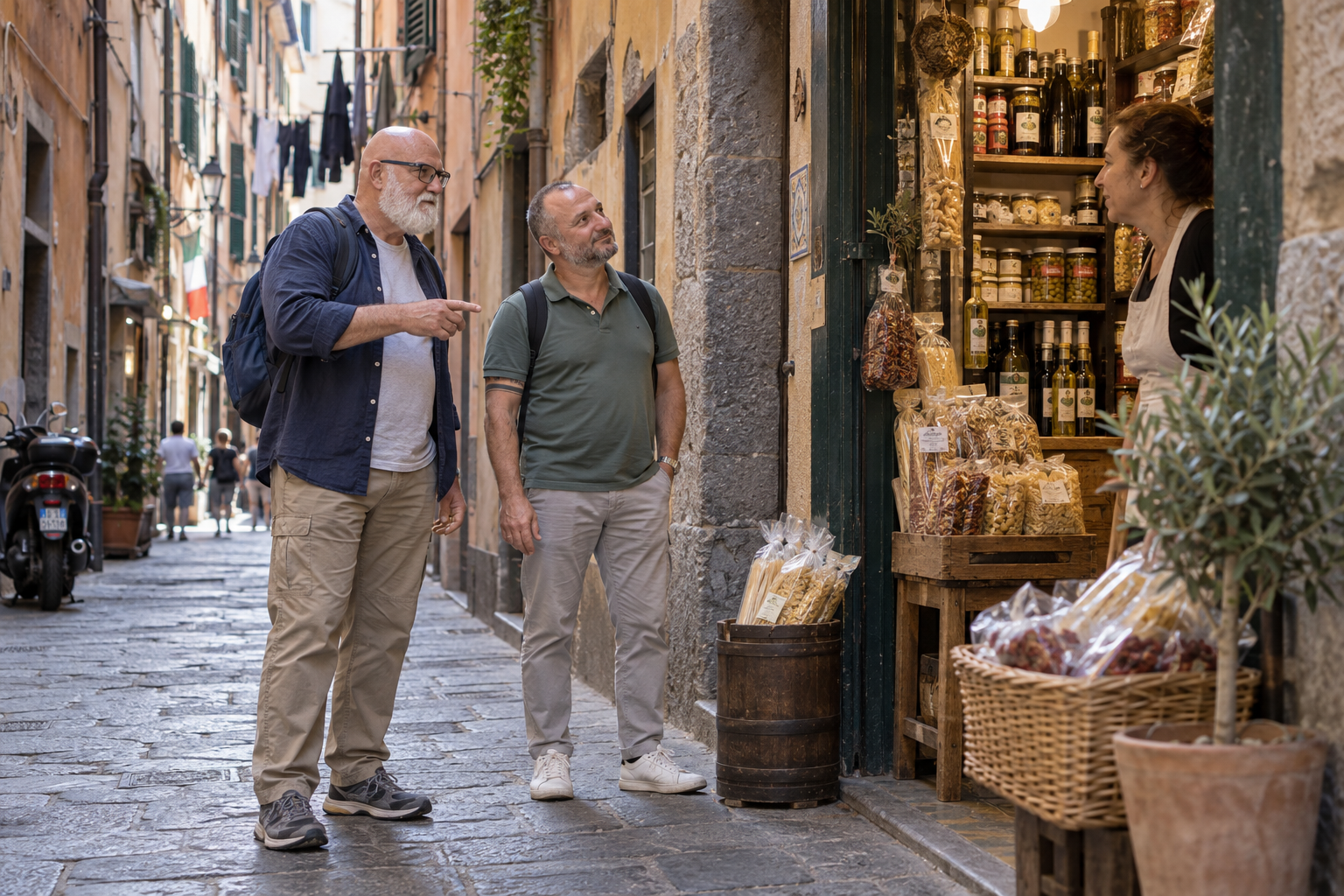
The lane was narrow enough that the upper floors nearly removed the sky. Laundry hung above us, scooters occupied the usable corners and voices carried from apartments we could not see. Nothing looked dangerous or theatrical. It was simply a part of the old city continuing with its day.
We stopped outside a very small food shop because its window was packed with jars, packets of dried mushrooms, anchovies, olive oil and several kinds of pasta. There was no polished display explaining Ligurian cuisine to visitors. Inside, the shelves were high, the floor was worn and the owner was speaking with a customer about what to cook that evening.
We went in intending only to ask for directions. Instead, the conversation moved to food. The owner explained the difference between buying pesto as a souvenir and buying it to eat that day. She spoke about basil, the importance of not heating pesto directly, and the local habit of serving it with trenette, potatoes and green beans. When I mentioned that we had come from Tuscany, she immediately began comparing the directness of Tuscan food with the more aromatic character of Ligurian cooking.
It was not a grand encounter, and nobody acted as if something significant had happened. That was precisely why I remembered it. We bought a few things, received directions and stepped outside with the reasonable confidence of two people who had understood about half of what they had been told.
Within minutes, we were uncertain again.
Lunch Without a Recommendation List
The shop owner had pointed us toward a nearby place for lunch. We found it by recognizing the doorway she had described rather than by using the map. It was a narrow trattoria with closely spaced tables and a menu built around what Genoa actually eats: focaccia, farinata, vegetable pies, pasta with pesto and simple fish dishes.
We ordered farinata first. Its ingredients—chickpea flour, water, olive oil and salt—make it sound almost too plain, but the result depends on a very hot oven, the right pan and exact timing. The edges arrived browned and crisp while the center remained soft. After that came pasta with pesto and a plate of vegetables. It was a practical lunch, not an event arranged for tourists, and it cost less than several forgettable meals I have eaten near famous Italian monuments.
At the next table, two local men were discussing football, roadworks and the changing character of the historic center with equal intensity. One of them heard us trying to reconstruct our route and joined the conversation. He did not offer a romantic explanation of the caruggi. He simply said that using them well takes practice. Genoese people navigate through names, slopes, shopfronts and remembered corners; visitors keep looking for a straight street that does not exist.
That observation explained the city better than any guidebook paragraph I had read.
San Lorenzo, De Ferrari and the Formal City
After lunch, we eventually reached Via San Lorenzo and the striped façade of Genoa Cathedral. The change was immediate. The street was wider, the landmarks clearer and the flow of visitors more predictable. From there we continued to Piazza De Ferrari, with its fountain, the Palazzo Ducale and the grand buildings that present Genoa at its most official.
This is the Genoa that is easier to photograph: broad façades, stone paving, decorated entrances and enough distance to see an entire building. It is impressive, but by then I understood that it represents only one version of the city.
We continued toward Via Garibaldi, once known as Strada Nuova. The street and its Renaissance and Baroque palaces belong to the UNESCO-listed system of the Strade Nuove and Palazzi dei Rolli. Wealthy Genoese families built these residences during the republic’s great financial period, and selected palaces were entered on official rolls for receiving distinguished state guests.
The palaces make their argument through scale, painted interiors, courtyards and staircases. After the compressed old lanes, Via Garibaldi felt almost improbably controlled. The contrast was not accidental. Genoa’s power produced both the crowded commercial city near the port and the aristocratic city above it.
Why the Wrong Turn Mattered
Had we followed the most efficient route from the Aquarium to San Lorenzo, De Ferrari and Via Garibaldi, we would still have had a good day. We would have seen the major sights and returned home with recognizable photographs.
But the wrong turn made the city coherent.
The Aquarium showed Genoa looking outward toward the sea. Sottoripa and Piazza Banchi revealed its commercial instincts. The caruggi showed how daily life had adapted to a dense medieval center, while Via Garibaldi displayed the fortunes created by centuries of maritime trade and finance. These were not separate attractions. They were different expressions of the same city.
Getting lost also corrected my first impression of Genoa. From the waterfront, parts of it can appear hard, noisy and complicated. Inside the old center, that complexity becomes more precise. Space is used intensely. Streets are not simply routes; they are places for deliveries, conversations, shopping, eating and getting from one steep level of the city to another.
I would not advise anyone to wander without paying attention. Genoa is a large city, and the historic center changes character from one lane to the next. A charged phone, ordinary urban awareness and a sense of direction back toward the port or the main streets are useful. But there is a difference between being careless and allowing a city to interrupt the route you planned.
By late afternoon, my friend and I had found our way back toward the water. The Aquarium was still the largest thing we had visited that day, but it no longer felt like the entire reason for going to Genoa. What I remembered most was smaller: a crowded shop window, a plate of hot farinata, directions that worked only briefly and a conversation we could never have scheduled.
In Genoa, the direct route would have shown us more landmarks. The wrong one showed us how the city works.
Useful Official Information
Aquarium of Genoa official website
Visit Genoa: official city guide
Visit Genoa: Palazzi dei Rolli and UNESCO heritage