
 We left Cremona after breakfast with no serious plan beyond spending two days near Lake Garda. There were only two of us, one small suitcase in the back of the car and a hotel reservation in Desenzano del Garda. The distance was short enough that the trip did not require much preparation. In little more than an hour, the flat country around Cremona would give way to the southern edge of the lake.
That was part of the attraction. Lake Garda is one of those places that can be treated as a major destination or as an improvised weekend. We chose the second version.
We intended to visit Desenzano and Peschiera, then drive through several other towns along the shore if traffic allowed. There was no list of essential sights and no attempt to complete a circuit of the lake. In two days, such a circuit would have turned most of the visit into a view through the windshield.
The only decision we had made in advance was to keep to the southern end, where the towns are close together and the roads back toward Cremona remain practical.
By late morning, we had parked in Desenzano.
Desenzano Without an Itinerary
Desenzano is not the most dramatic town on Lake Garda. It does not have the enclosed theatrical appearance of Sirmione or the mountain backdrop of the northern shore. It works differently. It is a real town that happens to occupy one of the lake’s most convenient positions, with trains arriving from Milan and Verona, ferries departing from the waterfront and local life continuing behind the promenades.
We walked first around Porto Vecchio, the compact old harbor near Piazza Malvezzi. Boats shifted slightly against their ropes, and people moved between the cafés and the arcades without any sense that they had come to inspect a monument. The harbor was small enough to understand at a glance, but it held our attention longer than expected.
From there we continued along the waterfront. The lake was broad and bright, with the far shore reduced to a pale line. From the southern end, Garda does not immediately resemble an alpine lake. Its scale suggests the sea, especially when the northern mountains disappear into haze.
We had lunch outside and watched ferries arrive with the usual brief confusion of passengers, bicycles and luggage. The menu offered lake fish, although we ordered something simpler. We had only just arrived and had not yet earned a long lunch.
Afterward, we visited the remains of the Roman villa above the lakefront. Its mosaics and foundations belonged to a very different Desenzano, but the reason for building there was still obvious. The site looked toward the same water, under the same open sky, with a position valuable long before hotels and weekend traffic appeared.
By midafternoon, the center had become busier. We collected the car and drove toward Sirmione.
The Road to Sirmione
The distance between Desenzano and Sirmione is short. The time required to travel it depends on everybody else having the same idea.
Traffic slowed well before the historic center. We left the car outside the restricted area and continued on foot toward the Scaligero Castle, where the narrow peninsula finally becomes medieval stone, water and crowded pedestrian streets.
Sirmione is famous enough that surprise is difficult. Photographs have already shown most visitors the crenellated walls, the harbor beside the castle and the lake visible between buildings. The reality is less orderly. Tour groups stop without warning. Restaurant signs compete for attention. People queue for gelato while trying to photograph the same view.
None of that makes the town false. It simply means that Sirmione has been admired by too many people to behave like a quiet village.
We walked beyond the busiest streets, past the turn toward the spa area and farther up the peninsula. The crowds thinned, though they never disappeared. Olive trees and villa gardens replaced souvenir displays. We did not go all the way to the Grotte di Catullo. There was not enough time to visit the archaeological site properly, and we had no interest in paying admission only to hurry through it.
Instead, we stopped where we could see the water on both sides of the peninsula. Boats cut white lines across the surface. Desenzano was somewhere beyond the western shore, close by road but indistinct from where we stood.
The decision to return before evening was sensible. We congratulated ourselves on it while sitting in traffic on the way back.
An Ordinary Evening in Desenzano
Our hotel was a few streets back from the lake, chosen for parking and price rather than character. The room looked onto another building. There was no balcony, no panoramic breakfast terrace and no reason to spend time there once we had changed clothes.
We returned to the center on foot as shops were closing and restaurants were preparing for dinner. The heat of the afternoon had eased. Along the promenade, the lake had changed from hard blue to grey, reflecting a sky that was still bright but no longer intense.
We ate near the old harbor. The meal was good without becoming an event: grilled fish, vegetables, bread and a bottle of Lugana divided between us. At the next table, a family negotiated with two tired children. Waiters moved chairs to accommodate another group. A delivery van attempted to pass through a space that was almost, but not quite, wide enough.
It felt like the end of an ordinary day trip, except that we did not have to drive back to Cremona.
After dinner, we walked beyond the center with no destination. The lakefront was still busy, but the movement had slowed. People occupied benches facing the water. Teenagers gathered near their scooters. A few boats remained out beyond the harbor lights.
Then we heard music.
The Concert We Could Not See
At first, it sounded like a radio playing from one of the bars: a bass line, a drumbeat and a male voice too distant for the words to be clear. When the song ended, applause moved across the water.
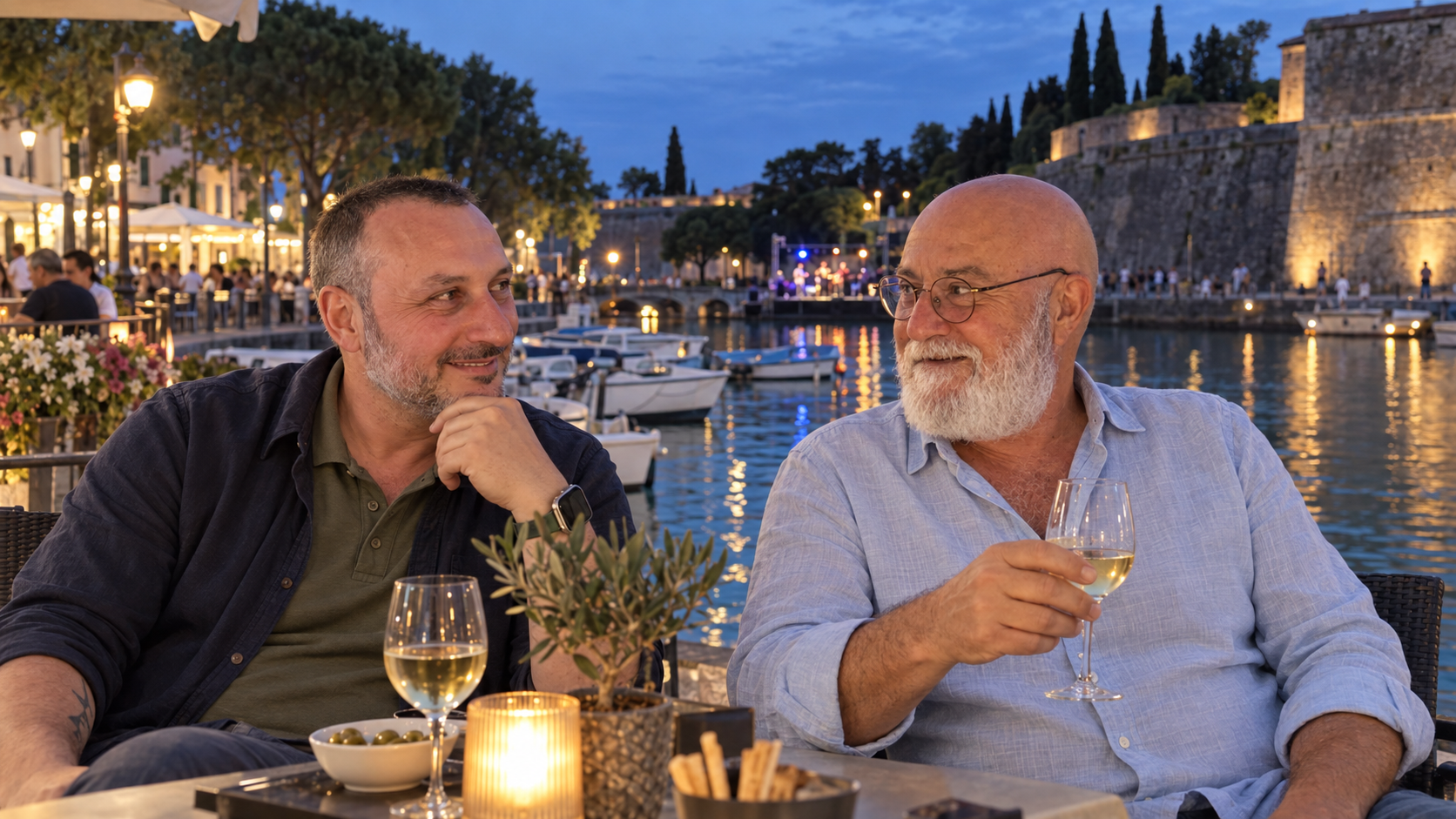
The sound was coming from a summer concert set up farther along the shore, on the opposite side of the old harbor and partly hidden by buildings and trees. We could see the glow of stage lights but not the musicians. From where we stood, the audience was only a dark concentration of people near the waterfront.
We could have walked toward it. It would have taken ten minutes, perhaps fifteen, to find the entrance and join the crowd. We discussed doing exactly that and continued standing where we were.
The next song began before we made a decision.
Across the water, the music lost some of its detail. The rhythm and melody arrived clearly, but the announcements dissolved into fragments. The lake seemed to separate the performance from everything normally attached to it: the stage, the name of the group, the pressure to watch, applaud or decide whether it was good.
We sat on a low wall facing the lights.
It was not a famous singer. At least, nobody around us behaved as if it were. The program sounded like a local summer event, with Italian songs from different periods and several standards adapted for a small band. We recognized pieces without always agreeing about their titles. On one song, the singer was replaced by a woman whose voice carried more clearly across the harbor.
A ferry moved slowly toward the landing and briefly blocked the stage lights. Its engine covered the quieter part of the song. When it had passed, the music returned as though someone had adjusted the volume.
Nothing important happened. We met nobody. There was no unexpected dedication and no song with a mysterious connection to our lives. We did not even discover the name of the band.
We listened because the music was there and because going closer would have changed the experience.
Why Distance Improved It
Concerts normally demand attention. Even a modest performance asks the audience to face the stage, observe the musicians and participate at the expected moments. From the other side of the water, none of that applied.
We could talk during a song, remain silent during the next one or watch the reflections of the colored lights break against the boats. The applause arrived a second after each ending, faint but unmistakable. It reminded us that an audience existed somewhere beyond the dark surface.
People walking behind us paused when they noticed the music. Some stayed for one song. Others identified the direction and went looking for the concert. A man with a dog stood nearby for several minutes, then continued without speaking.
The lake carried the sound unevenly. A gust of wind made the voice seem nearer; then it receded. Notes came cleanly across the open water but blurred when a boat passed or people gathered behind us. The physical distance became part of the performance.
We remained until the end of a slow song that neither of us knew. Then we left before the concert finished.
Back at the hotel, I searched online for the evening program but found several listings and could not tell which one we had heard. I stopped looking. The name would have added information without improving the memory.
Peschiera the Next Morning
We left Desenzano early enough to reach Peschiera del Garda before the worst of the traffic. The road passed the lower end of the lake through an area shaped as much by campsites, amusement parks and holiday apartments as by historic towns. Garda is not one continuous postcard. Much of its coast is commercial, practical and heavily used.
Peschiera announced itself through water before architecture. The Mincio leaves Lake Garda there, dividing the fortified town into channels crossed by bridges. Defensive walls, bastions and gates enclose a center that feels less like a conventional lakeside village than a small military island.
We entered through Porta Verona and walked along the canals. Boats were moored beneath old walls, and cyclists passed with panniers loaded for longer journeys. The route along the Mincio begins there and continues south toward Mantua, connecting the lake to the flat country from which we had arrived.
That geographical connection interested me more than I expected. Cremona and Lake Garda can feel like separate worlds—the Po Valley on one side, the holiday lake on the other—but the water system ignores that distinction. The Mincio carries the lake south into the plain and eventually toward the Po.
We stopped for coffee near one of the canals and watched rental boats leave in uncertain lines. Peschiera was already filling with day visitors, but its fortifications distributed them more effectively than the narrow streets of Sirmione had done.
Before lunch, we walked outside the center along the waterfront. From there the town’s military structure was easier to read: walls meeting water, bridges controlling entrances, and the lake opening immediately beyond them.
A Few More Towns, Not the Whole Lake
From Peschiera we continued east toward Lazise. The traffic was slow, but the distance was short. We parked outside the walls and entered through one of the old gates.
Lazise presented the version of Lake Garda that visitors expect: a compact center, a small harbor, restaurant tables under arcades and sections of Scaliger walls still defining the town. It was attractive and busy, with enough medieval structure to remain distinctive despite the shops and crowds.
We had lunch there and walked along the promenade. By then, we had begun making the mistake common to short trips: adding stops because the next town appeared close on the map.
Bardolino was only a little farther north, so we continued. We found another waterfront, another harbor and another center full of people deciding where to eat. Bardolino was pleasant, but our attention had become less precise. After Desenzano, Sirmione, Peschiera and Lazise, we were collecting towns rather than seeing them.
We bought coffee, sat near the lake and admitted that the trip had reached its natural limit.
The northern shore, with its mountains and narrower landscape, would require another visit. So would Salò and Gardone Riviera on the western side. Trying to add any of them would have meant arriving late, parking badly and leaving almost immediately.
We turned south.
The Drive Back to Cremona
From the eastern shore, the return journey passed Peschiera again before joining the motorway west. The lake disappeared quickly. Soon the landscape flattened, and road signs pointed toward places connected with work, errands and ordinary weeks rather than holidays.
We compared the towns we had visited. Sirmione was the most spectacular and the least relaxed. Peschiera had the strongest structure. Lazise was the easiest to enjoy without explanation. Desenzano, where we had spent the most time, felt the least like a display.
But none of those judgments defined the weekend.
What remained was the concert we had never properly attended. It occupied perhaps forty minutes of a two-day trip. We did not plan it, photograph it or learn enough about it to recommend it to anyone else.
The memory depended on our position: not in front of the stage, but across the water; not among the audience, but close enough to hear their applause; not searching for an experience, but finished with dinner and walking without purpose.
Lake Garda had offered larger views, older buildings and more recognizable places. Yet the clearest memory was sound arriving from somewhere we could barely see.
Had we walked around the harbor and joined the concert, I might remember the musicians. Because we stayed where we were, I remember the lake.