
 I traveled to Naples by train with a small group of friends. This affected the trip more than we initially expected. We did not have a car to park, protect or retrieve, and nobody had to remain sober-minded enough to drive through Naples at the end of the day. We arrived at Napoli Centrale, left our luggage and began walking.
Traveling with friends usually involves compromise. One person wants churches, another wants food, and somebody is always convinced that the destination is only ten minutes away. In Naples, this is not necessarily a disadvantage. The historic center rewards a route that changes repeatedly.
We had a list of places to see, but not a strict schedule. That proved useful. Naples is too dense for a rigid itinerary. Churches, courtyards, food counters, workshops and private homes occupy the same streets. Even a short distance can take an hour when everyone in the group stops for different reasons.
Piazza del Gesù and Santa Chiara
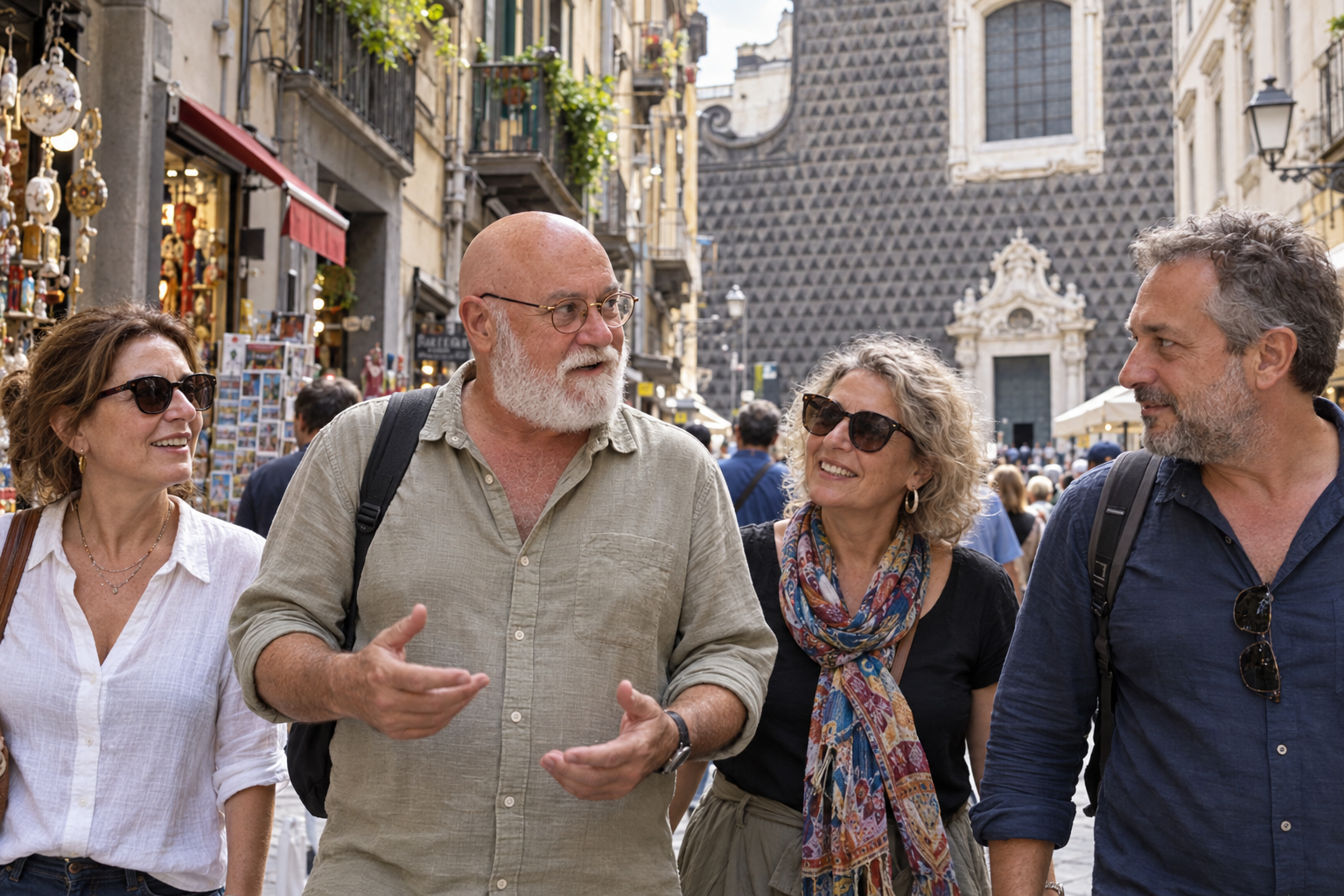
We began around Piazza del Gesù Nuovo, one of the most practical starting points for walking through the old city. The façade of the Church of Gesù Nuovo is immediately recognizable: severe, dark and covered with projecting diamond-shaped stones. It looks more like a fortified residence than the entrance to a church.
The interior provides the opposite impression. It is large, ornate and filled with colored marble, paintings and side chapels. Naples frequently produces this kind of sharp transition. The exterior of a building may reveal very little about what is behind it.
A few steps away stands the complex of Santa Chiara. We entered the church and later visited the cloister, with its majolica-covered columns and benches. It is one of the city’s best-known religious sites, but it does not feel detached from Naples. Traffic, voices and daily business continue immediately outside its walls.
During our trips through southern Italy, we visited many churches. After a while, it became necessary to resist treating them as a sequence of decorative interiors. Some deserve time rather than a quick photograph. Santa Chiara was one of them.
Nobody in our group experienced the place in quite the same way. Some concentrated on the architecture, others on the cloister, and one friend was already thinking about lunch. This difference in attention became the normal rhythm of the trip.
Following Spaccanapoli
From Piazza del Gesù, we continued along Via Benedetto Croce, part of the route commonly called Spaccanapoli. The name is more useful than precise: from above, the street appears to cut directly through the fabric of the old city, but at ground level it changes names as it passes through different sections.
This was not a peaceful walk. Delivery vehicles competed for space with pedestrians. Residents crossed from one doorway to another. Visitors stopped suddenly in the middle of the street to consult their phones. Motor scooters appeared whenever a gap opened.
We passed Palazzo Venezia and reached Piazza San Domenico Maggiore, where the space widened and the group could stop without blocking everyone behind us. The piazza works as a junction between several versions of Naples: university students, residents, tourists, bars and historic buildings all use it at once.
Nearby is the Cappella Sansevero, home of Giuseppe Sanmartino’s Veiled Christ. The chapel requires more planning than simply arriving at the door, and it is better treated as a specific visit rather than something to fit casually between lunch and coffee. Even from outside, the number of people waiting made its importance clear.
We continued along Via San Biagio dei Librai, where booksellers, food shops, religious objects and inexpensive souvenirs coexist within a few meters. Spaccanapoli is often described as though it were a single attraction. It is really a working axis through the city, and its interest comes from accumulation rather than from one decisive sight.
San Gregorio Armeno and Via dei Tribunali
We turned into Via San Gregorio Armeno, the street associated with Naples’ presepe tradition. The workshops remain open beyond the Christmas season, displaying traditional Nativity figures beside footballers, actors, politicians and other contemporary characters.
The street can be crowded enough to make progress slow. That is part of the experience, although it becomes less charming when a group tries to remain together. We repeatedly lost sight of one another and regrouped outside whichever shop had delayed the person at the back.
San Gregorio Armeno links the lower route of Spaccanapoli with Via dei Tribunali, the ancient decumanus running through another major section of the historic center. Near Piazza San Gaetano, the concentration of churches and archaeological sites becomes particularly evident. San Lorenzo Maggiore, the Basilica of San Paolo Maggiore and the entrances associated with underground Naples are all within a compact area.
Via dei Tribunali is also one of the main food streets of central Naples. We had discussed several famous pizzerias before the trip, but standing in a queue for a particular name did not interest everyone. We chose a busy place that could accommodate us without turning lunch into an appointment.
The meal was straightforward: pizza, fried starters, beer and water. We shared several dishes because that was easier than negotiating separate orders. The food was good, but it did not need an exaggerated story around it. In Naples, an excellent pizza can simply be lunch.
Our conversations with local people were equally ordinary. A shopkeeper corrected our direction. A waiter disagreed with our afternoon plan and suggested a better sequence. Another man explained which entrance to use for a nearby church. Nobody adopted us or transformed our lives. They answered questions, offered opinions and then returned to what they were doing.
That felt more convincing than the theatrical version of Neapolitan hospitality often presented to visitors.
The Duomo and the Streets Around It
From Via dei Tribunali, we continued toward Via Duomo and Naples Cathedral. The Duomo is closely associated with San Gennaro, but it contains several historical layers, including the Basilica of Santa Restituta and the Baptistery of San Giovanni in Fonte.
By this point, we had already entered several churches, and some members of the group were beginning to show signs of visual exhaustion. This is common in Naples. The city offers so much architecture and religious art that concentration eventually weakens.
We went inside anyway.
The visit was worthwhile, although not everyone stayed for the same length of time. Traveling in a group does not require moving as a single unit every minute. Some of us examined the chapels while others sat down or stepped outside.
Near the cathedral, Naples felt less arranged for display than it had around the most heavily visited sections of Spaccanapoli. Small businesses, apartment entrances and religious buildings shared the same constrained space. The old city was not functioning as an open-air museum. People lived and worked inside it.
That distinction matters. Naples would be easier to consume if its monuments were separated from daily life, but it would also be less interesting.
Via Toledo and the Quartieri Spagnoli
Later, we moved toward Via Toledo. After the narrow passages of the historic center, the street felt comparatively broad and formal. Shops, cafés and a constant flow of pedestrians gave it a different scale.
From Via Toledo, we entered the Quartieri Spagnoli. These streets have become heavily photographed, particularly around the murals and memorials dedicated to Diego Maradona. The football imagery is impossible to miss, but the neighborhood should not be reduced to one famous player or a background for social-media photographs.
The Quartieri Spagnoli remain densely inhabited. Laundry hangs above restaurants, scooters occupy available corners, and ground-floor rooms open almost directly onto the street. Tourism is now part of the district’s economy, but it has not erased its residential character.
We stopped for coffee and argued about whether to continue toward the Galleria Umberto I and Piazza del Plebiscito or return to the hotel. Fatigue settled the question more efficiently than discussion.
We continued.
The Galleria Umberto I, the Teatro di San Carlo, Piazza del Plebiscito and the exterior of the Royal Palace provided a more monumental conclusion to a day that had largely been spent in confined streets. Their scale made sense after the compression of the old town.
By then, however, nobody was approaching Naples as a checklist. We had walked too far, seen too much and eaten enough to stop pretending that every building required a considered reaction.
What Remained from the Day
I do not remember the trip because of one dramatic event. There was no great revelation, no improbable encounter and no perfect moment designed to summarize Naples.
What remains is the structure of the day: arriving by train, walking with friends, separating and regrouping, entering churches, looking for food, taking wrong turns and repeatedly revising the plan.
I remember Piazza del Gesù, the interior of Santa Chiara, the movement along Spaccanapoli, the congestion of San Gregorio Armeno and the constant activity on Via dei Tribunali. I remember the Duomo after several of us thought we had already seen enough churches. I remember Via Toledo and the Quartieri Spagnoli late in the day, when we were no longer trying to interpret everything we saw.
Naples did not require a romantic conclusion. It was direct, crowded and occasionally tiring. It demanded attention, but it did not ask for admiration at every corner.
That was enough to make the trip memorable.
External Sources
Historic Centre of Naples – Italia.it
The Ancient Centre and the Decumani – City of Naples
Santa Chiara Monumental Complex