
Part of Unexpected Italy: Stories from My Recent Travels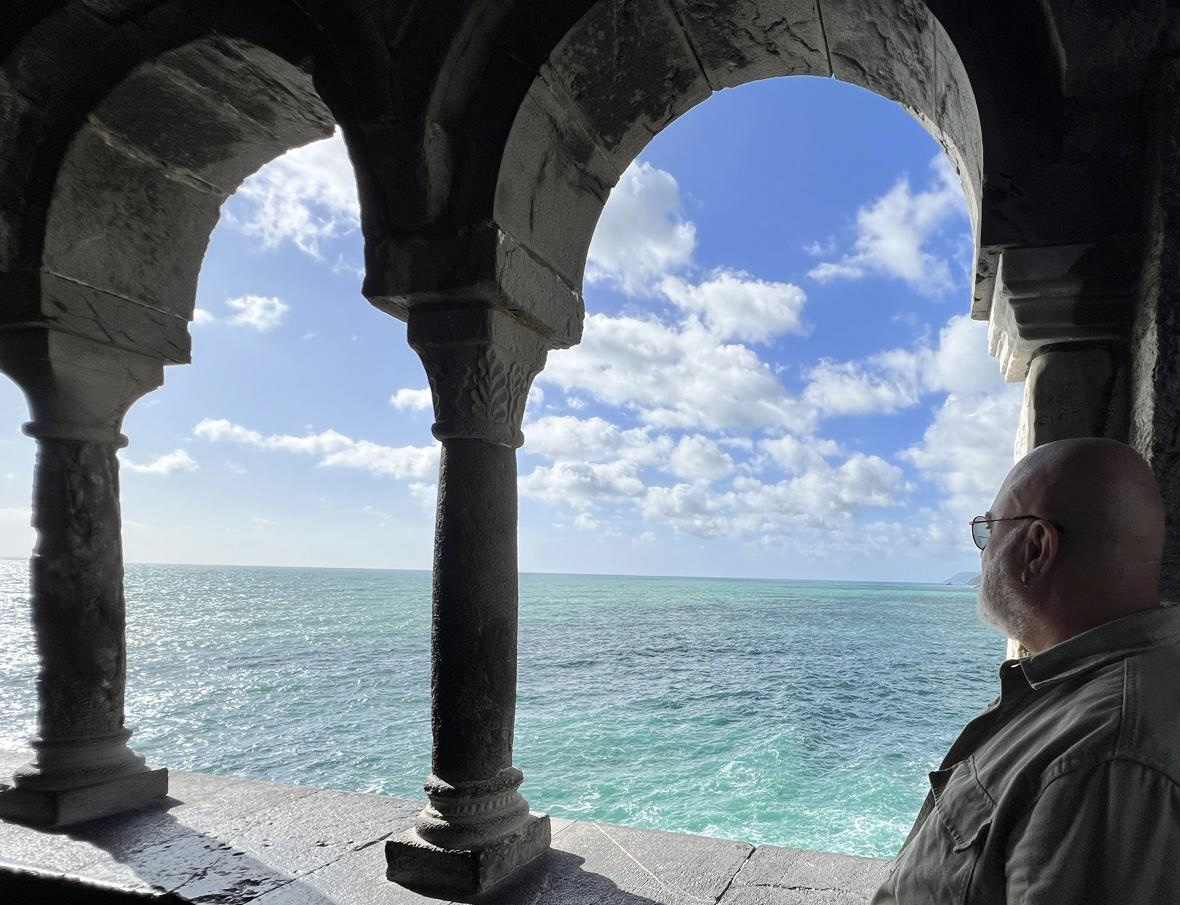 There is a point on the Ligurian coast where the road simply runs out. Beyond it are a striped medieval church, black rock and open sea. This is Portovenere, at the western entrance to the Gulf of La Spezia, better known as the Gulf of Poets.
I have visited the Cinque Terre and understand why people want to see those five villages. I also know what happens when a place becomes an item on everybody’s list. The railway platforms fill, the narrow lanes become a procession, and much of the day is spent negotiating other people’s photographs. Portovenere offers a different arrangement. It has the colored houses, boats, steep lanes and hard Ligurian coastline, but it is not on the Cinque Terre railway line. That single fact changes the rhythm of a visit.
Portovenere is not empty, especially on summer weekends or when excursion boats arrive. It would be dishonest to call it a secret. But come early, stay after the day-trippers leave, or visit outside July and August, and the village gives you room to look around rather than simply move with a crowd.
A Different Way to See the Ligurian Coast
The waterfront makes an immediate impression, although not because it has been arranged for visitors. Fishing boats and excursion vessels share the harbor. Restaurants occupy the ground floors of a tall wall of narrow houses painted in ochre, rust, rose and faded yellow. These buildings once formed part of the village’s defense: from the water they still look less like a cheerful postcard than a barrier with windows.
An opening beneath the houses leads into the old town. Via Giovanni Capellini, the main lane, is narrow enough to make the harbor feel suddenly distant. Small food shops, focaccerie and boutiques fill the lower floors. Above them, laundry, shutters and cables cross the strip of sky. The lane climbs gradually, with stone stairways breaking away toward the upper part of the village.
This is where Portovenere begins to separate itself from the standard Cinque Terre day. There is no need to collect five villages or check train times. The place is compact, but it rewards a slow circuit: the harbor, Via Capellini, the Church of San Lorenzo, Doria Castle, Byron’s Grotto and, finally, the Church of San Pietro at the end of the promontory.
I stopped more than once on the way, not because the walk was difficult, but because the village reveals itself in sections. From one passage there is a square. From another, the sea appears between buildings. A few minutes later, the colorful waterfront has disappeared and the coast becomes bare stone.
The Church Built Against the Sea
San Pietro does not sit above Portovenere like a decorative church in a landscape painting. It occupies the rock at the very tip of the headland, almost as if the building and promontory were one structure. Its black-and-white bands are unmistakably Ligurian, but the setting is severe: wind, salt, stone and water on three sides.
The site has layers of history. An early Christian church was established here, and the later Gothic section was consecrated in the 13th century. The result is not grand in scale. San Pietro is small and relatively austere, which is precisely why it works. A larger church would dominate the headland. This one seems to hold its position against the sea.
Inside, the alternating bands of dark and pale stone continue. Outside, an arched loggia opens toward the water. It is one of the rare famous viewpoints that still feels like a physical place rather than a viewing platform. The wind enters freely. Waves strike the rocks below. Palmaria stands across the narrow channel, close enough to study in detail, while the open Ligurian Sea begins on the other side.
I stayed there longer than I expected. There was no revelation and no need to manufacture one. The attraction was more direct: the church had survived centuries in a position that looks almost unreasonable, and the exposed rock made the pastel village behind me seem suddenly protected and domestic.
Byron’s Grotto: History, Reputation and a Good Story
On the seaward side of the promontory, below the area between San Pietro and Doria Castle, is the rocky inlet known as Grotta di Byron, or Byron’s Grotto. Its older name is Grotta Arpaia. According to local tradition, Lord Byron came here to swim, meditate and find inspiration. The most repeated story says that he swam across the gulf to visit Percy Bysshe Shelley at Lerici or San Terenzo.
It is a fine story, but it is better treated as legend than itinerary. The Byron association has become part of Portovenere’s identity, while the historical details of the supposed crossing are disputed. The grotto needs no exaggeration. The dark water, fractured cliffs and restless sea explain why generations wanted to attach a Romantic poet to it.
The writers were real, and so was their presence around the gulf. Percy Bysshe Shelley and Mary Shelley lived at Casa Magni on the water at San Terenzo, near Lerici, in 1822. Percy sailed from there and died that July when his boat went down during a storm on the return from Livorno. Byron belonged to the same expatriate literary circle and knew the Shelleys. Their lives around the gulf were brief, complicated and considerably less sentimental than later tourism language suggests.
The name “Gulf of Poets” came later. The playwright Sem Benelli is generally credited with using it in 1910, when he was living near San Terenzo. The phrase endured because it described more than one celebrated visitor. Over time this coast attracted or inspired writers including the Shelleys, Byron and D. H. Lawrence, as well as Italian literary figures connected with eastern Liguria.
It is easy to turn those names into a decorative list. The more interesting point is why writers kept coming. The gulf contains two opposing landscapes at once. It is sheltered enough to hold ports, villages and houses close to the water, yet its outer edges at Portovenere and Lerici face a sea that can become violent very quickly. Beauty and danger are not separate here. They occupy the same view.
What Portovenere Has That the Cinque Terre Does Not
Comparisons with the Cinque Terre are inevitable, but Portovenere should not be treated as a substitute assembled from similar parts. It has a different geography and history. The village looks across to the islands of Palmaria, Tino and Tinetto. Together with Portovenere and the Cinque Terre, they form part of the UNESCO World Heritage site recognized for the cultural landscape of this coast.
There is also a different practical experience. Because Portovenere has no railway station, visitors usually arrive by road from La Spezia or by boat when services are operating. That makes it less convenient, but the inconvenience filters the traffic. Instead of repeatedly boarding trains, you can spend the day within one coherent landscape.
The village also gives you choices without requiring a complicated plan. Walk up to Doria Castle for a wider view over the roofs and sea. Cross to Palmaria by boat for walking and swimming. Sit along the harbor with coffee or a glass of local white wine. Eat focaccia while walking through the old town, or order Ligurian dishes built around anchovies, mussels, pesto and fresh fish.
Most importantly, allow enough time for San Pietro. It should not be treated as the final photograph before leaving. Walk around the church, enter if it is open, look through the arches and then return toward the village slowly. The change from exposed headland to enclosed lanes is one of the best parts of Portovenere.
When to Go and How to Avoid the Worst Crowds
Spring and early autumn are the most balanced periods: generally pleasant weather, boat connections when seasonal services are running, and fewer visitors than in peak summer. Winter offers the quietest version of the village, although rough weather and reduced services can limit what you do.
If visiting in summer, arrive early in the morning or plan to remain into the evening. Midday is when day boats and coach excursions can make the waterfront and San Pietro busiest. Weekdays are usually a better choice than weekends. Comfortable shoes matter because the old town includes worn paving, slopes and steps, while the rocks near the sea can be slippery.
From La Spezia, the local bus is normally the most dependable public-transport option. Seasonal boats provide the more dramatic arrival and may connect Portovenere with La Spezia, Lerici and the Cinque Terre, depending on weather and the published timetable. Drivers should expect limited access in the historic center and paid parking outside it, with spaces becoming scarce during summer.
Anyone planning a broader Ligurian itinerary can combine Portovenere with La Spezia or Lerici rather than forcing it into an already crowded Cinque Terre schedule. It also works as a place to stay for travelers who want access to the famous villages while returning in the evening to a town with a more settled rhythm. Before booking, compare Portovenere accommodation options on Trip.com and confirm the exact location, because some properties marketed for the area may be outside the village.
The Last View from the Promontory
On the walk back from San Pietro, the harbor comes into view again. The colored houses return, boats move across the channel beside Palmaria, and the rock at the end of the village begins to look improbable from a distance. The church appears too exposed to have lasted, yet it has been there longer than nearly everything built for modern tourism.
That was the Portovenere I took away with me. Not an empty alternative to the Cinque Terre, and not a stage set for dead poets, but a working village positioned between a protected gulf and the open sea. Its literary history is worth knowing because the landscape makes the writers’ attraction understandable. You do not need to borrow their emotions, however. Stand beneath the arches of San Pietro with the wind coming off the water, and the place makes its own argument.
For more first-person destinations away from the standard itinerary, continue with the Unexpected Italy travel stories.
External Sources
Italia.it – Itinerary in the Gulf of Poets
Visit Spezia – The Gulf of the Poets
Visit Portovenere – Sea Caves and Grotta Byron
UNESCO – Portovenere, Cinque Terre, and the Islands