
Part of Unexpected Italy: Stories from My Recent Travels
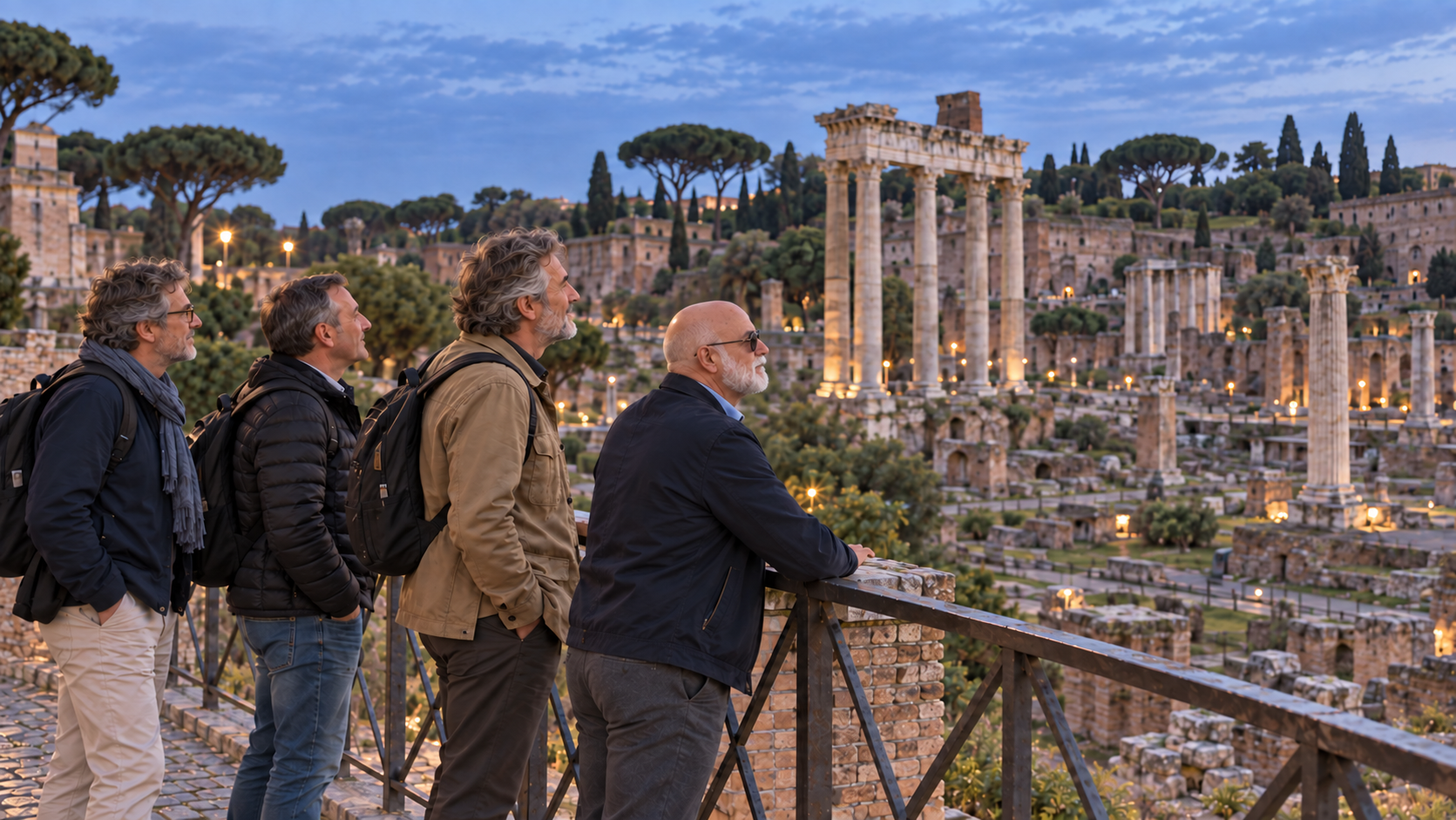 Rome has an official birthday: April 21. According to tradition, Romulus founded the city on that date in 753 BC. It is also my birthday, a coincidence I have always liked without trying to turn it into anything mystical. Still, arriving in Rome with three friends for four nights, I felt a private connection with the city before the trip had properly begun.
Rome and I were born on the same day, although it had a considerable head start.
This was not my first encounter with Rome, and I had no intention of pretending that four nights could reveal a city that has spent nearly three thousand years accumulating history, power, vanity, faith and contradiction. We went to see the major attractions because avoiding them for the sake of appearing sophisticated would have been ridiculous. But the Rome I remember most clearly emerged between those famous places: over dinner in small trattorias, during long walks after dark and in the pauses when none of us felt the need to speak.
Four Friends Arrive in Rome
Travelling with friends changes the scale of a city. Alone, I tend to observe and move at my own pace. In a group of four, every day becomes a negotiation: when to leave, where to eat, whether to take a taxi, who wants another coffee and who has already walked enough.
That did not make Rome more difficult. It made the trip more real.
We had four nights, so we did not build a military campaign disguised as an itinerary. Each day had one or two fixed destinations, while the rest was left open. Rome punishes excessive planning. Distances that seem short on a map become longer because something keeps interrupting the route: a church with an open door, an archaeological fragment behind a railing, a fountain, a shop window or a street that looks more interesting than the one you intended to follow.
Our first walks confirmed what everyone knows but photographs cannot explain. Rome is not arranged politely into historical periods. Ancient columns, Renaissance palaces, Baroque churches, apartment buildings, traffic and restaurant tables occupy the same field of vision. The city does not separate its past from its daily life. It parks scooters beside it and hangs laundry above it.
The Forum Is Not a Collection of Ruins
At the Roman Forum, I expected the familiar response: recognition mixed with historical interest. Instead, the place became more imposing the longer we stayed.
From a distance, ruins can seem manageable. They become objects to identify—the Arch of Septimius Severus, the Temple of Saturn, the House of the Vestals. Walking through the Forum is different. The broken buildings begin to recover their scale, and the present-day city temporarily loses some of its authority.
We moved between stones that had witnessed ceremonies, trials, commerce, political ambition and public punishment. It was not necessary to invent the sound of sandals or senators delivering speeches. The physical evidence was enough. This had been the centre of a system that governed an enormous part of the known world, and now visitors walked through it carrying water bottles and checking their phones.
The contrast was not depressing. It was clarifying.
From the Forum and Palatine Hill, Rome appeared as a city built repeatedly over itself, never entirely erasing what came before. By the time we reached the Colosseum, none of us needed a dramatic speech about eternity. The structure did the work on its own.
The Vatican and the Point of Saturation
The Vatican was another kind of experience. The concentration of art, architecture, religion and institutional power is so intense that normal attention becomes difficult to maintain.
At first, I tried to look carefully at everything. That is impossible. Gallery follows gallery; ceilings compete with walls; sculpture competes with painting; history competes with the people moving around you. Eventually, you have to admit that the human mind has a limit.
Then comes the Sistine Chapel, a place so familiar from reproductions that one might assume the surprise has already been removed. It has not. The real difficulty is not recognizing Michelangelo’s images. It is understanding the scale of the room and the physical labor behind what you are seeing, while standing among hundreds of other visitors trying to have their own private response in a shared space.
Outside, St. Peter’s Square restored a sense of proportion, although “proportion” is a strange word for Bernini’s colonnade. We stood there for a while rather than immediately moving to the next destination. Rome had begun to produce a kind of visual fatigue, but it was not unpleasant. It was the exhaustion that comes from receiving more than you can process.
Looking for The Great Beauty
Paolo Sorrentino’s The Great Beauty presents Rome as both magnificent and morally exhausted—a city in which beauty is everywhere but does not necessarily make people better or happier. I thought about the film several times during our stay, especially in the evening.
There is a temptation to call the feeling Stendhal syndrome: the dizziness or emotional disorientation associated with encountering too much beauty at once. I would not use the expression as a medical diagnosis. For me, it describes a moment when looking stops being passive and becomes physically tiring.
Rome can do that. A person turns a corner and sees a façade that would dominate a smaller city, yet in Rome it is simply one more layer. A fountain occupies a square with complete theatrical confidence. A dome appears above the roofs. A row of umbrella pines transforms the skyline. Then traffic starts moving again, somebody shouts, a waiter carries plates through a crowded room, and the city refuses to remain a beautiful image.
That is what The Great Beauty understands. Rome is not only beautiful. It is burdened by beauty. People continue to eat, flirt, complain, work, age and waste time in surroundings that would overwhelm almost anywhere else.
During one evening walk, I stopped for longer than my friends expected. There was no revelation and nothing supernatural happened. I simply reached the point at which another monumental view felt almost excessive. The city had exceeded my ability to respond appropriately. I looked, understood that I was impressed, and had no intelligent comment to make.
One of my friends asked if I was coming. I said yes, and we went to dinner.
That ordinary interruption saved the moment from becoming sentimental.
Dinner in the Smaller Rome
Our evenings belonged to a different Rome. We avoided restaurants whose menus appeared designed to reassure visitors from twenty metres away. Instead, we looked for small trattorias where the room was modest, the tables were close and dinner still felt like dinner rather than a performance of Italian life.
There were plates of carbonara, amatriciana and cacio e pepe, dishes so widely imitated that eating them in Rome can feel like returning them to their proper setting. We ordered artichokes when available, shared starters and argued mildly about wine. The meals were not all extraordinary, and that made them more believable. A city is not a tasting menu. Sometimes the pasta is excellent; sometimes the conversation matters more.
Around the table, the scale of Rome contracted. The emperors, popes, fountains and frescoes disappeared for a while. Four friends discussed the day, corrected one another’s memories and decided what could realistically be done tomorrow. These dinners gave the trip its structure more reliably than any itinerary.
They also reminded me that the most convincing part of Rome is not its promise of immortality. It is its appetite for the present.
Trastevere After Dark
Trastevere is no longer an undiscovered quarter, and there is no reason to describe it as one. In the evening, its narrow streets can be crowded with visitors, students, residents, restaurant workers and people simply looking for somewhere to sit. But popularity has not removed its character completely.
We walked without a fixed destination, passing the warm façade of Santa Maria in Trastevere, crowded tables and streets that became quieter only a few turns away from the busiest routes. Laundry, shutters and worn plaster prevented the neighborhood from looking like a film set, even when the light made it appear cinematic.
The pleasure of Trastevere was not finding a secret Rome that no one else knew. It was accepting a district where tourism and ordinary life occupy the same few metres, sometimes awkwardly. We stopped for a drink, watched people pass and stayed later than planned.
On the walk back, the city seemed less ceremonial. At night, distances shorten. Monuments appear without the daytime crowds, while streets that looked grand in the afternoon become simply the route home.
Sharing a Birthday with Rome
The traditional birthday of Rome is celebrated on April 21, the date on which the city’s foundation is conventionally placed in 753 BC. For Romans it is the Natale di Roma. For me, it is also personal.
I do not believe that sharing a birthday with a city determines character. Rome and I have different responsibilities, and it has had far more time to develop bad habits. But the coincidence gives me a way to think about age.
Rome does not conceal age. It displays it, repairs it, sells tickets to it and builds daily life around it. Damage is visible. So is continuity. A ruined temple can remain important without being restored to an imaginary perfection. A neighborhood can change without losing every trace of what it was. Beauty can survive alongside noise, disorder and fatigue.
That seems more useful than the usual language about staying young.
After four nights, we left without having “done Rome,” a phrase that never made much sense. We had seen the Vatican, walked through the Forum and stood before monuments that belong to the world’s common visual memory. We had also eaten in small trattorias, wandered through Trastevere and spent time together without needing every hour to become an event.
Rome had overwhelmed me at moments, but it had also returned me to ordinary life: a table, a glass of wine, a disagreement about directions, a friend waiting while I looked at something for too long.
Perhaps that is why sharing a birthday with Rome appeals to me. April 21 does not connect me to a perfect city. It connects me to a city that has accumulated beauty and damage in almost equal measure, and continues to live with both.
Practical Notes for Four Nights in Rome
Four nights are enough for a substantial first experience, but not for a complete one. We found it better to anchor each day around one major site and leave room for walking, meals and unplanned stops.
The Vatican Museums require time and concentration, so they should not be combined with an overloaded afternoon. The Colosseum, Roman Forum and Palatine Hill work naturally together, but the archaeological area involves considerable walking and uneven ground. Trastevere is best experienced without a rigid route, particularly after the formal sightseeing of the day is finished.
Advance reservations are sensible for the Vatican Museums and the Colosseum archaeological area. Use the official websites to check current opening times and ticket conditions before visiting.
External Sources
Rome’s Birthday and April traditions – Turismo Roma
Colosseum, Roman Forum and Palatine Hill – Official Archaeological Park
Plan a Visit to the Vatican Museums – Official Website